Emerging Markets 2026: The Best Opportunities Now
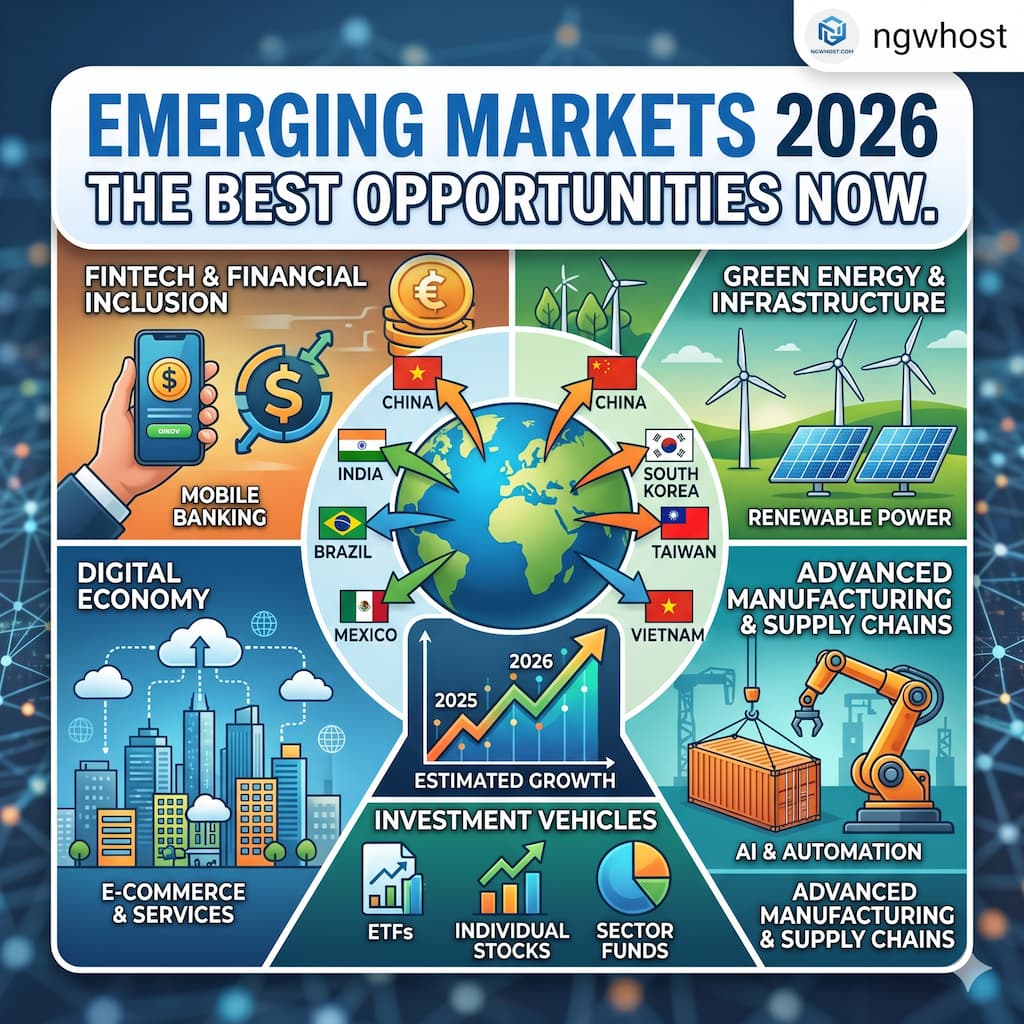
The global investment map has been fundamentally redrawn. As we navigate the second quarter of 2026, the traditional distinction between “developed” and “emerging” economies is blurring. While established markets grapple with aging demographics and plateauing productivity, a new guard of nations is leveraging rapid digitalization, green energy transitions, and a reshuffled global supply chain to offer unprecedented growth.
For the strategic investor at ngwhost.com, emerging markets (EM) no longer represent a peripheral “high-risk” bet. In 2026, they are the primary engine of global GDP expansion. However, the “broad-brush” approach to EM investing is dead. Success today requires a surgical focus on specific corridors where technology meets untapped demand. This guide identifies the top emerging market opportunities right now and the macro-forces driving them.
1. The “Silicon Corridor”: Southeast Asia’s Manufacturing Dominance
Southeast Asia has moved beyond being a “China Plus One” strategy. In 2026, it is a standalone powerhouse. Nations like Vietnam, Thailand, and Malaysia have successfully integrated into the high-tech value chain, moving from garment assembly to semiconductor packaging and electric vehicle (EV) components.
Vietnam: The New Industrial Frontier
Vietnam continues to outperform expectations. Its aggressive investment in 5G infrastructure and technical education has made it a favorite for global tech giants.
- The Opportunity: Industrial Real Estate and Logistics. As manufacturing clusters expand, the demand for “Smart Warehousing” and specialized supply chain software is skyrocketing.
- Macro Driver: A young, digitally native workforce that is rapidly moving into the middle class, fueling domestic consumption alongside export growth.
2. India: The World’s Services and Consumption Giant
In 2026, India stands as the world’s most populous nation and its fastest-growing large economy. The “India Stack”—the country’s unique digital public infrastructure—has enabled a formalization of the economy at a speed never before seen in history.
The Rise of the “Global Capability Centers” (GCCs)
India has transitioned from back-office support to being the R&D hub for the world. Thousands of multinational corporations now run their AI development and global strategy out of hubs in Bengaluru, Hyderabad, and Pune.
- The Opportunity: Financial Services and FinTech. With millions of citizens entering the formal banking system via digital ID, the market for micro-insurance, retail lending, and digital wealth management is in its early “hyper-growth” phase.
- Infrastructure Play: The massive government spend on high-speed rail and multi-modal logistics parks is creating a “connected” India that lowers the cost of doing business for domestic brands.
3. Brazil and the “Green Commodity” Supercycle
As the world accelerates its transition to a net-zero economy, Brazil has emerged as a critical “Green Superpower.” Beyond its traditional role as an agricultural titan, Brazil is now a primary provider of the materials required for the energy transition.
The Lithium and Copper Powerhouse
The interior of Brazil is seeing a “New Gold Rush” for battery metals.
- The Opportunity: AgTech and Sustainable Mining. Companies that provide AI-driven precision farming or “Low-Impact” mining technologies are seeing massive capital inflows.
- Renewable Energy Leadership: With over 80% of its electricity coming from renewable sources, Brazil is becoming the go-to location for “Green Data Centers”—the facilities that power the world’s AI while maintaining a low carbon footprint.
4. Mexico: The Nearshoring Final Form
Mexico is no longer just a neighbor to the US; it is its primary trade partner. In 2026, the “Nearshoring” trend has matured into a sophisticated integrated manufacturing ecosystem.
The “North American Battery Belt”
The northern states of Mexico are now home to some of the world’s largest EV gigafactories.
- The Opportunity: Commercial Real Estate and Cross-Border FinTech. There is a massive need for financial tools that facilitate seamless B2B payments and trade finance between Mexican suppliers and US manufacturers.
- Consumer Shift: The rising wages in the manufacturing sector are creating a new “Mexican Middle Class” with a high appetite for digital entertainment, e-commerce, and private healthcare services.
5. The “Digital Leap” in Africa: Nigeria and Kenya
While often overlooked due to short-term currency volatility, the long-term “Digital Leap” in Africa remains one of the most compelling stories of 2026.
FinTech as Infrastructure
In nations like Nigeria and Kenya, FinTech is the infrastructure.
- The Opportunity: B2B E-commerce and Agritech. Startups that use AI to connect smallholder farmers directly to global markets or provide digital inventory management for “informal” retailers are solving massive structural inefficiencies.
- The Demographic Dividend: Africa is the only continent with a significantly expanding youth population. By 2026, this demographic is driving a “Mobile-First” revolution in education (EdTech) and remote work services.
[Table: Emerging Market Performance Indicators – April 2026]
| Country | Projected GDP Growth (2026) | Primary Growth Sector | Digital Adoption Rate |
| India | 7.2% | AI Services / Infrastructure | 88% |
| Vietnam | 6.5% | Tech Manufacturing | 75% |
| Brazil | 3.1% | Green Commodities / Fintech | 82% |
| Mexico | 3.8% | Automotive / Nearshoring | 70% |
| Indonesia | 5.2% | Nickel Processing / Consumer | 78% |
6. The Risks: Navigating the “EM Minefield”
Investing in emerging markets in 2026 requires a robust risk-management framework. The opportunities are vast, but the “traps” are real.
Currency Volatility and The Dollar
Despite the “De-dollarization” talk of the early 20s, the US Dollar remains the world’s primary reserve currency. Sudden shifts in US interest rates can still trigger capital flight from EM nations. Investors should look for countries with high foreign exchange reserves and manageable external debt.
Political and Regulatory Shift
In 2026, “Resource Nationalism” is on the rise. Governments in some EM nations are seeking to increase their share of profits from mining and energy. At ngwhost.com, we advise looking for markets with established “Rule of Law” and a history of honoring international arbitration.
7. How to Position Your Portfolio for EM Growth
How should a modern investor participate in this growth? We suggest a “Tiered” approach:
- The “Broad” Foundation (50%): Use low-cost EM ETFs that provide exposure to the mega-caps in India, Taiwan, and South Korea. This provides stability and a floor of earnings.
- The “Thematic” Core (30%): Focus on specific themes like “Global Nearshoring” (Mexico/Vietnam) or “The Green Transition” (Brazil/Chile).
- The “Satellite” Growth (20%): Direct investment or specialized funds targeting high-growth FinTech and AgTech startups in frontier markets like Nigeria or Indonesia.
8. Identifying the “Winners of Tomorrow”
The winners of 2026 are not the “copycats” of Western models. They are the companies that solve local problems with global technology.
- Look for the Indonesian company using AI to optimize inter-island shipping.
- Watch the Indian firm providing affordable satellite-based broadband to rural villages.
- Monitor the Brazilian AgTech company using drones to reduce pesticide use by 90%.
Read More⚡ Blue-Chip Stocks vs Growth: Which Wins in 2026?
Conclusion: The Era of Strategic Optimism
Emerging markets in 2026 are no longer the “wild west” of finance. They are sophisticated, digitally-integrated economies that are indispensable to the global supply chain. For the readers of ngwhost.com, the message is clear: the most significant wealth creation of the next decade will likely happen outside the traditional “safe havens” of the West.
By focusing on the “Green Superpowers,” the “Manufacturing Disrupters,” and the “Digital Leap” nations, you can position your portfolio to capture the true velocity of global growth. The opportunities are there for those who have the data to see them and the courage to act.
The world is moving. Are you moving with it?