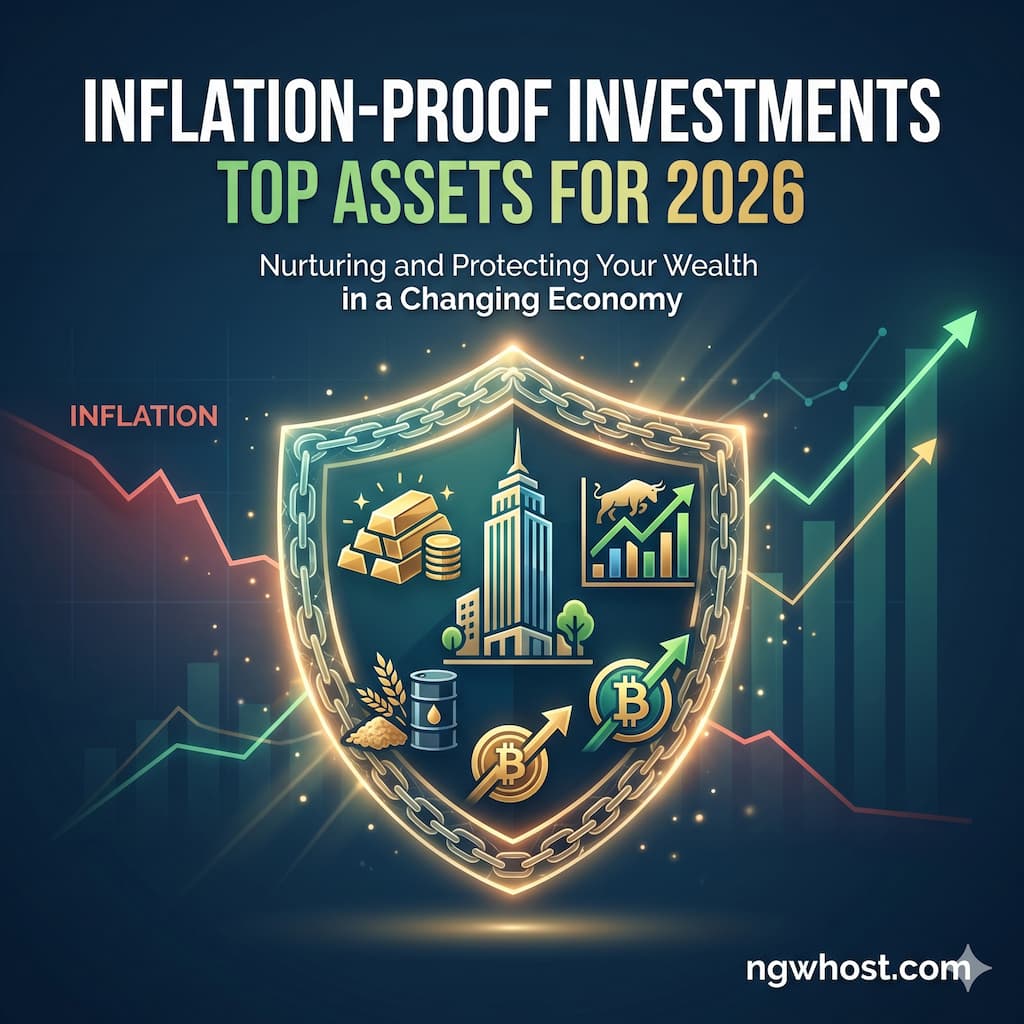
Inflation-Proof Investments: Top Assets for 2026
The global economic landscape of 2026 is defined by a paradox: rapid technological advancement existing alongside persistent inflationary pressures. For investors and wealth managers visiting ngwhost.com, the traditional “buy and hold” strategy for a 60/40 stock-bond portfolio is no longer a reliable shield. As central banks navigate the complexities of digital currencies and shifting supply chains, the purchasing power of fiat currency faces constant erosion.
To achieve true financial resilience, one must pivot toward assets that do more than just grow—they must outpace the rising cost of living. In this comprehensive guide, we analyze the top inflation-proof assets for 2026, ranging from hard commodities to decentralized digital gold.
1. Real Estate: The Classic Inflation Hedge
Real estate remains one of the most reliable hedges against inflation for a simple reason: as prices for goods and services rise, so do property values and rents. In 2026, however, the strategy has moved beyond simple residential ownership.
Residential vs. Commercial in 2026
While traditional office space has struggled, multi-family residential units and industrial logistics hubs have thrived. With the rise of e-commerce and regionalized supply chains, the demand for warehouse space near urban centers is at an all-time high.
- Inflation Linkage: Most commercial leases include CPI (Consumer Price Index) adjustment clauses, meaning your income automatically increases alongside inflation.
- Leverage: Inflation benefits the debtor. If you hold a fixed-rate mortgage on a property while the value of the currency drops, you are effectively paying back the bank with “cheaper” dollars while the asset’s value appreciates.
REITs and Tokenized Property
For those who don’t want to manage physical buildings, Real Estate Investment Trusts (REITs) and the emerging field of tokenized real estate allow for fractional ownership with high liquidity.
2. Commodities: Betting on the Tangible
When the value of paper money drops, the value of the “stuff” that makes the world work typically rises. In 2026, the commodity market is split into two critical sectors: Precious Metals and Green Energy Metals.
The Return of Gold and Silver
Gold remains the ultimate “store of value” when trust in central banks wavers. In 2026, gold has reclaimed its spot as a core portfolio stabilizer. Silver, with its dual role as a monetary metal and a critical component in solar panels and electronics, offers even higher upside potential during industrial expansion.
Critical Minerals (The “Green” Inflation Hedge)
Inflation in 2026 is often driven by the “Green Transition.” As the world electrifies, the demand for Lithium, Copper, Cobalt, and Nickel has created a super-cycle. Investing in the miners of these materials provides a hedge because these commodities are the literal building blocks of the modern economy. If the price of an EV goes up, it’s usually because the price of these metals went up first.
3. Bitcoin: Digital Gold in a Decentralized World
By 2026, the debate over whether Bitcoin is a legitimate asset class has largely been settled. Institutional adoption via ETFs and sovereign wealth fund allocations has stabilized Bitcoin’s volatility relative to its early years, making it a “Digital Gold” for the modern era.
Why Bitcoin Resists Inflation
Unlike fiat currencies, which can be printed at will, Bitcoin has a hard-capped supply of 21 million. This absolute scarcity is the perfect antithesis to inflationary monetary policy.
- Global Liquidity: In 2026, Bitcoin can be moved across borders instantly, making it a preferred asset for HNWIs in regions with unstable local currencies.
- Deflationary Nature: The “halving” cycles ensure that the issuance of new Bitcoin slows down over time, increasing its scarcity even as demand grows.
4. Treasury Inflation-Protected Securities (TIPS) and I-Bonds
For the conservative portion of a portfolio, government-backed securities designed specifically for inflation are essential.
- TIPS: The principal of a TIPS bond increases with inflation and decreases with deflation, as measured by the Consumer Price Index. When the bond matures, you are paid the adjusted principal or the original principal, whichever is greater.
- I-Bonds: These savings bonds earn interest through a combination of a fixed rate and an inflation rate that is set twice a year. In 2026, they remain a “risk-free” way to ensure your cash doesn’t lose its value in the bank.
5. High-Margin “Moat” Stocks
Not all stocks are created equal during inflation. Companies that rely on high amounts of labor and raw materials see their margins squeezed. However, companies with a “Wide Moat” and Pricing Power can pass increased costs directly to the consumer.
Characteristics of Inflation-Resistant Stocks:
- Low Capital Intensity: Tech companies or software-as-a-service (SaaS) providers don’t need to buy expensive raw materials to scale.
- Essential Services: Utilities and healthcare providers offer services that people cannot cut from their budgets, no matter how high prices go.
- Brand Loyalty: Luxury brands can raise prices by 10% without losing a single customer, effectively “outrunning” inflation.
6. Farmland: The Sustainable Store of Value
As the global population nears 8.3 billion in 2026, the amount of arable land per person is shrinking. Farmland is a unique asset class because it is both a real estate play and a commodity play.
- Intrinsic Value: People will always need to eat.
- Yield: Farmland provides an annual cash yield from crop sales plus the long-term appreciation of the land itself.
- Low Correlation: Farmland values historically have a very low correlation with the stock market, making it an excellent diversifier during periods of market volatility.
7. Infrastructure and Energy
Infrastructure projects—pipelines, cell towers, power grids, and toll roads—often have inflation protection built into their contracts. These assets provide essential services with high barriers to entry.
In 2026, Renewable Energy Infrastructure (Wind farms, Battery Storage) is particularly attractive. As government subsidies continue and carbon taxes increase the cost of fossil fuels, the “Green Energy” sector acts as a hedge against the rising cost of traditional energy.
8. Strategic Asset Allocation for 2026
Building an inflation-proof portfolio isn’t about picking one winner; it’s about balance. In the current economic climate, many experts at ngwhost.com suggest a “Barbell Strategy”:
- One side of the barbell: Highly stable, inflation-indexed assets (TIPS, I-Bonds, Gold).
- The other side of the barbell: High-growth, scarce assets (Bitcoin, Tech-Moat stocks, Green Minerals).
- The middle: Cash-flowing real assets (Real Estate, Farmland).
9. The Hidden Threat: “Shrinkflation” and Lifestyle Inflation
While we focus on assets, it is important to remember that inflation also affects your liabilities. In 2026, “Shrinkflation”—getting less for the same price—is rampant. To stay “Inflation-Proof,” an investor must also look at their debt.
- Debt Management: High-interest, variable-rate debt is the enemy during inflation. Refinancing into fixed-rate long-term debt allows you to pay back your liabilities with depreciated currency.
Read More⚡ High-Net-Worth Trends: Why Private Banking is Changing
10. Conclusion: Securing Your Future at ngwhost.com
Inflation is often called the “hidden tax” because it quietly devalues the hard work you’ve put into building your wealth. However, by shifting your perspective from “currency” to “assets,” you can turn a period of rising prices into a period of significant portfolio growth.
Whether it’s the digital scarcity of Bitcoin, the tangible security of Gold and Farmland, or the pricing power of Elite Equities, the tools to survive and thrive in 2026 are within reach. At ngwhost.com, we believe that the best investment you can make is in your own financial education and the agility of your portfolio.
The future is inflationary, but your wealth doesn’t have to be its victim. Position yourself today in the assets that the world will always value.
Stay ahead of the market with more deep dives into wealth preservation and digital assets at ngwhost.com.