High-Yield Savings vs. Bonds: Best Passive Income 2026
As we navigate the fiscal landscape of mid-2026, the strategy for generating passive income has undergone a significant transformation. The “easy money” era of the early 2020s is gone, replaced by a market defined by cooling inflation and a stabilizing interest rate environment. For investors looking to park their capital and watch it grow without active management, the debate has narrowed down to two titans: High-Yield Savings Accounts (HYSA) and Bonds.
At ngwhost.com, we believe that financial stability is the foundation of any successful digital venture. Whether you are a digital entrepreneur or a long-term saver, choosing the right vehicle for your cash reserves in 2026 requires more than just looking at a percentage sign. It requires understanding the interplay between Federal Reserve policy, market liquidity, and your own personal timeline.
In this 1,500-word deep dive, we compare High-Yield Savings versus Bonds to determine which is the king of passive income for the remainder of 2026.
1. The 2026 Macroeconomic Backdrop
To choose between an HYSA and a Bond, we must first understand the current economic “weather.”
As of April 2026, the global economy has entered what analysts call the “Soft Landing Plateau.” Inflation has largely settled near the 2.5% target, and the aggressive rate hikes of previous years have paused. The Federal Reserve’s benchmark rate currently sits in a range that allows both savings accounts and bonds to offer yields we haven’t seen in over a decade.
However, the direction of rates is the key. While rates are high today, the market is pricing in gradual cuts toward the end of 2026 and into 2027. This creates a specific “window of opportunity” for bondholders that doesn’t exist for savings account holders.
2. High-Yield Savings Accounts (HYSA): The Liquidity King
A High-Yield Savings Account is exactly what it sounds like: a savings account, typically offered by online-only banks, that pays a significantly higher interest rate than traditional “brick-and-mortar” banks.
How HYSA Performs in 2026
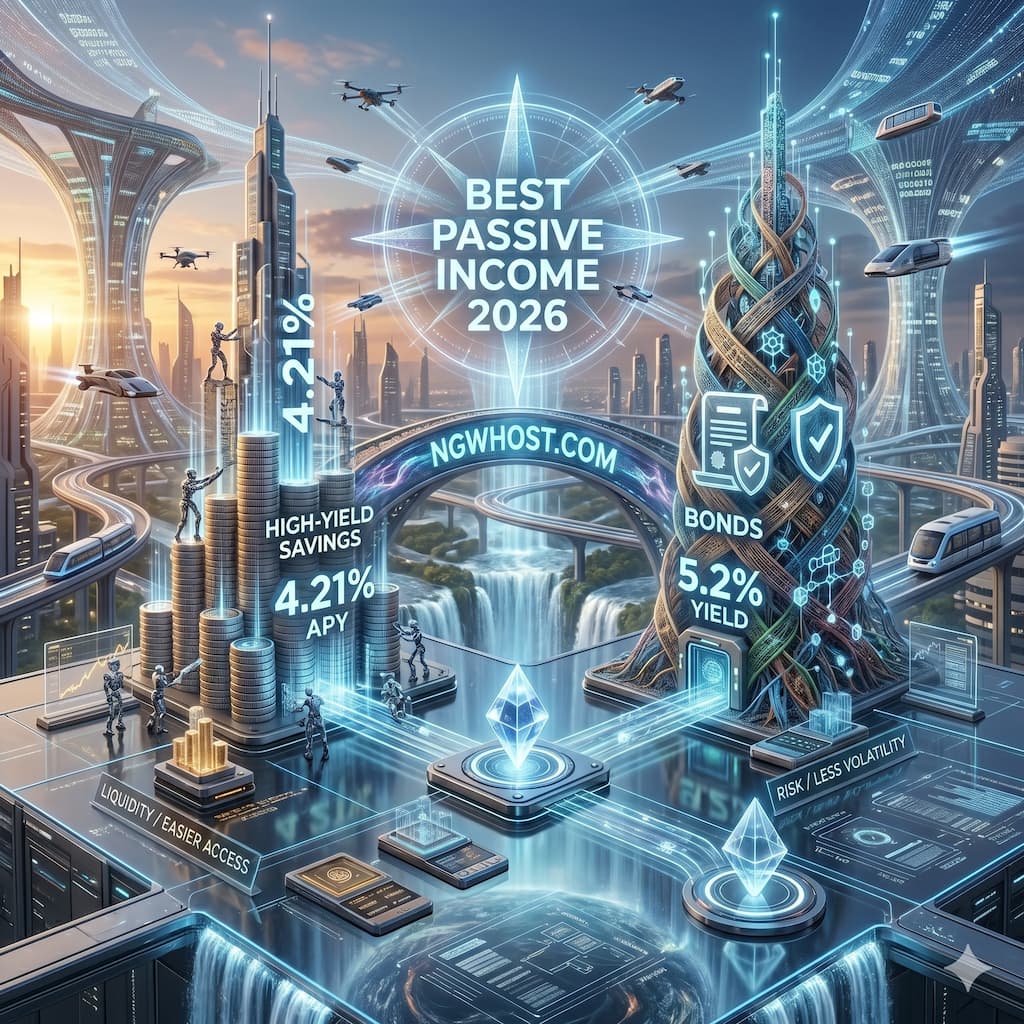
In 2026, the top-tier HYSAs are still offering attractive rates, often hovering between 4.2% and 4.7% APY. Because online banks don’t have the overhead of physical branches, they pass those savings on to you in the form of higher yields.
The Pros of HYSA in 2026
- Ultimate Liquidity: This is the biggest draw. You can move your money in and out with zero penalties. For the entrepreneurs at ngwhost.com, this “emergency fund” accessibility is vital.
- Compounding Interest: Most HYSAs calculate interest daily and credit it monthly. This “interest on interest” effect is powerful over a 12-month period.
- FDIC Insurance: Your money is backed by the government up to $250,000 per institution. In an era of digital banking shifts, this peace of mind is invaluable.
The Cons of HYSA in 2026
- Variable Rates: This is the “Achilles’ heel” of the HYSA in a cooling market. If the Fed cuts rates tomorrow, your bank will lower your APY the day after. You are not “locked in” to your return.
- Inflation Risk: While 4.5% looks good, if inflation stays stubborn at 3%, your “real” return is only 1.5%.
3. Bonds: The Strategy of “Locking In”
Bonds are essentially IOUs. You lend money to a government or a corporation for a set period, and in exchange, they pay you a fixed interest rate (a “coupon”) and return your principal at the end.
The 2026 Bond Market
The bond market in 2026 is seeing a resurgence in Treasury Notes and Investment-Grade Corporate Bonds. With 2-year and 5-year Treasuries yielding around 4.0% to 4.3%, they are slightly lower than the best HYSAs, but they offer something savings accounts cannot: Rate Protection.
The Pros of Bonds in 2026
- Fixed Income: When you buy a bond in April 2026, you lock in that rate for the duration. If rates drop to 3% in 2027, you are still collecting your 4.3% check.
- Capital Appreciation: This is the secret weapon. Bond prices move inversely to interest rates. If market rates fall, your “old” bond with a higher rate becomes more valuable. You can sell it on the secondary market for more than you paid.
- Tax Advantages: Certain bonds, like U.S. Treasuries, are exempt from state and local taxes—a major win for investors in high-tax regions like California or New York.
The Cons of Bonds in 2026
- Illiquidity: If you buy a 5-year bond and need the cash in 6 months, you have to sell it on the market. If rates have gone up in that time, you might have to sell at a loss.
- Complexity: Buying bonds requires a brokerage account and a basic understanding of “Yield to Maturity” versus “Coupon Rate.”
4. Head-to-Head Comparison: The 2026 Scorecard
| Feature | High-Yield Savings (HYSA) | Bonds (Treasuries/Corporate) |
| Current Yield | 4.2% – 4.7% | 4.0% – 4.5% |
| Risk Level | Extremely Low (FDIC) | Low (Government Backed) |
| Liquidity | High (Instant Access) | Moderate (Secondary Market) |
| Rate Stability | Variable (Changes with Fed) | Fixed (Locked for Term) |
| Tax Benefit | None (Taxed as Income) | State/Local Tax Exempt (Treasuries) |
5. Strategic Scenarios: Which is Best for You?
The “Best” passive income isn’t universal; it depends on your specific goal for 2026.
Scenario A: The “Emergency Fund” (HYSA Wins)
If you are an entrepreneur at ngwhost.com and you need $20,000 set aside in case your server costs spike or your client is late on a payment, keep that money in an HYSA. You cannot risk having your emergency cash locked in a bond that might be down in value when you need it.
Scenario B: The “Predictable Income” (Bonds Win)
If you have $50,000 that you don’t need for at least 2 or 3 years, and you want to ensure you are earning a steady check regardless of what the Federal Reserve does in 2027, Bonds are the superior choice. By locking in a 4%+ yield now, you are “future-proofing” your passive income against rate cuts.
Scenario C: The “Tax Optimization” (Bonds Win)
If you are in a high-income tax bracket, the state-tax exemption of Treasury bonds can make a 4.1% Treasury yield more profitable than a 4.6% HYSA yield after taxes are calculated.
6. The 2026 “Barbell Strategy”
Many sophisticated investors in 2026 are moving away from an “either/or” mentality and adopting the Barbell Strategy.
- The Left Side (Liquidity): Keep 3–6 months of expenses in a High-Yield Savings Account. This covers your short-term needs and takes advantage of the high current APYs.
- The Right Side (Long-Term): Put the remainder into a “Ladder” of Bonds (6-month, 1-year, and 2-year maturities).
The Bond Laddering Technique:
By buying bonds that mature at different times, you ensure that you always have “fresh” cash becoming available every few months, while still locking in the higher rates of 2026 for the longer-term portions of your portfolio.
7. The Role of Digital Banking and FinTech
In 2026, the line between these two products is blurring thanks to FinTech innovation. Many digital platforms now offer “Cash Sweeps” that automatically move your money between an HYSA and ultra-short-term Treasury bills to find the highest yield every single day.
For the readers of ngwhost.com, using these automated tools can add an extra 0.2% to 0.5% to your annual return—which, on a large balance, pays for your hosting and digital infrastructure costs many times over.
8. Risks to Watch Out For
Passive income is never 100% “risk-free.” As you finalize your 2026 strategy, watch for these “yield traps”:
- Inflation Spikes: If a geopolitical event in late 2026 causes oil prices to jump, inflation could return. In that case, your “locked-in” bond might suddenly feel very inadequate.
- Corporate Credit Risk: If you are chasing high yields in corporate bonds, remember that a “soft landing” isn’t a “no landing.” Some companies may still struggle to repay debt in a high-rate environment. Stick to “Investment Grade” (BBB or higher) for true passive safety.
- Bank Limits: Many HYSAs have limits on how many withdrawals you can make per month (Regulation D). Even though these were eased in previous years, some banks are re-imposing them in 2026 to manage their own liquidity.
Read More⚡ 2026 Crypto Regulations: What Investors Must Know
9. Conclusion: The Verdict for 2026
If we must choose a winner for the title of “Best Passive Income of 2026,” the award goes to a Balanced Mix, but with a slight edge to Bonds for those seeking true stability.
While the High-Yield Savings Account offers the highest current number today, the Bond market offers the highest certainty for tomorrow. In an era where the Federal Reserve is looking for any excuse to bring rates back down to “normal” levels, the ability to lock in 4%+ for the next few years is a gift that investors shouldn’t ignore.
Final Summary Checklist:
- Use HYSA for your first $10k–$25k (Liquidity).
- Use Bonds for any capital you won’t touch for 12+ months (Rate Protection).
- Use Automation at platforms like those discussed on ngwhost.com to ensure you aren’t leaving “lazy money” in a 0.01% checking account.
Passive income in 2026 isn’t about getting rich overnight; it’s about making your money work as hard as you do. By choosing the right balance between HYSA and Bonds, you ensure that while you are focused on building your business, your wealth is building itself.