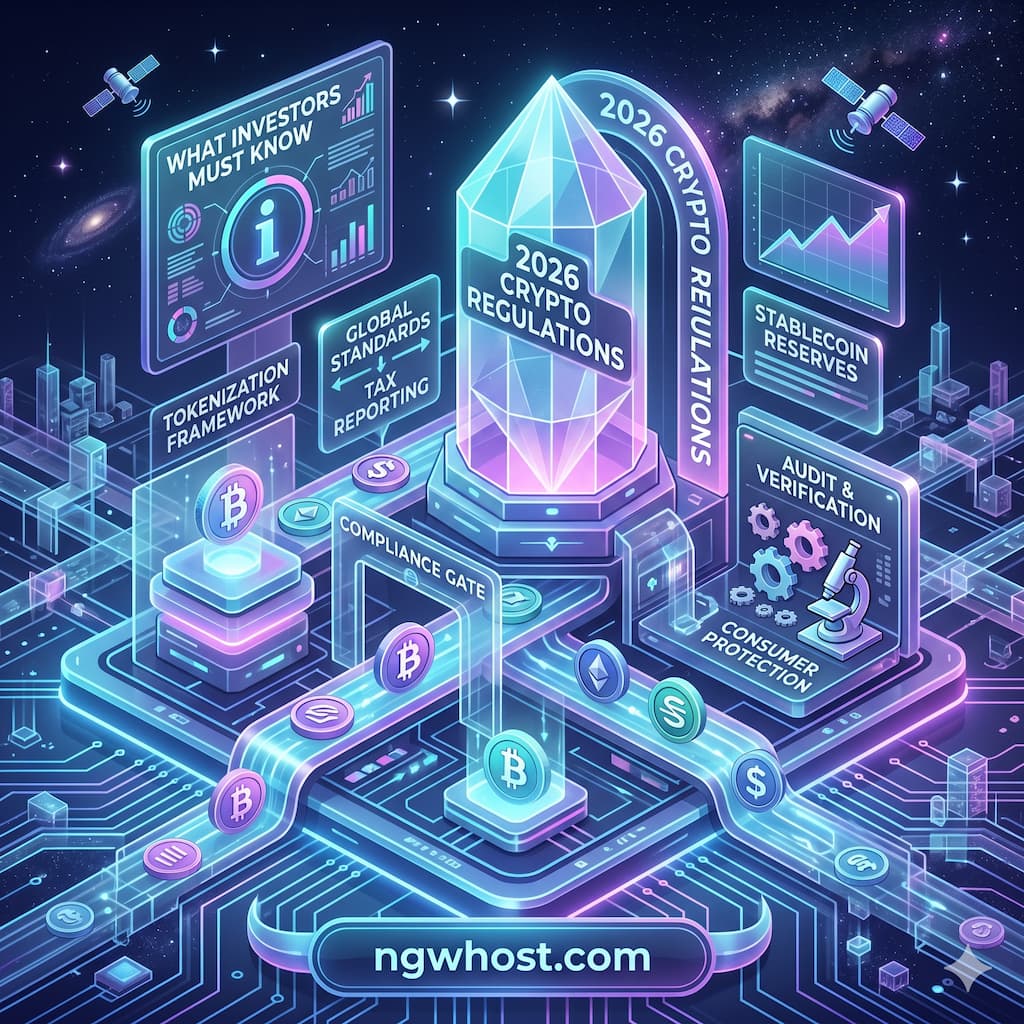
2026 Crypto Regulations: What Investors Must Know
The era of the “Digital Wild West” has officially drawn to a close. As we navigate through April 2026, the cryptocurrency market is no longer a peripheral experiment; it is a regulated asset class integrated into the global financial system. For investors at ngwhost.com, understanding the nuances of these new legal frameworks is the difference between long-term wealth preservation and devastating legal or financial setbacks.
2026 marks the first full year of implementation for several landmark pieces of legislation, most notably the MiCA (Markets in Crypto-Assets) regulation in Europe and the clarity emerging from the US Financial Innovation and Technology for the 21st Century Act (FIT21).
In this comprehensive guide, we will break down the essential crypto regulations for 2026 that every investor must know to stay compliant and profitable.
1. The Global “Gold Standard”: MiCA’s Full Implementation
If you trade or hold assets in Europe, 2026 is the year the MiCA Regulation reaches its definitive stage. It has become the blueprint for other nations, including Brazil and the UK.
Stablecoin Scrutiny (Asset-Referenced Tokens)
One of the most significant changes in 2026 is the restriction on non-compliant stablecoins. Regulators now require stablecoin issuers to maintain a 1:1 liquid reserve in high-quality assets (like government bonds or cash) held in segregated accounts.
- Investor Impact: Popular stablecoins that haven’t secured an E-Money Institution (EMI) license are being delisted from major exchanges. If you are holding “off-shore” stablecoins, you face significant liquidity risks. Always check if your stablecoin is “MiCA-compliant” to ensure you can off-ramp into Fiat currency.
CASP Licensing
Crypto-Asset Service Providers (CASPs)—which include exchanges, custodians, and wallet providers—must now have physical offices in the jurisdictions they serve.
- The Benefit: This provides investors with legal recourse. If an exchange fails or freezes your funds in 2026, you are protected by consumer laws that didn’t exist two years ago.
2. The US Landscape: Clarity at a Cost
After years of “regulation by enforcement,” 2026 brings structural clarity to the United States. The division between the SEC (Securities and Exchange Commission) and the CFTC (Commodity Futures Trading Commission) has finally been codified.
Security vs. Commodity: The Final Verdict
In 2026, the status of major assets like Ethereum (ETH), Solana (SOL), and Cardano (ADA) is no longer a subject of Twitter debates. Under the FIT21 framework, decentralized assets are officially classified as commodities.
- The Trade-off: While this clarity has led to the approval of several new Spot ETFs (Exchange Traded Funds), it also means that these projects must provide regular “Transparency Reports.” Projects that remain centralized or fail to disclose their “token distribution” are being flagged as high-risk by US-based brokerages.
The Rise of Qualified Custodians
Self-custody (using hardware wallets like Ledger or Trezor) remains legal, but 2026 has introduced the “Custody Rule” for institutional and high-net-worth individuals. To manage crypto for others, firms must use a “Qualified Custodian.”
- What to know: If you are investing through an IRA or a corporate fund, ensure your provider is a regulated custodian to avoid IRS penalties.
3. Tax Compliance: No More Hiding
If there is one thing that has changed most in 2026, it is Tax Visibility. The days of “hoping the taxman doesn’t find your wallet” are over.
The CARF Framework
The Crypto-Asset Reporting Framework (CARF) is now active across 50+ countries. This is an automatic information-exchange system. Exchanges are now legally required to report your transaction data directly to your home country’s tax authority (such as the Receita Federal in Brazil or the IRS in the US).
Cost-Basis Reporting
In 2026, your exchange will provide you with a 1099-DA (or equivalent) that shows your cost basis.
- Strategic Tip: Since AI-driven tax auditing is now standard for tax authorities, ensure you are using crypto tax software to reconcile your on-chain (DeFi) activity with your exchange activity. Discrepancies are being flagged automatically by government algorithms in 2026.
4. DeFi and the “Front-End” Regulation
Decentralized Finance (DeFi) was once thought to be unregulatable. In 2026, the regulators have found a way: The Interface Layer.
Regulated Gateways
While a smart contract on Ethereum cannot be stopped, the “Front-End” (the website you use to interact with it) is now subject to KYC (Know Your Customer) requirements in many regions.
- The “Un-hosted” Wallet Rule: Some jurisdictions now require exchanges to verify the ownership of an external wallet before you can withdraw funds to it. This is aimed at preventing money laundering, but it adds a layer of friction for investors who value privacy.
Governance Liability
If you participate in a DAO (Decentralized Autonomous Organization) and hold “Governance Tokens,” 2026 legal precedents suggest you may be held liable if the DAO engages in illegal activities.
- The Lesson: Be careful about which DAOs you actively participate in. Holding a token for investment is one thing; voting on proposals can now carry legal weight.
5. Travel Rule Compliance
The Financial Action Task Force (FATF) “Travel Rule” is fully operational globally in 2026. This means that for any transaction over $1,000, your personal information (name, address, ID) must “travel” with the transaction between service providers.
- Impact on Transfers: Transfers between major exchanges are now as documented as traditional bank wires. If you are moving large sums between international exchanges, expect a 24-hour “compliance hold” while the receiving exchange verifies the source of funds.
6. How to Protect Your Portfolio: A 2026 Checklist
Given this new regulatory environment, how should a savvy investor at ngwhost.com manage their assets?
I. Perform a “Compliance Audit”
Review your portfolio for “Zombie Tokens.” These are projects that have failed to comply with reporting standards or are being delisted from regulated exchanges. These assets often lose 90% of their liquidity overnight when a major regulation hits.
II. Separate “Trade” from “HODL”
- For Trading: Use fully licensed, regulated exchanges that provide transparent tax reporting.
- For Long-Term Holding: Continue using self-custody for your core assets (BTC, ETH), but keep meticulous records of your “On-Ramp” and “Off-Ramp” points to prove the source of funds in the future.
III. Embrace Proof-of-Reserves
Only leave funds on exchanges that provide Live Proof-of-Reserves (PoR). In 2026, several regional laws mandate that exchanges show their assets on-chain in real-time to prevent another “FTX-style” collapse.
IV. Understand “Wash Trading” Rules
Regulators in 2026 are cracking down on “Wash Trading” (buying and selling to yourself to create fake volume). While this was common in 2021, it is now considered market manipulation. If your account shows suspicious circular activity, you may face account freezes and legal inquiries.
7. The Future: CBDCs and the Integration
As we look toward 2027, the line between “Crypto” and “Banking” will continue to blur. Many central banks are launching CBDCs (Central Bank Digital Currencies).
While CBDCs aren’t cryptocurrencies in the traditional sense, they will be the primary “Bridge” for your crypto investments. In 2026, expect to see your traditional bank account offering a “Crypto Sidebar” where you can buy regulated assets directly from your banking app.
Read More⚡ Why Retail Investors are Flocking to Private Equity
Conclusion: Regulation as a Catalyst for Growth
While the “2026 Crypto Regulations” may feel restrictive to those who loved the early days of anonymity, they are actually the greatest catalyst for the next bull market.
Institutional money—pension funds, insurance companies, and sovereign wealth—cannot enter a market without clear rules. These regulations have provided the “green light” for trillions of dollars to potentially enter the space.
For the investor, the goal is simple: Stay compliant, keep records, and stay informed. By following the guidelines on ngwhost.com, you ensure that your digital assets remain an asset, not a liability.