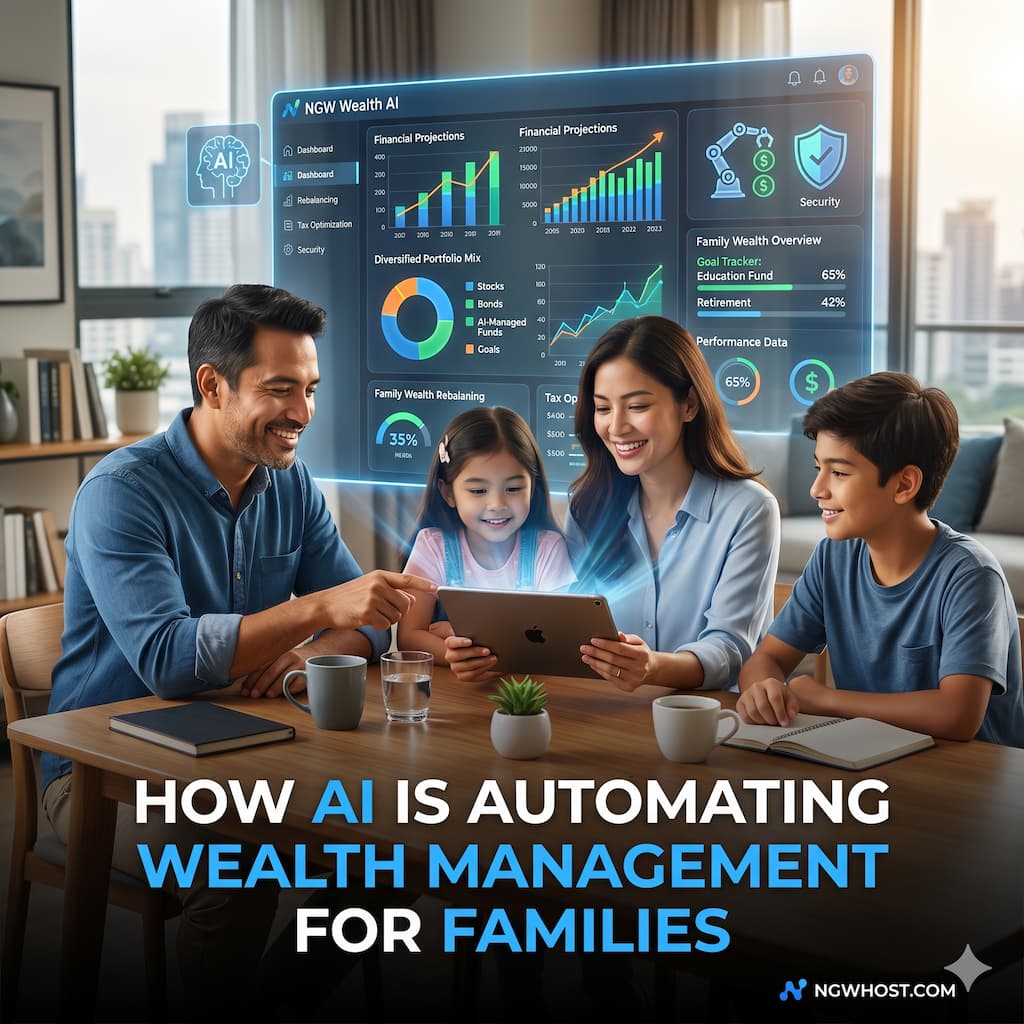
How AI is Automating Wealth Management for Families
For generations, comprehensive wealth management was a privilege reserved for the ultra-wealthy—families with dedicated offices, private bankers, and a fleet of accountants. For the average affluent family, financial planning often felt like a disjointed puzzle of spreadsheets, various banking apps, and an annual meeting with a human advisor that focused more on past performance than future strategy.
As we move through 2026, that barrier has dissolved. Artificial Intelligence is not just “changing” wealth management; it is completely automating the complex orchestration of family finances. At ngwhost.com, we are witnessing a transition from reactive financial planning to proactive, autonomous wealth management.
This shift allows families to manage intergenerational wealth, tax optimization, and portfolio diversification with a level of precision that was humanly impossible just a few years ago.
1. The Shift from Robo-Advisors to Autonomous Wealth Agents
To understand where we are in 2026, we must look at where we started. The “Robo-Advisors” of the early 2020s were simple algorithmic tools that rebalanced portfolios based on basic risk profiles. They were “set and forget” tools.
Today’s Autonomous Wealth Agents are different. They utilize Generative AI and Machine Learning to act as a digital “Chief Financial Officer” for the family unit.
Real-Time Decision Making
Unlike traditional models that require a human to trigger a trade or a move, AI agents monitor global markets 24/7. If a geopolitical event in Europe affects a specific sector in your portfolio, the AI doesn’t just send an alert—it can be authorized to execute a pre-approved hedging strategy instantly.
2. Hyper-Personalized Tax Loss Harvesting
Taxation is often the largest “leak” in a family’s wealth. Manually calculating tax-loss harvesting—selling securities at a loss to offset a capital gains tax liability—is a tedious process usually done once a year in December.
AI has turned this into a continuous, year-round process.
- Micro-Harvesting: AI identifies daily opportunities to capture losses in specific ETFs or stocks, instantly replacing them with similar assets to maintain market exposure.
- Multi-Account Coordination: For families with multiple brokerage accounts, trusts, and 401(k)s, AI looks at the entire family ecosystem. It ensures that an action in a child’s college fund doesn’t create a tax conflict with the parents’ retirement accounts.
3. Intergenerational Wealth Transfer and Estate Planning
One of the most complex aspects of family wealth is moving it from one generation to the next without losing 40% or more to taxes and legal fees. AI is now automating the “Living Estate Plan.”
Predictive Estate Modeling
AI tools can simulate thousands of “what-if” scenarios:
- What if the parents live to 95?
- What if a child buys a home in a high-tax state like California vs. a low-tax state like Florida?
- What if the family business is sold in 2030 vs. 2035?
By analyzing these variables, the AI suggests the optimal timing for “Gifting” and the creation of specific trust structures (like GRATs or SLATs) to maximize the amount of wealth staying within the family.
4. Family Sentiment and Goal-Based Investing
AI is now capable of more than just “math.” Through Natural Language Processing (NLP), AI wealth tools can analyze family meetings, emails, and goal-setting sessions to understand the values behind the money.
The “Family Mission” Algorithm
In 2026, wealth management isn’t just about a 7% return. It’s about meeting specific family milestones. AI can automate the allocation of capital toward:
- The Education Fund: Adjusting risk automatically as a child nears college age.
- Philanthropy: Identifying charitable organizations that align with the family’s stated values and optimizing the tax benefits of those donations.
- Lifestyle Milestones: Calculating exactly when the family can afford a secondary property or a sabbatical without jeopardizing long-term security.
5. Integrating Non-Traditional Assets
Family wealth in 2026 is no longer just stocks and bonds. It includes real estate, private equity, art, and digital assets (Bitcoin/Ethereum). Traditionally, these were “siloed.” You couldn’t see your art collection’s value alongside your brokerage account.
AI-driven platforms now provide a Unified Wealth View.
- Automatic Valuation: AI pulls real-time data from real estate markets and art auction databases to provide an accurate “Net Worth” pulse every morning.
- Liquidity Management: If the family needs $500,000 for a new investment, the AI analyzes the entire portfolio to suggest which asset to sell or borrow against to minimize taxes and maintain the target risk level.
6. Security, Privacy, and the “Digital Vault”
For families, the fear of a cyber-attack is paramount. Managing wealth online requires more than just a strong password.
AI is the primary line of defense in 2026. Behavioral Biometrics AI monitors how you interact with your wealth management dashboard. It learns your typing rhythm, your mouse movements, and your typical transaction patterns. If someone else logs in with your credentials, the AI detects the “behavioral mismatch” and freezes the account before a single dollar can be moved.
Furthermore, the automation of the “Digital Vault” ensures that all critical documents—deeds, wills, insurance policies—are cryptographically secured and automatically shared with the right family members or executors only when specific “smart contract” conditions are met.
7. The Hybrid Future: AI + Human Expertise
Despite the heavy automation, the human advisor has not disappeared. Instead, their role has shifted.
At ngwhost.com, we see the human advisor acting as a “Wealth Psychologist.” While the AI handles the execution, the tax-loss harvesting, and the rebalancing, the human advisor helps the family navigate the emotional complexities of wealth:
- Navigating family disputes over inheritance.
- Teaching children about financial responsibility.
- Making high-level ethical decisions about where the family’s legacy should lie.
The result is a “Cyborg” approach to wealth: The cold, efficient precision of AI combined with the warm, contextual empathy of a human professional.
Read More⚡ Blockchain in Supply Chain: Reducing Business Costs
8. Conclusion: Democratizing the Family Office
The automation of wealth management is the ultimate equalizer. What used to cost $100,000 a year in management fees can now be achieved for a fraction of the cost through AI-integrated platforms.
For the families following ngwhost.com, the message is clear: the tools to build and protect a multi-generational legacy are now at your fingertips. By automating the technical details of finance, AI allows you to focus on what the money is actually for: Time, Security, and Family.
The future of wealth management isn’t a ledger; it’s a conversation between your goals and the intelligent agents designed to help you reach them.
To learn more about the technology shaping the future of finance and infrastructure, stay connected with ngwhost.com.