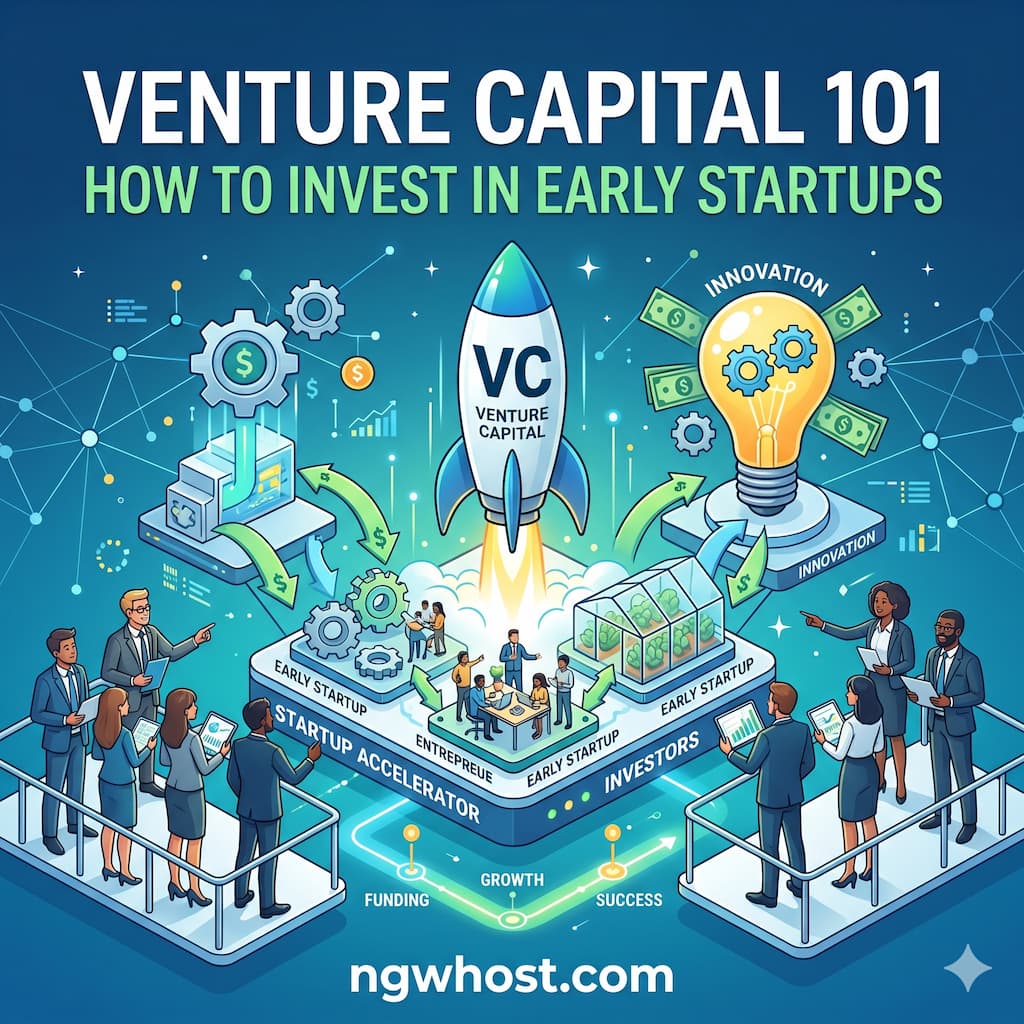
Venture Capital 101: How to Invest in Early Startups
The allure of finding the next “Unicorn” has long captivated the minds of the world’s most ambitious investors. We’ve all heard the stories: a few thousand dollars tucked into a garage-based startup like Apple or Amazon turning into a generational fortune. However, for a long time, the world of Venture Capital (VC) was a gated community, accessible only to institutional giants or the ultra-wealthy elite of Silicon Valley.
In 2026, those gates have been dismantled. Thanks to shifts in financial regulation, the rise of specialized digital platforms, and the democratization of private equity, the opportunity to invest in early-stage startups is now available to a much broader range of individuals. At ngwhost.com, we are passionate about the intersection of technology and capital. This comprehensive guide serves as your “101” masterclass on how to navigate the high-risk, high-reward world of Venture Capital.
1. What is Venture Capital? (The 2026 Context)
At its core, Venture Capital is a form of private equity where investors provide funding to startups and small businesses that are believed to have long-term growth potential.
The Life Cycle of a Startup
In 2026, the VC landscape is divided into distinct phases, each with its own risk profile:
- Pre-Seed/Seed Stage: This is the “Idea” or “Prototype” phase. Investors are betting on the founders and a vision.
- Series A: The startup has “Product-Market Fit” and needs capital to scale operations.
- Series B and C: These are “Growth Rounds” for companies that are already generating significant revenue and looking to dominate their market.
- Exit: This is where the investor makes their money—either through an Initial Public Offering (IPO) or an acquisition by a larger company.
2. Why Invest in Startups Now?
Why is 2026 the ideal time to enter the VC space?
- The AI Proliferation: We are in the middle of a massive technological paradigm shift. Startups today are using Agentic AI to do the work that used to require 50 employees, making them leaner and more profitable from Day 1.
- Lower Entry Barriers: Regulatory changes (like the evolution of the JOBS Act in the US and similar laws globally) allow “Accredited” and sometimes even “Retail” investors to participate in private rounds via syndicates.
- Alternative to Public Markets: With traditional stock markets often feeling “priced to perfection,” the private sector remains one of the few places where investors can find true 10x or 100x return potential.
3. How to Access Startup Deals
In the past, you needed to “know a guy.” Today, you need to know the right platforms and networks.
Equity Crowdfunding Platforms
Sites like Republic, Wefunder, and SeedInvest allow you to invest as little as $100 in early-stage companies. These platforms handle the legal vetting, making it easy for beginners to start.
Investment Syndicates
Syndicates are led by an “Angellist” or a “Lead Investor” who has deep industry expertise. They find the deal, negotiate the terms, and allow other investors to “tag along” by pooling their money. This is an excellent way to benefit from professional due diligence while only committing a few thousand dollars.
Angel Networks
If you prefer a “boots on the ground” approach, joining a local Angel Network allows you to hear pitches in person (or via Zoom), meet the founders, and collaborate with other local investors.
4. The Due Diligence Checklist: Assessing a Winner
Investing in a startup is not gambling; it is a rigorous process of elimination. Here is what the pros at ngwhost.com look for before writing a check:
The Team (The “Who”)
In early-stage investing, the Founders are more important than the Idea.
- Does the team have “Founder-Market Fit”? (e.g., Are they former engineers solving an engineering problem?)
- Do they have the “Grit” to survive the “Trough of Disillusionment”?
- Is there a balance between technical talent and sales ability?
The Market (The “Why Now?”)
- TAM (Total Addressable Market): Is this a $100 million problem or a $10 billion problem? VCs only care about the latter.
- The “Moat”: What prevents a giant like Google or Amazon from copying this product tomorrow? Is it a patent, a network effect, or unique data?
The Traction (The “Proof”)
Even a seed-stage company should show some “pull” from the market. This could be a waitlist of 10,000 users, letters of intent (LOIs) from enterprise clients, or consistent month-over-month growth in a beta product.
5. Understanding the “Power Law” of VC Returns
This is the most critical concept for a new VC investor to understand. In a typical portfolio of 10 startups:
- 5 to 6 will fail completely (Zero return).
- 2 to 3 will “zombie” along (Maybe give you your money back).
- 1 will be a “Home Run” (Providing 50x to 100x returns).
The Strategy: You cannot just pick one startup. To succeed in Venture Capital, you must build a portfolio of at least 15 to 20 companies. The “Winner” must pay for all the “Losers” and still provide a massive profit.
[Table: The VC Portfolio Power Law Simulation]
| Company | Investment | Outcome | Return |
| Startup A-E | $50,000 | Failure | $0 |
| Startup F-G | $20,000 | Acquisition (2x) | $40,000 |
| Startup H | $10,000 | “The Winner” (50x) | $500,000 |
| Total | $80,000 | Net Result | $540,000 |
6. The Logistics: Cap Tables, SAFEs, and Term Sheets
When you invest, you aren’t just giving cash; you are entering a complex legal contract.
The SAFE (Simple Agreement for Future Equity)
Most early-stage deals use a SAFE. It is not debt, and it is not yet “stock.” It is a promise that when the company raises a “priced round” (like a Series A) in the future, your investment will convert into shares at a discount.
- Valuation Cap: This is the maximum “price” at which your money converts. It protects you from the company becoming too successful before you get your shares.
The Term Sheet
This is the blueprint of the deal. It covers:
- Liquidation Preference: Who gets paid first if the company is sold for less than expected?
- Voting Rights: Do you have a say in major company decisions?
- Anti-Dilution: What happens to your percentage of the company when they raise more money later?
7. The Risks: What No One Tells You
VC investing is “High Octane” finance, but it comes with high-speed crashes.
- Illiquidity: Your money is “locked up” for 7 to 10 years on average. Do not invest money you might need for a house down payment or an emergency.
- Dilution: Every time the company raises more money, your percentage of ownership shrinks. If you don’t have “Pro-Rata” rights (the right to invest more to keep your percentage), you could end up with a very small slice of a very big pie.
- The “Hype” Trap: In 2026, many companies slap “AI” on their pitch deck just to raise money. You must be able to distinguish between a “Feature” (something OpenAI could build in a weekend) and a “Company” (a standalone business with a moat).
8. Becoming a Value-Add Investor
In 2026, money is a commodity. Top-tier founders want “Smart Money.”
- Network: Can you introduce them to their first 10 customers?
- Hiring: Can you help them find their first CTO?
- Advisory: Can you help them avoid the mistakes you made in your own career?
By being a “Value-Add” investor, you get access to the best deals (the “Allocation”) that other passive investors are blocked from.
Read More⚡ Tax Havens in 2026: Legal Strategies for Investors
Conclusion: Your Journey into the Future
Venture Capital is more than just a way to make money; it is a way to participate in the creation of the future. When you invest in a startup, you are backing an entrepreneur’s dream to change the world.
At ngwhost.com, we believe that the next decade will be defined by the companies being built right now in 2026. By understanding the mechanics of due diligence, the legal structures of SAFEs, and the math of the Power Law, you can move from a spectator to a participant in the innovation economy.
Start small, build a diverse portfolio, and remember: you aren’t just buying shares—you are buying a front-row seat to the next industrial revolution.