The Future of Gold: Is Digital Gold the New Standard?
For over 5,000 years, gold has stood as the ultimate symbol of wealth and stability. It has outlived empires, survived collapses of entire monetary systems, and remained the “insurance policy” for the world’s most powerful central banks. However, as we navigate the second quarter of 2026, the way we interact with this ancient metal is undergoing its most significant transformation since the invention of coinage.
At ngwhost.com, we are witnessing a pivotal moment in finance: the rise of Digital Gold. With gold prices reaching historic heights—approaching the projected $5,000/oz mark by the end of 2026—investors are no longer just asking if they should own gold, but how they should own it. Is the age of physical bars and coins giving way to the era of tokenized, blockchain-backed assets? Is Digital Gold becoming the new global standard?
1. Defining “Digital Gold” in 2026
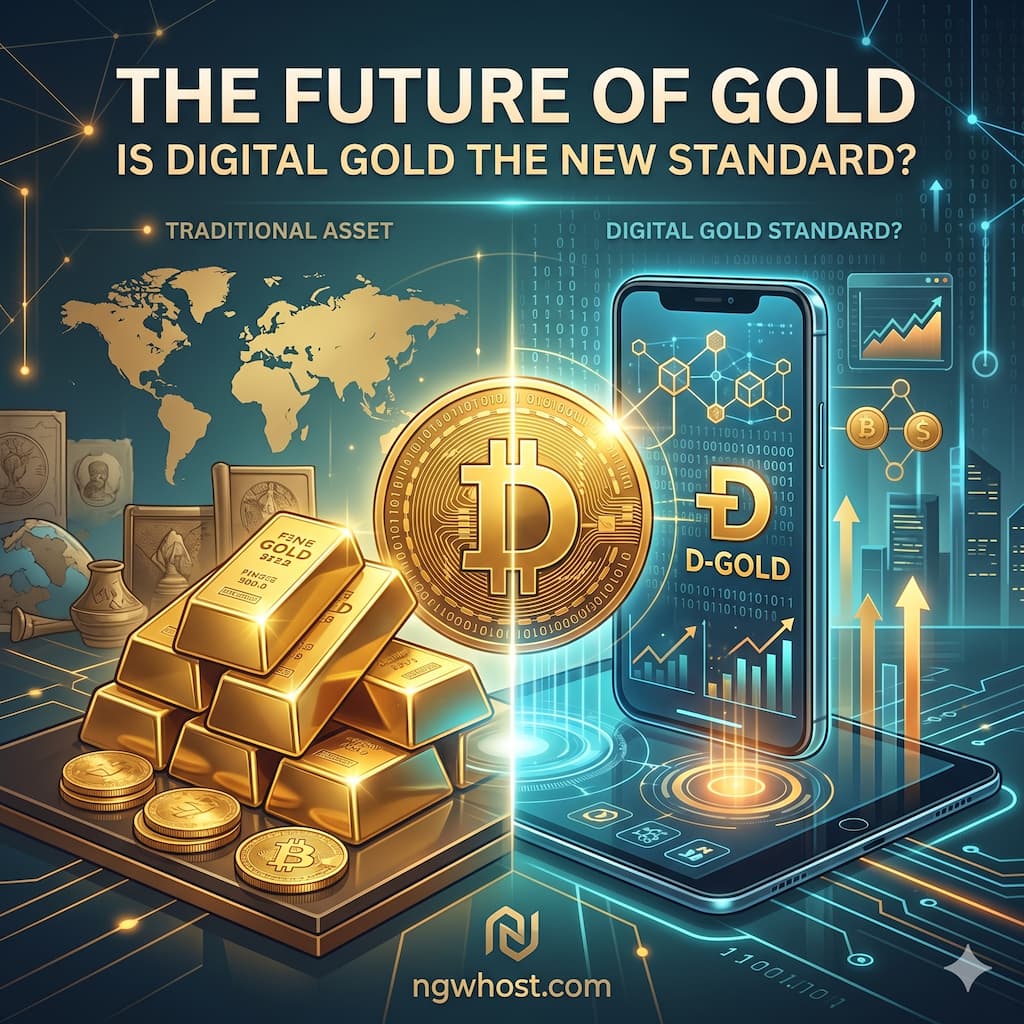
To understand the future, we must define what “Digital Gold” means in today’s market. It is not a speculative cryptocurrency like Bitcoin (often called “digital gold” in a metaphorical sense). Instead, Digital Gold in 2026 refers to Tokenized Physical Gold.
The Mechanism of Backing
When you purchase digital gold—through assets like PAX Gold (PAXG) or Tether Gold (XAUt)—you are buying a digital token that represents a direct legal claim to a specific, allocated amount of physical gold stored in professional, high-security vaults (usually in London or Switzerland).
- 1:1 Ratio: One token typically equals one troy ounce of 24K gold.
- Proof of Reserves: In 2026, leading platforms use decentralized oracles to provide Real-Time Proof of Reserves (PoR), allowing you to verify on-chain that the gold in the vault matches the tokens in circulation at any second.
2. Why Digital Gold is Winning: The 2026 Shift
As of early 2026, the market cap for tokenized gold has surpassed $6 billion, and projections from institutional market makers like Wintermute suggest it could triple to $15 billion by the end of the year. Why is this happening now?
Fractional Ownership: Gold for Everyone
Traditionally, buying a standard “Good Delivery” gold bar (400 oz) was restricted to the ultra-wealthy or institutions. Digital gold allows for fractional ownership. You can buy as little as 0.001 grams of gold via a mobile app. This has opened the gold market to a younger, digital-native generation of investors who prefer UPI-first payments and small-ticket investing.
Instant Liquidity and 24/7 Access
Physical gold is notoriously “illiquid.” If you want to sell a gold bar on a Sunday night, you simply cannot.
- The Digital Advantage: Tokenized gold trades on global exchanges 24/7. You can swap your gold for a stablecoin or fiat currency in seconds, even when traditional stock and bullion markets are closed.
- Global Portability: You can move $1 million worth of gold across borders digitally in minutes—a feat that is physically impossible and legally complex with actual bullion.
3. Physical vs. Digital: The Ultimate Comparison
For the readers of ngwhost.com, choosing between physical and digital depends on your specific goals.
| Feature | Physical Gold (Bars/Coins) | Digital Gold (PAXG / XAUt) |
| Storage | You must provide a safe or pay for a vault. | Handled by the issuer in insured vaults. |
| Liquidity | Requires physical transport and appraisal. | Instant, 24/7 trading on exchanges. |
| Minimum Buy | Typically 1 gram or 1 ounce. | As little as $1. |
| Fees | High buy/sell spreads and storage costs. | Low transaction fees; often no storage fees. |
| Redemption | Already in your hand. | Can be redeemed for physical gold (with minimums). |
| Counterparty Risk | None (if held at home). | Dependent on the issuer’s integrity and audits. |
4. The Institutional Wave: Gold in the “RWA” Revolution
In 2026, we are seeing the “Institutionalization of On-Chain Gold.” Large banks and asset managers are no longer viewing tokenized gold as a “crypto experiment.” It is now a core part of the Real World Asset (RWA) tokenization trend.
Lowering the Cost of Capital
Institutional players use digital gold to lower operational friction. In 2025 alone, trading volume for tokenized gold reached $178 billion, rivaling the top traditional gold ETFs. Institutions prefer the digital format because:
- Instant Settlement: T+0 settlement cycles versus the days-long process of physical delivery.
- Collateralization: In the Decentralized Finance (DeFi) space of 2026, you can use your PAXG as collateral to take out a loan without ever selling your gold.
5. Central Banks and the Digital Currency Factor
While retail investors embrace tokens, Central Banks are playing a different game. As of April 2026, Central Bank demand for gold remains near historic highs (averaging 585 tonnes per quarter).
The Geopolitical Insurance Policy
Countries like Poland, Uzbekistan, and China are aggressively adding to their physical reserves to hedge against a fragmented geopolitical landscape.
- The “Non-Digital” Reserve: While Central Banks are developing Central Bank Digital Currencies (CBDCs), they are doubling down on Physical Gold. Why? Because physical gold is the only asset that is not someone else’s liability. It cannot be “switched off” or “sanctioned” if it is held within your own borders.
6. The Challenges: What Could Stop Digital Gold?
Despite the explosive growth, Digital Gold still faces hurdles before it can be considered the absolute “New Standard.”
- Fungibility and Ecosystem Silos: Currently, digital gold products often operate in closed ecosystems. Gold bought on one platform may not be easily transferable to another, unlike physical gold, which “is just gold” anywhere in the world.
- The “Audit Gap”: While real-time proof of reserves is great, the market still relies on the honesty of the physical vaulting companies. A major scandal in a high-security vault could temporarily shatter trust in the entire digital segment.
- Regulatory Clarity: In 2026, MiCA-style regulations in Europe and evolving SEC guidelines in the US are still being fine-tuned for tokenized commodities.
7. Strategic Advice: How to Invest in Gold in 2026
If you are looking to secure your wealth in this high-priced environment, we suggest a Hybrid Strategy:
- The “Emergency” Physical (20%): Keep a small portion of your gold in physical coins (like Sovereigns or Maple Leafs) in a secure, local location. This is your “absolute zero” insurance for extreme systemic failure.
- The “Active” Digital (80%): Use tokenized gold (PAXG or XAUt) for the majority of your allocation. This allows you to benefit from gold’s price appreciation while maintaining the ability to rebalance your portfolio or access liquidity instantly.
- Verify the Issuer: Only use platforms that offer unallocated bar tracking and have a clear, realistic pathway for physical redemption if you ever decide you want the bars delivered to your door.
Read More⚡ Private Banking vs Wealth Management: Key Differences
8. Conclusion: The Hybrid Future
Is Digital Gold the new standard? The answer is a resounding “Yes” for the modern investor, but with a caveat.
In 2026, digital gold has become the standard for utility, liquidity, and accessibility. It has successfully democratized one of the oldest asset classes in human history. However, physical gold remains the standard for sovereignty and absolute security.
At ngwhost.com, we believe the “Future of Gold” isn’t a battle between the old and the new. It is a synergy. Technology has given us a way to make gold move at the speed of the internet, while the gold itself provides the stability that the internet’s fiat systems so often lack.
The gold bar hasn’t changed in 5,000 years. Our ability to own it, trade it, and use it to build a secure future has just become significantly smarter.