CBDCs vs. Stablecoins: What You Need to Know
The fundamental architecture of global finance is undergoing a seismic architectural shift. For decades, the movement of money relied on legacy infrastructure—systems like SWIFT and localized automated clearing houses (ACH) that are notoriously slow, expensive, and fundamentally disconnected from the high-velocity realities of the modern digital economy. Today, digital entrepreneurs, infrastructure architects, and e-commerce operators expect data to move globally in milliseconds. They are now demanding that capital do the exact same thing.
As we navigate the middle of the 2020s, the battle for the future of digital money is no longer about physical cash versus credit cards, nor is it simply about traditional fiat versus volatile cryptocurrencies like Bitcoin. The true war for the infrastructural rails of global commerce is being fought between two distinctly different digital assets: Stablecoins and Central Bank Digital Currencies (CBDCs).
For operators managing high-traffic web environments, international e-commerce portfolios, or digital service agencies (like the community here at ngwhost.com), understanding this distinction is not just an academic exercise. The outcome of this financial arms race will dictate how you accept payments, how you compensate international contractors, the transaction fees you pay, and the level of privacy your digital business can maintain.
This comprehensive guide dissects the architectural, philosophical, and operational differences between CBDCs and stablecoins, equipping you with the knowledge to prepare your digital infrastructure for the programmable economy.
1. The Private Bridge: Understanding Stablecoins
To understand the current digital financial landscape, we must first look at the solution that the free market built: the stablecoin.
A stablecoin is a type of cryptocurrency designed to maintain a stable value by pegging it to an external reference asset—most commonly the United States Dollar (USD), but occasionally gold or other major fiat currencies. They were originally created to solve a massive liquidity problem within the cryptocurrency exchange ecosystem: traders needed a way to park their capital in a stable asset during volatile market swings without having to constantly convert back and forth into traditional bank-held fiat, which triggers massive fees and multi-day settlement delays.
The Architecture of Stablecoins
Technologically, stablecoins operate on public, permissionless blockchain networks. Whether you are using Tether (USDT), USD Coin (USDC), or Dai (DAI), these tokens are deployed as smart contracts on underlying infrastructure like the Ethereum, Solana, Tron, or Polygon networks.
This means they inherit the technological benefits of those blockchains:
- Global Accessibility: Anyone with an internet connection and a digital wallet can receive a stablecoin.
- 24/7/365 Settlement: Unlike traditional banking infrastructure that closes on weekends and holidays, stablecoin networks never sleep. Settlement is finalized in seconds or minutes, at any hour.
- Programmability and DeFi Integration: Because they exist on public blockchains, stablecoins act as the foundational liquidity layer for Decentralized Finance (DeFi). They can be plugged directly into automated lending protocols, decentralized exchanges, and complex smart contract workflows.
The Centralization Paradox
While stablecoins utilize decentralized infrastructure to move money, the issuers of the most popular stablecoins are highly centralized corporate entities.
Tether Limited issues USDT, and Circle issues USDC. These companies operate by taking fiat deposits from clients, holding those dollars (and equivalent low-risk assets like short-term US Treasury bills) in traditional bank accounts, and then minting an equivalent amount of digital tokens on the blockchain. Therefore, while the transmission of a stablecoin is decentralized, the issuance and collateralization are entirely dependent on trusting a private corporation and its auditing firm.
Furthermore, because these are heavily regulated corporate entities, they possess the technical ability—and the legal obligation, when subpoenaed—to “blacklist” or freeze specific wallet addresses associated with illicit activity. They are a bridge between the heavily regulated legacy banking system and the open frontier of Web3.
2. The Sovereign Ledger: Understanding CBDCs
If stablecoins are the free market’s attempt to digitize fiat currency, Central Bank Digital Currencies (CBDCs) are the sovereign state’s direct response to regain control over the monetary system.
A CBDC is exactly what it sounds like: a digital form of a country’s sovereign fiat currency, issued and backed directly by the nation’s central bank. Unlike money held in a commercial bank account (which is technically a liability of that specific commercial bank), a CBDC is a direct liability of the central bank, carrying the exact same legal tender status as physical cash.
The Architecture of Sovereign Control
This is where the technological divergence becomes profound. While central banks are studying blockchain technology, the vast majority of CBDC projects currently in development or pilot phases (such as the digital yuan in China or the digital euro explorations) are not being built on public, permissionless blockchains like Ethereum.
Instead, CBDCs are built on private, permissioned Distributed Ledger Technology (DLT) or highly advanced, centralized relational databases.
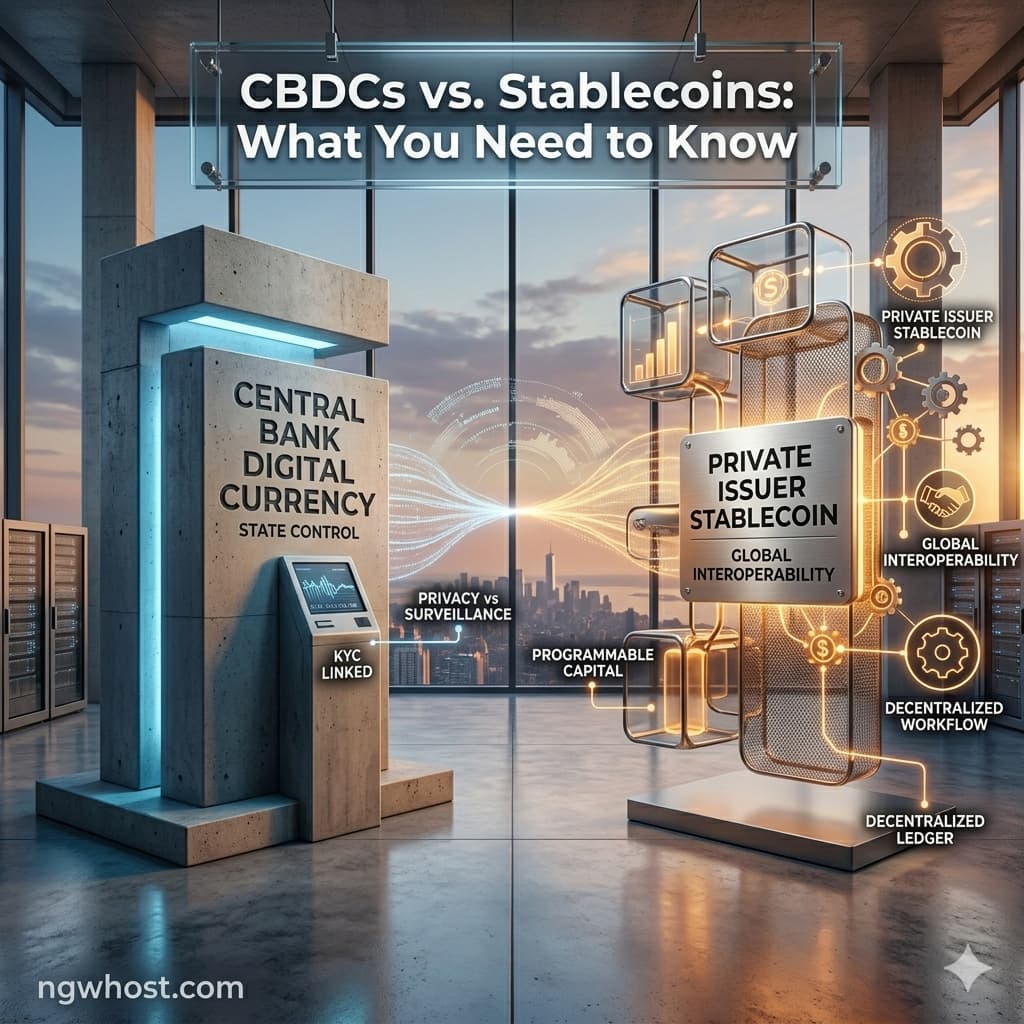
- Absolute Authority: The central bank (and authorized commercial banks acting as nodes) controls the ledger. You cannot anonymously spin up a server to validate transactions on a CBDC network as you can with Bitcoin or Ethereum.
- Identity Integration: CBDCs are inherently tied to digital identity frameworks. To hold a retail CBDC, a user must typically undergo rigorous Know Your Customer (KYC) and Anti-Money Laundering (AML) verification, directly linking their financial activity to their legal identity.
Types of CBDCs
Central banks are generally exploring two distinct deployment models:
- Wholesale CBDCs: Designed exclusively for use by financial institutions and commercial banks. They are intended to replace the outdated systems used for interbank clearing and international settlements, vastly improving the speed and reducing the cost of institutional capital movement.
- Retail CBDCs: Designed for the general public. In this scenario, everyday consumers and businesses would hold digital wallets directly connected to the central bank (or distributed through retail banks as intermediaries), using the digital currency to pay for everyday goods, services, and taxes.
3. The Core Conflicts: Where the Two Systems Clash
While both stablecoins and CBDCs aim to digitize fiat currency, their underlying philosophies, architectural designs, and operational implications are in direct opposition. When comparing the two, digital operators must evaluate four critical battlegrounds.
Battleground 1: Privacy and Financial Surveillance
The most heated debate surrounding digital currencies is the issue of privacy. Physical cash is the ultimate privacy tool; a transaction between two individuals leaves no digital footprint.
Stablecoins, operating on public blockchains, offer a degree of pseudonymity. While the ledger is completely public and transparent—meaning anyone can view the balance of a wallet—the wallet itself is just a string of alphanumeric characters. Unless the owner links their identity to that wallet (usually by interacting with a regulated crypto exchange), the user maintains operational privacy.
Retail CBDCs represent a paradigm shift in state surveillance. Because the central ledger is controlled by the government and linked to digital IDs, a CBDC would theoretically give the issuing state unprecedented, granular visibility into every single financial transaction made by its citizens. The state would know exactly who you bought a product from, when, and for how much. For businesses prioritizing customer data privacy, accepting CBDCs will require navigating profound new compliance and surveillance realities.
Battleground 2: Programmability and Control
Both systems offer programmability via smart contracts, but the application of that programmability is radically different.
With stablecoins, programmability is used by developers and businesses to create decentralized applications. You can program a smart contract to automatically release stablecoin funds to a web developer only after they commit code to a specific GitHub repository. It is a tool for business logic.
With CBDCs, programmability gives the government the power to dictate monetary policy at the individual level. A central bank could program stimulus funds to carry an expiration date, forcing citizens to spend the money before a certain deadline to artificially boost the economy. They could program the currency to be invalid for the purchase of specific restricted items, or automatically deduct tax obligations in real-time at the point of sale. While this reduces tax evasion to near zero, it fundamentally alters the concept of property rights and the freedom of capital.
Battleground 3: Global Interoperability vs. Walled Gardens
For digital entrepreneurs and e-commerce operators, cross-border commerce is the lifeblood of business.
Stablecoins are inherently borderless. A digital agency in Brazil can pay a freelance server administrator in the Philippines using USDC in three seconds, for a fraction of a cent, regardless of local banking hours. Stablecoins are the native currency of the global internet.
CBDCs, however, face massive interoperability hurdles. The US Digital Dollar, the Digital Euro, and the Digital Yuan will likely operate on completely different technological standards and sovereign ledgers. Unless central banks agree on a unified, global messaging and settlement protocol—which is geopolitically highly unlikely in a multipolar world—moving a CBDC across international borders may still require complex, slow intermediary correspondent banking systems. CBDCs threaten to create walled financial gardens, isolating digital economies.
Battleground 4: Counterparty Risk
The primary argument in favor of CBDCs is absolute safety. When you hold USDC or USDT, you are trusting a private corporation. If that corporation goes bankrupt, is mismanaged, or faces a catastrophic regulatory crackdown, your stablecoin could lose its peg to the dollar, wiping out your operational capital. (This risk was violently demonstrated by the collapse of algorithmic stablecoins like TerraUSD).
A CBDC, being a direct liability of the central bank, carries zero counterparty risk. Provided the sovereign government does not collapse, a digital dollar issued by the Federal Reserve will always be worth exactly one dollar. It is the safest digital asset possible.
4. Why Digital Operators and Infrastructure Providers Must Care
If you are running a digital business—whether it is managing a portfolio of high-traffic content sites, running complex server environments like those discussed on ngwhost.com, or operating a global e-commerce brand—you cannot afford to ignore this infrastructural shift. The transition from legacy payment rails to programmable digital currencies will impact every layer of your operations.
Re-architecting E-Commerce Payment Gateways
Currently, processing credit cards via Stripe or PayPal involves accepting interchange fees ranging from 2% to 3.5%, plus a flat fee per transaction. For high-volume businesses, this represents a massive drain on profit margins.
The widespread adoption of either stablecoins or Retail CBDCs will force a complete re-architecture of payment gateways. Forward-thinking operators are already integrating Web3 payment processors to accept USDC directly on their WooCommerce or Shopify storefronts, bypassing legacy financial institutions entirely and dropping transaction fees to fractions of a percent. When CBDCs launch, governments may mandate that domestic merchants provide the API infrastructure to accept the sovereign digital currency. You must ensure your server environments and payment plugins are agile enough to adopt these new APIs rapidly.
The Impact on Global Payroll and Vendor Settlements
The digital economy relies on a distributed global workforce. Paying remote developers, server architects, and freelance writers through traditional SWIFT wire transfers or platforms like Payoneer is slow, expensive, and subject to aggressive foreign exchange spreads.
Stablecoins have already become the preferred method of settlement for the global tech underground. Utilizing networks like Solana or Polygon to transfer stablecoins allows digital businesses to run global payroll in minutes with near-zero friction. However, as governments roll out Wholesale CBDCs, we may see legacy banks dramatically improve their international settlement speeds to compete. You must be prepared to maintain dual-accounting systems: one for decentralized stablecoin treasuries and one for heavily monitored CBDC or legacy fiat accounts.
Hosting, Infrastructure, and Node Operations
For server operators and infrastructure enthusiasts, the stablecoin ecosystem offers direct participation. E-commerce brands and agencies are increasingly choosing to run their own blockchain nodes (e.g., an Ethereum or Solana RPC node) on high-performance hosting environments to process their own stablecoin transactions securely, without relying on third-party API providers like Infura or Alchemy.
Conversely, the infrastructure powering CBDCs will be entirely closed-source and permissioned. You will not be able to spin up an aaPanel instance and run a Digital Dollar validator node. The infrastructure will be restricted to state-approved, tier-one commercial banks and heavily vetted enterprise contractors.
Read More⚡ Best Real Estate Investment Trusts (REITs) to Watch in 2026
Conclusion: A Coexistence of Ledgers
The debate between CBDCs and stablecoins is frequently framed as a zero-sum game, suggesting that the launch of sovereign digital currencies will instantly eradicate the need for corporate stablecoins. However, technological history suggests a different outcome: a complex, sometimes hostile, coexistence.
Central banks possess the ultimate regulatory authority. They have the power to legislate stablecoins out of existence or force them into such strict compliance frameworks that they functionally become extensions of the central bank anyway. However, sovereign governments are historically terrible at building consumer-facing software.
Stablecoins have a massive head start. They are deeply integrated into the thriving Web3 ecosystem, they are inherently borderless, and they possess the agility of private enterprise. They will likely remain the currency of choice for the decentralized internet, global freelancer networks, and decentralized finance protocols.
CBDCs, on the other hand, will likely dominate domestic retail payments, tax collection, and highly regulated institutional settlements. They will provide the safety and absolute compliance that massive corporations and risk-averse consumers demand.
For the modern digital architect, the mandate is clear. The era of static, dumb money is ending. The future belongs to programmable capital. Whether that capital is routed through the decentralized smart contracts of a stablecoin or the heavily monitored APIs of a Central Bank Digital Currency, your digital infrastructure must be robust, secure, and adaptable enough to process both.
To stay ahead of the curve on digital infrastructure, server optimization, and the technologies powering the modern web, continue exploring the deep-dive technical resources available right here at ngwhost.com.