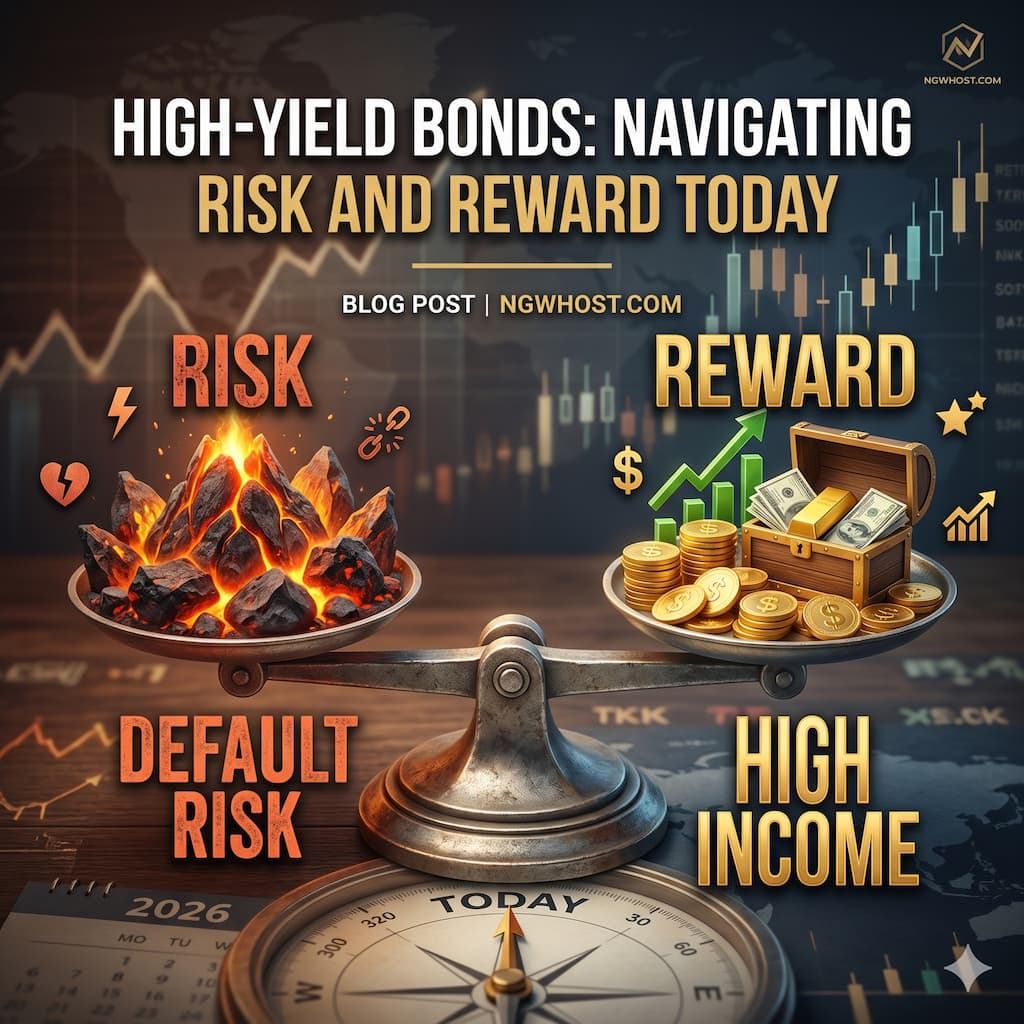
High-Yield Bonds: Navigating Risk and Reward Today
The global financial landscape of 2026 has presented investors with a complex puzzle. After years of fluctuating interest rates and shifting economic cycles, one asset class has consistently captured the spotlight for those seeking income beyond traditional savings: High-Yield Bonds.
Often referred to as “junk bonds,” these instruments are far more sophisticated than their nickname suggests. For the savvy investor at ngwhost.com, high-yield bonds represent a critical tool for portfolio diversification, offering a bridge between the relative safety of government debt and the volatility of the equity markets. However, in today’s environment, the “reward” comes with a specific set of “risks” that require a disciplined navigation strategy.
1. Defining High-Yield Bonds in the Modern Era
To navigate this market, we must first define what we are dealing with. High-yield bonds are corporate debt securities that carry credit ratings below “investment grade” (specifically, those rated BB or lower by S&P and Global Ratings, or Ba or lower by Moody’s).
The Fundamental Trade-Off
The premise is simple: because the issuing company has a higher perceived risk of default compared to a blue-chip giant or a sovereign nation, they must pay investors a higher interest rate (coupon) to attract capital. In 2026, as traditional yields have compressed in certain sectors, the “spread”—the difference between high-yield returns and risk-free government rates—has become the primary metric for value.
2. The Current Macro Environment: Why Now?
Why is “today” a pivotal moment for high-yield debt? Several macroeconomic factors are converging to make this asset class particularly interesting:
- Corporate Resilience: Despite fears of a slowdown, many “sub-investment grade” companies have spent the last two years strengthening their balance sheets and extending their debt maturities. This has created a “quality junk” segment where the risk of immediate default is lower than historical averages.
- The Search for Income: With inflation hovering in a persistent range, investors can no longer rely on cash or low-interest savings. High-yield bonds currently offer one of the few avenues to achieve a “real” (inflation-adjusted) positive return.
- Sector Rotations: We are seeing a massive shift in industries like renewable energy, AI infrastructure, and specialized healthcare. Many emerging leaders in these spaces issue high-yield debt to fuel their rapid scaling phase.
3. The “Reward” Side: Benefits of High-Yield Exposure
Higher Income Stream
The most obvious benefit is the coupon. In a world where 2% or 3% is common for “safe” debt, high-yield bonds can often provide 6% to 9%, depending on the credit tier. This consistent cash flow is vital for retirees or institutional funds that need to meet specific payout requirements.
Equity-Like Returns with Less Volatility
Historically, high-yield bonds have shown a strong correlation with the stock market but with lower standard deviation. They capture a significant portion of the upside during economic expansions while providing a “cushion” of interest payments during flat markets.
Capital Appreciation Potential
If a company’s credit rating is upgraded—moving from “Junk” to “Investment Grade” (a phenomenon known as becoming a “Rising Star”)—the price of the bond typically surges. Investors who identified the turnaround early reap the benefits of both high coupons and capital gains.
4. The “Risk” Side: What Could Go Wrong?
Navigating this market requires a cold, hard look at the potential pitfalls.
Default Risk
The most significant risk is that the issuer fails to make interest payments or return the principal. In 2026, while overall default rates remain manageable, specific sectors—particularly those over-leveraged during the tech boom of the early 20s—are showing signs of stress.
Interest Rate Sensitivity (Duration)
While high-yield bonds are generally less sensitive to interest rate changes than long-term government bonds (because their high coupons “pay back” the investment faster), they are not immune. A sudden, unexpected spike in global rates can cause the market price of existing bonds to drop.
Liquidity Risk
In times of market panic, the “bid-ask spread” for high-yield bonds can widen dramatically. It becomes difficult to sell your position quickly without taking a significant haircut on the price. This makes high-yield bonds a “buy and hold” or “strategic” asset rather than a tool for day-trading.
5. Sector Analysis: Where to Look Today
In 2026, not all high-yield bonds are created equal. Here is how we categorize the current sectors:
- Technology & AI Infrastructure: High demand for data centers has led many mid-tier tech firms to issue debt. These are often seen as “growth high-yield,” where the business model is strong, but the leverage is high due to capital expenditures.
- Energy Transition: Bonds linked to lithium mining and grid modernization are abundant. These carry “political risk” but are often backed by strong long-term contracts.
- Consumer Discretionary: This is the “danger zone.” As consumer habits shift toward experiences over physical goods, traditional retail bonds are increasingly risky.
6. How to Invest: Diversification is Your Only Free Lunch
For the individual investor, buying a single high-yield bond is akin to gambling. If that one company defaults, 100% of your capital is at risk.
The Power of Funds (ETFs and Mutual Funds)
The most effective way to navigate this market is through diversified funds. By owning a basket of 200 to 500 different bonds, a single default becomes a minor “blip” rather than a catastrophe.
- Passive ETFs: Great for low fees and broad market exposure.
- Active Management: In the high-yield space, active managers often earn their fees by “credit picking”—avoiding the companies that are about to fail and finding the “Rising Stars” before the rest of the market.
7. The 2026 Checklist for High-Yield Investors
Before adding high-yield bonds to your portfolio at ngwhost.com, run through this checklist:
- Check the Spread: Is the extra interest you are getting enough to compensate for the risk? If the spread over Treasuries is too narrow, it might be better to wait for a market correction.
- Analyze the Maturity Wall: When does the company have to pay back its debt? If a company has a massive “wall” of debt coming due in the next 12 months and no clear way to refinance, stay away.
- Assess “Covenant Lite” Bonds: Many bonds today have fewer protections for the investor. Ensure you understand what rights you have if the company starts to struggle.
- Evaluate the “Real” Yield: Subtract the current inflation rate from the bond’s coupon. If the number isn’t positive, you are losing purchasing power despite the high interest.
Read More⚡ How AI is Automating Wealth Management for Families
8. Conclusion: A Strategic Component of the Modern Portfolio
High-yield bonds are no longer the “wild west” of finance. They are a mature, essential asset class for anyone looking to optimize their income in 2026. By understanding that these bonds act as a hybrid between debt and equity, you can use them to boost returns without taking on the full “all-or-nothing” risk of the stock market.
The key to navigating risk and reward today is selectivity. Avoid the broad “junk” and look for the resilient companies that are using debt to build the infrastructure of tomorrow. Whether you are seeking a steady income or a “Rising Star” capital gain, high-yield bonds offer a path—provided you keep your eyes wide open.