AI in Algorithmic Trading: How Institutional Investors are Evolving
The New Frontier of Quantitative Finance
The global financial market has always been a ruthless battleground defined by speed, information asymmetry, and raw computational power. However, the landscape we are observing in 2026 represents the most profound paradigm shift in the history of Wall Street and global financial hubs. Algorithmic trading, which previously relied on static mathematical rules engineered by human quants, has been completely engulfed and redefined by Artificial Intelligence (AI) and Deep Machine Learning.
For technology professionals, systems administrators, and developers who frequent ngwhost.com, understanding this evolution is deeply fascinating. Modern algorithmic trading is no longer just a financial challenge; it is, at its very core, a monumental challenge of server infrastructure, real-time big data processing, and extreme latency optimization.
Hedge funds, tier-one investment banks, and proprietary High-Frequency Trading (HFT) firms are no longer merely executing orders faster than humanly possible. They are deploying massive neural networks to predict market movements before those movements even materialize in the exchange’s order book. This comprehensive guide explores in granular detail how AI is transforming institutional trading, the specific technologies being deployed, and the world-class server infrastructure required to support this financial revolution.
1. The Evolution: From Static Heuristics to Dynamic Inference
To fully grasp the impact of AI, we must first examine how algorithmic trading operated up until the last decade. The transition from human outcry pits to electronic trading was just the first step. The transition from electronic trading to AI is the true leap.
The Era of Rules-Based Trading
Historically, quantitative algorithms (“algos”) were programmed with rigid “If-Then” logic based on technical or statistical indicators. Strategies such as VWAP (Volume-Weighted Average Price), statistical arbitrage, or mean reversion relied on mathematical models that assumed the market would behave predictably based on historical precedent. For example, if a 50-day moving average crossed above a 200-day moving average (the classic “Golden Cross”), the algorithm would systematically execute a buy order.
The fatal flaw of this approach is rigidity. When macroeconomic conditions changed abruptly—such as during unforeseen geopolitical crises or sudden shifts in central bank monetary policy (market regime changes)—these rules-based algorithms frequently failed. They generated massive drawdowns because they could not adapt to novel patterns that had not been explicitly hard-coded into their logic by their human creators. They were fast, but they were fundamentally unintelligent.
The Rise of Machine Learning and Adaptive Models
The current revolution led by institutional investors involves the complete abandonment of static heuristics in favor of predictive, adaptive models. Artificial Intelligence in modern institutional trading is based on algorithms that continuously “learn” from ingesting live data. Instead of a quantitative developer telling the system exactly what variables to look for, the system is fed petabytes of historical and real-time market data. The AI then discovers hidden, highly complex, and non-linear correlations entirely on its own—patterns that would be completely invisible to the human brain or traditional statistical software.
2. The Core AI Technologies Powering Institutional Quants
Top-tier quantitative funds in 2026 do not rely on a single, monolithic artificial intelligence. Instead, they utilize a highly integrated ensemble of distinct AI disciplines, each serving a specific strategic purpose.
Deep Learning and Time-Series Forecasting
Artificial neural networks, particularly advanced architectures like LSTMs (Long Short-Term Memory networks) and financial-specific Transformers, are the workhorses of time-series prediction. These models excel at analyzing incredibly complex sequences of market events. They do not just look at the price of a single asset; they analyze the price variations of thousands of interconnected global assets simultaneously.
More importantly, these Deep Learning architectures process the “microstructure” of the market. They analyze the exact cadence of how limit orders are added, modified, or canceled in the Level 2 and Level 3 order books. By understanding this microscopic liquidity flow, the AI can predict the directional price movement for the next millisecond, minute, or trading session with astonishing statistical probability.
Natural Language Processing (NLP) and Sentiment Arbitrage
Financial markets are not moved solely by numerical data; they are moved by human sentiment, news events, earnings calls, and macroeconomic policy statements. Modern AI utilizes highly advanced Natural Language Processing algorithms (specialized, highly tuned variants of models like BERT or GPT) to effectively “read” the global internet in real-time.
When the Federal Reserve releases its meeting minutes, or when a CEO drops a surprise regulatory filing, NLP algorithms ingest the text, interpret the nuance and tone (e.g., hawkish vs. dovish monetary policy), cross-reference it with historical market reactions to similar phrasing, and execute massive block trades across equities, bonds, and forex markets. This entire process—from text publication to order execution—happens in fractions of a second, long before a human analyst has finished reading the first paragraph.
Reinforcement Learning: The Autonomous Agent
Perhaps the most cutting-edge area of AI in finance is Reinforcement Learning (RL). Inspired by the methodologies used to train AI to defeat human world champions in complex games like Go or Chess, RL involves dropping an autonomous AI “agent” into a highly realistic, simulated market environment.
The agent executes simulated trades and receives a mathematical “reward” for generating profit or a “punishment” for incurring losses or taking excessive risk. Through millions of simulated trading years (run overnight on massive server farms), the algorithm organically develops highly complex, deeply unorthodox trading strategies. These agents learn to adapt autonomously to bull markets, bear markets, or high-volatility sideways chop, discovering paths to “Alpha” (excess return) that human managers could never conceptualize.
3. Alternative Data: The High-Octane Fuel for AI
An AI model is only as powerful as the data it consumes. If every hedge fund has access to the exact same historical price feed from the New York Stock Exchange, any competitive advantage is immediately arbitraged away. To feed their insatiable Machine Learning models, institutional investors are spending billions of dollars annually acquiring “Alternative Data.”
Alternative Data refers to non-traditional information sources that provide early indicators of economic activity or corporate performance.
- Geospatial and Satellite Imagery: Computer vision algorithms process daily satellite images of retail parking lots (like Walmart or Target) to predict quarterly sales volume weeks before official earnings reports are released. They monitor the shadows cast by global oil storage tanks to estimate crude supply, or track the transponders of cargo ships to gauge supply chain bottlenecks.
- IoT and Geolocation Tracking: AI models analyze anonymized smartphone location data to measure foot traffic in commercial districts, providing real-time barometers of consumer economic health.
- Credit Card Transaction Exhaust: Massive streams of anonymized credit card receipts are ingested by neural networks to identify shifting consumer brand preferences and revenue trends in real-time, allowing funds to front-run the traditional analyst estimates of Wall Street banks.
These massive, unstructured, and noisy datasets are fundamentally useless to a human trader. They can only be cleansed, normalized, and correlated to financial asset prices through the brute force of robust Deep Learning models.
4. The Infrastructure Imperative: A Server and Network Perspective
For the systems administrators, developers, and entrepreneurs reading the ngwhost.com blog, this is the crux of the matter. AI-driven institutional trading is arguably the most hostile, unforgiving, and demanding computing environment on the planet. This level of AI cannot run on standard shared hosting, basic cloud instances, or poorly optimized VPS environments. It requires a world-class, custom-built server architecture.
The Millisecond War: Colocation and Zero Latency
In AI-driven High-Frequency Trading, speed is not measured in seconds; it is measured in microseconds (millionths of a second) and nanoseconds. If an NLP model detects a geopolitical event and identifies a profitable arbitrage opportunity, but the network request takes 5 milliseconds too long to reach the exchange, a competing institutional fund will steal the trade.
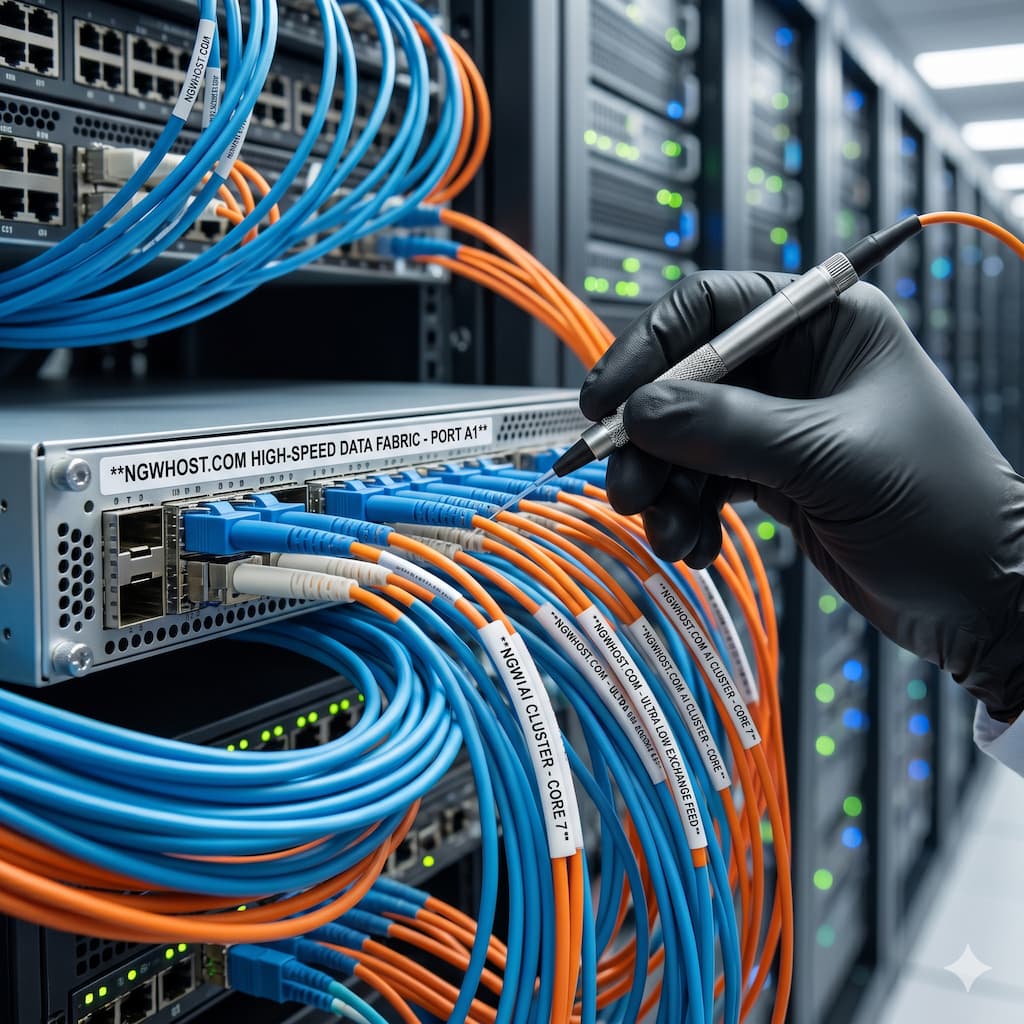
To eliminate network latency, funds utilize Colocation. They rent physical rack space directly inside the data centers owned by the stock exchanges (such as the massive facilities in Secaucus or Carteret, New Jersey). By physically positioning their servers mere meters away from the exchange’s matching engine, they reduce the length of the fiber-optic cables the data packets must travel. In this arena, the speed of light through glass is the absolute limiting factor.
Hardware Acceleration and Kernel Bypass
Standard server configurations are too slow for HFT. The traditional process of a network packet hitting a Network Interface Card (NIC), triggering a hardware interrupt, traversing the Linux kernel network stack, and finally reaching the trading application takes too many microseconds.
- To achieve peak execution speed, institutions use Kernel Bypass technologies (like Solarflare cards and OpenOnload). This allows the network packets to completely bypass the server’s operating system and be read directly by the trading application’s user space.
- Furthermore, they heavily utilize FPGAs (Field-Programmable Gate Arrays). These are custom-programmed silicon chips that execute trading logic at the hardware level. The AI model determines the strategy, but the FPGA executes the order directly on the wire, faster than any software-based CPU process could ever manage.
Server Stability, DNS, and Redundancy
While execution requires low latency, the continuous training of Deep Learning models requires massive, brute-force computational power. Institutions maintain formidable clusters of advanced GPUs to process petabytes of alternative data.
In this environment, server stability is paramount. A server crash or a network routing error during peak market hours can cost millions of dollars per minute. For infrastructure managers, ensuring bulletproof DNS resolution, robust BGP routing to prevent network blackouts, and instantaneous failover protocols is a critical mission. If an external API feed providing sentiment data throws a cURL error due to a failed host resolution, the AI is momentarily blinded. Therefore, redundant, active-active server clusters are mandatory, ensuring that if a primary node experiences thermal throttling or connectivity issues, a secondary node assumes control without dropping a single packet.
5. The Systemic Risks and the Rise of Explainable AI (XAI)
Despite its immense power, handing over financial control to autonomous machines introduces massive systemic risks, forcing a rapid evolution in institutional risk management.
The “Black Box” Dilemma
Many advanced Deep Learning models suffer from the “Black Box” problem. They ingest data and generate a highly profitable trading decision, but the internal logic of the neural network is so incredibly complex that it is almost impossible for a human quantitative auditor to understand why or how the AI arrived at that specific conclusion. If a fund loses a billion dollars on a rogue algorithmic trade, financial regulators (like the SEC) will demand clear explanations that the machine may not natively be able to provide.
Explainable AI (XAI) and Circuit Breakers
To solve this critical governance issue, institutional investors are pioneering the field of Explainable AI (XAI). This branch of artificial intelligence is focused entirely on creating models that are intrinsically interpretable, or building secondary models that can generate auditable, human-readable reports. These reports detail exactly which variables—for example, a specific geopolitical news headline combined with a drop in options volume—carried the most mathematical weight in the decision to execute an order.
Furthermore, modern trading infrastructure must include hard-coded, logical Circuit Breakers. These are strict, human-defined parameters operating outside the AI’s control. If the autonomous model begins to exhibit erratic behavior not seen in historical simulations, or if market volatility spikes beyond safe operating parameters (risking a machine-induced “Flash Crash”), the circuit breakers instantly sever the connection to the exchange and liquidate positions, protecting the firm’s capital from algorithmic hallucinations.
6. The Future Horizon: Quantum Machine Learning
While GPU-based AI and classical computing dominate the present, the medium-term future of institutional algorithmic trading lies in the intersection of Machine Learning and Quantum Computing.
Certain financial problems—such as real-time portfolio optimization across thousands of assets under complex liquidity constraints (calculating the Markowitz efficient frontier dynamically)—are computationally intractable for even the most powerful classical supercomputers. Tier-one quantitative funds are already financing research and testing algorithms on early-stage quantum computers. When commercial quantum supremacy is stably achieved, the institutions that have the infrastructure and algorithmic agility to integrate Quantum Machine Learning will completely overwhelm the rest of the market in terms of risk-adjusted returns.
Read More⚡ Cybersecurity: Protecting Assets in the Quantum Computing Era
Conclusion: Infrastructure as the Ultimate Competitive Advantage
Algorithmic trading has evolved far beyond the simple automation of spreadsheets and statistical rules. The integration of Deep Learning and Artificial Intelligence by institutional investors has transformed the global capital markets into a relentless arms race of cutting-edge software engineering, data science, and extreme hardware optimization.
At the very center of this financial revolution are not just the mathematicians and quantitative analysts, but the IT infrastructure architects. The ability to process billions of unstructured data points with NLP models in real-time, and to execute those decisions in zero-latency colocation environments, ultimately dictates the winners and losers of modern finance.
For the digital entrepreneurs, developers, and systems administrators who manage intensive digital ecosystems—the very professionals who rely on insights from platforms like ngwhost.com—the institutional trading market serves as the ultimate proving ground. It pushes the absolute boundaries of what modern servers, networks, and code can achieve. The future of global finance is autonomous, highly predictive, and fundamentally reliant on flawless infrastructure that never drops a packet.
Stay tuned to the ngwhost.com blog for more deep dives into how server infrastructure, network optimization, and artificial intelligence are shaping the most competitive industries in the digital economy.