Liquidity Pools: Managing Institutional Assets Efficiency
The structural core of international institutional asset management is experiencing a code-driven, architectural realignment. For decades, corporate treasuries, wholesale investment funds, sovereign wealth allocators, and enterprise capital managers have operated within highly centralized, fragmented, and heavily intermediated market structures. Sourcing, deploying, and rebalancing massive corporate asset reserves has traditionally required navigating a sprawling network of legacy commercial banks, broker-dealers, clearinghouses, and central securities depositories.
While these conventional frameworks provided systemic stability during earlier eras of physical commerce, they introduce severe operational constraints inside modern, high-velocity digital networks.
Procuring and moving capital via traditional rails remains remarkably inefficient. Transaction clearing windows routinely stretch across multi-day horizons, capital deployment visibility is obscured by siloed banking portals, and vast pools of enterprise capital remain structurally stagnant due to heavy administrative friction and the high costs of market coordination.
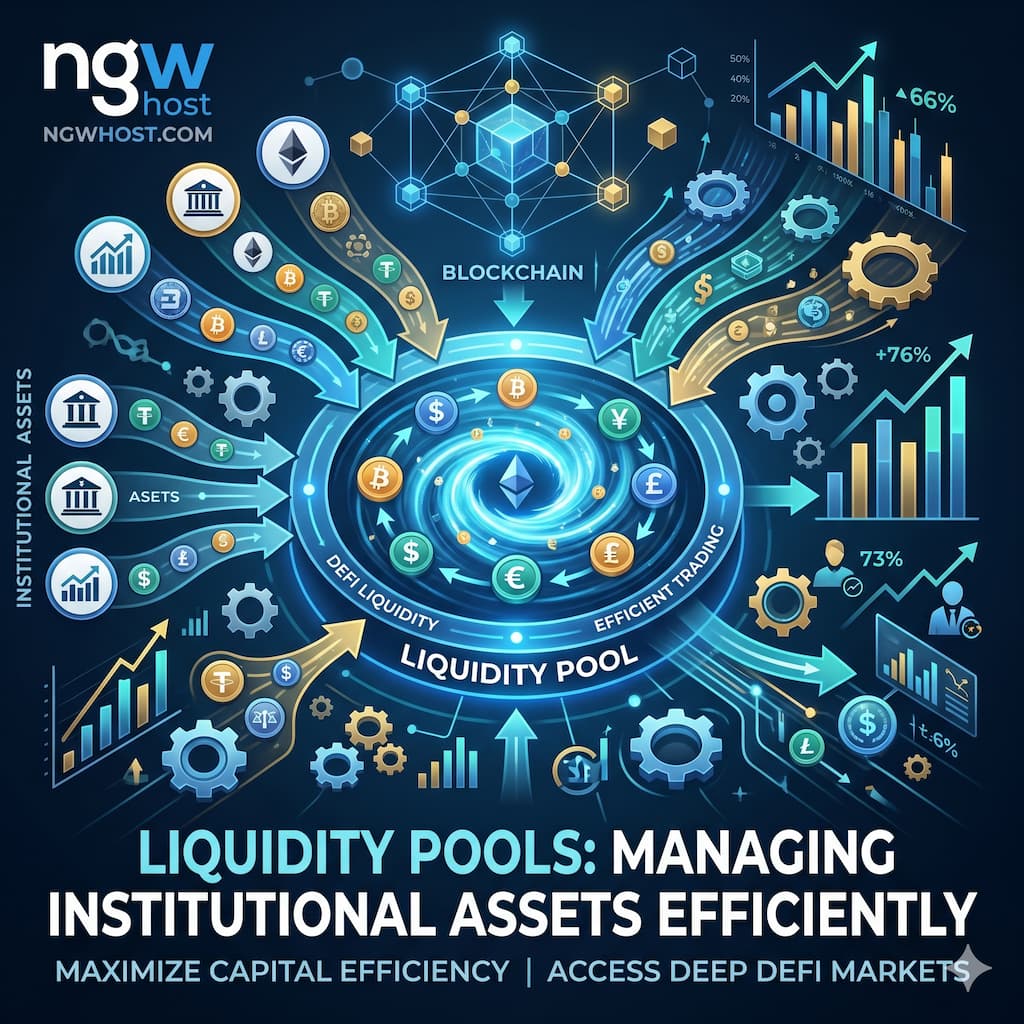
To shatter these operational performance caps and achieve peak capital efficiency, progressive enterprise finance networks are moving beyond traditional banking limitations. They are systematically shifting their capital infrastructure toward decentralized, automated execution frameworks: Institutional Liquidity Pools in Web3.
Far from a speculative tool, institutional-grade liquidity pools leverage advanced smart contracts, automated market-making algorithms, permissioned distributed ledgers, and secure oracle networks. By building on these programmatic rails, enterprises can transform traditional financial instruments and treasury reserves into highly fluid, fractionalized, and composable digital assets, redefining institutional liquidity and optimizing capital velocity on a global scale.
1. The Core Paradigm Shift: From Disconnected Ledgers to Algorithmic Capital Pools
To engineer an agile, modern corporate treasury and investment core, Chief Information Officers and financial directors must shift their fundamental operational philosophy away from batch-processed, siloed ledger accounts and toward continuous, real-time value mobility.
- Legacy Capital Sourcing: Relies on discrete, disconnected asset pools managed by isolated banking entities. Capital deployment is inherently slow, dependent on regional clearing hours, manual settlement matching, and varying jurisdictional compliance handshakes.
- The Programmable Liquidity Layer: Unifies financial logic, asset ownership, real-time clearing, and multi-party compliance into a single, automated ledger layer. It utilizes smart-contract-driven protocols to enable continuous, programmatic capital availability.
By embedding tokenized assets directly into automated liquidity pools, institutional operations completely bypass historic execution bottlenecks. The corporate balance sheet evolves from a static repository of idle banking reserves or illiquid private assets into a high-performance, programmable liquidity matrix designed to capture immediate market yields, minimize transaction friction, and optimize capital conversion cycles at peak velocity.
2. Core Pillars of an Institutional-Grade Liquidity Architecture
Constructing a production-grade automated asset deployment framework capable of scaling safely across distributed enterprise networks and public-permissioned blockchain infrastructures requires an integrated, secure technology stack built on four foundational engineering pillars.
Pillar I: High-Velocity Real-World Asset (RWA) Ingestion
The practical integration of decentralized liquidity within corporate capital markets depends entirely on the seamless digitization of traditional financial instruments into compliant, programmable blockchain tokens.
Systems architects deploy automated Asset Tokenization Factories that transform standard financial instruments—including corporate bonds, trade receivables, commercial paper, and real estate asset allocations—into immutable digital tokens on permissioned ledger fabrics. The onboarding architecture integrates advanced data links that pull asset valuations directly from trusted off-chain financial data providers. These tokens retain full legal compliance, including hardcoded transfer rules that prevent unauthorized asset movements outside of verified corporate investor networks.
Pillar II: Algorithmic Peer-to-Pool Execution
Traditional enterprise capital operations require corporate treasuries to source matching counterparties manually via legacy broker-dealers, a process that introduces significant clearing costs, execution delays, and structural market friction.
Treasury operations utilize highly optimized Automated Market Maker (AMM) Smart Contracts and institutional lending protocols. These algorithmic frameworks eliminate the need for traditional order books by allowing corporations to interact directly with automated liquidity pools. Instead of waiting hours or days for an institutional counterparty to accept a bid, corporate treasuries can execute high-volume asset swaps, trade tokenized commercial paper, or deploy capital reserves into yield-bearing pools instantly at mathematically optimized pricing structures, shrinking transaction settlement times to near-zero.
Pillar III: Institutional Permissioned Pools and Zero-Knowledge Identity
Enterprise entities are strictly prohibited from mixing corporate capital pools with unverified, anonymous participants, as doing so would violate international corporate governance, accounting mandates, and financial safety rules.
Corporate platforms deploy specialized Institutional Permissioned Liquidity Pools. These closed-loop decentralized environments utilize zero-knowledge identity proofs (zk-KYC) and continuous whitelisting registries. Before an entity can route capital into or pull liquidity from a permissioned pool, they must clear rigorous regulatory compliance filters—including Know-Your-Business (KYB), Anti-Money Laundering (AML), and international sanctions screenings. The system verifies identity states cryptographically while completely masking private corporate operational metadata from the public ledger.
Pillar IV: Cross-Chain Communication Networks and Interoperability
Large corporations distribute their digital assets, cloud applications, and data storage systems across a variety of private ledgers, enterprise networks, and public blockchain infrastructures to ensure operational resiliency.
To prevent the fragmentation of corporate capital across isolated digital silos, infrastructure platforms deploy advanced Cross-Chain Communication Networks. These frameworks act as secure financial bridges, enabling corporate treasuries to move capital, execute smart-contract calls, and rebalance liquidity reserves across completely distinct blockchain environments programmatically in a single transaction, maximizing asset agility and preventing liquidity fragmentation.
3. High-Performance Optimization: The Institutional Efficiency Ledger
Transitioning an enterprise treasury or institutional fund away from fragmented legacy banking rails to an automated liquidity pool infrastructure fundamentally redefines the operational benchmarks of capital efficiency.
- Capital Settlement Finality: Traditional wire transfers, clearing houses, and international custody networks require 1 to 3 business days. Web3 liquidity pools deliver near-instant, sub-second atomic clearing via smart contracts.
- Intermediary Extraction Drag: High cumulative fees extracted by broker-dealers, custodians, transfer agents, and underwriters. Drops transactional fees by up to 75% via direct peer-to-pool execution.
- Working Capital Trapped In Reservoirs: Substantial cash and asset reserves locked up in low-yield clearing accounts to cover settlement delays. Automated liquidity networks eliminate capital lock-up entirely through real-time asset accessibility and automated delivery-versus-payment (DvP).
- Compliance Audit Visibility: Manual, delayed reconciliation across siloed banking portals and accounting ledgers. Provides continuous, immutable real-time cryptographic tracking across all active digital registries.
- Asset Fraud and Counterparty Exposure: Opaque settlement paths vulnerable to clearing failure or counterparty insolvency. Mitigated near-zero through atomic, conditional settlement contracts that execute only when all criteria are met.
4. Operational Implementations: Liquidity Architecture in Active Markets
Evaluating how automated capital networks perform under complex, real-world enterprise environments demonstrates their capacity to transform global corporate capital management and investment velocity.
Algorithmic Working Capital Sourcing and Asset Swaps
Consider a multinational manufacturing conglomerate that requires rapid access to short-term working capital to finance an immediate infrastructure expansion run. Under traditional capital market models, the company would spend weeks coordinating with an investment bank syndicate, drafting legal offering documents, paying steep underwriting fees, and waiting for the bank to manually distribute the commercial paper to corporate buyers.
The enterprise accelerates this capital acquisition pipeline by utilizing an institutional-grade liquidity pool network. The company’s treasury system automatically mints tokenized short-term debt tokens directly on a permissioned blockchain layer.
The system distributes these tokens instantly into a whitelisted, yield-seeking institutional liquidity pool.
Global asset managers and pension allocators waiting within the permissioned network purchase the debt tokens programmatically via compliant stablecoins. The transaction settles with absolute cryptographic finality in minutes instead of weeks, routing capital to the operations instantly while bypassing expensive bank syndication fees entirely.
Real-Time Cross-Border Treasury Rebalancing and Yield Capture
A global logistics and commercial real estate enterprise operates dozens of high-value distribution hubs and shipping centers internationally. The firm holds billions of dollars in highly stable, cash-generating underlying real estate assets; however, because these assets are locked within physical brick-and-mortar structures, the firm cannot easily tap into their value to fund immediate, localized operational cash shortfalls or currency spikes in opposite hemispheres.
The corporation optimizes its internal asset agility by anchoring its physical portfolio to an automated real-world asset (RWA) tokenization core. The platform tokenizes specific fractional tranches of the firm’s commercial real estate assets into compliant digital asset representations.
When a foreign subsidiary experiences an operational cash deficit, the platform automatically exposes these fractional tokens to whitelisted institutional lending pools.
Global allocators supply instant liquidity against the tokenized real estate collateral via secure cross-chain networks. The entire financing loop executes autonomously in seconds, allowing the enterprise to self-fund its global business operations smoothly, avoid forced asset firesales, and eliminate short-term corporate borrowing costs completely.
5. Security Architecture for Hardened Institutional Control Planes
Centralizing enterprise core data models, executing continuous automated liquidity rebalancing, and serving high-velocity cross-chain pipelines introduces intense data privacy and system security demands. Because institutional liquidity platforms manage the direct movement of global corporate treasury assets, they represent premium targets for advanced cyber-espionage networks, model-tampering exploiters, and malicious data harvesting rings.
[Corporate Assets] ──> [Confidential Compute Enclave] ──> Anonymized Liquidity Vault ──> Institutional Network
Implementing Anonymized Data Tokenization across Funding Pipelines
To feed predictive analytical models and execute mass business intelligence aggregation safely without violating international privacy frameworks or exposing highly sensitive internal trade secrets to external network layers, system architects implement an automated data tokenization proxy directly at the edge of the data ingestion stream.
Before any raw database write, client profile change, or transactional log string is committed to cross-cloud storage buckets, all sensitive personal data fields and proprietary corporate identifiers are automatically extracted, cryptographically hashed, and replaced with secure tokens. The distributed data science applications and machine learning engines process their optimization models strictly over anonymized operational metadata, maintaining total system performance while ensuring absolute corporate confidentiality.
Hardening the Governance Layer via Multi-Party Computation (MPC) Keys
Corporate treasuries and institutional funds must never allow single administrator accounts, individual financial analysts, or unmonitored financial applications to possess the independent authority to initiate high-value digital asset transfers, alter tokenization smart-contract code parameters, or interact with unverified liquidity environments.
Implement strict Multi-Party Computation (MPC) cryptographic frameworks paired with dynamic multi-signer authorization rules across the asset management console. Executing any significant outward transaction, modifying a tokenization smart contract, or altering an institutional permissioned liquidity pool’s boundary parameters must require concurrent, cryptographic confirmation from a distributed quorum of verified executive keys across completely isolated network environments, preventing single points of failure from compromising the enterprise core.
6. Regulatory Convergence: Navigating Global Digital Asset Standards
Scaling an institutional liquidity pool architecture requires absolute compliance with an evolving web of international corporate governance, data tracking, and tokenization compliance standards.
- The MiCA Framework (European Union): Imposing strict operational parameters across all EU member states, MiCA enforces clear rules for digital stablecoin issuance, tokenized asset representations, and platform transparency, establishing a predictable compliance pathway for European enterprise capital deployment.
- The SEC and Commodity Guidance (United States): Enforcing rigid oversight parameters, these frameworks demand that any tokenized real-world asset or corporate debt issuance must map cleanly to existing securities compliance laws, requiring funds to utilize regulated transfer agents, compliant oracle links, and qualified custodians.
- Global Basel Committee Banking Rules: International banking standards dictate explicit capital reserve limits and risk-weight parameters for digital asset and tokenized RWA exposures held on institutional balance sheets, forcing corporations to maintain meticulous, real-time cryptographic audit trails across all active digital registries.
Read More⚡ Credit Risk: Predictive Models for Enterprise Lending
Conclusion: Orchestrating the Frictionless Corporate Capital Engine
The deployment of a modern Web3 institutional liquidity pool architecture is not an optional optimization update for corporate finance departments and asset managers; it is a fundamental technological requirement to navigate tomorrow’s hyper-connected, high-velocity economic landscape. The legacy methodology of managing global corporate cash lines, real estate holdings, and debt issuance through slow, human-centric banking intermediaries—while tolerating severe settlement delays, opaque capital visibility, and high administrative friction—is an unsafe operational approach that invites capital stagnation and balance-sheet erosion.
By engineering an integrated, forward-looking financial fabric built on high-throughput permissioned liquidity pools, automated asset tokenization factories, cross-chain interoperability bridges, and ironclad multi-party cryptographic verification protocols, progressive enterprise leaders transform their corporate treasuries from passive tracking nodes into high-performance strategic weapons.
Ultimately, the definitive advantage in the global wealth ecosystem belongs entirely to the visionary enterprises that can evaluate, fractionate, and deploy capital as fast as they process data—mastering advanced asset tokenization and liquidity pool frameworks to drive secure, highly efficient, and market-leading global scale across any commercial horizon.
Deploying computationally intensive asset tokenization factories, high-throughput permissioned liquidity lakes, secure open-banking API gateways, and ultra-low latency cross-chain settlement networks requires world-class, zero-downtime server infrastructure. Secure your company’s digital financial core on an unassailable infrastructure foundation by exploring the premium enterprise hosting configurations at ngwhost.com.