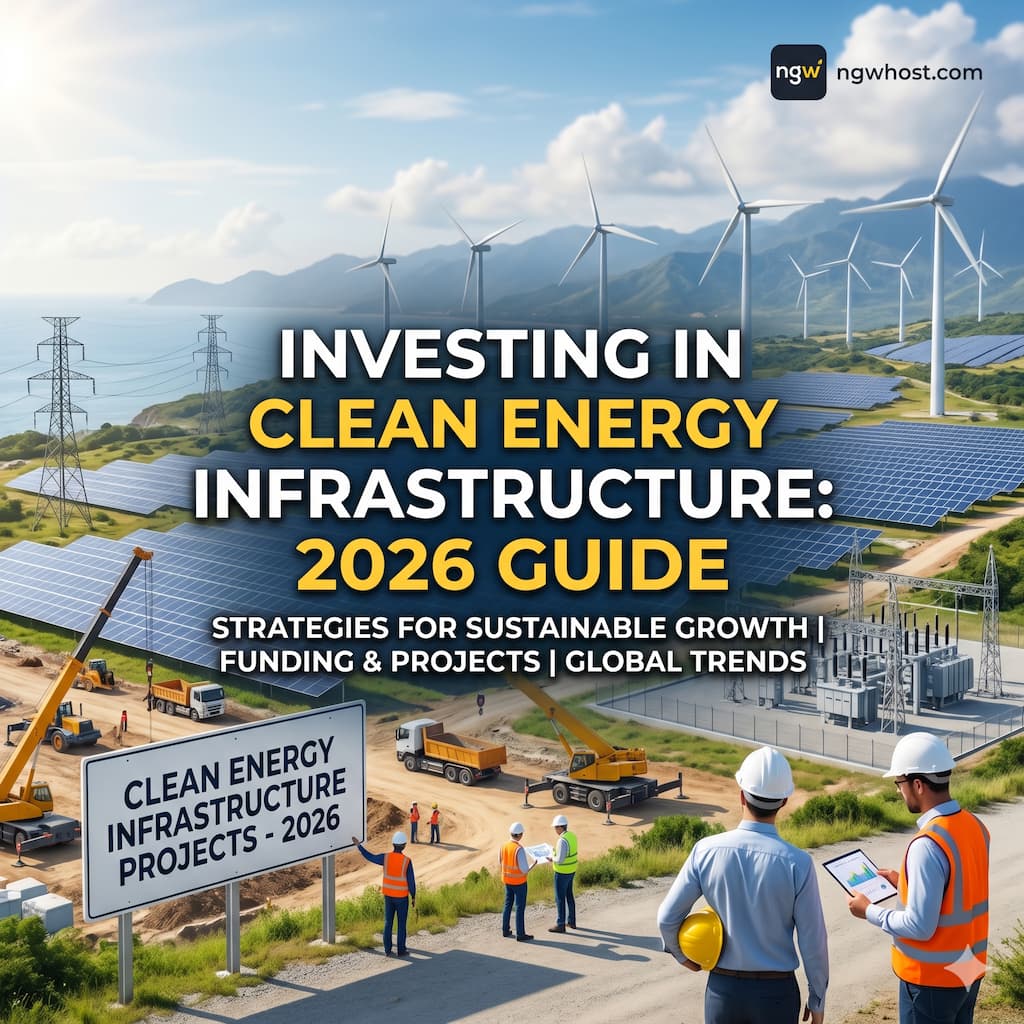
Investing in Clean Energy Infrastructure: 2026 Guide
The global energy matrix is undergoing a tectonic transformation. As we progress through May 2026, investing in clean energy infrastructure has transitioned from an idealistic environmental, social, and governance (ESG) checklist into one of the most lucrative, resilient, and strategically vital asset classes in the macroeconomy. The financial world is no longer debating the feasibility of the green transition. Instead, capital allocators are rushing to solve a far more pressing crisis: an unprecedented surge in global electricity demand.
For years, energy efficiency and decoupling kept power grids stable. However, the corporate landscape of 2026 is defined by a massive, power-hungry technological expansion. The explosive build-out of hyperscale Artificial Intelligence (AI) data centers, the electrification of heavy industrial manufacturing, and the compounding growth of international electric vehicle (EV) fleets are straining legacy energy grids to their absolute limits.
According to institutional data, global renewable energy investment hit $2.2 trillion, making up the vast majority of all global energy utility spending. To meet long-term climate targets and power the digital economy, public-private capital deployments must continue to scale exponentially. For the web administrators, digital entrepreneurs, and technology investors within the ngwhost.com community, understanding the mechanics of infrastructure investing is the ultimate shortcut to capturing predictable, inflation-hedged yields.
This comprehensive 2026 guide delivers an analytical deep-dive into the modern clean energy infrastructure landscape, evaluates the top investment sectors, details the primary deployment vehicles, and provides a tactical framework to de-risk your capital stack.
1. The 2026 Macro Environment: The Convergence of Tech and Electrons
To successfully allocate capital to clean energy projects this year, you must understand the underlying economic drivers that have permanently shifted energy correlations with broader equity markets.
Historically, renewable energy stocks were highly sensitive to fluctuating interest rates and equipment supply chain gluts. In 2026, while macro interest rates remain elevated, the sector’s growth is insulated by a structural, non-negotiable demand vector: The Tech-AI Power Mandate.
  THE 2026 ENERGY ACCELERATION LOOP
┌──────────────────────────────────────────────────┐
│   Exponential AI & Data Center Buildout          │
└────────────────────────┬─────────────────────────┘
                         │
                         ▼
┌──────────────────────────────────────────────────┐
│   Unprecedented Strain on Legacy Regional Grids  │
└────────────────────────┬─────────────────────────┘
                         │
                         ▼
┌──────────────────────────────────────────────────┐
│ MANDATORY DEMAND FOR 24/7/365 CLEAN CAPACITIES    │
│ * Utility-Scale Solar + Storage                  │
│ * Next-Generation Grid Modernization             │
│ * Baseload Nuclear & SMR Systems                 │
└──────────────────────────────────────────────────┘
Hyperscale tech operators are executing aggressive corporate mandates to ensure their AI computation runs entirely on zero-emission power. Simultaneously, regional grid operators across major power markets are facing severe spare capacity shortages. Because bringing new generating capacity online at high velocity is paramount, clean technologies—specifically utility-scale solar and battery storage—have become the default choice for rapid deployment.
For infrastructure investors, this supply-demand mismatch translates into highly predictable, long-term, and inflation-protected cash flows.
2. Core Clean Energy Sectors Leading the 2026 Matrix
Investing in clean energy requires a granular understanding of the technology readiness levels (TRL) and financial profiles of individual asset classes. In 2026, four key sectors anchor the global infrastructure pipeline.
I. Utility-Scale Solar and Energy Storage Ensembles
Utility-scale solar combined natively with battery energy storage systems (BESS) represents the most attractive and commercially mature asset class in the 2026 investment landscape.
- The Economics: Capital costs for utility-scale solar installations (100+ MW) have stabilized at a highly efficient $800 to $1,000 per kW, driven by declining battery component costs and advanced photovoltaic manufacturing efficiencies.
- The Target Return: These assets routinely deliver highly predictable Target Internal Rates of Return (IRRs) of 12% to 15%, backed by long-term Power Purchase Agreements (PPAs) signed with investment-grade corporate tech buyers or traditional regulated utilities.
- The Storage Multiplier: Battery storage is no longer an optional add-on; it is an investment multiplier. By adding 4-to-6-hour lithium-ion or long-duration flow batteries to a solar facility, developers can store excess energy during peak solar hours and sell it back to the grid during high-priced evening ramps, capturing lucrative arbitrage spreads.
II. Onshore and Floating Offshore Wind Platforms
Wind infrastructure continues to serve as a vital macro-capacity pillar, though deployment paths vary significantly based on geographic complexity.
- Onshore Wind (TRL 9): Fully mature and heavily institutionalized. Modern onshore wind turbines routinely achieve exceptional 35% to 45% capacity factors, providing steady-state, predictable yield for conservative infrastructure funds.
- Offshore Wind (TRL 7 – Floating): Floating offshore wind platforms present elevated technical and commercial execution risks, but offer superior returns for early-stage risk capital. By operating in deeper ocean waters where wind profiles are stronger and more consistent, offshore installations regularly unlock 45% to 55% capacity factors, making them essential for scaling grid-level capacities near major coastal urbanization hubs.
III. Grid Modernization, Interconnection, and Transmission Assets
A massive bottleneck in the 2026 clean energy transition is grid integration. Thousands of gigawatts of clean energy projects are currently stalled in regional interconnection queues because legacy transmission lines lack the capacity to carry the electrons from remote solar fields and wind farms to urban centers.
- The Infrastructure Solution: Massive capital is flowing directly into grid transmission infrastructure, high-voltage direct current (HVDC) lines, and smart grid automation hardware. Companies specializing in utility modernization and large-load grid connectivity are experiencing record backlogs, making transmission equity a defensive asset class with steady, utility-regulated returns.
IV. Small Modular Reactors (SMRs) and Baseload Nuclear
While variable renewables like solar and wind dominate immediate capacity additions, tech-focused data infrastructure requires uninterrupted, 24/7/365 baseload power.
- The Evolution: In 2026, both public policy and private capital are converging on nuclear energy, specifically Small Modular Reactors (SMRs). These factory-built, lower-risk nuclear units solve the multi-billion-dollar cost overruns and decades-long deployment timelines that plagued legacy atomic plants. While representing higher initial technology risks, SMR platforms are increasingly backed by strategic public de-risking mechanisms, offering asymmetric upside for long-horizon institutional investors.
3. Comparative Economics of Renewable Deployment
To help your investment committee visualize asset profiles across the energy matrix, consider the standard 2026 structural benchmarks:
| Solar & Clean Energy Category | Average Capital Cost | Plant Operational Lifetime | Target Asset IRR | Core Risk Vector |
| Utility-Scale Solar (100+ MW) | $800 – $1,000 / kW | 25 – 30 Years | 12% – 15% | Grid interconnection latency & curtailment risks. |
| Commercial Rooftop (50-500 kW) | $1,400 – $1,800 / kW | 20 – 25 Years | 15% – 18% | Counterparty credit risk of the underlying business tenant. |
| Onshore Wind Installations | $1,200 – $1,500 / kW | 20 – 25 Years | 10% – 13% | Local environmental permitting and zoning setbacks. |
| Battery Storage (BESS Systems) | $250 – $350 / kWh | 15 – 20 Years | 14% – 17% | Commodity chemical pricing and battery degradation curves. |
| Regulated Utility Developers | WACC-Based Matrix | 40+ Years | 8% – 12% | Regulatory rate-case adjustments and political policy shifts. |
4. Investment Vehicles: Mapping Your Entry Corridor
You do not need to be a multi-billion dollar institutional fund manager to participate in the clean energy infrastructure boom. The financial marketplace provides multiple entry corridors tailored to different liquidity and risk appetites.
A. Listed Infrastructure Equities and Cleantech ETFs
The most liquid corridor for individual digital entrepreneurs and treasury managers is public equity markets. Investors allocate capital to pure-play utility developers, component manufacturers, and grid engineering conglomerates.
- The Strategic Edge: Look for companies with dominant market positioning in utility modernization and massive multi-billion-dollar project backlogs. Diversified cleantech ETFs tracking global transition indexes offer immediate, hands-off diversification across the entire value chain—including critical minerals, wind turbine manufacturing, and advanced inverter technologies.
B. Infrastructure YieldCos (Yield Corporations)
For income-focused investors looking for alternatives to traditional real estate or volatile dividend stocks, YieldCos represent an elite financial vehicle.
- The Structure: A YieldCo is a publicly traded corporate spin-off explicitly formed to own and operate mature, cash-generating, operational clean energy assets. By shielding their earnings through structured depreciation credits, YieldCos pass highly predictable, tax-advantaged dividend distributions directly to shareholders, typically yielding consistent 5% to 8% annual payouts backed by long-term power purchase contracts.
C. Private Equity Infrastructure Funds and Syndicates
Accredited investors and family offices route capital into private placement funds targeting utility-scale developers. These funds manage the full asset lifecycle: acquiring raw land, navigating local environmental permitting, securing interconnection rights, purchasing equipment, and constructing the physical asset. While requiring high minimum investments and multi-year lock-up horizons, private infrastructure equity captures the maximum valuation arbitrage, often flipping operational, de-risked assets to institutional pension funds for premium returns.
5. De-Risking Your Energy Stack: The 2026 Risk Management Protocol
Deploying capital into large-scale infrastructure requires a rigorous framework to manage technical, regulatory, and financial exposures:
- The Interconnection and Grid Bottleneck Risk: The single largest operational hazard in 2026 is securing grid connection. A developer can build a state-of-the-art solar farm on time and under budget, but if the regional grid operator delays building the connecting substation, the asset sits idle, generating zero revenue while debt interest compounds. The Rule: Only invest in developers that secure firm, contractually guaranteed interconnection agreements before pouring concrete or purchasing equipment.
- Mitigating Policy and Regulatory Turmoil: While current global legislative tailwinds provide powerful tax credits, political cycles introduce long-term policy risk. To insulate your portfolio from sudden changes in government incentives, focus on projects whose underlying financial viability is supported by pure market-driven economics—where the levelized cost of energy (LCOE) for renewables is fundamentally cheaper than local fossil-fuel alternatives, even without accounting for government subsidies.
- Managing Power Price Volatility: Selling electricity directly into volatile wholesale merchant markets exposes an asset to severe price dips during hours of peak solar or wind production (a phenomenon known as the “cannibalization effect”). Secure long-term revenue stability by mandating that your projects lock in Fixed-Price Corporate PPAs with investment-grade tech giants or creditworthy utilities, guaranteeing cash flow predictability across a 15-to-25-year horizon.
6. The Systems Synergy: Engineering Redundancy for Wealth Assets
For the advanced cloud developers, data architects, and digital systems engineers who scale their web applications and enterprise platforms on ngwhost.com, the structural logic of clean energy infrastructure investing is deeply native.
When you configure a high-performance corporate hosting layout or an enterprise cloud network, you don’t tolerate single points of failure. You don’t leave your system architecture vulnerable to a single server drop or a sudden localized data corruption. You design with systemic redundancy: you utilize load balancers to route data traffic efficiently, deploy isolated cloud instances across multiple geographic zones to handle processing spikes, and maintain secure, multi-region backups to ensure absolute operational resilience.
Investing in a diversified Clean Energy Infrastructure Portfolio is simply extending that exact same systemic, asset-level engineering to your capital stack:
- Your Tier-1 Public Utility Developers and YieldCos operate as your high-velocity edge nodes, delivering immediate, liquid, and predictable cash flows directly to your treasury.
- Your Solar + Storage Project Allocations act as your resilient core database clusters, compounding your foundational reserves behind the security of long-term corporate contracts, completely insulated from broader equity market volatility.
- Your Allocations to Grid Modernization and Baseload Technologies behave as your secure, long-term backups, silently capitalizing on the structural expansion of the global digital economy independent of short-term economic cycles.
By mastering this technical configuration, you strip away financial vulnerability, eliminate asset drag, and position your wealth to compound in lockstep with the massive electrification of the world.
Read More⚡ Cross-Border Payments: The 2026 Fintech Revolution
Conclusion: Activating the Infrastructure Edge
The transition to clean energy infrastructure has evolved past a simple trend—it is the foundational grid layer powering the future of the global economy. In a modern landscape where technology expansion requires unprecedented volumes of electrons, leaving your corporate treasury or personal capital exposed to un-optimized, inflation-vulnerable assets is an unacceptable operational drag.
Success within this high-value sector is not a matter of speculation or chasing market hype. It is an exact discipline of structural capital allocation and rigorous risk governance. By constructing a balanced portfolio across mature utility solar and storage ensembles, locking in long-term corporate PPAs to guarantee revenue predictability, diversifying across liquid YieldCos and private syndicates, and prioritizing projects with secure interconnection rights, you effectively construct an un-breachable wall around your capital.
The global digital economy will continue to accelerate, data centers will continue to scale, and the demand for clean, reliable electrons will remain relentless. Build your capital stack with absolute precision, align your portfolio with the technological forces rewriting the energy grid, and let your enterprise grow with absolute predictability.