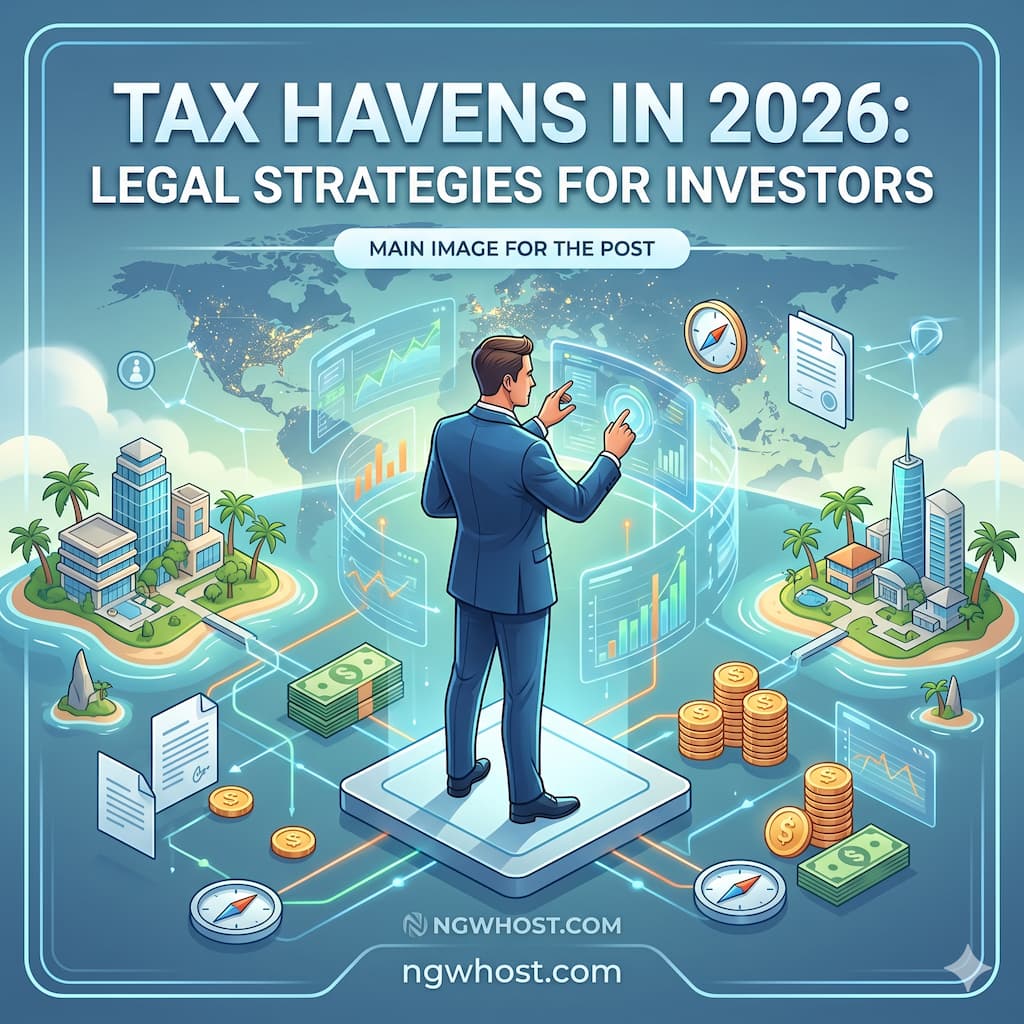
Tax Havens in 2026: Legal Strategies for Investors
The global fiscal landscape has undergone a seismic shift. In 2026, the term “tax haven” no longer carries the “cloak-and-dagger” offshore imagery of the 1980s. Following years of increased transparency, the implementation of the OECD’s Pillar Two global minimum tax, and a surge in digital nomadism, the world of international tax planning has matured. Today, at ngwhost.com, we recognize that tax optimization is not about hiding wealth; it is about strategic residency, jurisdictional arbitrage, and legal compliance.
For the modern investor, the goal in 2026 is to align their personal and business interests with jurisdictions that offer not just low tax rates, but high levels of digital infrastructure, political stability, and “investor-friendly” regulatory frameworks. This guide explores the legal strategies for navigating tax havens in the current year, ensuring your wealth is protected within the bounds of international law.
1. The Death of Secrecy: The New Standard of Transparency
Before diving into specific jurisdictions, it is vital to understand the “Ground Rules” of 2026. The era of the “untraceable” offshore account is over.
CRS and Automatic Exchange of Information (AEOI)
In 2026, over 120 countries participate in the Common Reporting Standard (CRS). If you are a resident of Brazil and hold an account in a “haven” like the Cayman Islands or Switzerland, that information is automatically reported to your home tax authority.
- The Legal Strategy: Instead of seeking secrecy, investors are seeking Substance. Modern tax planning focuses on moving “Mind and Management” to the low-tax jurisdiction. If you want to benefit from a country’s tax laws, you must prove that your business or your person actually lives and operates there.
2. The “Digital Nomad” and Residency-Based Havens
With the rise of remote work and decentralized businesses, many investors are choosing to move their personal residency to jurisdictions that offer “Territorial Taxation” or “Lump-Sum” tax models.
The United Arab Emirates (UAE): The Global Hub
The UAE remains a titan in 2026. While they introduced a 9% corporate tax on domestic profits in 2023, their “Free Zones” and the absence of personal income tax for residents make it an attractive anchor for digital entrepreneurs.
- The Strategy: Establishing a Free Zone company allows you to manage global operations with 0% personal income tax and 0% tax on dividends, provided you meet the “Economic Substance” requirements.
Portugal and the “Post-NHR” Era
Portugal’s Non-Habitual Residency (NHR) program was modified, but 2026 has seen the rise of the “Incentivized Scientific Research and Innovation” regime. This targets high-value tech entrepreneurs and investors with a 20% flat tax on professional income and exemptions on most foreign-sourced income.
- The Strategy: For investors in the tech sector, Portugal provides a gateway to the EU with a significantly lower tax burden than its neighbors.
3. The Corporate Playbook: Holding Companies and IP
For the readers of ngwhost.com who manage digital assets or software companies, the placement of Intellectual Property (IP) and holding structures is the primary lever for optimization.
Singapore: The Asian Stronghold
Singapore remains the gold standard for “Tier 1” tax optimization. With a top corporate rate of 17% and extensive tax treaties, it is the ideal location for a regional holding company.
- Legal Strategy: Use Singapore to hold your international subsidiaries. Under the “Participation Exemption” rules, dividends flowing into Singapore from foreign subsidiaries can often be received tax-free, allowing for efficient capital redeployment across global markets.
The Rise of “Specialized” Havens: The Cayman Islands and BVI
The British Virgin Islands (BVI) and Cayman Islands have successfully pivoted to become the hubs for Investment Funds and Digital Asset Entities.
- The Strategy: If you are launching a crypto fund or a private equity vehicle in 2026, these jurisdictions offer a tax-neutral environment. The fund itself pays no tax, allowing the tax liability to flow through to the individual investors in their respective home countries—a perfectly legal and standard industry practice.
4. Wealth Preservation: Trusts and Foundations in 2026
Tax optimization is often inseparable from Asset Protection. In 2026, high-net-worth investors are increasingly using offshore trusts to shield their wealth from litigation and ensure smooth succession.
The Cook Islands and Nevis
These two jurisdictions are world-renowned for their Asset Protection Trust laws.
- The Legal Strategy: Assets placed in a properly structured Cook Islands Trust are virtually unreachable by foreign creditors. In 2026, these structures are used not for tax evasion, but as a “Legal Fortress” against frivolous lawsuits in an increasingly litigious global environment.
[Table: Top Legal Tax Havens by Investor Need – 2026]
| Need | Top Jurisdiction | Primary Benefit |
| Personal Residency | UAE / Dubai | 0% Personal Income Tax; High Quality of Life. |
| Tech / EU Access | Portugal / Malta | Low Effective Rates for Innovation Income. |
| IP & Holding Co. | Singapore | Stable Legal System; Extensive Treaty Network. |
| Asset Protection | Nevis / Cook Islands | Strongest Statutory Protection against Creditors. |
| Digital Nomads | Paraguay / Panama | Territorial Tax; Ease of Residency. |
5. The “Substance” Requirement: Don’t Get Caught in the Trap
The biggest mistake investors make in 2026 is failing to establish Economic Substance. Tax authorities now use AI-driven audits to look for “Shell Companies.”
How to Prove Substance:
- Physical Office: You must have a dedicated physical space in the jurisdiction.
- Local Employees: You should have competent personnel on the ground managing the business.
- Local Board Meetings: Strategic decisions must be made and documented within the jurisdiction’s borders.
- Local Bank Account: Operational expenses should be paid through a local financial institution.
Failure to meet these requirements can lead to “Controlled Foreign Corporation” (CFC) rules being triggered in your home country, effectively negating any tax benefits of the haven.
6. Crypto and Digital Assets: The New Frontier
In 2026, the “Tax Haven” map for crypto investors looks very different. Some countries are positioning themselves as “Crypto-Safe Havens” by offering 0% tax on capital gains from digital assets.
- El Salvador: With the “Bitcoin Office” and legal tender status, it offers a permanent residency path for investors who hold BTC.
- Puerto Rico (Act 60): For US citizens, this remains the only way to achieve a 0% tax rate on capital gains without giving up their US passport—provided they spend at least 183 days a year on the island.
7. The Role of the “Tax-Efficient” Portfolio
Legal tax havens are just one part of the puzzle. On ngwhost.com, we advocate for a holistic view. Even if you don’t move abroad, you can use “Haven-Like” structures within your portfolio:
- Exchange-Traded Funds (ETFs) domiciled in Ireland: For non-US investors, Irish-domiciled ETFs are more tax-efficient for US stocks due to a specific tax treaty that reduces withholding tax on dividends from 30% to 15%.
- Life Insurance Wrappers (PPLI): Private Placement Life Insurance allows you to wrap your investments in a life insurance policy, deferring taxes on all growth until the funds are withdrawn.
8. Compliance: The Cost of Doing Business
In 2026, the most expensive mistake you can make is non-compliance. With the rise of the Global Minimum Tax (GMT), large multinational entities are already feeling the heat. For the individual investor, the cost of expert legal and tax advice is now a mandatory “Entry Fee.”
Working with a Fiduciary
You should never set up an offshore structure based on a YouTube video or a blog post alone. You need:
- A tax attorney in your Home Country (e.g., Brazil).
- A tax attorney in the Destination Country (e.g., Singapore).
- An international tax strategist to bridge the two.
Read More⚡ Real Estate Crowdfunding: Investing with Small Capital
Conclusion: Strategy Over Evasion
In 2026, a “Tax Haven” is not a place to hide; it is a place to build. Whether you are seeking the 0% environment of the UAE, the strategic holding power of Singapore, or the asset protection of Nevis, the goal is to create a structure that is resilient, transparent, and fully legal.
At ngwhost.com, we believe that the world is your marketplace. By understanding the legal strategies available in today’s tax-neutral jurisdictions, you can ensure that more of your capital goes toward your next big venture, your family’s future, and your long-term legacy.
The map of the world is a map of opportunity. Are you positioned to take advantage of it?