
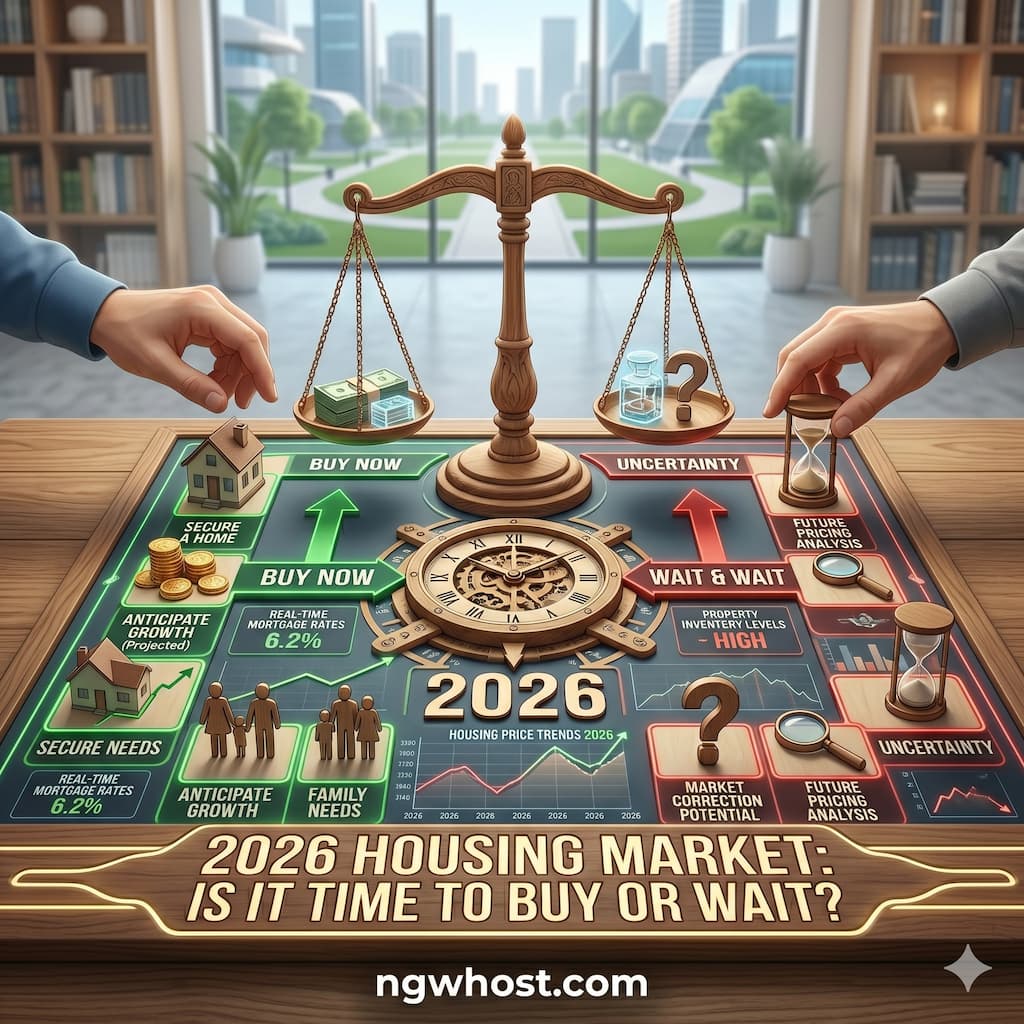
2026 Housing Market: Is it Time to Buy or Wait?
The housing market has always been a game of strategy, timing, and a bit of nerves. As we navigate through April 2026, the question on every potential homeowner’s mind is no longer just “Can I afford it?” but rather, “Is this the right moment, or am I catching a falling knife?”
The landscape of 2026 is vastly different from the frantic bidding wars of the early 2020s or the stagnant “rate-lock” freeze of 2024. Today, we see a market defined by cautious rebalancing.
In this comprehensive guide, we will break down the data, the economic forecasts, and the psychological factors at play to help you decide if 2026 is your year to sign the papers or stay on the sidelines.
The Current State of Affairs: 2026 at a Glance
To understand where we are going, we must look at where we are. As of mid-2026, the “Great Freeze” that characterized the previous two years has begun to thaw, but it hasn’t exactly turned into a summer heatwave.
1. Mortgage Rates: The 6% Anchor
For much of 2025, the 30-year fixed-rate mortgage hovered stubbornly around 7%. In 2026, we have finally seen some relief. Most lenders are currently quoting rates in the 6.1% to 6.4% range. While some optimistic forecasts from Morgan Stanley suggest we could see a dip toward 5.75% by the end of the year, the era of 3% rates is firmly in the rearview mirror.
2. Inventory Levels
One of the biggest shifts in 2026 is the gradual return of inventory. Active listings are up roughly 9% year-over-year. This isn’t because of a massive wave of foreclosures, but rather “life happening.” People who have been holding onto their 3% mortgages for four years are finally reaching breaking points—growing families, job transfers, and divorces are forcing homes back onto the market.
3. Home Prices
If you were waiting for a 2008-style crash, 2026 might be a disappointment. Prices haven’t plummeted; they have simply stopped skyrocketing. Nationally, we are seeing a modest appreciation of 2% to 3%. In some “refuge markets” in the Midwest and Northeast, prices are actually still rising as buyers flee the unaffordable West Coast and Sun Belt.
The Case for Buying in 2026
For many, the “Wait and See” approach is starting to lose its luster. Here is why 2026 might actually be the strategic window you’ve been looking for.
Less Competition, More Choice
Remember the days of “waiving inspections” and “paying $50k over asking”? In 2026, those are largely gone. With inventory rising and the frenzy cooled, buyers actually have leverage. You can ask for repairs. You can negotiate on closing costs. You can take a weekend to think about a property instead of making an offer in the driveway.
The “Marry the House, Date the Rate” Strategy
The 2026 market is perfect for the refinance play. By buying now while prices are relatively flat, you lock in your purchase price. If rates do drop into the 5s in 2027—as some economists predict—you can refinance. However, if you wait until rates hit 5% to buy, you’ll likely be competing with a million other buyers who had the same idea, which will drive the purchase price right back up.
Rent Inflation vs. Mortgage Stability
While home prices have moderated, rent hasn’t always followed suit. In many metropolitan areas, the cost of a monthly mortgage payment is finally starting to reach parity with luxury rental rates. Owning in 2026 allows you to fix your largest monthly expense while the “rental treadmill” continues to speed up.
The Case for Waiting
On the flip side, 2026 isn’t a “gold rush” for everyone. There are valid reasons to keep your down payment in a high-yield savings account for another year.
The Affordability Gap
Even with rates at 6.2%, the combination of high home prices (left over from the 2021 surge) and current borrowing costs means that the “Affordability Index” is still near historic lows. For a first-time buyer, the monthly DTI (Debt-to-Income) ratio might still be too tight for comfort.
Economic Uncertainty
The 2026 economic outlook remains mixed. While a major recession hasn’t materialized, job growth has slowed in the tech and finance sectors. If your industry feels shaky, taking on a 30-year debt obligation in a “flat” market might not be the wisest move.
Better Rates Might Be Six Months Away
If you believe the more dovish analysts, the Federal Reserve may continue to ease toward the end of 2026. Waiting until Q4 2026 or Q1 2027 could potentially save you $200–$400 a month on your mortgage payment if rates settle closer to 5.5%.
Regional Spotlights: Where is 2026 “Hot”?
The US housing market is not a monolith. In 2026, we are seeing a “Great Migration” toward value.
| Region | Trend | Recommendation |
| Midwest (Ohio, Michigan) | High demand, low price volatility. | Buy: These are “refuge markets” where your dollar still goes far. |
| South (Florida, Texas) | High inventory, cooling prices. | Wait: More supply is coming online; you might find a better deal in 6 months. |
| Northeast (CT, NY Suburbs) | Tight supply, steady appreciation. | Buy: Prices here rarely drop; if you find a home, grab it. |
| West (California, Arizona) | Stagnant prices, high entry cost. | Wait/Negotiate: Sellers are getting desperate; lowball offers are starting to work. |
Financial Checklist: Are You Ready for 2026?
Before making the jump, run through these “2026 Reality Check” numbers:
- The 20% Rule (Modified): While 20% down is ideal, in 2026, having at least 10% is crucial to avoid being “underwater” if the market dips slightly.
- Credit Score: To get that coveted 6.1% rate, you’ll need a score of 760+. Anything lower, and you might still be looking at 6.8% or higher.
- Emergency Fund: Do not empty your savings for the down payment. With 2026 labor markets being “fickle,” you need 6 months of mortgage payments in a liquid account.
The Verdict: Buy or Wait?
You should BUY in 2026 if:
- You plan to stay in the home for at least 7 to 10 years.
- You have found a home that fits your needs perfectly (the “forever home”).
- You are currently in a high-rent situation with no equity building.
- You value the ability to negotiate with sellers who are no longer seeing 10 offers on day one.
You should WAIT if:
- You are looking for a “quick flip” or short-term investment (the margins are too thin right now).
- Your job security feels tenuous.
- You are holding out for a specific neighborhood where inventory is still at zero.
- The monthly payment at 6.3% leaves you “house poor” (spending more than 35% of your take-home pay).
Read More⚡ Robo-Advisors for HNWIs: 2026 Wealth Trends
Final Thoughts
The 2026 housing market is a professional’s market. It is no longer a game for speculators or the faint of heart. It is a time for those with stable finances to find quality homes without the “hunger games” atmosphere of years past.
Timing the bottom is a fool’s errand. Instead, focus on time in the market. If the numbers work for your budget today, 2026 provides a more stable, predictable environment to plant your roots than we have seen in nearly a decade.
Looking for more real estate insights or hosting solutions for your property business? Visit ngwhost.com for the latest in tech and market trends.