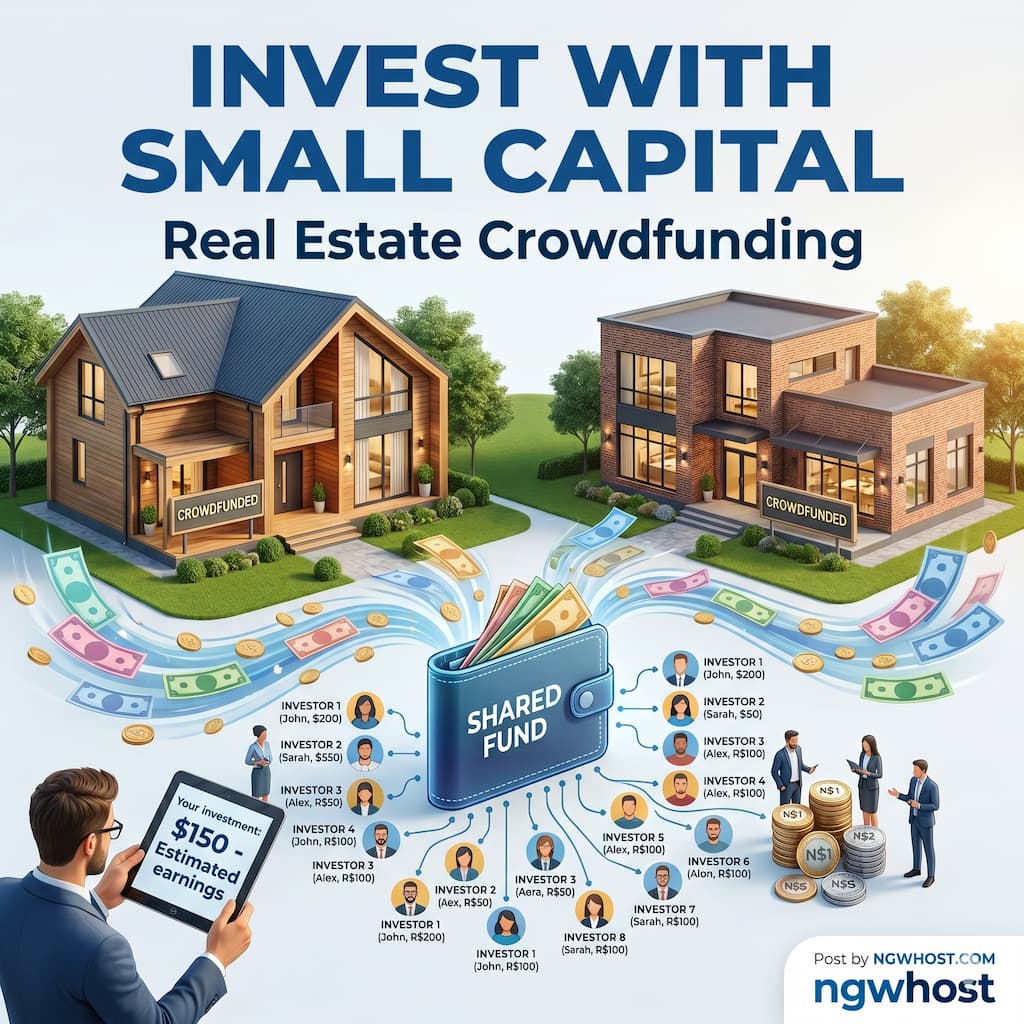
Real Estate Crowdfunding: Investing with Small Capital
For decades, the real estate market was seen as the playground of the wealthy. To own property, you typically needed tens of thousands of dollars for a down payment, a high credit score, and the stomach for property management. But in 2026, the barriers to entry have crumbled. Through Real Estate Crowdfunding, the “democratization of property” is no longer a buzzword—it is a functional reality for millions of small-scale investors.
At ngwhost.com, we believe that financial independence should be accessible to everyone, regardless of their starting balance. Whether you have $100 or $10,000, crowdfunding allows you to claim a piece of the global real estate pie. This guide will walk you through the mechanics, the risks, and the best platforms to help you start building a property portfolio without needing to buy a whole building.
1. What is Real Estate Crowdfunding?
At its core, real estate crowdfunding is a method of raising capital by pooling small amounts of money from a large number of individuals. Instead of one person buying a $1 million apartment complex, 1,000 people contribute $1,000 each.
The Ecosystem
The process involves three main players:
- The Sponsor (Developer): The individual or company that identifies, acquires, and manages the property.
- The Platform: The digital marketplace that connects sponsors with investors, handles the legal paperwork, and facilitates the transfer of funds.
- The Investor (You): The person who provides the capital in exchange for a share of the profits or interest payments.
2. The Two Primary Models: Equity vs. Debt
Before you invest your first dollar, you must understand the two ways you can participate in a project.
Equity Crowdfunding (Ownership)
In this model, you are essentially a shareholder in a specific property. You own a small percentage of the building.
- How you make money: You receive a portion of the rental income (dividends) and a share of the profit when the property is eventually sold (capital appreciation).
- The Reward: High potential for long-term gains. If the property value doubles, your investment doubles.
- The Risk: You are the last to get paid if things go south. If the property doesn’t sell for a profit, your returns may be lower than expected.
Debt Crowdfunding (Lending)
Here, you act as the bank. You lend your money to a developer to fund a project, and the loan is secured by the property itself.
- How you make money: You receive fixed interest payments at regular intervals (monthly or quarterly).
- The Reward: Predictable, steady cash flow. Debt investors are usually paid before equity investors.
- The Risk: Your return is capped. If the developer makes a 100% profit, you still only get your agreed-upon 8% or 10% interest.
3. Why Invest in 2026? The Benefits of Crowdfunding
The 2026 real estate market is uniquely suited for crowdfunding for several reasons:
Low Barrier to Entry
You can start with as little as $10 to $100. This allows you to “learn while you earn” without risking your entire life savings on a single transaction.
Diversification at Scale
With $5,000, you couldn’t buy a house. However, with crowdfunding, you could put $500 into ten different projects: a warehouse in Texas, a multi-family unit in Brazil, a vacation rental in Florida, and a retail space in London. This spreads your risk across different geographic locations and asset classes.
Passive Income
Crowdfunding is truly “hands-off.” You don’t have to deal with “tenants, toilets, or trash.” The sponsor handles the property management, repairs, and legal disputes, while you simply monitor your dashboard and collect distributions.
4. The Risks: What You Must Know
No investment is without risk, and real estate is notoriously illiquid.
- Liquidity Risk: Unlike stocks, you cannot sell your “share” of a building in seconds. Most crowdfunding investments have a holding period of 3 to 10 years. While some platforms offer secondary markets, they often come with fees or require a waiting period.
- Platform Risk: If the platform itself goes bankrupt, your investment could be tied up in legal proceedings for years. Always choose platforms with a proven track record and strong regulatory compliance.
- Market Risk: Real estate values fluctuate. A recession or a rise in interest rates can lower property values, impacting your potential capital gains.
5. Top Platforms for Small Capital in 2026
Depending on your location and budget, several platforms have emerged as the “gold standard” for retail investors.
| Platform | Minimum Investment | Best For | Investor Type |
| Fundrise | $10 | Beginners & Diversified Funds | Non-Accredited |
| Arrived | $100 | Single-Family & Vacation Rentals | Non-Accredited |
| RealtyMogul | $5,000 | Commercial REITs | Both |
| Estateguru | €50 | European Short-Term Loans | Both |
| Reental | €100 | Tokenized Real Estate (Global) | Both |
Fundrise: The Gateway for Beginners
Fundrise remains the leader for those starting with very small amounts. They offer “eREITs” (Electronic Real Estate Investment Trusts) that diversify your money across dozens of properties automatically.
Arrived: Owning a Piece of a Vacation Rental
If you’ve ever wanted to own an Airbnb but didn’t have the $500k to buy one, Arrived allows you to buy “shares” of individual vacation homes. You get a cut of the nightly rental income.
6. Tokenization: The Future of Real Estate (2026 & Beyond)
On ngwhost.com, we frequently discuss how blockchain is changing the world. In 2026, Real Estate Tokenization is the next evolution of crowdfunding. By turning a property into digital tokens on a blockchain, investors can gain even more benefits:
- Higher Liquidity: Tokens can be traded on secondary exchanges 24/7.
- Lower Fees: Blockchain reduces the middleman costs associated with traditional legal transfers.
- Global Access: An investor in Brazil can easily buy a token representing a piece of a New York skyscraper.
7. How to Start Your Portfolio: A Step-by-Step Guide
- Set Your Budget: Determine an amount you can afford to leave untouched for at least 5 years.
- Define Your Goal: Do you want income (Debt/Dividends) or growth (Equity/Appreciation)?
- Research the Platform: Check for ECSP licenses (in Europe) or SEC compliance (in the US). Read user reviews regarding their payout history.
- Analyze Individual Deals: Don’t just trust the platform’s “12% Expected Return” headline. Read the Offering Circular. Look at the property’s location, the developer’s track record, and the local vacancy rates.
- Reinvest Your Dividends: To truly grow your wealth, use the “DRIP” (Dividend Reinvestment Plan) approach. Automatically put your monthly rental income back into new projects.
8. Tax Implications of Crowdfunding
Real estate income is often taxed differently than regular income.
- Depreciation: One of the best perks of equity crowdfunding is that you can often benefit from “paper losses” due to depreciation, which can offset the taxes on your rental income.
- K-1 vs. 1099: Some platforms issue a Form 1099 (simple), while others issue a Schedule K-1 (more complex). Be prepared to spend a little more on tax preparation if your portfolio grows large.
Read More⚡ Cybersecurity in Banking: How to Protect Your Funds
Conclusion: Start Small, Think Big
Real estate crowdfunding has leveled the playing field. You no longer need to be a millionaire to benefit from the stability and growth of the property market. By starting small, diversifying your projects, and maintaining a long-term perspective, you can turn a few hundred dollars into a meaningful financial foundation.
At ngwhost.com, we empower you to take control of your financial destiny through technology. The “brick and mortar” world is now digital—are you ready to claim your corner of it?