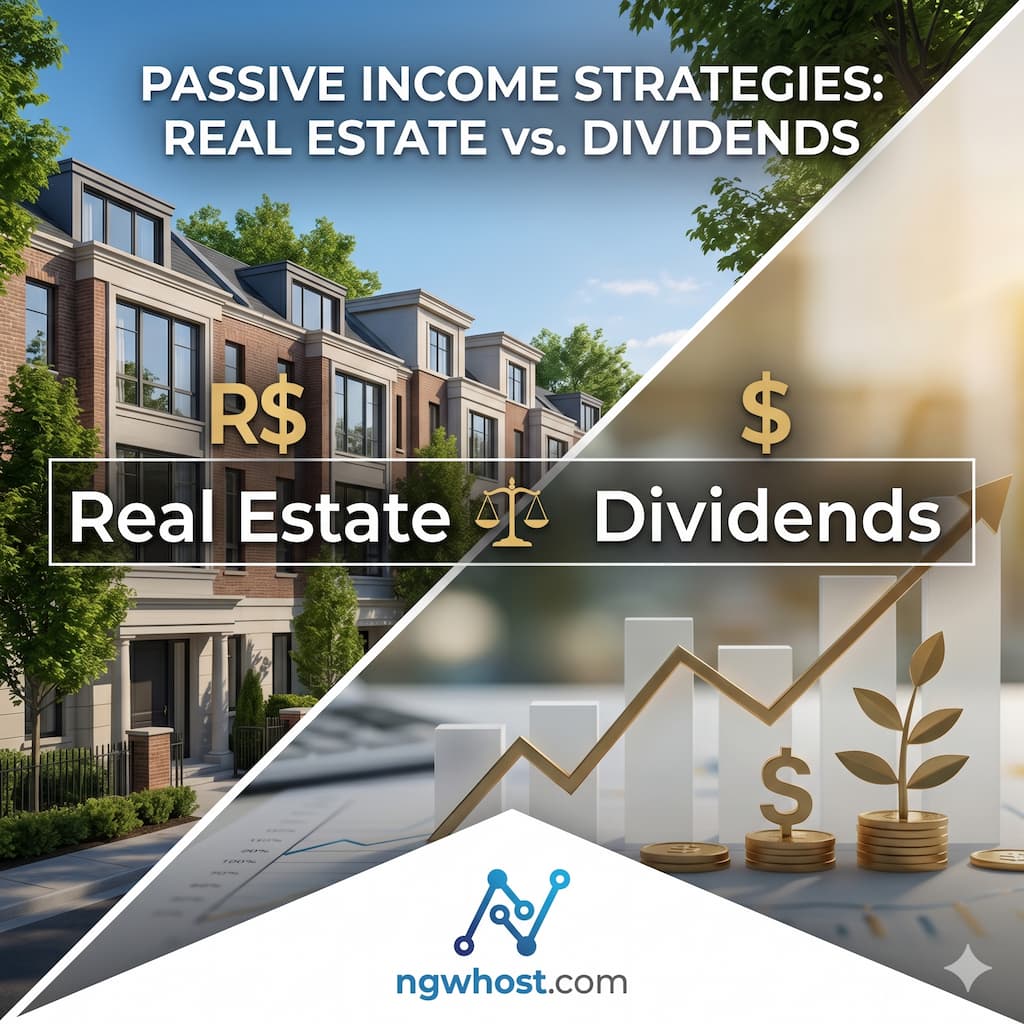
Passive Income Strategies: Real Estate vs. Dividends
The dream of “making money while you sleep” has never been more attainable than it is in 2026. As traditional career paths continue to evolve into freelance, remote, and entrepreneurial models, the importance of building a robust stream of passive income has shifted from a luxury to a financial necessity.
For the modern investor, two titans dominate the passive income landscape: Real Estate and Dividend-Paying Stocks. Both have minted millionaires for decades, yet they offer fundamentally different experiences in terms of effort, risk, liquidity, and tax treatment.
In this comprehensive guide for ngwhost.com, we will dissect these two strategies to help you determine which vehicle is best suited to carry you toward financial independence.
The Philosophy of Passive Income in 2026
Passive income is often misunderstood. It is rarely “set and forget” from day one. Instead, it is the result of front-loading effort—either through the investment of capital (money) or the investment of time—to create an asset that generates recurring revenue with minimal ongoing labor.
As we navigate the economic climate of 2026, characterized by stabilizing interest rates and the integration of AI in asset management, the choice between brick-and-mortar and paper assets requires a more nuanced approach than ever before.
1. Real Estate: The Tangible Powerhouse
Real estate is the world’s oldest and most proven wealth-building tool. When you invest in real property, you are buying a piece of the physical world.
The Mechanisms of Wealth in Real Estate
- Rental Income (Cash Flow): This is the “passive” part. After paying the mortgage, taxes, insurance, and maintenance, the remaining rent is your profit.
- Appreciation: Historically, real estate tends to increase in value over time, often outpacing inflation.
- Leverage: This is the “secret sauce.” You can buy a $500,000 asset with only $100,000 of your own money (a 20% down payment). If the property value goes up by 5%, you haven’t made 5% on your money—you’ve made 25% on your initial investment.
- Tax Advantages: In many jurisdictions, you can deduct depreciation, mortgage interest, and property taxes, often leading to “tax-free” cash flow in the eyes of the government.
The Reality Check: Is it Truly Passive?
Real estate is often described as a “business” rather than a pure investment. Even with a property manager, you are still the CEO. You must deal with “The Three Ts”: Tenants, Toilets, and Trash. In 2026, while smart home tech and AI-driven property management platforms have made the job easier, the physical nature of the asset means things will eventually break, and markets will fluctuate.
2. Dividend Investing: The Liquid Alternative
Dividend investing involves buying shares of profitable companies that distribute a portion of their earnings back to shareholders. It is the ultimate “low-friction” investment.
The Mechanisms of Wealth in Dividends
- Regular Payouts: Many companies (especially “Dividend Aristocrats”) pay out cash every quarter or month.
- Compound Growth: By utilizing a Dividend Reinvestment Plan (DRIP), you can automatically use your dividends to buy more shares, creating a snowball effect of exponential growth.
- Liquidity: If you need $10,000 tomorrow, you can sell your stocks with the click of a button. You cannot sell a “bedroom” of a house to pay for an emergency.
- Zero Management: You don’t have to fix a leaky faucet at Coca-Cola or Apple. Thousands of world-class employees work to generate that profit for you.
The Risks of the Market
The primary risk here is volatility. Stock prices can drop 20% in a month during a market correction. Additionally, companies are not legally obligated to pay dividends; if a company hits a rough patch, they can cut or eliminate the payout entirely.
Real Estate vs. Dividends: A Direct Comparison
| Feature | Real Estate | Dividend Stocks |
| Barrier to Entry | High (Down payments, closing costs) | Low (Start with $10 or $100) |
| Effort Level | Medium to High (Active management) | Very Low (Fully passive) |
| Control | High (You decide the rent and upgrades) | None (You are a silent partner) |
| Liquidity | Low (Takes months to sell) | High (Sell in seconds) |
| Tax Treatment | Excellent (Depreciation/Write-offs) | Moderate (Qualified dividends taxed lower) |
| Leverage | Easy (Mortgages are standard) | Risky (Margin trading is dangerous) |
3. Strategy: Choosing Your Path
The “right” choice depends on your personality, your current capital, and your goals.
When to Choose Real Estate
Real estate is for the investor who wants control and maximum growth through leverage. If you are comfortable managing people (contractors/tenants) and want to build a massive net worth starting with a smaller amount of capital, real estate is the winner.
In 2026, we are seeing a rise in “Fractional Real Estate” platforms, which allow you to buy shares of a rental property. This is a great middle-ground for those who love property but hate the maintenance.
When to Choose Dividends
Dividend investing is for the investor who values time and simplicity. If you are a busy professional or an entrepreneur who wants to focus 100% of your energy on your business (like your projects here at ngwhost.com), then a portfolio of high-quality dividend ETFs or individual stocks allows your money to work for you without taking up any headspace.
4. The Hybrid Approach: The 2026 Meta-Strategy
Why choose one when you can have both? Many successful investors use a “Barbell Strategy”:
- Phase 1: Use a high-income skill or business to generate cash.
- Phase 2: Invest that cash into Dividend Stocks for immediate, liquid passive income.
- Phase 3: Once the dividend portfolio is large enough, use it as the “down payment fund” for high-quality Real Estate assets to lock in long-term wealth and tax benefits.
Read More⚡ How to Invest in Quantum Computing Stocks 2026
Conclusion: Building Your Digital and Physical Empire
Passive income is the bridge between working for a living and living for your work. Whether you prefer the tangible security of a physical home or the streamlined efficiency of a global stock portfolio, the key is to start now.
In the digital age, your assets—whether they are hosted on a server or built on a foundation of concrete—determine your level of freedom. At ngwhost.com, we understand the value of infrastructure. Just as a reliable host is the foundation of a great website, a reliable passive income strategy is the foundation of a great life.
Summary Checklist for 2026 Investors:
- Determine your “Active Capacity”: Do you have 5 hours a week for property, or 5 minutes for a brokerage app?
- Assess your Capital: Do you have the $50k+ needed for a solid property down payment, or are you starting from zero?
- Consult a Tax Professional: Real estate laws in 2026 are complex; ensure you are maximizing your local deductions.
- Diversify: Don’t put your entire life savings into one house or one stock.
Final Thought: The best investment is the one you will actually stick with. If you hate talking to people, stay away from landlording. If you panic when the news says the market is down, stay away from stocks. Know yourself, and the wealth will follow.