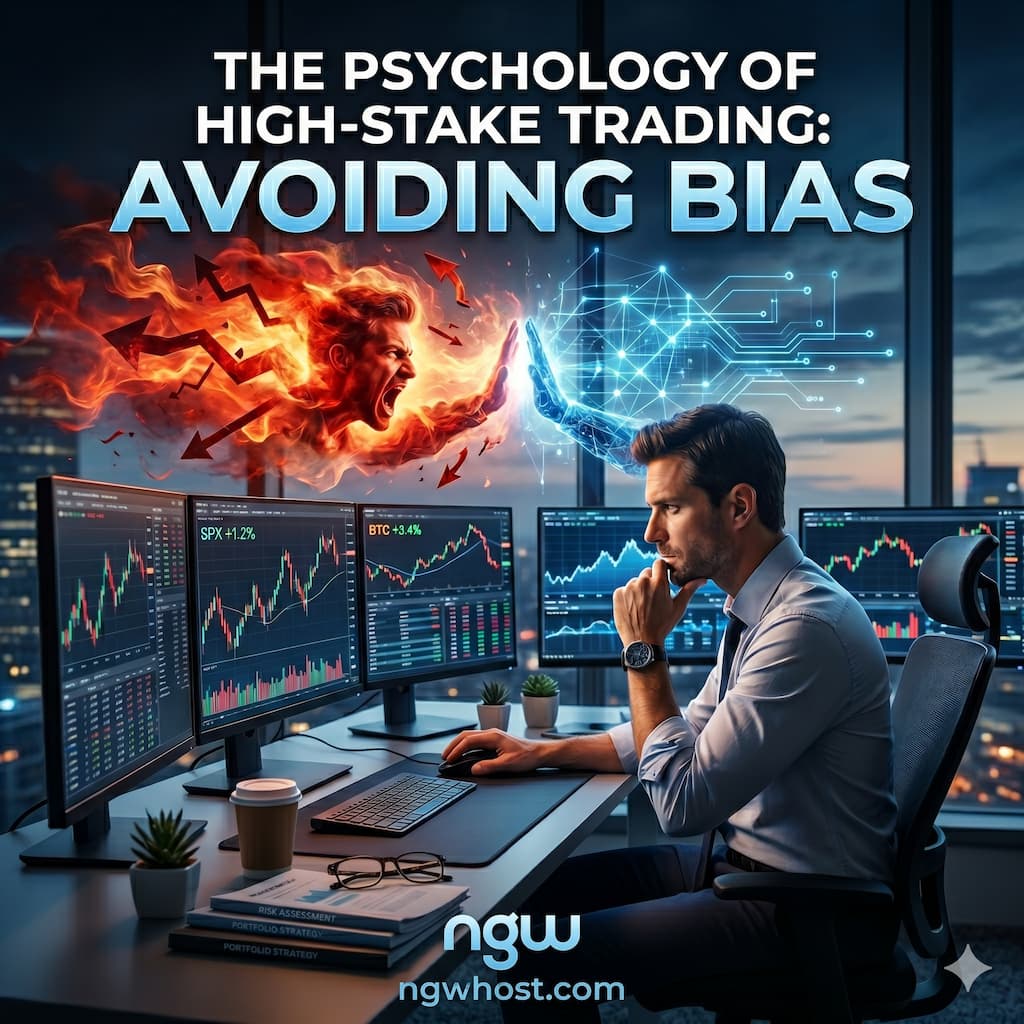
The Psychology of High-Stake Trading: Avoiding Bias
In the high-pressure world of 2026, where algorithmic execution happens in microseconds and global markets are more interconnected than ever, the greatest challenge a trader faces isn’t the market itself—it’s their own mind.
At NGWHost, we understand that behind every high-performance digital infrastructure is a human decision-maker. Whether you are managing a corporate treasury or a high-frequency retail portfolio, your success depends on your ability to remain objective under fire. This guide explores the psychological pitfalls of high-stake trading and provides actionable strategies to neutralize the biases that lead to catastrophic losses.
The Biological Reality of High-Stakes Trading
Our brains were not evolved to trade financial markets. We were evolved for survival on the savanna. In 2026, neuroscience has confirmed that the “Fight or Flight” response is triggered by a plummeting stock chart just as easily as it was by a predator thousands of years ago.
The Amygdala Hijack
When a trade goes against you, the amygdala—the brain’s emotional center—can take over, bypassing the prefrontal cortex (the area responsible for logic and planning). This “hijack” is why even the most seasoned professionals find themselves “revenge trading” or freezing in the face of a mounting loss.
To win in 2026, you must build a “psychological firewall” between your emotions and your execution.
5 Critical Cognitive Biases in 2026
To avoid bias, you must first name it. In the current market environment, these five psychological traps are responsible for the majority of trading failures.
1. Loss Aversion: The Pain of Being Wrong
Research in behavioral finance suggests that the pain of a loss is twice as intense as the joy of an equivalent gain.
- The Trap: You hold onto a losing position, hoping it will “break even,” because realizing the loss feels like a personal failure.
- The 2026 Reality: In a fast-moving market, “hoping” is a strategy for bankruptcy. Loss aversion turns a small, manageable exit into a portfolio-killing disaster.
2. Confirmation Bias: The Echo Chamber
With the explosion of AI-curated news feeds, confirmation bias is more dangerous than ever.
- The Trap: You seek out news, tweets, and analysts that agree with your current position while ignoring data that suggests you are wrong.
- The 2026 Reality: If you are “long” on a sector, your AI-driven social feed will naturally show you bullish content. This creates a false sense of certainty that blinds you to emerging risks.
3. Anchoring Bias: The Ghost of Prices Past
- The Trap: You fixate on a specific price point (the “anchor”)—often the price you bought at or a recent all-time high—and base all future decisions on that irrelevant number.
- The 2026 Reality: The market doesn’t care what price you paid. Anchoring prevents you from seeing that the fundamental environment has changed, leaving you stuck in a “value trap.”
4. Recency Bias: The Myth of the Streak
- The Trap: You give undue weight to your most recent trades. If you’ve had three winners in a row, you feel “invincible” and increase your risk. If you’ve had three losers, you become “gun-shy” and miss a perfect setup.
- The 2026 Reality: High-stakes trading is a game of probabilities over thousands of trades. Your last three trades have zero statistical impact on the outcome of your next one.
5. Overconfidence Bias: The “Guru” Complex
- The Trap: After a period of success, you begin to believe you have a “special intuition” that transcends your trading plan.
- The 2026 Reality: The market is a master at humbling the overconfident. In 2026, excessive risk-taking driven by ego is the fastest way to lose institutional backing.
Professional Strategies to Neutralize Bias
High-performance traders don’t try to “stop” feeling emotions; they develop systems that make emotions irrelevant to the outcome.
1. Implementation of “Hard” Stop-Losses
A stop-loss is not just a technical tool; it is a psychological release valve.
- Strategy: Set your stop-loss before you enter the trade. Once the trade is live, the decision is no longer yours to make—it belongs to the system. This prevents loss aversion from “negotiating” with you when the price hits the exit point.
2. The “Inversion” Exercise
To combat confirmation bias, professional desks use a technique called “Inversion.”
- Strategy: Before entering a trade, spend five minutes writing down the “Bear Case” (if you are going long). What would have to happen for this trade to fail? If you can’t find a reason why you might be wrong, you haven’t done enough research.
3. The Three-Strike Rule (Revenge Trading Defense)
Emotional arousal increases with every loss.
- Strategy: If you hit three consecutive losses in a single session, or a total daily loss limit, you must shut down your platform. Walk away for at least four hours. This allows your cortisol levels to reset and brings your prefrontal cortex back online.
4. Detailed Trading Journaling (The “Post-Mortem”)
You cannot fix what you do not measure.
- Strategy: Don’t just record prices. Record your emotional state. Were you anxious? Bored? Greedy? Over time, you will see patterns. For example, you might realize that 80% of your losses occur when you trade out of “boredom” during low-volatility hours.
The Role of Technology: AI as a Psychological Partner
In 2026, technology is no longer just for execution; it’s for behavioral monitoring. Many elite trading platforms now use AI to monitor a trader’s behavior in real-time. If the AI detects that you are deviating from your historical patterns—such as increasing position sizes after a loss or shortening your holding time—it can trigger an alert or even temporarily lock your execution to prevent a “tilt” event.
At NGWHost, we provide the high-uptime, low-latency infrastructure that these sophisticated behavioral tools require. When your systems are reliable, you remove one of the biggest psychological stressors: technical anxiety.
Building a “Trading Stoicism” Routine
Success in high-stake environments requires a lifestyle that supports mental clarity.
- Mindfulness and Meditation: Studies show that consistent mindfulness practice thickens the prefrontal cortex and shrinks the amygdala. This directly improves your ability to stay calm during a market crash.
- Physical Regulation: High-stakes trading is physically demanding. Dehydration and lack of sleep directly impair your cognitive ability to resist bias. Treat yourself like a professional athlete.
- Separation of Wealth and Self-Worth: If your self-esteem rises and falls with your P&L, you will never be able to trade objectively. You must view your trading capital as “ammunition” for a game, not as a measure of your value as a human being.
Read More⚡ ESG Investing in 2026: Profit with Purpose
Conclusion: The Ultimate Edge
In the competitive landscape of 2026, technical edges are fleeting. Strategies get “arbed” away, and algorithms are copied. The only sustainable competitive advantage is psychological resilience.
By identifying your biases, automating your risk management, and maintaining a disciplined mental routine, you move from being a victim of the market’s volatility to a master of it. At NGWHost, we are proud to power the platforms that help traders stay connected, stay fast, and stay disciplined.
Your Mental Checklist for Tomorrow’s Session:
- Is my stop-loss based on technical levels or my own ego?
- Have I looked at the counter-argument for this trade?
- Am I trading because there is a setup, or because I want to “win back” a loss?
- Is my environment (and my hosting) stable enough to keep me calm?
Master your mind. Master the market. Visit NGWHost.com for the infrastructure you need to trade with total confidence.