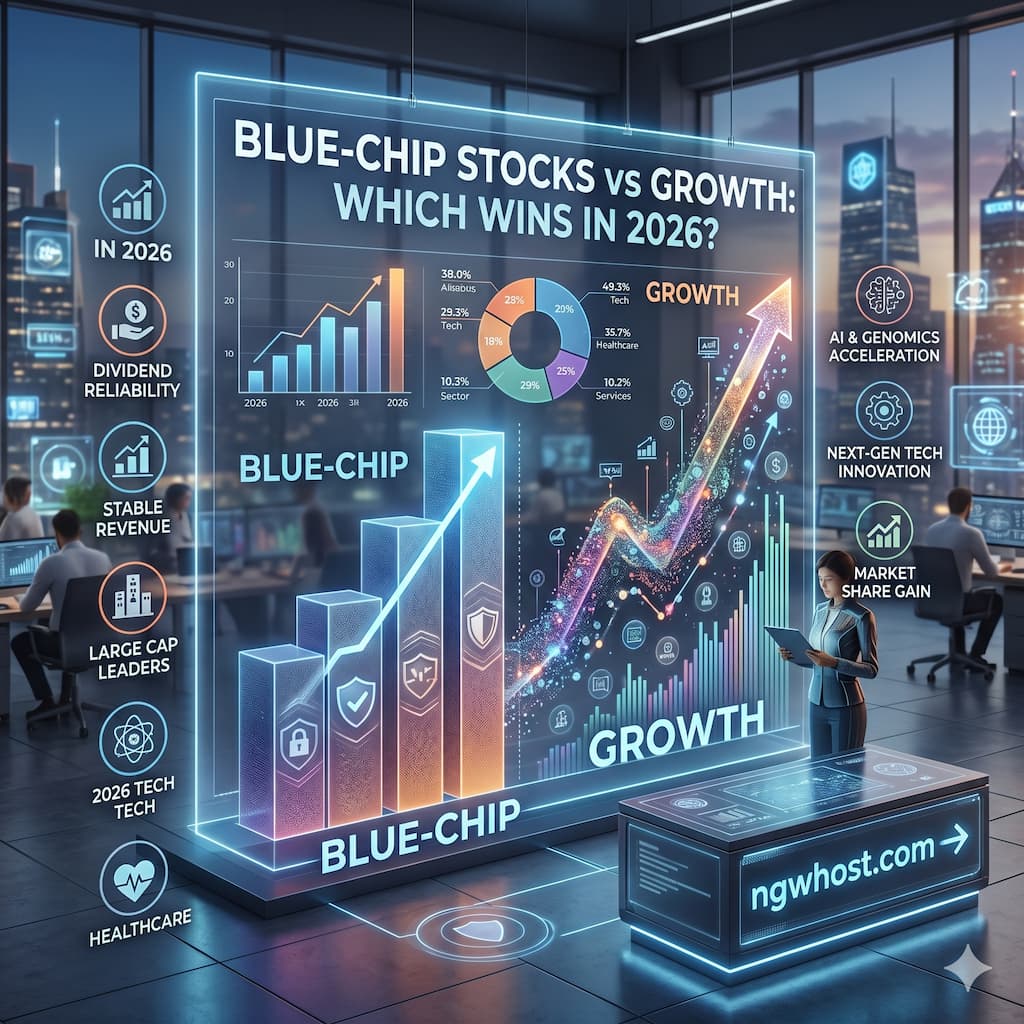
Blue-Chip Stocks vs Growth: Which Wins in 2026?
The financial landscape of 2026 has become a fascinating laboratory for economic theories. After several years of navigating “higher-for-longer” interest rates, a transformative AI revolution, and shifting global trade alliances, investors are standing at a crossroads. The age-old debate has returned with renewed intensity: Should you anchor your portfolio in the stability of Blue-Chip Stocks, or should you chase the exponential potential of Growth Stocks?
For the community at ngwhost.com, this isn’t just an academic exercise. It is a strategic decision that will define wealth accumulation for the next decade. As we analyze the market dynamics of April 2026, we see that the traditional definitions of “safety” and “risk” are being rewritten. This comprehensive guide explores which asset class is positioned to win in the current environment and how you can balance both to outperform the market.
1. The 2026 Macro Landscape: Context is Everything
To determine the winner, we must first look at the “arena” where these stocks are competing. As of Q2 2026, the global economy is characterized by:
- The “Neutral” Interest Rate: Central banks have moved away from emergency hikes, settling into a “neutral” rate environment that is neither stimulative nor restrictive. This provides a stable floor for valuations but eliminates the “easy money” era that fueled the 2010s.
- The AI Productivity Peak: We are moving from the “hype” phase of Artificial Intelligence to the “implementation” phase. Companies are now being judged not on their AI promises, but on their AI-driven profit margins.
- Persistent Sector Bifurcation: We are seeing a massive performance gap between companies that have successfully digitized their operations and those still tethered to legacy industrial models.
2. Blue-Chip Stocks: The Case for the “Fortress” Portfolio
Blue-chip stocks—the titans like Microsoft, Johnson & Johnson, and Procter & Gamble—represent the established order. In 2026, their appeal is rooted in Resilience and Reliability.
Why Blue-Chips are Winning Today:
- Pricing Power: In an environment where input costs remain sticky, blue-chip companies have the brand equity to pass costs onto consumers. Their “moats” are deeper than ever.
- Dividend Security: For investors seeking income, blue-chips are the ultimate “safety net.” In 2026, “Dividend Aristocrats” (companies that have increased dividends for 25+ years) are seeing record inflows as aging demographics prioritize cash flow over speculative gains.
- The “Flight to Quality”: Whenever geopolitical tensions rise—whether in the South China Sea or Eastern Europe—capital flows back into the mega-cap staples of the S&P 500.
The 2026 Blue-Chip Risk:
The primary risk for Blue-Chips in 2026 is Stagnation. Large-cap companies can become victims of their own size. When you already own 40% of a global market, doubling your revenue is a gargantuan task. There is also the “Kodak Risk”—the danger that a blue-chip giant fails to pivot to new technologies fast enough to avoid disruption.
3. Growth Stocks: The Case for the “Exponential” Portfolio
Growth stocks—ranging from mid-cap biotech innovators to AI-integrated SaaS platforms—are the engines of the future. In 2026, growth is no longer about “growth at any cost”; it is about Scalable Profitability.
Why Growth is Winning Today:
- Operating Leverage: Modern growth companies, especially in the software and green energy sectors, have minimal “marginal costs.” Once their product is built, every new customer is almost pure profit.
- The Disruptive Edge: In 2026, “disruption” is happening faster than ever. Small, agile growth companies are using AI to automate tasks that used to require thousands of employees, allowing them to underprice blue-chip competitors.
- Post-Correction Valuations: After the “Growth Winter” of the mid-20s, many high-potential companies are trading at reasonable Price-to-Earnings (P/E) ratios for the first time in years. The “froth” has been washed out, leaving behind high-quality businesses.
The 2026 Growth Risk:
Growth stocks remain highly sensitive to discount rates. If inflation creeps back up and central banks are forced to pivot toward hikes, growth valuations will be the first to contract. There is also the “Binary Outcome” risk—in growth, you are often betting on a technology that either changes the world or becomes obsolete in 18 months.
4. Head-to-Head: P/E Ratios and Valuations in 2026
For the analytical readers of ngwhost.com, the numbers tell a compelling story.
| Metric | Blue-Chip Average (2026) | Growth Average (2026) |
| Forward P/E Ratio | 16x – 19x | 28x – 45x |
| Dividend Yield | 2.5% – 4.5% | 0% – 0.5% |
| Avg. Revenue Growth | 3% – 7% | 15% – 40% |
| Cash Reserves | Extremely High | Moderate / Reinvesting |
The Verdict on Valuation: Blue-chips are “fairly valued” relative to historical norms, while Growth is “optimistically valued.” This means Blue-chips have a higher “Margin of Safety,” but Growth has the “Velocity of Return.”
5. The “Hybrid” Winner: The Rise of the “Grown-Up Growth”
One of the most important trends of 2026 is the blurring of these two categories. We are seeing the rise of companies that possess Blue-Chip balance sheets with Growth-level innovation.
Think of the “Magnificent Seven” (Apple, Amazon, Alphabet, etc.). Are they Blue-Chips? Yes, they have billions in cash. Are they Growth? Yes, they are leading the AI revolution. In 2026, the “winners” are those that fall into this Compounder Category. They provide the stability of a fortress with the upside of a rocket ship.
6. Sector Winners for 2026
If you are looking to place your bets for the remainder of the year, here is where the smart money is moving:
- Blue-Chip Winner: The Energy & Utilities Sector. As AI data centers require massive amounts of power, the “boring” utility companies have become high-performing assets.
- Growth Winner: Cybersecurity and Defense Tech. In a world of increasing digital warfare and sovereign tensions, companies providing AI-driven security are seeing unprecedented contract growth.
- Growth Winner: Longevity & Biotech. With the first “Anti-Aging” clinical trials showing success in early 2026, this sector is the new frontier for 10x returns.
7. Portfolio Strategy: The 60/40 Split for 2026
How should you position your portfolio? At ngwhost.com, we generally advocate for a Barbell Strategy in 2026.
- The Anchor (60%): High-quality Blue-Chips and “Compounders.” These protect your capital from market drawdowns and provide a steady stream of dividends for reinvestment.
- The Alpha (40%): High-conviction Growth stocks. These provide the “fuel” to outperform the S&P 500. Focus on companies with a clear path to profitability and a unique technological moat.
8. Identifying the “False Growth” Trap
In 2026, you must be careful of “AI Washing.” Many legacy companies are claiming to be “growth” stories because they integrated a chatbot into their website.
- The Litmus Test: Does the AI actually reduce their cost of goods sold (COGS) or increase their customer lifetime value (LTV)? If not, it’s just marketing. Real growth in 2026 is visible in the Operating Margin.
Read More⚡ Central Banks and AI: Predicting Market Crashes
Conclusion: Which Wins in 2026?
So, which wins?
- In terms of Total Return (Alpha): Growth is likely to win, provided you select the “Quality Growth” tier. The sheer speed of AI-driven disruption is creating value at a rate that mature Blue-Chips cannot match.
- In terms of Risk-Adjusted Returns: Blue-Chips remain the winner. For the investor who values sleep as much as profit, the ability to weather a 20% market correction with a portfolio of “Fortress” companies is invaluable.
The real “winner” in 2026 is the Intelligent Investor who realizes that these are not two separate teams, but two different tools in a single toolkit. Use Blue-chips to preserve the wealth you have, and use Growth to build the wealth you want.
At ngwhost.com, we believe the best days of the market are still ahead. Whether you are buying the stability of the past or the innovation of the future, the key is to stay invested, stay disciplined, and stay curious.