Layer-2 Scaling: Driving Enterprise Blockchain Efficiency
The integration of distributed ledger technology (DLT) into global corporate architecture has passed its initial proof-of-concept phase. International enterprises, financial institutions, and supply chain syndicates have recognized that decentralized state machines provide unparalleled advantages in multi-party data reconciliation, asset tokenization, cryptographic audibility, and automated legal execution via smart contracts.
However, as corporate IT teams attempt to transition these decentralized networks into high-throughput, mission-critical production environments, they run directly into a structural bottleneck known as the Blockchain Trilemma.
The foundational layer of a public or large-scale consortium network—referred to as Layer-1 (L1)—is architected to prioritize absolute security and decentralized consensus above all else. Every transaction must be broadcast globally, processed by thousands of independent computing nodes, and committed to an append-only block fabric.
While this design guarantees structural immutability and eliminates single points of failure, it inflicts severe performance costs on the network. Under heavy usage loads, standard L1 protocols suffer from severe transactional congestion, high processing latencies (varying from minutes to hours), and volatile, unpredictable gas execution fees.
For an enterprise entity managing millions of daily real-time supply chain transactions, micro-payments, or high-frequency trade clearings, relying strictly on a raw L1 engine is operationally impossible and economically unviable. Paying a variable fee for a single transaction or tolerating unpredictable clearing queues shatters corporate service-level agreements (SLAs).
To capture the security guarantees of an unassailable L1 without sacrificing enterprise-grade throughput and cost predictability, corporate technology leaders are deploying an advanced execution framework: Layer-2 (L2) Scaling Architectures.
1. The Architectural Paradigm: Decoupling Execution from Settlement
To engineer a highly scalable blockchain framework, system designers must transition away from the legacy assumption that every single data computation must happen directly on the foundational consensus layer. The ultimate objective of an integrated Layer-2 framework is the execution of Computation Offloading.
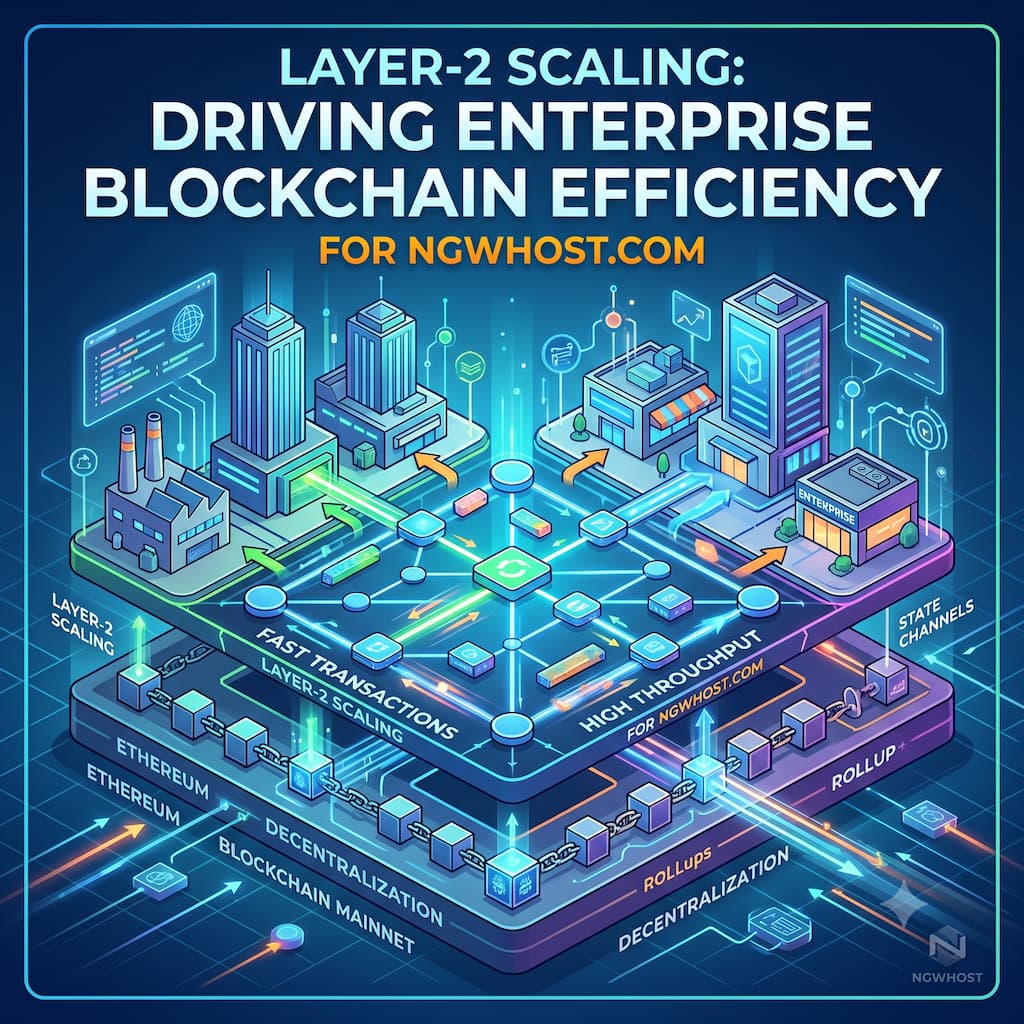
An L2 infrastructure functions as an independent, high-performance execution highway running directly on top of the L1 foundation. The core principle is elegant: the L2 layer processes thousands of complex business logic calculations, state updates, and transaction sequences off-chain in milliseconds.
Once a massive batch of transactions is executed locally, the L2 compresses the entire dataset into a single, compact cryptographic proof or transaction summary and routes it down to the L1.
The L1 treats this batch as a single transaction, executing final settlement and anchoring the compressed data to its immutable security core. By decoupling computational execution from global consensus settlement, enterprises achieve a radical expansion in performance without diluting the underlying network’s trust architecture.
2. Core Pillars of the Enterprise Layer-2 Infrastructure Stack
Building a resilient, enterprise-grade L2 environment requires a systematic understanding of the varying mathematical structures used to compress and secure off-chain data. Technology teams build their scaling strategies around three dominant L2 technical frameworks.
Pillar I: Rollup Architectures (Optimistic vs. Zero-Knowledge)
Rollups represent the most powerful and secure class of Layer-2 scaling solutions because they maintain an explicit property known as Data Availability on the L1. This means that while computation happens off-chain, the transaction data itself is continuously published down to the base layer, ensuring the network can be fully reconstructed at any moment.
- Optimistic Rollups: This framework operates under the assumption that all off-chain transactions are valid by default. Transactions are bundled together and committed to the L1 immediately without upfront validation. To prevent fraud, the architecture enforces a strict Fraud-Proof Window (typically 7 days). During this period, any independent monitoring node can submit a mathematical challenge proving a transaction was fraudulent. If fraud is verified, the network state rolls back, and the malicious sequencer is penalized. For enterprises, while Optimistic Rollups provide massive throughput gains, the multi-day withdrawal delay introduces capital inefficiencies for liquid financial assets.
- Zero-Knowledge (ZK) Rollups: ZK-Rollups replace human monitoring windows with absolute mathematical certainty. Instead of assuming transactions are valid, a ZK-Rollup runs every off-chain batch through an intensive cryptographic computation to generate a Validity Proof (such as a SNARK or STARK). This proof is submitted directly to an L1 smart contract alongside the compressed block data. If the mathematical proof validates, the transactions achieve instant finality on the base layer. ZK-Rollups represent the gold standard for enterprise scaling; they eliminate withdrawal delays, compress data fields up to 100x, and offer unprecedented performance velocities.
Pillar II: State Channels and Directed Micro-Payment Corridors
For enterprise use cases that demand continuous, sub-second transaction velocities between a fixed, known group of counterparties—such as two global logistics partners continuously settling toll infrastructure fees or localized IoT devices streaming electricity telemetry—processing data through a rollup can still introduce unnecessary overhead.
- The Scale Blueprint: Teams implement State Channels. A state channel allows participants to lock a portion of the L1 state into a secure multi-signature smart contract. Once locked, the counterparties can exchange an infinite volume of transactions off-chain directly with each other. These transactions require no block confirmations and consume zero gas; they are simply cryptographically signed state updates. When the business interaction concludes, the final net balance state is submitted to the L1, which executes a single closing settlement transaction.
Pillar III: Sidechains and Enterprise Appchains
When a corporate entity requires complete, uncompromised control over its runtime operating environment, transaction access rules, and structural block parameters, it deploys custom Sidechains or Appchains (Application-Specific Blockchains) bridged directly to the L1 fabric.
- The Scale Blueprint: Utilizing enterprise development toolkits (such as Avalanche Subnets, Arbitrum Orbit, or Polygon CDK), organizations spin up single-tenant, independent blockchain networks. These appchains maintain their own local consensus validators, allowing the company to mandate that all network nodes pass background identity checks, comply with local data privacy regulations, and process transactions using a fixed, predictable fee model. A secure cryptographic bridge handles the transfer of tokenized assets and state roots between the permissioned appchain and the global public L1, providing a balanced hybrid enterprise environment.
3. High-Performance Optimization: The Layer-1 vs. Layer-2 Metric Matrix
Deploying a software-defined Layer-2 infrastructure allows enterprise systems architects to bypass the performance constraints of legacy decentralized databases.
- Transactional Throughput: Highly constrained past 15–30 TPS on traditional Layer-1 engines. Scaled L2 frameworks unlock massive velocity scaling past 10,000+ TPS programmatically.
- Average Settlement Latency: High and variable structural lag on L1, varying with gas block space. L2 delivers sub-second off-chain execution with rapid proof settlement loops.
- Transaction Fee Predictability: Volatile L1 gas markets create unpredictable operational overhead. L2 provides stable, fraction-of-a-cent micro-fees for high-volume transactions.
- Data Compression Efficiency: Low on standard L1 because every field must be recorded globally. L2 compresses records up to 100x using mathematical validity verification.
- Corporate Access Control: Public configurations restrict privacy on basic L1 setups. L2 supports enterprise appchains that selectively mask operational ledger details.
4. Operational Implementations: Layer-2 Scaling in Action
To comprehend the transformative scale of L2 infrastructure, we can evaluate how global corporations deploy these scaling fabrics across everyday enterprise operations.
High-Frequency IoT Supply Chain Telemetry
Managing an international pharmaceutical or cold-chain grocery supply network requires tracking thousands of moving containers, automated warehouse pallets, and transport assets simultaneously. Every asset is equipped with IoT sensors that output continuous updates regarding location coordinates, interior temperature bounds, and humidity levels.
Attempting to log every individual sensor update directly to an L1 blockchain would trigger astronomical gas fees within hours, crashing the network’s economic viability.
By inserting a high-throughput ZK-Rollup layer, the IoT devices stream their telemetry directly into an off-chain sequencer at a rate of thousands of events per second. The L2 engine processes the data streams, checks the telemetry against pre-set quality compliance boundaries via smart contracts, and rolls up 50,000 individual readings into a single, compact validity proof.
This proof is submitted to the L1 in a single transaction, anchoring a bulletproof, unalterable audit trail of the entire supply chain’s compliance record at a fraction of a cent per log.
International Interbank Settlement and Liquidity Optimization
For global financial institutions executing cross-border currency conversions, trade finance clearings, or institutional remittance routing, processing payments through legacy banking corridors involves multiple correspondent banks, high transfer fees, and days of settlement lag.
By building a permissioned L2 Appchain network anchored to a public L1, a banking consortium can establish an instant interbank settlement network. Banks tokenize fiat reserves into compliant digital cash assets on the appchain.
When a trade clears, the L2 state machine executes atomic, sub-second delivery-versus-payment settlement across the ledger. Because the appchain is private, transaction details remain fully masked from competitors, while the periodic cryptographic state anchoring down to the public L1 ensures that the network’s financial records are backed by unassailable, global security.
5. Security Architecture for Layer-2 Enterprise Bridges
Because Layer-2 networks function by locking massive pools of value and state data inside L1 smart contracts while processing transactions off-chain, the cryptographic bridges connecting these layers represent high-priority targets for advanced cyber-adversaries. Securing these bridges demands a strict adherence to Zero-Trust Infrastructure Standards.
Implementing Decentralized Multi-Party Sequencer Networks
Many early-stage or poorly architected L2 networks rely on a single, centralized server node—known as a Sequencer—to accept, order, and batch off-chain transactions. A centralized sequencer introduces an unacceptable single point of failure; if the sequencer crashes or faces a coordinated DDoS attack, the enterprise’s transaction pipeline freezes.
- The Security Remedy: Enterprise L2 architectures deploy a decentralized network of sequencers managed via Multi-Party Computation (MPC) cryptographic nodes. The task of ordering and batching transactions is rotated programmatically across a distributed pool of verified validator nodes. This design ensures that even if multiple individual sequencing nodes face infrastructure outages or adversarial compromises, the broader L2 scaling fabric continues to validate, compress, and settle corporate data without interruption.
Formal Verification of L2 Bridging Smart Contracts
Cross-layer smart contracts handle the absolute custody of locked enterprise assets on the L1. A single logical code bug or edge-case vulnerability within the bridge’s lock-and-mint script can result in catastrophic capital loss.
- The Security Remedy: Prior to moving any live capital onto an L2 network, all bridging smart contracts must undergo rigorous Formal Verification Audits. Formal verification uses advanced mathematical logic to audit the contract’s source code, proving scientifically that the program will behave exactly as intended under every conceivable runtime scenario. This approach eliminates the risk of coding errors and shields the enterprise capital core from exploit vectors.
6. Regulatory Convergence: Adhering to Global Digital Asset Directives
Deploying enterprise blockchain solutions requires navigating a tightening web of global regulatory frameworks. Compliance leaders must ensure their scaling architectures conform with international oversight bodies.
- The MiCA Framework (European Union): Enforcing strict guidelines across all EU member states, MiCA mandates that any digital asset or tokenized instrument must operate with absolute transparency, verified asset reserves, and auditable transaction tracking pipelines.
- The SEC Digital Security Mandates: Imposing rigorous criteria within the United States, this framework requires that any tokenized corporate bond, fractionalized equity, or yield-bearing asset must utilize a permissioned ledger architecture equipped with automated KYC/AML compliance enforcement.
- Global Data Sovereignty Regulations: Directives like GDPR require that personal identifiable information (PII) must never be permanently recorded on a public, immutable ledger. Layer-2 architectures satisfy this requirement by processing and masking raw user data off-chain within local enclaves, publishing only anonymous cryptographic validity proofs down to the public L1.
Read More⚡ Private Equity Trends: Navigating Cross-Border Tech Buyouts
Conclusion: Engineering the Automated Corporate Fabric
The integration of Layer-2 scaling architectures is not an optional optimization for corporate blockchain projects; it is a fundamental technological requirement to achieve enterprise-grade scale. The historical methodology of deploying decentralized applications directly on congested L1 engines—while accepting high transaction fees, unpredictable settlement latencies, and visible data exposure—is an unviable strategy that stalls corporate growth.
By decoupling computational execution from base-layer consensus, deploying high-density ZK-Rollup proof systems, leveraging permissioned appchain networks, and hardcoding zero-trust cryptographic security into cross-layer bridges, technology leaders do far more than just accelerate transaction speeds. They forge an incredibly fast, cost-predictable, and structurally unassailable engine for global corporate innovation.
Ultimately, the competitive advantage in the future of the digital economy belongs entirely to the agile enterprises that can process transactions as fast as they process data—mastering Layer-2 scaling fabrics to drive secure, seamless, and market-leading global expansion across any digital horizon.
Deploying computationally intensive ZK-Rollup provers, high-throughput L2 sequencer nodes, decentralized vector databases, and real-time cross-chain bridge monitoring portals requires world-class, zero-downtime server infrastructure. Secure your company’s digital ledger core on an unassailable foundation by exploring the premium enterprise hosting configurations at ngwhost.com.