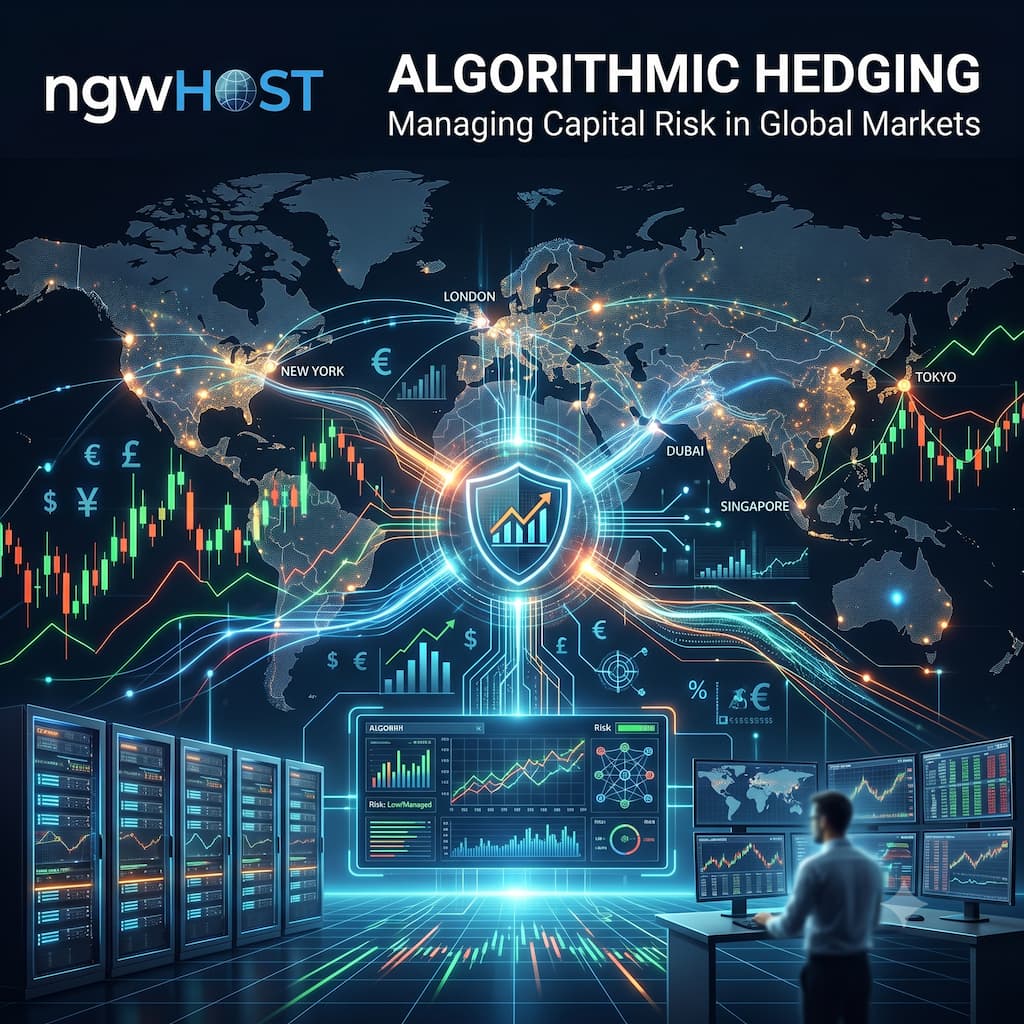
Algorithmic Hedging: Managing Capital Risk in Global Markets
The modern international financial landscape operates in a state of high-velocity interconnection. Corporate treasuries, institutional asset managers, and global enterprise networks execute business operations across multiple geographic borders, exposing their capital infrastructure to a continuous matrix of market risks. A sudden shift in a central bank’s interest rate policy, an unexpected supply-chain disruption across cross-border trade corridors, or a flash liquidity contraction in foreign exchange (FX) markets can instantly erode operating margins and wipe out projected corporate equity.
Historically, managing these financial exposures relied on manual, retrospective hedging strategies. Risk committees analyzed historical variance tables, evaluated regional exposures on a monthly or quarterly cadence, and manually placed protective derivative contracts via traditional banking counterparty desks.
While these static techniques offered adequate protection in slower, isolated economic eras, they introduce severe systemic vulnerabilities in today’s electronic, automated market structure.
When correlations between traditionally distinct asset classes shift instantly during macroeconomic shocks, relying on human intervention and delayed spreadsheets creates severe capital risk exposure. To insulate corporate balance sheets from rapid market movements, preserve operational cash flows, and secure systemic advantages during periods of heightened volatility, enterprise leaders are upgrading their risk architecture.
They are systematically deploying autonomous, data-driven frameworks known as Algorithmic Hedging. Far from a speculative trading mechanism, algorithmic hedging represents the definitive defense fabric for institutional capital preservation.
1. The Strategic Imperative: Quantifying Multi-Variable Capital Risk
To build a high-performance algorithmic hedging framework, risk directors must first categorize global market volatility into distinct, structurally measurable risk vectors.
Vector I: Currency and Foreign Exchange (FX) Volatility
Multinational corporations that source materials globally or generate revenues across multiple international jurisdictions face severe transaction and translation risk. If an enterprise sells software or industrial equipment in the European Union but anchors its core corporate reporting ledger in US Dollars, a sudden 5% appreciation of the USD against the Euro can decimate quarterly earnings projections—even if local sales volumes hit record highs.
Algorithmic hedging tracks these currency pairs continuously, calculating real-time value-at-risk (VaR) parameters and placing automated counter-positions to smooth out currency fluctuations.
Vector II: Interest Rate Swings and Debt-Servicing Volatility
As global macroeconomic cycles experience rapid shifts in monetary policy, corporate capital structures backed by variable-rate commercial debt face immediate cost inflation. A sudden, unhedged spike in central bank interest rates expands debt-servicing requirements overnight, consuming free cash flow that was originally earmarked for research and development or capital expenditures (CapEx).
Algorithmic models monitor the global yield curve, programmatically converting variable interest exposures into predictable, fixed-rate obligations through automated derivative matching.
Vector III: Commodity Price Adjustments and Input-Cost Risk
For industrial manufacturers, automotive conglomerates, and logistics networks, localized geopolitical friction can trigger severe, unexpected spikes in the cost of raw inputs—such as aluminum, semiconductor components, energy, or freight capacity.
If a company operates under long-term, fixed-price supply contracts with its customers but must purchase its raw inputs from volatile spot markets, input-cost spikes can compress manufacturing margins to zero. Algorithmic hedging shields the organization by automatically scaling long positions in relevant commodity futures contracts the moment price velocities breach predefined thresholds.
2. Core Pillars of an Institutional Algorithmic Hedging Architecture
Transitioning a corporate treasury from manual derivative placement to an autonomous hedging engine requires an integrated, multi-layered technology stack built across four foundational pillars.
Pillar I: High-Throughput Real-Time Market Data Ingestion
The functional core of an algorithmic risk engine is its capacity to digest, normalize, and interpret massive streams of international market data without introducing latency or processing gaps.
- The Scale Blueprint: Platforms implement cloud-native data ingestion pipelines integrated directly into global interbank liquidity feeds, electronic communication networks (ECNs), and institutional data providers (such as Bloomberg B-PIPE or Reuters). The engine continuously ingests real-time pricing telemetry, order-book depth matrices, and implied volatility surfaces across hundreds of derivative instruments simultaneously, creating a live, unified model of global market state.
Pillar II: Dynamic Delta-Neutral and Real-Time Risk Parity Core
Traditional hedging playbooks treat risk mitigation as a binary, all-or-nothing decision: a contract is either hedged or unhedged. Algorithmic architecture replaces this static model with continuous, mathematical adjustments known as Dynamic Delta Hedging.
- The Scale Blueprint: The algorithm calculates the portfolio’s aggregate Delta (\Delta)—the exact mathematical sensitivity of the enterprise’s corporate assets relative to changes in underlying market prices. As spot prices fluctuate, the engine runs continuous calculus loops to determine the required offset. It automatically executes fractional trades in liquid derivatives (such as futures, options, or swaps) to keep the aggregate portfolio within a strict, risk-neutral envelope, systematically eliminating downside exposure without requiring human approval.
Pillar III: Multi-Asset Programmatic Execution and Smart Order Routing
Once the hedging model identifies a required structural modification to its protective positions, it must execute those trades across global exchanges without triggering high execution costs or alerting market counterparties.
- The Scale Blueprint: The hedging engine connects directly to centralized and decentralized execution venues via hardened Application Programming Interfaces (APIs). The system utilizes sophisticated execution algorithms—such as Time-Weighted Average Price (TWAP) or Volume-Weighted Average Price (VWAP)—to slice a multi-million-dollar protective order into thousands of micro-transactions. These transactions are distributed across multiple distinct liquidity pools via Smart Order Routing (SOR), minimizing price slippage and preserving execution anonymity.
Pillar IV: Continuous Predictive Stress Testing and Scenario Simulation
Maintaining a resilient capital defense requires the hedging infrastructure to evaluate its effectiveness against unexpected, extreme market dislocations, commonly referred to as Black Swan Events.
- The Scale Blueprint: The algorithm hooks directly into historical macro databases and real-time news sentiment data lakes to execute thousands of automated, continuous Monte Carlo Simulations. The system models how the enterprise asset pool would behave during a wide array of potential macro crises—such as a sudden regional banking failure, a major geopolitical supply corridor freeze, or a flash currency devaluation. If a simulation reveals that a specific tail-risk event would breach the corporation’s maximum allowable loss thresholds, the algorithm automatically adjusts its base options structures to add tail-risk protection.
3. High-Performance Optimization: The Risk Architecture Matrix
Upgrading from human-centric risk modeling to an autonomous algorithmic hedging engine radically alters an organization’s capital performance metrics.
- Risk Evaluation Latency: Manual review requires days or weeks of multi-department aggregation. Algorithmic engines process risk profiles in sub-milliseconds through live data loops.
- Execution Slippage Cost: Large block orders face heavy price penalties via manual dealer desks. Smart order routing slices orders across venues to achieve near-zero slippage.
- Human Error Mitigation: Manual execution is highly vulnerable to keying errors and fatigue. Automated systems enforce absolute mathematical accuracy across all trade parameters.
- Portfolio Drag Efficiency: Static hedges impose heavy, continuous premium costs on corporate cash flows. Dynamic delta-tuning minimizes premium costs up to 40% via precise sizing.
- Regulatory Compliance Auditing: Manual reporting requires laborious log collection for audit compliance. Algorithmic frameworks generate an immutable, real-time cryptographic audit trail of every transaction.
4. Operational Implementations: Algorithmic Hedging in Global Corporate Commerce
Analyzing how these mathematical risk frameworks perform across real-world enterprise environments demonstrates their ability to stabilize multinational cash flows.
Dynamic FX Hedging for Global E-Commerce Conglomerates
Consider a global retail conglomerate that processes millions of daily digital transactions across dozens of international currencies, while consolidating its primary corporate capital reserves in London (GBP). The company faces an unceasing stream of micro-transactional FX risk. If a major currency pair like the EUR/GBP spikes unpredictably during a high-volume shopping holiday, the conversion margins can collapse before the funds can clear through traditional banking networks.
By deploying an automated FX hedging engine, the platform interfaces directly with its digital payment processing gateways. As international customer checkouts occur, the engine calculates the net currency exposure in real time.
The moment the unhedged cross-border exposure breaches a predefined capital threshold, the algorithm automatically places fractional short-term FX forward contracts or mini-futures through an ECN to lock in the precise exchange rate. This real-time automation insulates the corporate treasury from intraday market volatility, guaranteeing consistent, predictable profit margins.
Dynamic Input-Cost Stabilization for Global Freight and Logistics Networks
A global maritime shipping and air-freight logistics network relies heavily on fuel capacity to sustain its international transport fleets. Fuel costs represent its primary, highly volatile operational input expense. If geopolitical tensions trigger a sudden, sharp spike in global crude oil or marine gasoil prices, the company’s operating costs can skyrocket faster than it can adjust its long-term client shipping rates.
The organization protects its balance sheet by implementing a commodity-focused algorithmic hedging engine. The algorithm tracks spot energy prices, international shipping volumes, and global refining margin data points concurrently.
If the model detects a strong upward momentum trend in fuel spot markets combined with tightening global storage inventories, it automatically buys call options and enters into energy swap agreements across commodity exchanges.
As physical fuel prices rise at the pump, the financial gains generated by the algorithm’s derivative positions cleanly offset the higher physical fuel bills, allowing the logistics network to maintain stable shipping rates and protect shareholder equity.
5. Security Architecture for Automated Capital Trading Engines
Because an enterprise algorithmic hedging engine manages direct connections to corporate bank repositories, executes multi-million-dollar financial transactions, and commands active API credentials to global exchange networks, the underlying technology infrastructure represents a high-priority target for sophisticated cyber-espionage entities and malicious financial threat actors.
[Inbound Market Telemetry] ──> [Zero-Trust API Envelope] ──> [MPC Multi-Signer Quorum] ──> [ Hardened Exchange Ledger]
Implementing Multi-Party Computation (MPC) Cryptographic Trade Safeguards
Enterprise risk managers must never store the master private keys or API administrative authorization tokens to their corporate exchange accounts on standard cloud servers or within single physical hardware storage drives.
- The Security Solution: Deploy a comprehensive Multi-Party Computation (MPC) architecture across the entire trading execution infrastructure. MPC cryptographically divides the administrative access keys into separate, mathematical shards distributed across geographically isolated server environments and independent executive risk heads. To authorize a significant modification to the core hedging parameters, alter capital transfer destinations, or release substantial trading margins, a preset quorum of corporate signers must validate the transaction concurrently, neutralizing the threat of single-point credential theft or insider collusion.
Enforcing the Zero-Trust API Network Envelope
As algorithmic hedging engines interact continuously with external banking APIs, public derivative exchanges, and multi-tenant cloud telemetry feeds, the communication corridors must be completely secured against interception or tampering.
- The Security Solution: Wrap all inbound and outbound data feeds, trading endpoints, and internal analytics systems inside a strict Zero Trust Network Access (ZTNA) envelope. Every single connection path must mandate rotating cryptographic access tokens, present valid mutual TLS (mTLS) certificates, and undergo real-time behavioral payload inspection. Any network packet displaying anomalous execution telemetry is instantly isolated, keeping the enterprise financial engine protected from lateral intrusion or external data manipulation.
6. Regulatory Convergence: Adhering to International Financial Standards
Deploying automated financial engines requires strict adherence to an evolving global network of financial regulatory oversight frameworks.
- The Dodd-Frank Act / EMIR Compliance: Imposing rigid transaction-reporting parameters within the United States and the European Union, these directives require that all over-the-counter (OTC) and exchange-traded derivative positions executed by corporate entities must be reported to central trade repositories within strict, time-delimited windows.
- MIFID II Framework: Enforcing absolute market transparency across European capital channels, MiFID II requires algorithmic execution systems to maintain rigorous, timestamped event logging, document exact smart-order routing logic, and pass systematic stress-testing validation loops to protect market stability.
- Global Data Sovereignty Mandates: Directives like GDPR require that any personal or corporate identity records linked to financial transactions must reside strictly within local sovereign cloud nodes, forcing algorithmic platforms to employ decentralized, multi-region database architectures.
Read More⚡ Asset Management: Strategy for Institutional Wealth Allocation
Conclusion: Securing Long-Term Corporate Capital Moats
The deployment of an algorithmic hedging infrastructure is not an optional optimization tool for corporate finance departments; it is a fundamental architecture upgrade required to navigate tomorrow’s hyper-connected, high-velocity economic arena. The legacy practice of managing multi-market volatility through slow, human-centric evaluation processes—while tolerating severe execution slippage, opaque data visibility, and lagging risk response loops—is an unviable operational methodology that invites catastrophic balance-sheet erosion.
By forging an integrated risk management fabric built on high-velocity data ingestion, continuous dynamic delta-neutral calculus cores, automated smart order routing, and ironclad multi-party cryptographic security protocols, progressive enterprise leaders transform their corporate treasuries from passive cost centers into powerful strategic assets.
Ultimately, the future of international enterprise stability belongs entirely to the agile corporations that can evaluate and mitigate capital risk as fast as the market moves—mastering algorithmic hedging structures to drive secure, unassailable, and market-leading global scale across any financial horizon.
Deploying computationally intensive risk parity simulators, high-throughput market data lakehouses, real-time delta-hedging execution engines, and low-latency smart order routing portals requires world-class, zero-downtime server infrastructure. Secure your company’s financial core on an unassailable foundation by exploring the premium enterprise hosting architectures at ngwhost.com.