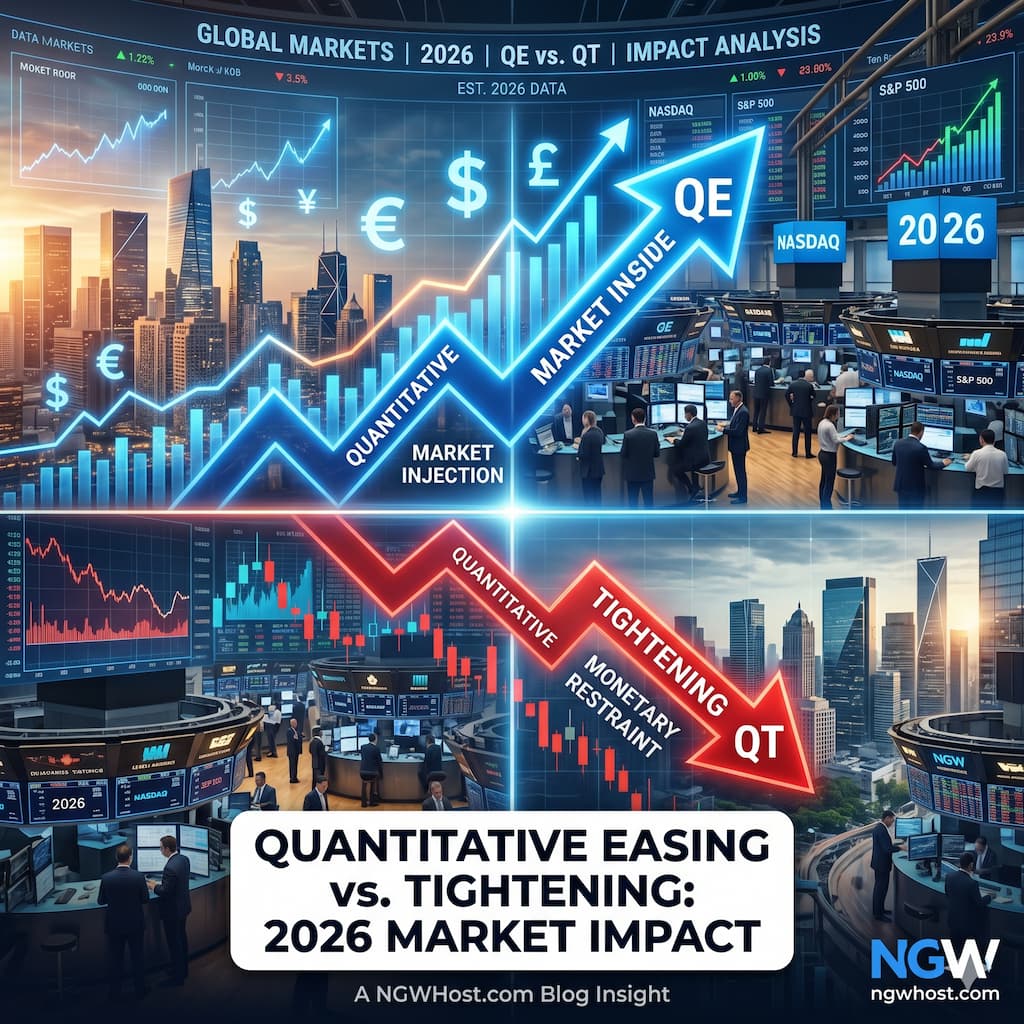
Quantitative Easing vs. Tightening: 2026 Market Impact
As we move through May 2026, the global financial architecture is undergoing one of its most complex structural shifts in decades. For the readers of ngwhost.com, who understand that digital infrastructure and financial stability are inextricably linked, the battle between Quantitative Easing (QE) and Quantitative Tightening (QT) has moved from theoretical central bank policy to a daily driver of market volatility and opportunity.
In this deep dive, we will explore the 2026 landscape where central banks are no longer moving in lockstep, the resurgence of inflation fueled by geopolitical shocks, and the definitive impact of these balance sheet maneuvers on your portfolio and business.
1. The 2026 Macro Pulse: A Divergent World
To understand the 2026 market, one must first recognize that the era of “unified global easing” is over. We are currently witnessing a historic Policy Divergence among the world’s major central banks.
The Federal Reserve: Re-injecting Liquidity
After a multi-year campaign of shrinking its balance sheet, the U.S. Federal Reserve officially ended its Quantitative Tightening (QT) program on December 1, 2025. As of May 2026, the Fed has shifted back into a supportive stance.
- Reinvestment: The Fed is now reinvesting the proceeds from maturing assets back into the market.
- Targeted Easing: Since late 2025, the Fed has been purchasing short-term government debt at a rate of up to $40 billion per month. This isn’t “full-scale QE,” but it is a strategic injection of liquidity designed to stabilize short-term funding markets and support the massive “AI-driven” technology investment cycle currently fueling the S&P 500.
The Bank of England and ECB: The Long Squeeze
In contrast, the Bank of England (BoE) and the European Central Bank (ECB) remain in active tightening mode.
- BoE’s Active Sales: The BoE is aggressively reducing its balance sheet, aiming for a £70 billion reduction by September 2026.
- The Middle East Shock: A new conflict in the Middle East has pushed global energy prices higher, causing UK inflation to spike to 3.3% in April 2026. This has forced the BoE to maintain a “tight” stance, keeping the Bank Rate at 3.75% even as the economy shows signs of slack.
2. Quantitative Easing (QE) vs. Tightening (QT): The Mechanics
For those managing digital assets or servers on ngwhost.com, these policies are the “blood pressure” of the global economy.
Quantitative Easing (QE): The Accelerator
When the Fed or ECB “eases,” they create digital bank reserves to buy government bonds and mortgage-backed securities.
- Impact: This drives bond prices up and yields down.
- The Goal: To flood the system with cash, making borrowing cheaper for businesses and encouraging investors to move capital into “riskier” assets like tech stocks, real estate, and digital infrastructure.
Quantitative Tightening (QT): The Brake
QT is the process of letting those assets roll off the balance sheet without replacing them, or actively selling them back to the market.
- Impact: This removes liquidity from the system, effectively “tightening” the supply of money.
- The Goal: To fight inflation by increasing long-term borrowing costs and cooling down an overheated economy.
3. Market Impact: Why May 2026 is a Turning Point
The current month marks a critical junction where the “lagged effects” of 2025’s tightening are colliding with 2026’s new inflationary pressures.
A. The Tech Equity “Supercycle”
The S&P 500 has delivered double-digit returns for three consecutive years leading into 2026. However, the “AI Supercycle” is facing a test. While the Fed’s pivot to reinvestment provides a liquidity floor, the BoE and ECB’s ongoing QT is creating a “liquidity vacuum” in European markets.
Market Risk: If investor patience with AI’s Return on Investment (ROI) thins, the removal of liquidity through QT could trigger a sharp correction in tech valuations, as seen in the recent 10% drawdowns in major indices.
B. Fixed Income and Yield Curves
In May 2026, government bond yields remain near post-GFC highs, often hovering above 5% for certain maturities.
- The Opportunity: For the first time in years, “Cash is not trash.” High-yield savings and money market funds are benefiting from the structural shift toward higher terminal rates.
- The Burden: For corporations with high debt-to-GDP ratios, the “Tightening” in Europe is making refinancing an expensive nightmare, leading to a surge in M&A activity as smaller firms are swallowed by cash-rich giants.
C. Real Assets and Commodities
With headline inflation expected to remain “sticky” around 3% in the U.S. and higher in Europe, May 2026 has seen a rotation into Real Assets. Gold, defense stocks, and companies providing domestic energy resilience are the winners of the “Fragmentation” theme currently dominating the J.P. Morgan Mid-Year Outlook.
4. Comparing the Giants: A Policy Snapshot (May 2026)
| Region | Policy Stance | Quantitative Status | Interest Rate |
| USA (Fed) | Neutral/Supportive | QE-Lite (Reinvesting) | 3.50% – 3.75% |
| UK (BoE) | Restrictive | Active QT (-£70bn target) | 3.75% |
| Eurozone (ECB) | Restrictive | Unwinding PEPP | 2.00% |
5. Strategic Roadmap for Investors on ngwhost.com
How do you protect your wealth and business when the world’s two largest economic zones are pulling in opposite directions?
1. Stress-Test Your Portfolio
The correlation between stocks and bonds is structurally higher in 2026. Traditional “60/40” portfolios are failing to provide the diversification they once did.
- Action: Incorporate Alternative Strategies—such as private credit or inflation-linked bonds—that perform well in “sticky” inflation environments.
2. Monitor the “Liquidity Scarcity” in Europe
If you have business interests or investments in the Eurozone, stay alert for “emerging reserve scarcity.” As the ECB continues its QT, money market rates could spike unexpectedly.
- Action: Ensure your cash holdings are in high-yield, liquid accounts that can adapt to rapid rate shifts.
3. Lean into AI Productivity
The best hedge against a “Tightening” environment is Efficiency. In 2026, companies that use AI to drive margin expansion and labor productivity are the ones that will maintain valuations even as liquidity is withdrawn from the system.
6. The “1970s Redux” Risk
A major concern for analysts this month is the “Rolling Shock” reality. If the Middle East energy shock persists through the second half of 2026, we risk a replay of the 1970s—where sticky inflation collides with weakening demand (Stagflation).
In this scenario, central banks like the BoE may be forced to increase rates even as the economy slows, a move that would drastically accelerate the negative impact of Quantitative Tightening.
Read More⚡ High-Yield Savings Accounts: Best Rates in May 2026
Conclusion: Agility is the New Alpha
In May 2026, the “Macro” is no longer a backdrop; it is the main event. The divergence between the Fed’s supportive “reinvestment” and the BoE/ECB’s aggressive “tightening” has created a fractured market frontier.
For the ngwhost.com community, the path forward is clear: be selective, stay liquid, and anchor in real assets. The era of “easy money” is a memory, and the era of “intelligent money” has begun. By understanding the mechanics of QE and QT, you can position your business and your investments to thrive, regardless of which way the central bank winds blow.
The balance sheets are shrinking, but your opportunity doesn’t have to. Are you positioned for the pivot?