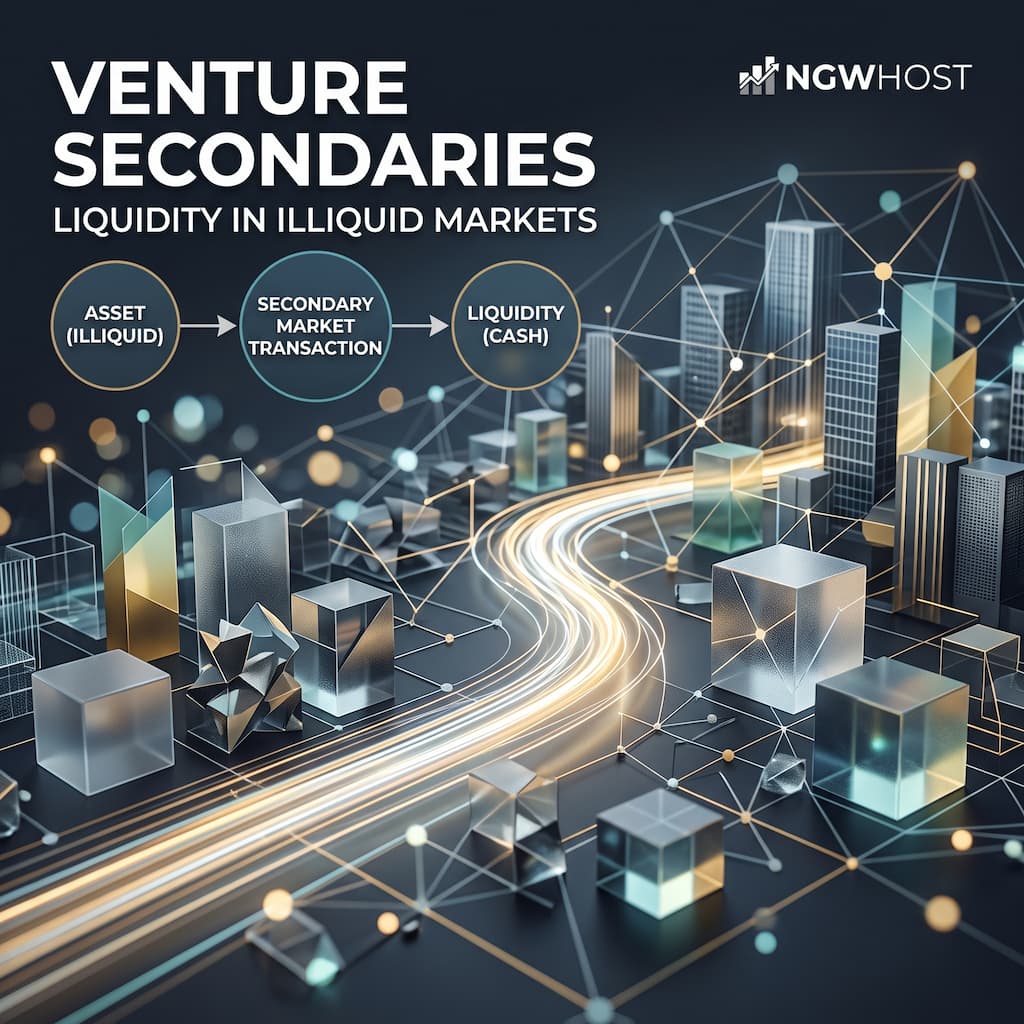
Venture Secondaries: Liquidity in Illiquid Markets
For decades, venture capital operated on a simple, predictable liquidity cycle. Institutional limited partners (LPs) committed capital to venture funds with a standard ten-year lifecycle. Venture capitalists deployed that capital into early-stage technology startups, nurtured those companies through successive funding rounds, and achieved complete liquidity through an initial public offering (IPO) or a strategic trade sale within five to seven years. Founders, early employees, and early-stage angel investors received substantial cash windfalls, while institutional funds distributed liquid returns back to university endowments, pension funds, and family offices.
That traditional liquidity timeline has fundamentally broken down.
Over the past decade, high-growth technology companies have chosen to remain private significantly longer. Fueled by private mega-rounds and alternative financing mechanisms, modern tech unicorns often spend twelve to fifteen years in private hands before even considering an IPO.
Simultaneously, macroeconomic volatility, elevated interest rates, and subdued public equity markets have created an unprecedented exit bottleneck. Billions of dollars in enterprise value remain trapped on private corporate balance sheets and fund cap tables.
This structural lock-up has created a severe liquidity crunch across the global venture ecosystem:
- Institutional LPs face negative net cash flows, unable to fund new capital calls because aging venture portfolios are not distributing liquidity.
- Venture Capital GPs struggle to raise successor funds without showing realized distributions (DPI – Distributed to Paid-In Capital).
- Founders and Early Employees find their net worth tied entirely to illiquid private shares, despite having spent a decade building successful market leaders.
To resolve this liquidity dilemma, the private capital ecosystem is executing a massive structural shift toward Venture Secondaries.
Venture secondaries represent the private market mechanisms that allow existing shareholders—including founders, employees, early investors, and venture funds—to sell their private company shares or fund stakes to dedicated secondary buyers before an official IPO or M&A transaction. No longer viewed as a distressed fire sale or a lack of conviction, the venture secondary market has transformed into a strategic, multi-billion-dollar liquidity management layer for modern technology finance.
This post analyzes the structural mechanics of venture secondaries, evaluates LP-led vs. GP-led transactions and direct secondary tenders, compares primary venture rounds against secondary market liquidity, and examines the cloud server infrastructure required to host high-consequence financial transaction platforms on ngwhost.com.
1. The Liquidity Squeeze: Why Private Markets Demand Secondary Solutions
To understand why secondary transaction volumes are surging across global technology hubs, one must examine the core structural friction points eroding traditional private market exits.
The Prolonged “Staying Private Longer” Era
In the early 2000s, technology companies went public at an average age of four to six years. Amazon, for instance, completed its IPO just three years after its founding. Today, enterprise SaaS leaders, fintech giants, and AI infrastructure platforms regularly spend ten to fifteen years scaling privately.
While staying private shields management teams from the scrutiny and quarterly compliance overhead of public markets, it locks employee equity and investor capital into indefinite holding patterns.
The DPI Deficit for Institutional LPs
Institutional limited partners allocate capital to venture funds based on the expectation of cyclical cash distributions. Throughout the 2010s bull market, venture funds reported exceptional paper gains (TVPI – Total Value to Paid-In Capital) driven by rapidly escalating private valuations.
However, paper gains cannot pay pension obligations or university operational budgets. LPs require realized cash returns (DPI).
When public IPO windows freeze, LPs stop receiving distributions, forcing them to turn to secondary buyers to rebalance their private equity allocations.
The Talent Retention and Liquidity Crisis
Startups attract top-tier engineering, product, and executive talent by offering substantial equity packages (stock options and RSUs).
When a company’s path to an IPO stretches past a decade, employees face significant financial strain. They hold illiquid paper wealth while needing liquidity to buy homes, pay taxes on exercised options, or fund family milestones.
Without structured secondary liquidity programs, high-performing employees leave mature startups for public companies that offer liquid equity compensation.
2. Structural Mechanics: The Core Types of Venture Secondary Transactions
The venture secondary market is not a single monolithic transaction type; it encompasses several distinct legal, financial, and contractual frameworks tailored to different market participants:
Direct Secondaries (Employee & Founder Share Sales)
In a direct secondary transaction, existing shareholders (founders, former and current employees, angel investors) sell their common stock or vested equity directly to an incoming institutional secondary buyer:
- Company-Sponsored Tender Offers: The company’s board approves a structured liquidity program, setting a fixed share price and allowing eligible employees to sell a pre-determined percentage of their vested shares (e.g., 10% to 20%) to an approved institutional investor.
- Bespoke Direct Transfers: An individual shareholder negotiates a private sale of their shares to an external buyer. These transactions are typically subject to the company’s Right of First Refusal (ROFR) and require formal board approval.
LP-Led Secondary Transactions (Portfolio Level)
In an LP-led transaction, an institutional limited partner sells its commitment in an existing venture capital fund to a secondary fund manager.
The buyer takes over the selling LP’s position in the fund, assuming all future capital call obligations and acquiring the rights to all future distributions from the underlying portfolio companies. This allows the selling LP to achieve immediate cash liquidity and rebalance its portfolio allocation.
GP-Led Secondary Transactions & Continuation Vehicles
When a venture fund reaches the end of its contractual 10-year term, but several of its high-performing portfolio companies still have substantial growth potential and are not yet ready for an IPO, the General Partner (GP) may structure a Continuation Vehicle (CV):
- The Continuation Fund: The GP creates a new special-purpose fund backed by dedicated secondary investors.
- The Asset Transfer: The trophy assets from the aging fund are rolled into the new continuation vehicle.
- The LP Choice: Existing LPs are given a choice: they can either cash out their position immediately at a market-clearing secondary price or roll their equity into the new vehicle to participate in future upside.
3. Structural Optimization Ledger: Primary Venture Rounds vs. Venture Secondaries
Evaluating the core legal, financial, and operational differences that separate traditional primary capital raises from secondary transactions highlights why mature tech ecosystems utilize both mechanisms synergistically.
Capital Flow & Balance Sheet Impact
- Primary Venture Round: Capital flows directly onto the company’s balance sheet to fund operational growth, hiring, R&D, and marketing.
- Venture Secondary Transaction: Capital flows directly to selling shareholders (founders, employees, early investors). Zero cash is added to the corporate balance sheet.
Corporate Ownership & Equity Dilution
- Primary Venture Round: Highly dilutive. The company issues brand-new shares of stock, diluting the ownership percentages of all existing shareholders.
- Venture Secondary Transaction: Non-dilutive. Existing shares simply transfer from one holder’s name to another on the cap table. Total share count remains unchanged.
Share Class & Liquidation Preferences
- Primary Venture Round: Involves newly created Preferred Stock featuring liquidation preferences, anti-dilution clauses, and board representation rights.
- Venture Secondary Transaction: Typically involves existing Common Stock (or older Preferred series), which carries standard voting rights and no seniority over existing preferred classes.
Pricing Mechanism & Market Valuation
- Primary Venture Round: Establishes the company’s official “post-money” valuation based on forward-looking growth projections and institutional term sheets.
- Venture Secondary Transaction: Clears at a market-driven discount (or premium) to the last primary preferred valuation, reflecting asset illiquidity and share class differences.
4. Market Realities: Pricing Dynamics, Discounts, and Information Asymmetry
Executing a secondary transaction involves navigating complex market dynamics that do not exist in public stock exchanges:
The Common vs. Preferred Discount
Because secondary transactions involving employees typically deal in common stock, secondary pricing historically trades at a discount to the company’s last primary preferred stock valuation. Preferred stock carries downside protection (such as 1x liquidation preferences and dividend rights) that common stock lacks.
Depending on broader market conditions, secondary common shares typically clear at a 15% to 40% discount relative to the last primary round.
The Right of First Refusal (ROFR) and Board Approval
Unlike public stock markets where shares settle freely between buyers and sellers, private company bylaws almost universally contain strict transfer restrictions:
- Right of First Refusal (ROFR): Before a private sale can settle, the company (and often major preferred investors) holds the legal right to purchase the shares on the exact same terms negotiated with the external buyer.
- Information Rights and Non-Disclosure: Private companies closely guard their internal financial performance, customer churn metrics, and revenue figures. Secondary buyers must often price assets with limited access to internal management data, relying on sophisticated secondary underwriting models and market intelligence.
5. Systemic Operations: Cloud Infrastructure for High-Throughput Financial Gateways
Deploying, monitoring, and scaling private secondary trading platforms, automated tender offer portals, and institutional cap table management software demands an underlying digital server infrastructure that prioritizes high availability, low latency, and zero-downtime execution. Modern private market platforms process continuous, high-consequence data streams—ranging from encrypted shareholder equity ledgers and real-time secondary order books to automated KYC/AML verification pipelines and banking settlement webhooks.
If an enterprise secondary platform, institutional broker gateway, or equity compliance portal experiences database configuration drift, network packet loss, or server downtime during a live tender offer window, the consequences are immediate. Legal transfer notices drop, settlement clearing windows expire, and sensitive shareholder equity transactions stall—damaging institutional trust and introducing severe regulatory compliance liabilities.
To eliminate this operational friction, progressive fintech software engineering teams and digital platform developers deploy highly optimized, zero-downtime server architectures.
These infrastructure layers continuously monitor active API endpoints, encrypted cap table database write paths, and high-throughput transactional processing nodes, ensuring response times stay locked within sub-millisecond thresholds regardless of traffic volume.
Maintaining an unassailable infrastructure perimeter is vital to eliminate bandwidth bottlenecks, protect proprietary shareholder records, and preserve platform trust, driving peak structural execution across enterprise portals and hosting domains like ngwhost.com.
6. Strategic Playbook: How Modern Tech Companies Manage Secondaries
Rather than treating secondary transactions as an ad-hoc disruption, forward-thinking founders and CFOs actively integrate secondary programs into their ongoing capital management strategy:
- Implement Regular Company-Sponsored Tender Offers: Leading private companies conduct annual or biannual tender offers alongside major primary rounds. This provides controlled, fair liquidity for long-tenured employees while curating the cap table with high-quality, long-term institutional secondary funds.
- Clean Up the Cap Table: As companies mature, early angel investors, former advisors, and departed employees can clutter the shareholder register. Structured secondary programs allow the company to consolidate smaller share blocks into the hands of dedicated institutional partners who can support future growth.
- Mitigate Adverse Selection: When companies restrict unregulated, one-off secondary sales and replace them with transparent, board-approved liquidity programs, they eliminate information leaks, maintain control over secondary share pricing, and ensure compliance with securities regulations (such as Rule 144 and Section 409A valuations).
Read More⚡ Quantum Sensing: Navigation and Detection Without GPS
Conclusion: The Permanent Maturation of Private Capital Markets
Venture Secondaries are not a temporary byproduct of a slow IPO market; they mark a permanent, structural evolution in how private capital markets function. The historical paradigm that forced private companies and long-tenured employees to endure a decade of complete illiquidity before accessing capital is an obsolete framework that has been superseded by sophisticated secondary mechanisms.
The future of technology finance belongs entirely to the visionary founders, institutional fund managers, and data-driven platform networks that master the orchestration of venture secondary liquidity today.
By combining structured tender offers, GP-led continuation vehicles, transparent secondary underwriting, and zero-downtime digital cloud infrastructure perimeters, the international technology and investment communities are building an unassailable foundation for long-term innovation.
As private market infrastructure matures and secondary transaction volumes continue to expand globally, secondary liquidity will become standard practice across every high-growth tech enterprise—permanently establishing Venture Secondaries as the essential engine delivering liquidity in illiquid private markets worldwide.
Hosting computationally intensive financial transaction engines, processing real-time equity data streams, validating cloud-scale automation pipelines, and managing ultra-secure global server frameworks requires world-class, zero-downtime infrastructure. Secure your enterprise digital data framework on an unassailable foundation by exploring the premium hosting configurations at ngwhost.com.