
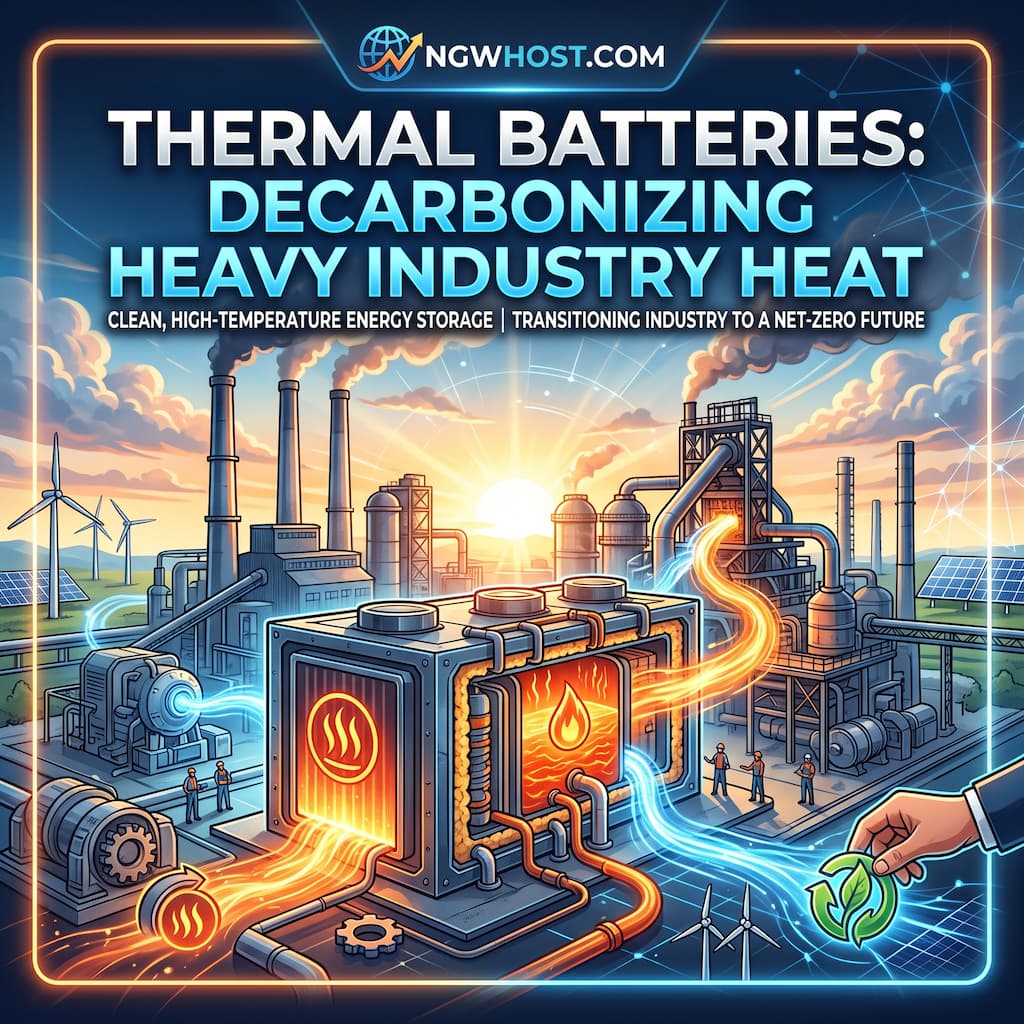
Thermal Batteries: Decarbonizing Heavy Industry Heat
Global decarbonization dialogues routinely center on electrical grids, passenger electric vehicles, solar farms, and battery-buffered consumer electronics. While greening the power grid is vital, focusing entirely on electricity overlooks a massive, carbon-intensive reality of global energy consumption: industrial process heat.
Approximately half of the world’s final energy consumption is dedicated to heat, and industrial process heat alone accounts for roughly a quarter of all global greenhouse gas emissions.
From high-temperature cement kilns and steel blast furnaces to food pasteurization lines, paper drying rollers, and chemical synthesis reactors, heavy industry runs on thermal energy.
Historically, fossil fuels—specifically natural gas, coal, and heavy fuel oil—held a practical monopoly over industrial heat. Fossil fuels provide high energy density, precise temperature control, continuous round-the-clock baseload reliability, and historically low unit costs.
Electrifying high-temperature industrial heat has historically been considered economically unfeasible due to two core hurdles:
- The Grid Capacity Bottleneck: Direct industrial electrification with resistance heaters demands massive, expensive electrical grid upgrades to manage volatile peak loads.
- The Intermittent Renewable Mismatch: Solar and wind power generate cheap, abundant clean electricity during the day or in windy conditions, but heavy industrial plants cannot halt production when the sun sets or the wind dies down. Continuous manufacturing requires uninterrupted thermal baseload power 24/7/365.
To solve this systemic energy bottleneck, an essential engineering primitive is scaling across the clean tech sector: Industrial Thermal Batteries.
A thermal battery (or thermal energy storage system) takes low-cost, intermittent clean electricity during periods of renewable overproduction, converts it into thermal energy via resistive heating elements, and stores that heat inside ultra-dense, low-cost solid or liquid media (such as refractory bricks, crushed rock, graphite blocks, or molten silicon) at temperatures reaching up to 1,500°C to 2,000°C.
When the plant requires energy, the thermal battery discharges continuous, high-temperature heat, superheated steam, or hot air on demand—delivering fossil-free baseload process heat at price parity with fossil fuels.
This post analyzes the thermodynamic mechanics of thermal energy storage, evaluates leading storage media and charging architectures, compares fossil-fired industrial heat against thermal battery systems, and examines the cloud server infrastructure required to host high-consequence industrial energy telemetry engines on ngwhost.com.
1. The Industrial Heat Barrier: Understanding Thermal Tiers
To understand why chemical engineering and heavy manufacturing plants are installing thermal batteries, one must examine the specific temperature tiers that define industrial thermal processes.
Industrial heat is categorized into three distinct operational tiers:
Low-Temperature Process Heat (<150°C)
Used extensively in commercial food processing, brewing, textile washing, agricultural drying, and district heating. This tier can often be addressed using commercial industrial heat pumps, which deliver high coefficients of performance (COP) at low temperature ranges.
Medium-Temperature Process Heat (150°C to 400°C)
Required for paper and pulp drying, chemical distillation, plastic molding, and rubber vulcanization. Standard industrial heat pumps cannot reliably operate at these elevated levels, forcing facilities to burn natural gas boilers to generate high-pressure steam.
High-Temperature Process Heat (>400°C to 1,500°C+)
Essential for heavy manufacturing, including primary chemicals (ethylene, ammonia), cement calcination, glass melting, and steel metallurgy.
This tier accounts for the vast majority of industrial fuel combustion emissions. Direct electrification via electrical resistance elements at this scale creates massive electrical power spikes that overwhelm localized grid substations.
Thermal batteries bridge this gap across both medium and high-temperature tiers by decoupling energy intake from energy output.
2. Structural Mechanics: How Thermal Energy Storage Systems Work
An industrial thermal battery functions as an electro-thermal energy buffer.
The system operates across three fundamental mechanical phases:
Phase 1: The Charging Cycle (Joule Heating)
When regional solar or wind farms generate excess electricity—often resulting in low or negative wholesale electricity spot prices—the thermal battery draws power from the grid or a collocated renewable generation plant.
The electrical power is routed through high-efficiency resistive heating elements, converting electrons into heat through Joule heating at nearly 100% conversion efficiency.
Phase 2: High-Density Thermal Containment (The Thermal Core)
The generated thermal energy is absorbed by a massive, insulated thermal storage core.
Depending on the specific engineering architecture, storage media include:
- Refractory Ceramic Bricks & Firebricks (e.g., Rondo Energy, Electrified Thermal Solutions): Engineered from abundant iron-oxide or alumina materials capable of withstanding temperatures exceeding 1,500°C for decades without physical degradation.
- Graphite & Solid Carbon Blocks (e.g., Antora Energy): Carbon blocks store heat at temperatures above 1,800°C, glowing white-hot and emitting intense thermophotovoltaic radiation.
- Molten Silicon & Liquid Metals (e.g., Fourth Power): Utilizes liquid silicon running in closed-loop systems capable of achieving ultra-high energy densities at extreme operating temperatures.
- Crushed Rock & Sand Beds (e.g., Polar Night Energy, Brenmiller Energy): Utilizes low-cost, locally sourced mineral aggregate packed inside vacuum-insulated pressure vessels.
The thermal core is surrounded by multi-layered, specialized insulation (such as microporous silica and vacuum jackets), ensuring thermal losses are kept below 1% to 2% per 24-hour period.
Phase 3: The Discharging Cycle (On-Demand Steam and Heat)
When the manufacturing facility requires process heat, ambient air, inert nitrogen gas, or water is circulated through internal heat-exchange channels running through the thermal core.
The fluid absorbs the stored heat, discharging as superheated steam, high-pressure hot air, or direct radiative thermal energy routed directly into the facility’s existing piping manifolds.
3. Structural Optimization Ledger: Fossil-Fired Boilers vs. Thermal Batteries
Evaluating the core operational, financial, and regulatory parameters that separate traditional natural gas combustion from industrial thermal batteries illustrates why industrial plant managers are adopting thermal energy storage.
Primary Energy Source & Feedstock
- Fossil-Fired Industrial Boilers: Volatile fossil commodities (natural gas, fuel oil, coal) subject to geopolitical supply shocks and price swings.
- Industrial Thermal Batteries: Low-cost, intermittent zero-carbon electricity (solar PV, onshore/offshore wind, hydro) captured during off-peak hours.
Carbon Footprint & Scope 1 Emissions
- Fossil-Fired Industrial Boilers: High Scope 1 emissions. Continuous greenhouse gas output (CO2, NOx, sulfur particulates) directly at the factory site.
- Industrial Thermal Batteries: Zero Scope 1 emissions. Fully fossil-free on-site heat delivery with zero point-source emissions.
Fuel-to-Heat Conversion Efficiency
- Fossil-Fired Industrial Boilers: 75% to 85% thermal efficiency due to significant flue-gas heat loss escaping through exhaust stacks.
- Industrial Thermal Batteries: 95%+ round-trip thermal efficiency. Closed-loop insulation systems retain nearly all absorbed electrical energy.
Integration with Existing Industrial Piping
- Fossil-Fired Industrial Boilers: Existing standard baseline setup.
- Industrial Thermal Batteries: Drop-in replacement. Feeds directly into existing plant steam lines, kilns, and heat exchangers without requiring plant-wide retooling.
4. High-Impact Industrial Deployments: Decarbonizing Core Sectors
Thermal batteries are being deployed across major industrial sectors, replacing fossil combustion with scalable thermal storage:
Cement and Concrete Manufacturing
Cement production is one of the world’s largest industrial polluters, requiring temperatures around 1,450°C to calcine limestone into clinker inside massive rotary kilns.
Thermal batteries pre-heat raw mineral feedstocks and deliver ultra-high-temperature air to kiln burners, displacing fossil fuels without disrupting the delicate thermochemical balance of clinker formation.
Steelmaking and Metallurgy
Primary steel manufacturing relies on burning metallurgical coking coal in blast furnaces.
By integrating thermal batteries with emerging Direct Reduced Iron (DRI) plants, steelmakers can use stored renewable heat to pre-heat green hydrogen gas and iron ore pellets, eliminating coal dependencies across heavy metallurgy pipelines.
Chemical Synthesis and Petrochemical Cracking
Producing fundamental industrial chemicals (such as ethylene, propylene, and ammonia) requires continuous steam cracking furnaces running at 800°C to 900°C.
Thermal batteries supply steady, high-temperature radiative heat to chemical cracking tubes, removing natural gas combustion from downstream chemical supply chains.
Food, Beverage, and Consumer Goods
Breweries, dairy processing plants, and food manufacturing facilities use massive volumes of low-to-medium-pressure steam for pasteurization, sterilization, cooking, and bottle washing.
Thermal batteries charge from on-site rooftop solar arrays during midday peak generation hours, discharging continuous steam throughout night shifts to eliminate natural gas boiler usage.
5. Systemic Operations: Cloud Infrastructure for High-Throughput Energy Telemetry
Deploying, managing, and optimizing industrial thermal battery fleets and wholesale power arbitrage systems demands an underlying digital server infrastructure that prioritizes high availability, low latency, and zero-downtime execution. Modern thermal battery installations operate on sophisticated industrial IoT (IIoT) control planes that process continuous, high-consequence data streams—ranging from multi-point thermal core thermocouple readouts and internal airflow velocity sensors to real-time wholesale electricity grid pricing APIs and automated power-dispatch webhooks.
If an industrial thermal control platform, automated grid-arbitrage gateway, or factory energy management system experiences database configuration drift, network latency, or server downtime during a critical grid-charging window, the consequences are immediate. The system misses low-cost electricity pricing spikes, thermal balancing algorithms fail, and factory steam production can fall out of compliance—triggering costly production shutdowns.
To eliminate this operational friction, progressive clean energy software providers, industrial plant operators, and digital platform developers deploy highly optimized, zero-downtime server architectures.
These infrastructure layers continuously monitor active API endpoints, encrypted SCADA telemetry database write paths, and high-throughput energy arbitrage calculation nodes, ensuring processing response times stay locked within sub-millisecond thresholds regardless of data volume.
Maintaining an unassailable infrastructure perimeter is vital to eliminate bandwidth bottlenecks, protect proprietary plant automation logic, and preserve platform trust, driving peak structural execution across enterprise portals and hosting domains like ngwhost.com.
6. Economic Realities: The Power-Arbitrage Playbook
The core economic driver behind thermal batteries is electricity price arbitrage.
Unlike chemical lithium-ion batteries—which are expensive, degrade with deep daily cycling, and become cost-prohibitive beyond 4 to 8 hours of storage duration—thermal battery materials are exceptionally cheap:
- Abundant, Low-Cost Storage Media: Materials like firebrick, graphite, and crushed rock cost pennies per kilogram, allowing thermal batteries to scale to 12, 24, or 48 hours of continuous storage capacity without exponential cost increases.
- Zero Chemical Degradation: Refractory bricks and solid carbon blocks do not experience dendrite formation, thermal runaway, or capacity fading. They can be cycled multiple times per day across a 30-to-40-year operational lifespan without degradation.
- Capturing Negative and Low-Cost Electricity Pricing: In regions with high solar and wind penetration (such as Texas, California, and Northern Europe), wholesale power prices frequently drop near zero or enter negative territory during peak generation hours. Thermal batteries consume this cheap energy, transforming it into heat that competes directly with natural gas on a dollar-per-gigajoule basis.
Read More⚡ Parallel EVMs: Scaling Blockchain Execution Speed
Conclusion: The Thermal Transformation of Heavy Industry
Thermal Batteries are not an incremental sustainability measure; they represent a fundamental thermodynamic shift in global industrial manufacturing. The legacy model that forced heavy industry to rely on uninterrupted fossil combustion to power thermal manufacturing is an obsolete paradigm that is being replaced by scalable, electro-thermal storage networks.
The future of global manufacturing belongs entirely to the visionary chemical engineers, plant managers, and data-driven platform networks that master the orchestration of industrial thermal batteries today.
By combining abundant solid storage media, high-temperature Joule heating, dynamic power-grid arbitrage, and zero-downtime digital cloud infrastructure perimeters, the international technology and clean energy communities are building an unassailable foundation for global industrial decarbonization.
As renewable energy overproduction expands and carbon tariffs (such as the EU Carbon Border Adjustment Mechanism) take effect globally, thermal energy storage will become standard infrastructure across every heavy industrial plant—permanently establishing Thermal Batteries as the essential engine decarbonizing heavy industry heat worldwide.
Hosting computationally intensive energy telemetry engines, processing real-time system data streams, validating cloud-scale automation pipelines, and managing ultra-secure global server frameworks requires world-class, zero-downtime infrastructure. Secure your enterprise digital data framework on an unassailable foundation by exploring the premium hosting configurations at ngwhost.com.