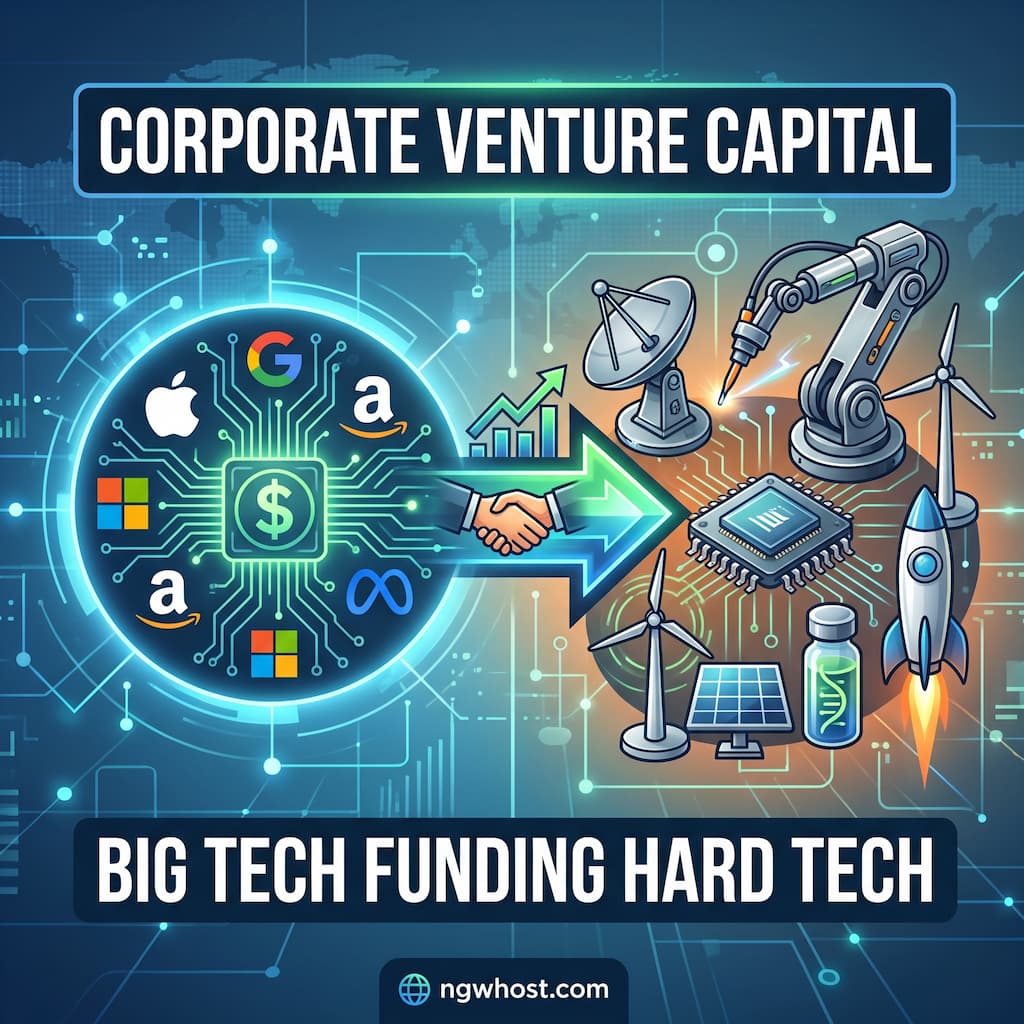
Corporate Venture Capital: Big Tech Funding Hard Tech
For most of the past two decades, venture investment followed a predictable path of least resistance: lightweight digital assets. Traditional institutional venture capital firms poured trillions of dollars into consumer mobile apps, enterprise Software-as-a-Service (SaaS) platforms, direct-to-consumer marketplaces, and social networks. These purely software ventures offered irresistible investment dynamics: minimal upfront capital expenditures, near-zero marginal costs of distribution, rapid iteration cycles, and paths to multi-billion-dollar liquidity events within short five-to-seven-year fund horizons.
However, as pure-play software markets approached saturation and the global technological frontier shifted toward physical-world transformations, the limitations of traditional software venture capital became starkly visible.
The critical bottlenecks of modern human civilization are no longer purely digital; they are deeply physical.
Modern global progress is now dictated by capital-intensive, hardware-dependent disciplines known collectively as Hard Tech:
- Advanced semiconductor manufacturing and extreme ultraviolet lithography.
- Generative artificial intelligence compute clusters and custom silicon accelerators.
- Nuclear fission small modular reactors (SMRs) and commercial magnetic confinement fusion.
- Orbital launch vehicles, satellite constellations, and space infrastructure.
- Grid-scale battery storage chemistries and industrial thermal batteries.
- Autonomous robotics, synthetic biology, and quantum computing systems.
Hard tech ventures break the traditional venture capital model. They require hundreds of millions of dollars in upfront capital expenditures before generating a single dollar of commercial revenue. They carry long development cycles of seven to twelve years, face severe physical and thermodynamic laws, and require specialized industrial cleanrooms, test sites, and specialized manufacturing plants.
Traditional financial venture capitalists, constrained by ten-year fund lifecycles and limited partner (LP) distribution demands, struggle to support these long-horizon, high-capex physical engineering projects alone.
To fill this capital and operational void, a powerful financial force has stepped forward to bankroll the physical frontier: Big Tech Corporate Venture Capital (CVC).
Corporate Venture Capital arms operated by hyperscale technology conglomerates (such as Alphabet/GV, Microsoft, NVIDIA, Amazon, Intel Capital, and Qualcomm Ventures) have pivoted from passive balance-sheet investing into the primary financiers, commercial customers, and operational partners of the hard tech revolution.
This post analyzes the structural mechanics of Big Tech CVC investment, evaluates strategic alignment versus financial returns, compares institutional financial VC against corporate venture capital, and examines the digital cloud server infrastructure required to host high-consequence corporate investment telemetry platforms on ngwhost.com.
1. The Hard Tech Capital Dilemma: Why Financial VC Stalls
To understand why hyperscale balance sheets have become essential to the physical engineering ecosystem, one must examine the friction points separating traditional venture capital structures from hard tech requirements.
The 10-Year Fund Lifecycle Mismatch
Traditional venture capital firms raise blind pools of capital from institutional LPs (such as university endowments and pension funds) structured around fixed ten-year lifecycles:
- Years 1 to 3: Initial capital deployment across early-stage seed and Series A rounds.
- Years 4 to 7: Follow-on capital reserves and portfolio scaling.
- Years 8 to 10: Portfolio liquidation via IPOs or M&A to return cash to LPs.
A B2B SaaS company can launch an MVP in three months, achieve product-market fit in two years, and scale to an exit within six years.
In contrast, a commercial nuclear fusion startup or an advanced semiconductor foundry requires five to seven years just to complete fundamental physics validation, build pilot containment vessels, and navigate complex regulatory approvals before even beginning commercial production. Financial VC timelines are structurally too short to accommodate these physics-based development curves.
The Capex Valley of Death
In software, a million-dollar seed round buys engineering talent and cloud compute credits. In hard tech, a seed round is consumed instantly by specialized cleanroom leases, CNC machining tools, specialized vacuum chambers, and precision optics.
When hard tech startups reach the transition from laboratory prototype to commercial-scale manufacturing (Series B and Series C), they encounter the Capex Valley of Death—the requirement for $100 million to $500 million to build dedicated fabrication facilities.
Financial VCs are rarely structured to write equity checks of that magnitude for single pre-revenue companies.
The Offtake and Go-to-Market Barrier
Developing revolutionary hardware is meaningless without guaranteed industrial buyers. A startup manufacturing next-generation optical interconnects or low-carbon industrial heat cannot survive on trial pilots; it needs massive, multi-year commercial offtake contracts.
Financial VCs can provide cash, but they cannot personally purchase tens of thousands of specialized GPU server racks or gigawatts of clean electricity. Big Tech corporate balance sheets can.
2. Structural Mechanics: How Big Tech Deploys Strategic Capital
Corporate Venture Capital is fundamentally distinct from traditional financial venture investing. While financial VCs measure success purely on financial returns (IRR and DPI multiples), Corporate Venture Capital operates on a dual mandate: financial sustainability paired with strategic corporate alignment.
Modern Big Tech CVC programs deploy capital across four primary strategic mechanisms:
The CVC Strategic Investment Toolkit
- Mechanism 1: Direct Equity Investment: Providing massive non-dilutive and dilutive equity checks drawn directly from corporate cash reserves or dedicated evergreen funds.
- Mechanism 2: Advanced Market Commitments & Commercial Offtake: Signing binding multi-year agreements to purchase the startup’s hardware, compute capacity, or clean energy before production even begins.
- Mechanism 3: Subsidized Infrastructure & Compute Allocations: Supplying startups with millions of dollars in compute credits, GPU cluster access, foundry allocations, and specialized testing laboratories.
- Mechanism 4: Joint Development & Technical Co-Engineering: Embedding Big Tech hardware and software engineers directly into startup development pipelines to co-design customized silicon, cooling loops, and firmware interfaces.
1. Direct Strategic Equity Investments (Evergreen Corporate Balance Sheets)
Unlike traditional VC funds that must return capital to external LPs within ten years, Big Tech conglomerates invest directly from their corporate balance sheets or structured evergreen funds.
Because these corporations generate tens of billions of dollars in free cash flow quarterly from their core software, cloud, and advertising monopolies, they have the patience to hold illiquid hard tech equity for 12 to 15 years without facing structural liquidity pressure.
2. Commercial Offtake Agreements as Capital Catalysts
The single most transformative tool in the Big Tech CVC arsenal is the Advance Commercial Offtake Agreement.
When Microsoft backs a small modular nuclear reactor startup (such as Helion or Constellation energy agreements) or Amazon backs an industrial thermal battery developer, the value is not just the equity check. The corporation commits to purchasing 100% of the facility’s power output for the next 15 to 20 years to power its AI data center fleets.
This guaranteed corporate offtake derisks the startup completely, allowing it to unlock traditional, low-cost project finance debt from global infrastructure banks to build its physical plants without excessive equity dilution.
3. Compute-for-Equity and Foundry Access Partnerships
In the modern AI and semiconductor era, capital is often synonymous with physical compute.
When Big Tech giants like NVIDIA, Google, and Microsoft invest in frontier AI labs and custom silicon designers, the investment package frequently includes guaranteed access to thousands of advanced GPU clusters, optical networking fabrics, and priority semiconductor foundry queue slots.
This access provides hard tech startups with specialized compute power that money alone cannot buy on open commercial markets.
3. Structural Optimization Ledger: Traditional Financial VC vs. Corporate Venture Capital
Evaluating the strategic, operational, and financial dimensions that separate traditional venture firms from Big Tech CVCs illustrates why founders of capital-intensive physical technology companies combine both funding sources.
Capital Horizon & Fund Duration
- Traditional Financial VC: Rigid 10-year fund lifecycle with strict pressure to liquidate assets in years 7 to 10.
- Big Tech Corporate CVC: Flexible, evergreen holding horizons supported by ongoing corporate cash flow.
Check Size & Balance Sheet Depth
- Traditional Financial VC: Constrained by total fund size (typically $100M to $1B total fund capacity). Individual check sizes are capped by risk limits.
- Big Tech Corporate CVC: Massive balance sheet capacity ($50B+ corporate cash reserves). Can deploy single checks exceeding $500M to multi-billions.
Strategic Commercial Support
- Traditional Financial VC: General network introductions, recruiting support, and board-level financial advice.
- Big Tech Corporate CVC: Guaranteed commercial customer offtake, access to global supply chains, priority foundry allocations, and co-engineering resources.
Governance & Acquisition Friction
- Traditional Financial VC: Neutral shareholder aligned strictly with maximizing financial valuation and open-market M&A bidding.
- Big Tech Corporate CVC: Potential strategic conflicts of interest, Right of First Refusal (ROFR) acquisition clauses, and potential signaling risks to rival tech conglomerates.
4. Real-World Case Studies: Big Tech Powering the Physical Frontier
The impact of Big Tech CVC is evident across every major physical engineering frontier today:
AI Silicon Accelerators and Semiconductor Packaging (NVIDIA, Intel, Qualcomm)
Developing a novel microchip architecture requires upwards of $200 million for tape-outs, mask sets, and advanced EDA software licenses.
Through its venture arm, NVIDIA has strategically invested across the entire hardware stack—funding optical interconnect innovators, quantum computing platforms, robotics foundation startups, and liquid-cooling engineering firms—creating an expansive hardware ecosystem that natively integrates with its proprietary CUDA software platform.
Next-Generation Clean Energy and Nuclear Power (Microsoft, Amazon, Google)
The explosive growth of multi-gigawatt artificial intelligence data centers has collided directly with corporate net-zero climate mandates. With regional electrical grids unable to supply sufficient continuous clean power, Big Tech balance sheets are directly financing advanced energy systems.
Microsoft, Amazon, and Google have deployed billions into small modular nuclear reactors, deep geothermal drilling systems (such as Fervo Energy), and industrial thermal storage to power dedicated cloud server regions independently of vulnerable public grids.
Autonomous Robotics and Spatial Intelligence (Amazon Industrial Innovation Fund)
Amazon established its dedicated $1 billion Industrial Innovation Fund specifically to finance hard tech robotics, supply chain automation, and spatial hardware startups.
By testing early-stage autonomous mobile robots, bipedal humanoids, and automated picking arms directly inside its massive global fulfillment network, Amazon provides startups with real-world validation data while modernizing its own logistical operations.
Commercial Aerospace, Launch Systems, and Satellites (Alphabet, Qualcomm)
From low-Earth orbit broadband constellations to lunar exploration landers, aerospace hardware requires extreme capital outlays.
Alphabet’s strategic investments in satellite communications and rocket propulsion systems have provided the multi-hundred-million-dollar funding foundations required to manufacture physical orbital hardware.
5. Systemic Operations: Cloud Infrastructure for High-Throughput Investment Telemetry
Managing, monitoring, and orchestrating global corporate venture portfolios, joint development engineering pipelines, and multi-facility industrial hardware milestones demands an underlying digital server infrastructure that prioritizes high availability, low latency, and zero-downtime execution. Modern CVC platforms process continuous, high-consequence data streams—ranging from real-time portfolio cap table equity ledgers, patent database indexing feeds, and hardware supply chain telemetry to automated NDA-protected data room access controls and institutional banking clearing webhooks.
If an enterprise corporate venture portal, portfolio telemetry monitoring gateway, or strategic co-engineering data hub experiences database configuration drift, network latency, or server downtime during an active funding syndication window or commercial contract closing, the consequences are immediate. Confidential due diligence documents desynchronize, strategic board approvals stall, and sensitive transaction settlement deadlines are missed—introducing serious regulatory and legal compliance liabilities.
To eliminate this operational friction, progressive corporate investment teams and enterprise software developers deploy highly optimized, zero-downtime server architectures.
These infrastructure layers continuously monitor active API endpoints, encrypted corporate database write paths, and high-throughput transactional processing nodes, ensuring response times stay locked within sub-millisecond thresholds regardless of data volume.
Maintaining an unassailable infrastructure perimeter is vital to eliminate bandwidth bottlenecks, protect proprietary trade secrets, and preserve institutional trust, driving peak structural execution across enterprise portals and hosting domains like ngwhost.com.
6. Navigating the CVC Minefield: The Founder’s Strategic Playbook
While Big Tech corporate capital unlocks unmatched resources for hard tech founders, taking corporate money requires careful legal and strategic navigation:
- Avoid Restrictive Right of First Refusal (ROFR) Clauses: When accepting capital from a Big Tech giant, founders must avoid granting restrictive acquisition rights or exclusive commercial distribution lock-ins that could prevent rival conglomerates (e.g., accepting an investment from Google that prevents selling products to Amazon or Microsoft) from bidding on the company in the future.
- Maintain Independent Cap Table Balance: The most successful hard tech companies construct a balanced syndicate—pairing strategic Corporate Venture Capitalists (who provide offtake, compute, and hardware validation) with top-tier Financial VCs (who protect the founder’s valuation, ensure governance independence, and advocate for an open-market IPO).
- Protect Core Intellectual Property (IP): Joint development agreements must cleanly establish IP ownership boundaries. Founders must ensure that their underlying patent portfolios remain 100% owned by the startup, preventing corporate partners from internalizing the technology into their own in-house research divisions.
Read More⚡ Perovskite Solar Cells: Doubling Renewable Efficiency
Conclusion: The Capital Engine of the Physical Century
Corporate Venture Capital is no longer a peripheral corporate development experiment; it represents the essential capital and commercial engine driving the modern industrial renaissance. The historical paradigm that assumed software venture capital alone could solve the world’s most fundamental physical, energy, and computational challenges was an incomplete strategy that has reached its structural limits.
The future of global innovation belongs entirely to the visionary hard tech founders, corporate venture architects, and data-driven platform networks that master the orchestration of strategic corporate capital today.
By combining massive corporate balance sheets, guaranteed commercial offtake contracts, priority compute infrastructure, and zero-downtime digital cloud infrastructure perimeters, the international technology and industrial communities are building an unassailable foundation for physical progress.
As the physical requirements of artificial intelligence, clean energy, and robotics continue to expand exponentially, Big Tech balance sheets will remain the indispensable bridge across the valley of death—permanently establishing Corporate Venture Capital as the defining engine funding hard tech worldwide.
Hosting computationally intensive investment telemetry engines, processing real-time system data streams, validating cloud-scale automation platforms, and managing ultra-secure global server frameworks requires world-class, zero-downtime infrastructure. Secure your enterprise digital data framework on an unassailable foundation by exploring the premium hosting configurations at ngwhost.com.