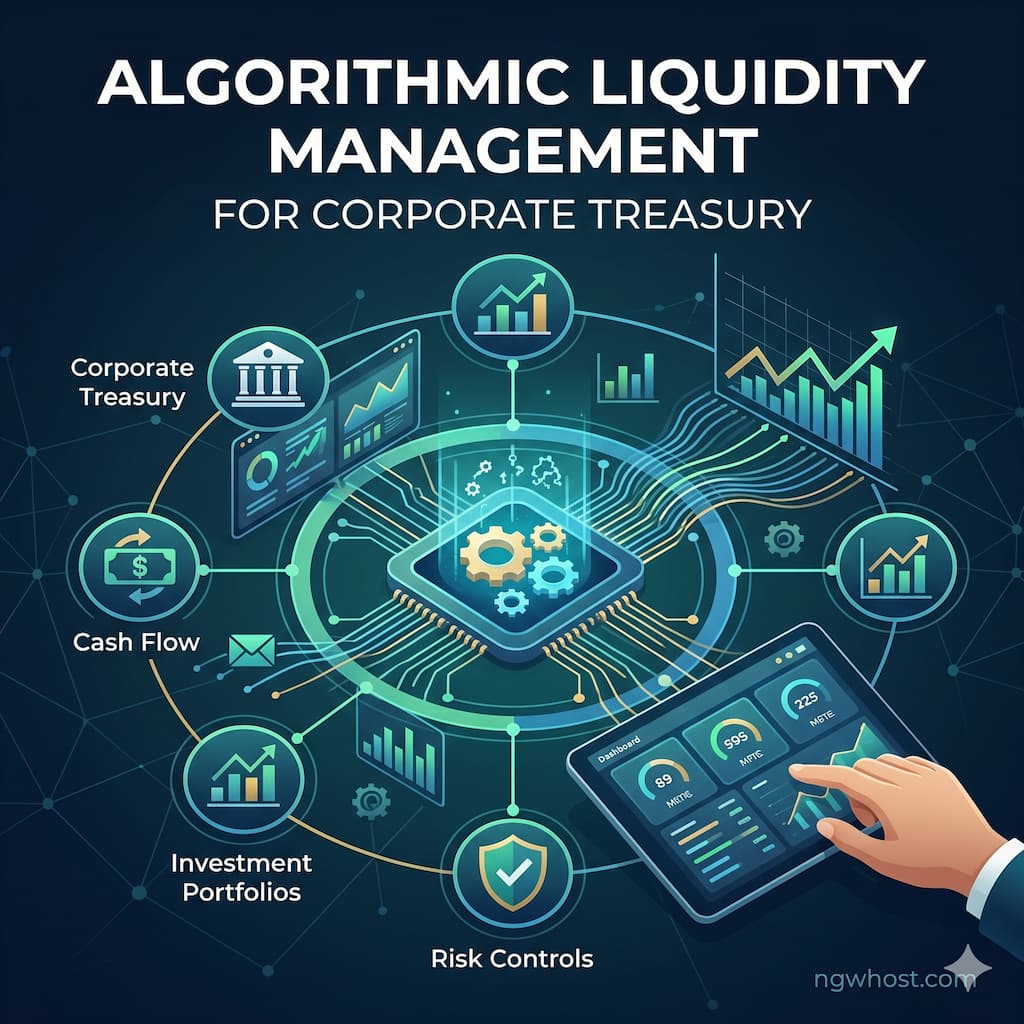
Algorithmic Liquidity Management for Corporate Treasury
The baseline math governing corporate treasury has completely outgrown manual calculation models. As we operate in May 2026, enterprise asset allocators, chief financial officers, and technology entrepreneurs face a hyper-fluid, fragmented macroeconomic environment. Corporate liquidity is no longer a static cash reserve slumbering within a localized tier-1 banking relationship. Instead, it has evolved into a highly distributed, non-linear digital matrix spanning multi-currency commercial accounts, virtual IBAN clearing grids, automated overnight lending protocols, and tokenized real-world assets (RWAs).
Historically, managing corporate cash flow was a slow, linear discipline. Treasurers spent the early hours of every business morning manually exporting CSV bank balances across separate regional entities, compiling spreadsheets, calculating daily funding thresholds, and executing manual wire positioning sweeps. By the time this fragmented data was parsed and approved for allocation, the underlying market conditions had moved.
In an era where digital automation defines competitive margins, leaving corporate capital idle or relying on human administrative cycles to reposition cash across international lines introduces severe operational drag.
For the forward-thinking developers, e-commerce leads, and technology infrastructure managers within the ngwhost.com community, operational efficiency is an ironclad architectural law. We design web platforms, server arrays, and database clusters to eliminate latency, eradicate resource waste, and systematically remove single points of failure.
Applying this exact same systemic discipline to your company’s balance sheet requires a total transition from manual treasury forecasting to Autonomous, Real-Time Algorithmic Liquidity Management Infrastructure.
    THE 2026 ALGORITHMIC TREASURY LAYER
┌──────────────────────────────────────────────────┐
│   DYNAMIC MULTI-BANK API & DATA INGESTION MESH   │
└────────────────────────┬─────────────────────────┘
                         │
                         ▼
┌──────────────────────────────────────────────────┐
│         ALGORITHMIC ORCHESTRATION ENGINE         │
│  * Real-Time Working Capital Burn Calculations   │
│  * Automated Multi-Currency Cash Concentration   │
│  * Programmatic Overnight Yield Allocation       │
└────────────────────────┬─────────────────────────┘
                         │
                         ▼
┌──────────────────────────────────────────────────┐
│  TERMINAL EXTRACTION OF YIELD & RUNWAY PROTECTION│
└──────────────────────────────────────────────────┘
By connecting advanced quantitative intelligence and secure open-banking APIs directly to your corporate financial ledger, liquidity management shifts from an administrative chore into a programmable growth tool. This comprehensive 2026 brief provides a technical deconstruction of the algorithmic treasury stack, details advanced cash concentration models, and outlines an actionable blueprint to maximize your corporate cash-flow velocity with zero manual operational drag.
1. The 2026 Treasury Metamorphosis: From Static Buffers to Flow Mechanics
To successfully deploy an algorithmic liquidity architecture today, you must first replace the traditional concept of static corporate cash buffers with the mechanics of continuous data fluid-dynamics. The modern evolution of enterprise cash tracking can be classified into three distinct technical waves:
- The Periodic Spreadsheet Era (The Past): Retrospective auditing. Treasurers ran manual end-of-day balances, attempting to predict future multi-week working capital demands using basic linear regression models. This generated structural capital inefficiencies—forcing corporations to either carry massive, low-yield safety balances that decayed under inflation, or face sudden, localized cash deficits when international invoices cleared ahead of projections.
- The API Aggregation Era (The Transition): Passive cash visibility. Open-banking protocols and specialized treasury management systems (TMS) introduced real-time balance aggregation dashboards. Financial leads could log into a singular screen to audit their global cash footprint across international institutions. While powerful, this framework remained passive, requiring human financial managers to review charts, calculate concentration trajectories, and manually trigger intercompany sweeps.
- The Agentic Algorithmic Era (2026): The current global standard. Corporate liquidity behaves as an Autonomous, Self-Optimizing Yield Network. Powered by large reasoning foundation models natively linked to secure banking execution rails and corporate ERP systems, the treasury engine operates 24/7/365. It continuously parses inbound e-commerce revenue velocities, models real-time working capital burn variations, predicts upcoming vendor payment dates, and autonomously redistributes liquidity across your global corporate footprint to eradicate cash-flow drag.
According to global corporate capitalization metrics recorded this quarter, technology enterprises utilizing fully integrated algorithmic liquidity management systems experience an average 40% acceleration in cash-velocity loops and capture up to 180 basis points of additional yield on their floating capital reserves compared to competitors stuck in manual banking paradigms.
2. Core Technological Pillars of Algorithmic Treasury Infrastructure
Scaling a borderless digital platform while protecting your company’s capitalization parameters requires integrating four foundational technological pillars directly into your platform’s financial and system architectures.
I. High-Availability Multi-Bank API Integration Meshes
Traditional banking communication relies on rigid, batch-processed messaging formats (such as end-of-day SWIFT MT940 files) that report financial positions hours after they occur. Algorithmic liquidity engines completely bypass this bottleneck by deploying continuous Open-Banking API Integration Frameworks (such as PSD2/PSD3 nodes and custom institutional webhooks).
- The Technical Speed: The platform establishes persistent, low-latency data handshakes with all corporate banking accounts, multi-currency wallets, and international payment gateways simultaneously.
- The Outcome: The system captures sub-second telemetry on every inbound transaction, authorized credit card capture, or pending outbound invoice, transforming your global cash statement into a living, real-time data stream.
II. Predictive Machine Learning Cash-Flow Forecasting
Determining the exact amount of liquidity required across multiple international subsidiaries to prevent localized overdrafts without trapping excess capital in zero-interest accounts is an intense optimization challenge. Algorithmic engines handle this complexity via Deep Learning Time-Series Modeling.
- The Analytical Matrix: The forecasting models ingest years of historical enterprise resource planning (ERP) records, recurring payroll files, vendor payment terms, and e-commerce checkout conversion velocities.
- The Optimization Performance: The AI blends internal enterprise patterns with external real-world indicators—such as localized holiday calendar shifts, macro interest-rate fluctuations, and seasonal consumer demand indicators. The system continuously outputs a rolling 90-day predictive cash-flow curve with a validated greater than 95% accuracy rate, allowing the system to securely minimize idle cash cushions without introducing operational default risks.
III. Automated Multi-Currency Cash Concentration and Sweeping
For expanding technology brands operating across multiple geographic borders, managing multi-currency cash pools manually creates an administrative nightmare. Algorithmic liquidity management deploys Dynamic, Multi-Echelon Sweeping Protocols.
- The Execution Corridors: When the system notes that a specific regional subsidiary has captured a cash surplus exceeding its predicted 7-day operational requirement, the algorithm automatically executes an automated sweep.
- The Algorithmic Tuning: The cash is programmatically routed through the most cost-efficient financial corridor—leveraging instant local clearing networks (like SEPA Instant in Europe, FedNow in the United States, or Pix in Brazil)—concentrating the global capital into a master pool, completely eliminating manual treasury transfer latency.
IV. Continuous Programmable Yield Allocation Core
Once corporate capital is safely concentrated into a centralized ledger, allowing it to sit un-allocated even for a single night results in an unnecessary loss of yield efficiency. Algorithmic management modules operate an Event-Driven Yield Allocation Engine.
- The Yield Autopilot: The algorithm monitors live yield metrics across a pre-vetted, highly secure spectrum of short-term financial instruments—including tokenized sovereign treasury bills, AAA-rated institutional money market funds, and regulated overnight lending vaults.
- The Sub-Second Sweep: Every afternoon, the system calculates the exact cash volume available for overnight investment, automatically deploys the tranches into the highest-yielding compliant asset nodes, and liquidates the positions the following morning before your operational payment queues open, ensuring your money never experiences a minute of un-productive downtime.
3. The 2026 Treasury Software Plane: Elite Algorithmic Engines
Transforming your enterprise treasury from a slow administrative cost-center into an agile, highly predictable competitive moat requires connecting your corporate repositories to context-aware management software. The current landscape features elite optimization platforms:
| Platform Category | Leading 2026 Platforms | Core Corporate Utility | Standout Engineering Advantage |
| API-First Treasury Core | Kyriba / HighRadius / Trovata.io | Multi-bank API balance aggregation, automated cash sweeping, & FX tracking | Unified Bank Connectivity: Programmatically links with thousands of global financial institutions via direct APIs. |
| Enterprise Asset Mesh | Palantir AIP for Finance / BlackRock Aladdin | Cross-asset risk modeling, liquidity simulation, & automated ledger sync | Ontological Data Unification: Unifies messy relational ERP logs seamlessly with unstructured macroeconomic data streams. |
| Tokenized RWA Yield Hubs | Securitize / Centrifuge / Superstate | Accessing tokenized sovereign short-term debt & institutional cash instruments | Atomic 24/7 Liquidity Settlement: Permits instant deployment and redemption of cash reserves outside traditional banking windows. |
4. Tactical Blueprint: Engineering a High-Availability Algorithmic Treasury
Transitioning your enterprise away from manual banking patterns and constructing an automated, data-driven liquidity engine requires a systematic, architecturally sound roadmap.
Step 1: Maximize Financial Data Liquidity via Unified APIs
An autonomous algorithmic routing engine’s forecasting precision is fundamentally bounded by the visibility and completeness of its incoming data streams. You must eliminate your internal financial data silos.
Establish direct API connections and real-time open-telemetry webhooks connecting your e-commerce storefront billing layers, internal ERP databases (SAP, NetSuite), multi-currency corporate banking portals, and primary server deployment logs on ngwhost.com into a centralized, highly secure Unified Operations Data Lake. This provides your algorithmic models with an unobstructed, 360-degree stream of truth representing your true operating cash flow.
Step 2: Configure the “Human-in-the-Loop” Governance Matrix
Do not attempt to remove human strategic judgment entirely from high-stakes corporate treasury and capitalization choices. While autonomous agents are unmatched at rapid data collection, multi-file synthesis, and sub-second hazard isolation, ultimate risk ownership and long-term visionary orientation require human emotional intelligence. Implement a highly fluid communication corridor:
[Live Cash-Flow Anomaly Detected] ──► [AI Models Future Liquidity Drawdowns] ──► [AI Builds Optimized Sweeping Options] ──► [Human CFO One-Click Authorization]
Configure your platform’s configuration settings to push high-conviction risk reports and pre-populated concentration workflows straight into a centralized Live Operational Feed. The AI handles the exhaustive heavy lifting—calculating drawdowns, sourcing liquidity options, and writing the execution scripts—while the human executive retains absolute veto power, authorizing high-ticket operations with a single click before the automated system modifies corporate allocations or commits capital.
Step 3: Implement Zero-Trust Security Parameters and Automated Reserves
As your treasury concentration loops accelerate into real-time velocities, protecting your floating liquidity from advanced digital threat vectors and platform counterparty risks becomes an absolute priority. Enforce strict Zero-Trust Financial Security Guardrails:
- Store your active operational digital signatures and API authentication keys inside Hardware Security Module (HSM) enclaves.
- Mandate multi-signature cryptographic authorization frameworks for any automated transfer exceeding custom thresholds.
- Configure automated, programmatic rules to maintain a secure, segregated infrastructure liquidity buffer on reliable hosting arrays like ngwhost.com, guaranteeing that your core, non-negotiable platform operations remain 100% stable independent of background optimization experiments.
5. Critical Risk Management: Navigating the Algorithmic Treasury Pitfalls
Operating a highly automated, software-driven corporate capital stack requires a highly defensive risk-management posture to insulate your enterprise from severe downside traps:
- The Hazard of the Algorithmic Herding Loop: Because autonomous treasury models are engineered to react to market anomalies instantly, an unnoticed code drift, database corruption, or extreme formatting variance in an early tracking phase can cascade rapidly. If an agent misinterprets an anomalous, short-term data glitch as a valid liquidity deficit signal, it can trigger automated systems to execute massive, un-authorized asset liquidations or cross-border loops simultaneously, generating intense transactional fee friction. Engineering teams must implement strict Operational Bound Safeguards and velocity throttles to constrain automated liquidation loops.
- The Threat of Upstream API Spoofing and Cyber Sabotage: As treasury operations become deeply interconnected via open APIs and automated function calling, cybercriminal syndicates target vendor networks to compromise primary enterprise networks. Malicious actors can access a secondary data portal and inject falsified intent or inventory metrics into your liquidity engine, tricking your systems into canceling vital orders, altering cash allocation parameters, or rerouting capital to unsecure locations. Implement Zero-Trust Token Verifications and strict cryptographic data hygiene rules across all incoming data streams.
- Navigating the Complexities of Multi-Jurisdictional Tax Drag: Automated cross-border cash sweeping frequently triggers complex cross-border tax liabilities—including localized capital gains withholding mandates, transfer stamp duties, and structural adjustments to your company’s effective tax rate profile. An automated concentration sweep that appears highly lucrative on the dashboard can rapidly degrade in net value once international tax obligations are calculated at settlement. Ensure your accounting infrastructure models the localized fiscal consequences of every transfer corridor before locking in execution contracts.
6. The Systems Synergy: Building High-Availability Financial Networks
For the advanced cloud systems developers, full-stack database architects, and technology visionaries who anchor their web platforms and enterprise applications to the ngwhost.com ecosystem, the structural logic of an automated algorithmic treasury architecture is completely second nature.
When you configure an enterprise hosting layout, scale an international web application cluster, or manage an enterprise database network, you do not tolerate single points of failure. You don’t leave your system architecture vulnerable to an isolated computing crash, a localized network drop, or an un-monitored processing leak. You design with structural, mathematical redundancy: you utilize load balancers to distribute data traffic smoothly, deploy isolated container instances across multiple geographic data zones to handle processing spikes effortlessly, and maintain secure, multi-region database mirrors to ensure that if a critical server cluster drops offline, the broader network continues to perform flawlessly without data loss or capital corruption.
Deploying an integrated Algorithmic Liquidity Management Architecture is simply extending that exact same systemic, multi-layered structural redundancy to your company’s balance sheet and financial capital stacks:
- Your Multi-Bank API Integration Meshes and Virtual IBAN Corridors operate as your high-velocity edge nodes, parsing, clearing, and routing daily incoming capital allocations with absolute fluid, real-time precision.
- Your Predictive Time-Series Forecasting Models and Multi-Agent Simulation Networks act as your resilient core database systems, instantly compounding, testing, and protecting your active capital reserves, completely insulated from individual human blind spots or local banking system failures.
- Your Automated Yield Allocation Engines and Zero-Trust Financial Guardrails behave as your secure, enterprise-grade system firewalls, silently optimizing your operating margins, shielding your corporate treasury from market volatility, and ensuring absolute legal defensibility against changing global regulatory demands.
By mastering this integrated configuration, you strip away balance sheet vulnerabilities, eliminate structural cash drag, and position your digital brand to scale at terminal velocity while retaining absolute, sovereign control over the global enterprise you built.
Read More⚡ Secondary Market Liquidity: Private Equity Strategies
Conclusion: Securing the Capital Efficiency Victory
The traditional monthly financial review and slow capital auditing desk have run their course. In a hyper-competitive global marketplace defined by rapid technological adaptation and instant corporate fulfillment requirements, forcing your treasury personnel to rely on click-by-click manual data entry and historical guessing games is a recipe for operational failure and margin erosion.
The path to sustainable corporate scalability requires an absolute embrace of autonomous, predictive, and data-liquid software architecture applied directly to your liquidity ledger. By unifying your multi-source financial data feeds via high-performance cloud networks, linking your risk telemetry directly into your central ERP and repository cores, enforcing rigorous project-level unit economic tracking, and prioritizing continuous algorithmic backtesting, you completely remove risk, friction, and human operational latency from your expansion loops entirely.
The capital of the global digital economy is flowing at internet speed. Build your financial perimeter with absolute architectural precision, protect your cap table fiercely, and let your enterprise scale to global heights on your own terms.