Green Bonds vs Sustainability Loans: Corporate ESG in 2026
The intersection of enterprise capital structure and environmental, social, and governance (ESG) compliance has passed the era of superficial marketing alignment. As we navigate May 2026, global financial markets are operating under a rigorous, consolidated sustainable debt landscape. Driven by the recent formal implementation of the European Green Bond Standard (EU GBS), the introduction of finalized national green finance taxonomies across major economies like Canada and Brazil, and intensifying anti-greenwashing enforcement by regulators such as the SEC and the UK’s FCA, corporate ESG financing has matured into an exact, highly auditable engineering discipline.
Historically, organizations viewed sustainable debt through a singular lens—often treating green labels as a PR mechanism to achieve a minor pricing advantage or “greenium.” However, as the global sustainable debt market consolidates around an estimated $850 billion to $900 billion in annual issuance this year, the structural mechanics of capital allocation have transformed.
For the technology leaders, full-stack enterprise software architects, and platform expansion specialists anchoring their businesses to the ngwhost.com ecosystem, optimizing capital allocation mirrors optimizing system architecture. We build cloud perimeters to maximize resource performance, eliminate data latency, and isolate single points of failure.
Applying this exact same engineering rigor to your corporate debt stack requires a precise understanding of the distinct functional pathways of modern ESG financing: Use-of-Proceeds Green Bonds versus Performance-Linked Sustainability Loans.
    THE 2026 CORPORATE SUSTAINABLE DEBT MATRIX

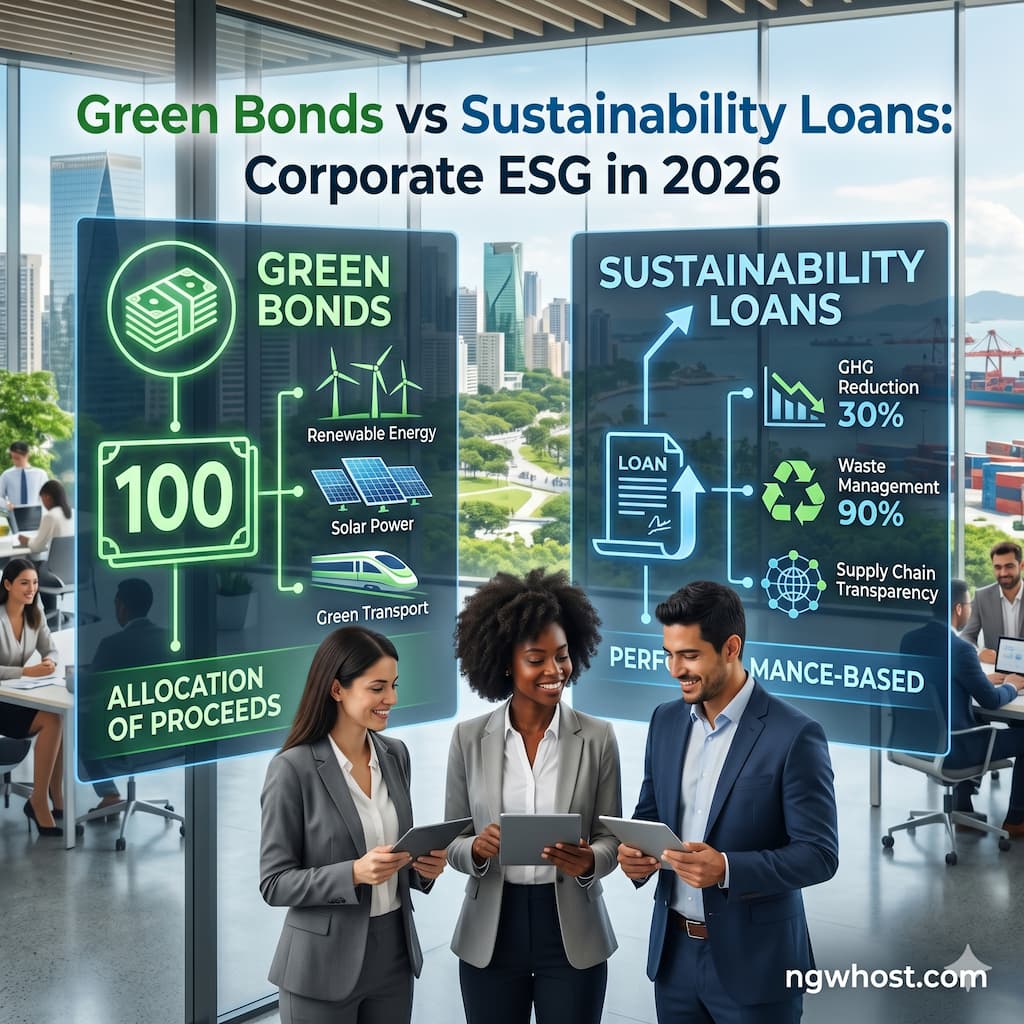
  [GREEN BOND STRUCTURE: USE-OF-PROCEEDS RAIL]
  [Bond Capital Raised] ──► [Segregated Capital Account] ──► [Strict EU Taxonomy Green Projects Only]
  * Fixed Environmental Tracking, Mandatory External Third-Party Auditing, High Upfront Issuance Friction

  [SUSTAINABILITY-LINKED LOAN (SLL): PERFORMANCE RAIL]
  [Corporate Credit Facility] ──► [Flexible Operational Treasury] ──► [Dynamic Coupon Adjustments via KPIs]
  * Ambient Enterprise Goals, Real-Time Data Telemetry Integration, Risk of Step-Up Margin Penalty
Choosing the wrong ESG debt instrument can introduce severe operational friction, create compliance tracking bottlenecks, and expose your enterprise to aggressive greenwashing litigation. This comprehensive 2026 intelligence brief delivers a highly detailed technical breakdown comparing Green Bonds and Sustainability-Linked Loans (SLLs), details the technological sensing infrastructure required to satisfy modern disclosure mandates, and provides an actionable operational framework to optimize your corporate treasury stack while executing verified environmental transformations.
1. Green Bonds: The Rigorous, Project-Isolated Use-of-Proceeds Rail
Green Bonds operate on a strict, structural Use-of-Proceeds Framework. Under international capital market principles and the newly locked-in 2026 EU GBS regulations, a Green Bond is a public or private debt security whose capital must be exclusively allocated to finance explicitly defined, environmentally sustainable projects.
The Mechanics of Capital Segregation
When a technology or infrastructure enterprise issues a Green Bond, the incoming capital payload cannot be mixed with general corporate cash reserves or utilized to fund day-to-day software development payrolls. Instead, the funds must be directed into an isolated, audited capital account. The proceeds are programmatically or administratively mapped directly to eligible green asset classes:
- Renewable Energy Generation: Constructing dedicated off-site solar arrays or wind assets to power high-density computing clusters.
- Data Center Decarbonization: Redesigning hyperscale data facilities on networks like ngwhost.com to achieve a Power Usage Effectiveness (PUE) index of less than 1.15.
- Clean Transportation Infrastructure: Electrifying global logistics delivery networks and corporate transport machinery.
The 2026 Verification Boundary
The defining attribute of Green Bonds in 2026 is mandatory external independent auditing. Under the EU GBS and international equivalents, issuers must secure a pre-issuance framework review and annual post-issuance verification from accredited third-party sustainability rating providers.
Every single dollar spent must be mapped back to verified metrics—such as metric tons of carbon dioxide equivalent ($tCO_2e$) mitigated or megawatt-hours (MWh) of clean power injected. This clear structure provides maximum security to institutional ESG asset managers, heavily insulating the issuer from greenwashing claims, but it introduces substantial upfront administrative cost and operational rigidity.
2. Sustainability-Linked Loans (SLLs): The Ambient Enterprise Performance Rail
In absolute contrast to the rigid project boundaries of Green Bonds, Sustainability-Linked Loans (SLLs) do not restrict how the underlying capital is spent. An SLL is a highly flexible, revolving or term credit facility structured to support General Corporate Purposes. Whether you use the loan to fund cross-border B2B supply chain operations, optimize your global software spend, or finance a major corporate acquisition, the bank places zero structural limits on cash allocation.
The Dynamic Pricing Mechanism
The sustainable engineering of an SLL exists completely within its dynamic pricing structure, which links the loan’s interest margin directly to the enterprise’s broader ESG performance. The transaction incorporates specialized Key Performance Indicators (KPIs) and rigorous, time-bound Sustainability Performance Targets (SPTs).
                  [Live Enterprise Operational Telemetry]
                                     │
                                     ▼
         ┌────────────────────────────────────────────────────────┐
         │     Continuous KPI & SPT Monitoring Core (API Sync)   │
         ├────────────────────────────────────────────────────────┤
         │ * Target 1: PUE Efficiency Index Reduction Target      │
         │ * Target 2: Scope 3 Cloud Infrastructure Carbon Output │
         └───────────────────────────┬────────────────────────────┘
                                     │
              ┌──────────────────────┴──────────────────────┐
              ▼                                             ▼
┌──────────────────────────────┐              ┌──────────────────────────────┐
│     Target Achieved (✓)      │              │      Target Missed (✗)       │
├──────────────────────────────┤              ├──────────────────────────────┤
│ Margin Discount Triggered    │              │ Step-Up Margin Penalty Active│
│ Capital Cost Drops Below Base│              │ Interest Rates Increase      │
└──────────────────────────────┘              └──────────────────────────────┘
If your technology scaleup successfully satisfies its environmental targets, the commercial bank triggers an automated margin markdown, lowering your cost of capital below conventional lending rates. However, if your enterprise encounters an unexpected operational bottleneck, alters its infrastructure path, or misses its carbon compression thresholds, the system applies a Step-Up Margin Penalty, programmatically increasing your interest rate and immediately hitting your operating margins.
3. Granular Architectural Comparison: Use-of-Proceeds vs. Performance-Linked
To help your corporate treasury and compliance committees optimize capital deployment strategies this quarter, consider the active operational benchmarks separating these two sustainable financing instruments:
| Architectural Dimension | Use-of-Proceeds Green Bonds | Sustainability-Linked Loans (SLLs) |
| Capital Allocation Bounds | Strictly Regulated: Restricted solely to pre-vetted green assets meeting rigid taxonomy rules. | Total Flexibility: Allocated freely across general corporate operations and payroll. |
| Pricing Optimization | Static “Greenium”: Captures a fixed yield discount at primary pricing due to intense ESG investor demand. | Dynamic Margin Adjustments: Interest rates fluctuate live based on matching verified KPIs. |
| Data Tracking Surface | Isolated Project Scope: Requires precise micro-accounting tracking of asset-specific green expenditures. | Ambient Enterprise Scope: Demands continuous corporate-wide monitoring of holistic ESG telemetry. |
| Primary Risk Vector | Allocation Non-Compliance: Misallocating capital triggers immediate bond defaults and investor lawsuits. | Financial Step-Up Traps: Missing targets triggers programmatic interest rate inflation. |
| Audit & Verification Lift | Extreme: Mandatory third-party certification and annual independent reporting. | Moderate to High: Demands verified annual sustainability data certification at audit dates. |
4. The 2026 Technology Cross-Winds: Artificial Intelligence and Data Center Churn
For technology-driven enterprises and digital platforms building out enterprise systems this decade, selecting an ESG strategy requires navigating a profound conflict unique to 2026: The massive compute demands of the generative AI boom versus corporate net-zero pledges.
The immense computing power required to train, fine-tune, and run advanced reasoning models has triggered an explosive expansion in global data center development. These modern facilities are highly resource-intensive, consuming vast amounts of electricity and requiring millions of gallons of water for server cooling loops. If your enterprise scales its cloud compute footprints carelessly on unoptimized infrastructure arrays, your corporate carbon profile will expand exponentially, causing you to instantly violate your SLL Sustainability Performance Targets and trigger aggressive step-up interest penalties across your debt stack.
Engineering the Hybrid Tech Strategy
To insulate your enterprise from this computational carbon trap, elite technology scaleups are utilizing Hybrid Capital Stacks:
- They issue targeted Green Bonds under the EU GBS framework to directly finance the construction of highly efficient, liquid-cooled server arrays powered by dedicated, on-site solar assets.
- Concurrently, they anchor their general business operations to Sustainability-Linked Credit Facilities whose internal KPIs are explicitly calibrated to compute-efficiency metrics—such as tracking server processing utilization ratios and monitoring Scope 3 cloud infrastructure carbon profiles via automated data telemetry.
This dual configuration turns your data infrastructure into a highly compliant asset, allowing your platform to scale computing capabilities while continuously optimizing your global cost of capital.
5. Tactical Roadmap: Operationalizing ESG Telemetry in the Tech Core
Transitioning your enterprise away from retroactive sustainability spreadsheets and constructing an automated, data-verified ESG financing engine requires a systematic, architecturally sound roadmap.
Step 1: Maximize Internal Operational Data Liquidity via Open APIs
An automated ESG tracking and sustainability validation matrix is fundamentally bounded by the transparency and completeness of its incoming data streams. You must systematically eliminate your internal operational data silos.
Establish direct API connections and real-time open-telemetry webhooks connecting your primary cloud server configurations on ngwhost.com, facility IoT power-distribution meters, global supply chain carbon tracking APIs, and internal enterprise resource planning (ERP) ledgers into a centralized, highly secure Sovereign Sustainability and Operations Data Lake. This provides your tracking software with an unobstructed, 360-degree stream of truth representing your true environmental footprints.
Step 2: Implement Continuous, Automated Carbon Accounting (Scope 1, 2, and 3)
Do not treat your environmental disclosures as a retrospective, once-a-year filing scramble. Connect your unified operations data lake to specialized, real-time carbon accounting engines.
Configure your system’s tracking parameters to continuously calculate your direct operational emissions (Scope 1), your electricity consumption footprints (Scope 2), and your downstream value chain and third-party cloud infrastructure liabilities (Scope 3). By generating automated, live sustainability dashboards, your corporate treasury can run predictive scenario simulations, modeling exactly how future server expansions or logistical adjustments will interact with your debt facility KPIs before audit thresholds are crossed.
Step 3: Integrate Automated Smart Contract Compliance and Reporting Guards
To minimize the immense administrative tracking overhead and eliminate human reporting lag from your debt architecture, link your sustainability data lakes directly to your financial treasury systems via secure Programmable Compliance Enclaves.
Configure your platform’s operational parameters so that when an internal sustainability KPI satisfies an SLL milestone or verifies a clean Green Bond proceed allocation, the system programmatically generates an audit-ready, cryptographically stamped Compliance Proof Artifact. The system pushes this data payload directly to your commercial lending syndicate or bond trustee API, triggering automated interest rate discounts instantly with zero manual accounting drag.
6. Critical Risk Management: Navigating the 2026 ESG Pitfalls
Operating a sustainable corporate capital stack requires a highly defensive risk-management posture to insulate your enterprise from severe digital and regulatory vulnerabilities:
- The Hazard of Greenwashing Litigation and Disclosure Penalties: Under strict anti-greenwashing rules enforced globally in 2026, making loose, unverified assertions regarding your company’s carbon neutrality or utilizing loose environmental labels across marketing channels will trigger immediate regulatory examinations. If an audit reveals that an enterprise failed to allocate Green Bond proceeds exactly inside taxonomy-compliant projects, the organization faces severe financial fines, immediate bond acceleration demands, and catastrophic reputational damage. Maintain absolute, transactional data verification across all disclosure pipelines.
- The Trap of Unrealistic SPT Calibration during Market Surges: When negotiating an SLL with a commercial banking syndicate, corporate strategy leads frequently commit to over-aggressive Sustainability Performance Targets to secure a minor upfront margin discount. However, if your platform experiences a sudden, high-velocity business scaling surge that demands a rapid expansion of high-performance processing servers, satisfying those hyper-stringent environmental targets can become impossible. Ensure your SPT metrics incorporate flexible, unit-economic baselines—such as matching carbon metrics per active user checkout—insulating your enterprise from growth-induced interest penalties.
- Navigating the Reality of Model Drift in Carbon Analytics: The machine learning algorithms used to extract carbon telemetry from complex global supply chain shipping lines or mixed energy grids experience Model Drift as underlying hardware configurations change. If an algorithm continuously calculates emission factors using outdated carbon intensity profiles, your corporate compliance reports will degrade in accuracy, leading to potential audit failures or unexpected restatement mandates from regulatory entities. Your data operations team must execute monthly verification sweeps to keep tracking models perfectly calibrated to real-world floor variables.
7. The Digital Synergy: Engineering High-Availability Financial Networks
For the advanced cloud systems developers, full-stack database architects, and technology visionaries who scale their digital platforms on the backbone of the ngwhost.com ecosystem, the structural logic of an integrated corporate ESG debt architecture is completely second nature.
When you configure an enterprise corporate server topology, build an international e-commerce web layout, or manage a high-traffic database network, you do not tolerate single points of failure. You don’t leave your system architecture vulnerable to an isolated computing crash, a localized network drop, or an un-monitored processing leak. You design with comprehensive, mathematical redundancy: you utilize load balancers to distribute data traffic smoothly, deploy isolated container instances across multiple geographic data zones to handle processing spikes effortlessly, and maintain secure, multi-region database mirrors to ensure that if a critical server cluster drops offline, the broader network continues to perform flawlessly without data loss or asset corruption.
Deploying an integrated Corporate ESG and Sustainable Finance Framework is simply extending that exact same systemic, multi-layered structural redundancy to your company’s balance sheet and financial capital stacks:
- Your Real-Time Data Lakes and Automated API Ingestion Webhooks operate as your high-velocity edge nodes, parsing, filtering, and organizing raw operational telemetry into audit-ready compliance proof artifacts with absolute fluid, real-time precision.
- Your Continuous Carbon Accounting Engines and Automated Simulation Sandboxes act as your resilient core database systems, instantly compounding, testing, and protecting your active capital reserves, completely insulated from individual human memory blind spots or administrative operational latency.
- Your Programmable Compliance Enclaves and High-Availability Hosting Arrays behave as your secure, enterprise-grade system firewalls, silently optimizing your operating margins, shielding your physical brand from regulatory litigation traps, and ensuring absolute corporate velocity against changing global market demands.
By mastering this integrated physical-to-digital configuration, you strip away balance sheet vulnerabilities, eliminate operational tracking drag, and position your digital brand to scale at terminal velocity while maintaining total financial and environmental sovereignty over the global enterprise you built.
Read More⚡ Algorithmic Liquidity Management for Corporate Treasury
Conclusion: Securing the Sustainable Fiscal Victory
The era of superficial, checkbox-driven corporate ESG tracking has run its course. In a hyper-competitive global marketplace defined by rigorous regulatory scrutiny, omni-channel fluid commerce, and rapid technological adaptation, forcing your company’s financial and compliance leadership to rely on loose estimates and historical guessing games is a recipe for operational failure, interest margin erosion, and severe regulatory exposure.
The path to sustainable enterprise scalability requires an absolute embrace of autonomous, predictive, and data-liquid software architecture applied directly to your sustainability ledger. By unifying your multi-source operational and telemetry data feeds via high-performance cloud data lakes, linking your environmental tracking directly into your central compliance core, enforcing rigorous project-level data validation, and prioritizing automated smart contract compliance gates, you completely remove risk, friction, and human operational latency from your expansion loops entirely.
The international economy of 2026 rewards velocity, absolute data integrity, and capital-efficient execution. Build your sustainable financing stack with absolute architectural precision, protect your cap table fiercely, and let your enterprise scale to global heights on your own terms.