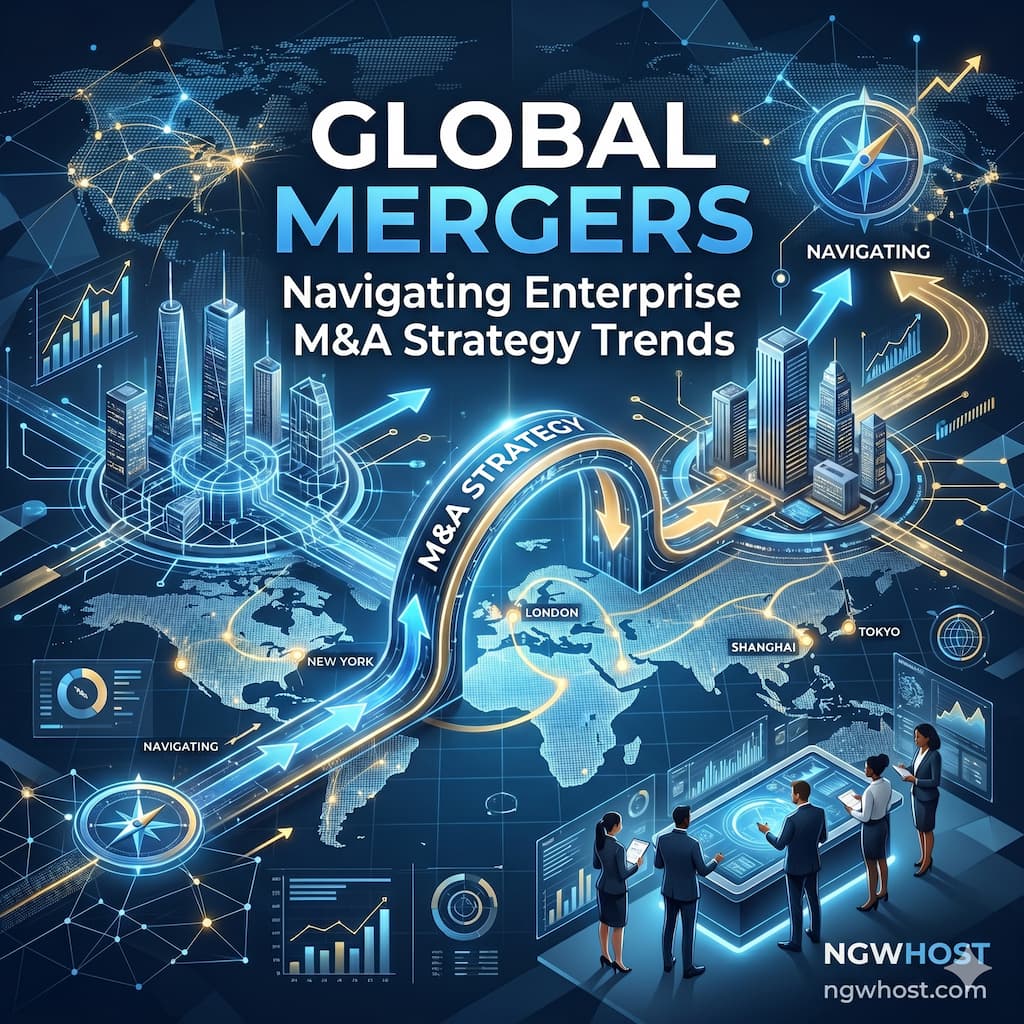
Global Mergers: Navigating Enterprise M&A Strategy Trends
The architectural blueprint governing international corporate consolidation is undergoing an intense, data-driven restructuring. For generations, corporate boards, institutional private equity syndicates, and enterprise acquisition executives managed global Mergers and Acquisitions (M&A) through a combination of relationship-driven deal sourcing, manual due diligence audits, and trailing retrospective valuation models compiled over multi-month transaction timelines. Corporate consolidation strategy functioned within a highly deterministic, linear paradigm, relying extensively on siloed investment banking networks, localized legal discovery frameworks, and snapshot accounting summaries.
While this traditional, human-centric transaction lifecycle provided structured execution mechanics during slower-moving industrial eras, it introduces severe systemic vulnerabilities inside today’s hyper-connected, volatile commercial ecosystem.
Modern global enterprise networks handle massive informational mass, manage deeply integrated cross-border supply chains, and operate amidst shifting regulatory mandates that completely overwhelm conventional investment auditing practices.
Relying on legacy due diligence workflows under this high-velocity paradigm leaves corporate development groups blind to active structural and technological liabilities. This informational delay leads to elevated transaction failure rates, post-merger operational drag, severely misallocated corporate capital, and catastrophic integration blackouts that destroy shareholder enterprise value.
To eliminate execution friction, accelerate post-closing transaction synergy velocity, and secure an absolute market-leading competitive moat, progressive corporate leaders are fundamentally overhauling their consolidation perimeters. They are abandoning passive, reactive deal pipelines and deploying advanced Intelligent Enterprise M&A Analytics and Integration Frameworks.
Far from a speculative corporate data room addition or a basic task management checklist, building a scalable international consolidation core combines high-throughput programmatic market telemetry ingestion, automated algorithmic synergy modeling, predictive cultural and compliance risk simulation, and hardware-insulated zero-trust data perimeters straight into the core corporate infrastructure.
1. The Strategic Paradigm Shift: From Descriptive Evaluation to Continuous Deal Foresight
To engineer a highly resilient corporate consolidation engine capable of scaling safely across thousands of distributed international market segments, Chief Executive Officers and corporate development directors must transition their underlying transactional philosophy. The focus must move away from retrospective document auditing and shift entirely toward predictive strategic foresight.
The Structural Evolution of Enterprise Merger Frameworks
- Legacy Transaction Management: Relies almost entirely on historical data rooms and snapshot accounting disclosures. Corporate development teams analyze trailing financial statements, historical customer acquisition cost (CAC) metrics, and past operational ledger closures compiled at discrete execution milestones.
- The Predictive M&A Analytical Fabric: Reconfigures this framework entirely. It connects the enterprise’s core operational intelligence systems directly with live global market analytics pipelines, international firmographic databases, open-source code repositories, and streaming global sector valuation trackers.
By embedding quantitative software intelligence straight into corporate development workflows, technology enterprises transcend traditional consolidation bottlenecks. The transaction pipeline evolves from an ad-hoc administrative process into an active, optimized strategic engine designed to identify market synergies, flag compliance anomalies, and model integrated workforce capacities weeks before formal letters of intent (LOI) are exchanged, optimizing capital deployment velocity at peak efficiency.
2. Core Pillars of an Institutional M&A Analytics Architecture
Constructing a production-grade acquisition and integration infrastructure capable of scaling safely across multi-jurisdictional target systems requires a robust technology layer anchored by four foundational execution pillars.
Pillar I: Programmatic Ingestion Factories and Financial Feature Stores
The ultimate predictive accuracy of an enterprise acquisition model and its capacity to isolate real-world target alignment depend entirely on the volume, consistency, and ingestion velocity of the data pipelines feeding its analytical loops.
Systems architects deploy automated Corporate Ingestion Factories connected straight to international market data registries, open corporate intelligence APIs, and target data enclaves via secure API infrastructure layers. The integration architecture processes this data into a centralized, enterprise-grade Financial Feature Store that unifies and standardizes unstructured target logs—including dynamic workforce movement trends, rolling product deployment velocities, customer concentration metrics, and historical regulatory filing histories—into live mathematical feature vectors within microseconds. This configuration ensures that internal acquisition evaluation models scan target profiles using verified data definitions, completely preventing analytical skew.
Pillar II: Algorithmic Synergy and Cap-Table Simulators
As a global corporation executes multi-market acquisitions, its capital allocation paths and underlying cap-table realities become highly complex, containing multiple tiers of minority equity holdings, complex earn-out structures, cross-border tax vehicles, and localized employee stock option pools.
Venture operations and corporate development teams utilize advanced Cap-Table and Synergy Simulation Engines. These mathematical models execute continuous non-linear programming scripts and multi-variable regression models to project the exact cascading impact of incoming asset combinations. The platform simulates how varied transaction variables—such as distinct debt-to-equity financing structures, floating integration timelines, localized labor cost shifts, and cross-border currency basis variations—will impact the acquiring corporation’s weighted average cost of capital (WACC), cash runway boundaries, and long-term earnings per share (EPS) scaling trajectories across millions of hypothetical post-closing horizons.
Pillar III: Stochastic Integration Stress Testing and Monte Carlo Simulators
Maintaining an unassailable financial perimeter during aggressive cross-border consolidation campaigns requires the corporate development core to continuously evaluate its systemic resilience against sudden, catastrophic macroeconomic dislocations or post-merger integration failures.
The infrastructure integrates advanced Monte Carlo Capital Simulators that run millions of continuous, automated integration stress tests over the prospective combined enterprise. The system models how the combined entity’s operational cash runway, customer subscription retention rates, debt covenant requirements, and product development pipelines would perform under severe market disruptions: an abrupt global supply chain contraction, a sudden interest-rate hike by central banking systems, an extended regulatory anti-trust delay, or an unexpected wave of post-merger talent churn. If a simulation indicates that an integration vector risks pushing the combined enterprise’s cash runway below critical safety boundaries, the platform triggers automated resource-rebalancing alerts, enabling corporate leaders to adjust structural integration plans long before a closing transaction executes.
Pillar IV: Real-Time Early Warning Systems (EWS) and Post-Merger Monitoring
Waiting for traditional quarterly or annual corporate financial audits to evaluate the execution success of a post-closing integration campaign exposes the enterprise to massive, unhedged operational degradation windows.
Operations groups deploy an automated Early Warning System (EWS) connected straight to live operational telemetry pipelines across the newly integrated enterprise subsidiaries. The framework monitors organizational behavioral features continuously against adaptive risk-threshold parameters. If the analytical engine isolates an uncharacteristic drop in code deployment velocities across an acquired product engineering group, combined with a sudden elongation in localized customer fulfillment cycles or a spike in talent attrition signals, it triggers an immediate automated intervention playbook: it programmatically alerts the dedicated post-merger integration office, reallocates engineering support assets to the struggling node, and surfaces a detailed risk-remediation profile to executive dashboards in seconds, minimizing the operational blast radius of integration friction.
3. High-Performance Optimization: The M&A Strategy Metric Ledger
Upgrading an enterprise transaction infrastructure away from legacy human-centric investment banking models to an automated, scaled predictive analytics framework completely redefines an organization’s consolidation efficiency and portfolio performance benchmarks.
- Due Diligence Data Latency: Traditional manual data room preparation and review require weeks of uncoordinated multi-party auditing efforts. Scaled analytical platforms deliver continuous, instant audit-ready target environments.
- Synergy Projection Precision: Opaque spreadsheets prone to structural human logic and calculation formula errors. Driven by live, continuous data ingestion and multi-variable non-linear simulation models mapping all structural operational inputs.
- Post-Merger Attrition Awareness: Delayed; executive management teams frequently notice culture and operational friction months after a merger closes. Sub-second response times driven by real-time automated telemetry monitoring agents and Early Warning Systems.
- Transaction Cost Optimization: High dependence on expensive, dilutive investment banking syndicates and manual legal auditing firms. Slashed by up to 60% through automated target profiling, programmatic synergy calculations, and algorithmic verification loops.
- Intellectual Property Shielding: High exposure; vulnerable to sensitive data leakage via shared unencrypted emails and unmonitored external clouds. Hardened protection through role-based cryptographic access gates and hardware-isolated confidential computing enclaves.
4. Real-World Applications: M&A Analytics Platforms in Active Global Markets
Evaluating how advanced risk management and acquisition platforms perform under complex, real-world corporate conditions highlights their vital role in maximizing transactional safety and protecting global shareholder value.
Preempting Code Plagiarism and Structural Security Vulnerabilities in Tech Mergers
Consider a major multinational enterprise software conglomerate that is orchestrating the strategic acquisition of an emerging, high-growth deep-tech artificial intelligence platform to integrate specialized machine learning models into its global cloud product suite. The acquisition timeline is highly aggressive, moving across a tight 30-day closing window to prevent competing market buyers from driving up target valuation multiples.
During the intense software code auditing phase, an unmonitored target developer inadvertently copies a significant block of open-source proprietary code protected by highly restrictive legal copyleft licenses into the core product repository, while concurrently leaving a critical, unpatched API access control vulnerability open within the staging database network.
If this transaction were cleared and closed using traditional, human-centric technical due diligence workflows, the code contamination and structural network vulnerability would remain completely undetected until months after the acquisition finalized. This oversight would expose the parent corporation to catastrophic copyright litigation, immediate loss of proprietary IP protections, and severe network exploitation vulnerabilities that could allow threat actors to harvest global enterprise user logs.
However, because the acquiring enterprise mandates an automated, multi-tier corporate ingestion factory and code auditing pipeline, the target repository is scanned programmatically at the code level before any definitive transaction execution. The static analysis scanner maps the code structure instantly, flags the copyleft license violation, and exposes the open access control vulnerability.
The system generates an immediate, high-priority risk alert detailing the exact lines of code responsible for the exposure.
The corporate development team utilizes this real-time data to adjust transaction terms, requiring the target to remediate the codebase prior to closing, saving millions in legal liabilities and securing the enterprise software architecture from external data exploitation.
Optimizing Cross-Border Supply Chain Synergy Following a Global Consolidation
A massive industrial manufacturing corporation executes a cross-border merger with a prominent regional automotive component distributor to secure localized distribution channels and lower international component transit overhead across diverse geographic boundaries. The combined enterprise coordinates dozens of manufacturing plants, shipping ports, and regional fulfillment warehouses globally. Following the closing of the transaction, the integration office must rapidly align two completely distinct logistics networks to achieve the cost-saving synergies promised to the investment board.
The enterprise eliminates integration friction and stabilizes its operational margins by anchoring its post-merger playbook to a stochastic workflow optimization engine. The platform ingests real-time supply chain telematics, warehousing fulfillment records, and localized customs clearance histories from both entities via secure APIs.
Using advanced multi-variable non-linear optimization models, the system projects processing bottlenecks across the combined logistics matrix under millions of hypothetical weather and geopolitical constraints.
The system automatically highlights that consolidating three overlapping regional distribution hubs into a single centralized node will optimize transit speeds while cutting unnecessary structural overhead by 35%.
The system programmatically routes inventory transfers, updates local warehouse enterprise management systems, and balances carrier contracts automatically, driving immediate, data-verified operational synergy velocities that maximize investor returns.
5. Security and Infrastructure Architecture for Hardened M&A Control Planes
Centralizing global target company accounting records, integrating live proprietary source code repositories, tracking cap-table simulation models, and automating post-merger data integration pathways introduces intense data privacy and network security demands. Because global M&A analytics platforms manage the direct data lifelines and strategic blueprints of multi-million dollar corporate transactions, they represent primary targets for advanced persistent threat actors, corporate data harvesting syndicates, and adversarial short-selling networks.
Implementing Anonymized Data Tokenization across Merger Pipelines
To train predictive valuation models, evaluate factor analysis, and present target operational data streams safely to institutional investment boards during deep-dive due diligence without violating global user privacy directives (such as GDPR or CCPA) or exposing sensitive corporate trade secrets to public network observers, organizations must implement a robust data perimeter.
Systems architects deploy an automated data tokenization proxy directly at the front edge of the M&A data ingestion stream. Before any target financial ledger, customer registry database, or transactional log string is written to the central predictive data lakehouse, all sensitive personal fields and specific corporate partner identifiers are automatically extracted, cryptographically hashed, and replaced with secure tokens. The underlying machine learning engines and data scientists process their optimization models strictly over anonymized operational metadata and firmographic indicators, maintaining total analytical performance while ensuring absolute corporate confidentiality.
Hardening the Acquisition Core via Enclave Isolation and Multi-Party Control
Because the centralized M&A strategy console commands the absolute view of corporate consolidation targets, pricing valuations, and post-merger integration blueprints, accessing this administrative engine requires extreme security constraints.
- Enclave Isolation: Isolate the entire quantitative modeling core, analytics databases, and API configuration consoles inside a strict Zero-Trust Network Access (ZTNA) envelope. Every corporate user account, data-scientist terminal, and internal software integration must clear continuous multi-factor authentication, rigorous automotive behavioral risk screening, and endpoint device posture assessments before gaining access to the platform interface. The data repositories must run within hardware-isolated Confidential Computing Enclaves equipped with hardware-level memory encryption, keeping all enterprise consolidation insights completely insulated from unauthorized lateral access, internal insider threats, or external data exploitation at all times.
- Multi-Party Control: Corporate technology boards must ensure that any structural alteration to global asset valuation parameters, modification of target risk boundaries, or authorization of data integration pathways requires concurrent cryptographic confirmation from a distributed quorum of verified security officer keys across completely isolated network environments, preventing single points of failure from compromising the enterprise core.
6. Regulatory Convergence: Navigating International Antitrust and Compliance Mandates
Scaling a comprehensive international M&A strategy framework requires absolute compliance with an evolving matrix of global corporate governance, financial accounting mandates, and foreign investment tracking standards.
- The Hart-Scott-Rodino (HSR) and Global Antitrust Rules: Regulatory enforcement bodies globally are increasingly scrutinizing market consolidation plays, stating that large-scale corporate mergers must present verifiable, transparent economic data and clear tracking records to demonstrate that the transaction will not trigger monopolistic market control or anti-competitive consumer environments.
- The Committee on Foreign Investment (CFIUS) / Global FDI Directives: Regulatory bodies are increasingly analyzing cross-border technology acquisitions and foreign investment injections, stating that acquiring critical infrastructure or digital-native tech platforms from foreign sovereign entities can trigger mandatory compliance reviews, making comprehensive capitalization and transaction transparency frameworks mandatory for enterprise allocators.
- Global Corporate Accounting and SOX Mandates: Requiring public and rapidly expanding pre-IPO organizations to maintain pristine, auditable internal financial and operational controls, these frameworks dictate that any software tool or predictive analytics platform used to manage corporate balance sheets or compute merger forecasts must present verifiable data tracking pipelines and absolute code lineage.
Read More⚡ Web3 Audits: Securing Smart Contract Data Infrastructure
Conclusion: Orchestrating the Unassailable Consolidation Moat
The deployment and scaling of an advanced Intelligent Enterprise M&A Strategy framework is not a discretionary luxury for high-growth global enterprises; it is a fundamental technological requirement to achieve long-term corporate resilience and sector dominance. The historical strategy of managing multi-million dollar international mergers and cross-border corporate capitalization through slow, manual spreadsheet tracking—while tolerating severe data latency, due diligence verification risks, and unhedged post-merger talent churn rates—is an unsafe operational approach that invites market displacement, massive equity destruction, and systemic integration failure.
By engineering an integrated, forward-looking software fabric built on high-throughput real-time target data ingestion pipelines, automated cap-table and synergy simulation engines, stochastic post-closing integration stress-testing platforms, and real-time early warning telemetry watchdogs, progressive enterprise leaders transform their corporate development frameworks from passive tracking logs into high-performance strategic weapons.
Ultimately, the definitive advantage in the global commercial ecosystem belongs entirely to the visionary enterprise leaders that can evaluate transaction risks, optimize operational structures, and deploy consolidation capital as fast as the market moves—mastering advanced global merger frameworks to drive secure, highly predictable, and market-leading global scale across any commercial horizon.
Deploying computationally intensive synergy simulation engines, high-throughput financial data lakehouses, real-time target profiling pipelines, and ultra-secure global acquisition management dashboards requires world-class, zero-downtime server infrastructure. Secure your company’s strategic enterprise core on an unassailable infrastructure foundation by exploring the premium enterprise hosting configurations at ngwhost.com.