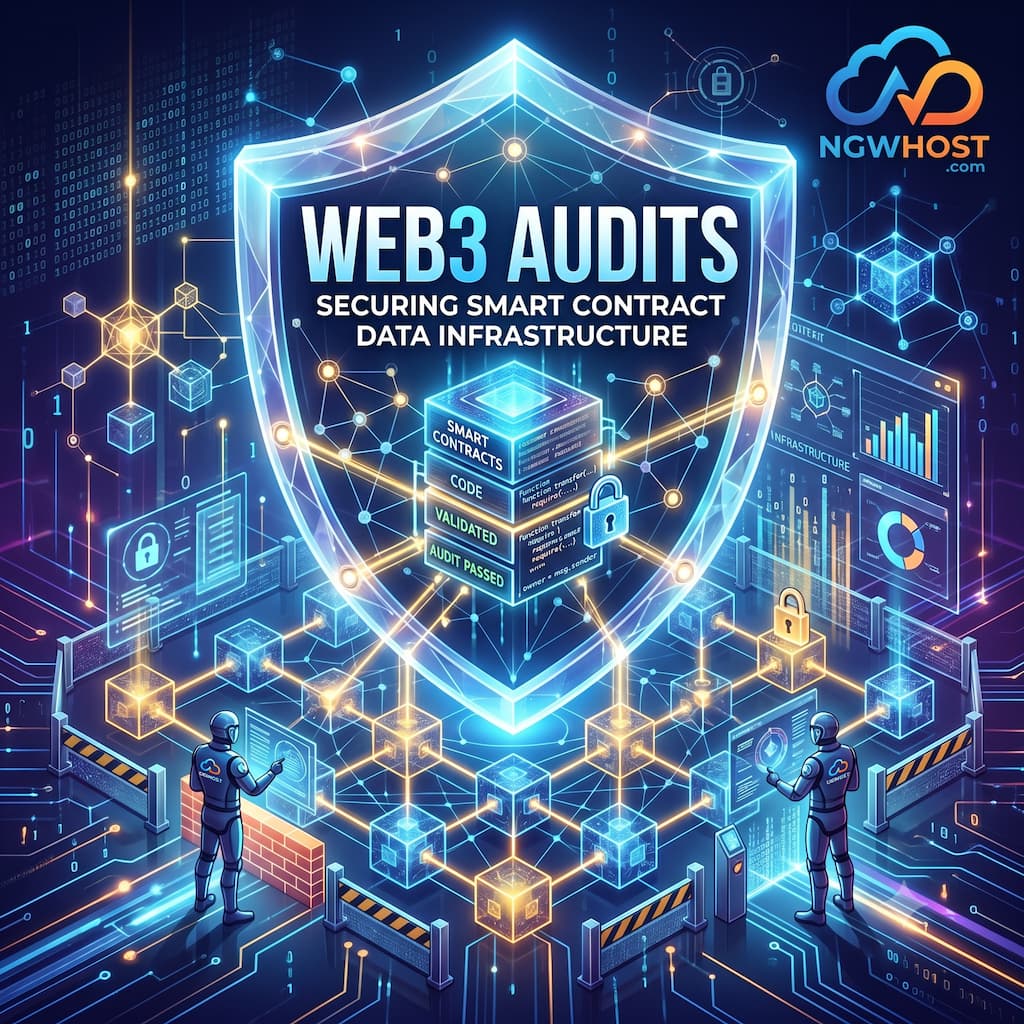
Web3 Audits: Securing Smart Contract Data Infrastructure
The structural framework governing enterprise asset management, global supply chain tracking, and digital identity registries is undergoing an intense, code-driven realignment. For decades, international commerce relied entirely on centralized database architectures, manual multi-party clearings, and trusted localized intermediaries. Today, the operational reality for progressive enterprises requires the deployment of decentralized networks. Organizations are shifting core transactional lifelines onto public-permissioned ledgers, anchoring high-value operations to autonomous smart contracts.
However, as enterprise allocators scale their digital footprint inside the Web3 matrix, they run into a critical security ceiling that conventional cybersecurity frameworks cannot resolve: the absolute finality of smart contract execution.
In traditional software development, a discovered bug or server vulnerability can be patched rapidly through an emergency hotfix deployment, minimal system downtime, or database rollbacks. In the immutable domain of Web3, once a smart contract is compiled and deployed to a live distributed ledger, its underlying logic is entirely unalterable and completely public. Any hidden software loophole, arithmetic oversight, or access control flaw becomes instantly visible to global threat actors and adversarial exploitation networks.
Operating a global B2B infrastructure under this open-source reality using unverified code structures introduces severe systemic risk. A single smart contract vulnerability can trigger immediate capital exhaustion, irreversible data leakage, compliance failures, and permanent damage to an organization’s market reputation.
To insulate digital balance sheets, eliminate code blind spots, and guarantee absolute transaction finality, forward-thinking technology leaders are overhauling their release management protocols. They are moving away from ad-hoc manual testing and deploying comprehensive, automated Smart Contract Governance and Web3 Audit Frameworks.
1. The Architectural Paradigm Shift: Why Traditional AppSec Fails in Web3
To build an unassailable data infrastructure layer, enterprise systems engineers and security directors must first analyze why conventional application security (AppSec) models are structurally insufficient when confronted with Web3 architectures.
 [Traditional AppSec Architecture]: Perimeter Firewalls ──> Retrospective Patching ──> Centralized Database Rollbacks
 [Hardened Web3 Audit Framework]: Formal Verification ──> Automated Static Analysis ──> Immutable Logic Enforcement
- Legacy Security Models: Rely heavily on network parameter defense, localized firewalls, and reactive patch management loops. If an intruder breaks a security boundary, administrators isolate the compromised server segment, roll back database logs to a clean snapshot, and update the application code retrospectively.
- The Web3 Security Paradigm: Demands a shift from parameter defense to absolute execution correctness. Because smart contracts operate as self-executing economic engines managing immutable state transitions, security must be mathematically proven at the code level before any deployment occurs.
By establishing an uninterrupted, multi-tier auditing verification pipeline, enterprise platforms eliminate hidden logical flaws. The software development lifecycle transitions from a fast-paced “move fast and break things” routine into an disciplined engineering lifecycle designed to guarantee absolute data integrity, protocol resilience, and unassailable network visibility across all distributed endpoints.
2. Core Pillars of a Production-Grade Web3 Security Stack
Constructing an enterprise-grade auditing and security infrastructure capable of safeguarding complex smart contract systems across distributed commercial fabrics requires an integrated technology layer anchored by four foundational execution pillars.
Pillar I: Automated Static Analysis and Vulnerability Scanners
The initial defense layer of any comprehensive Web3 audit protocol depends on the rapid, consistent execution of automated scanning engines designed to identify well-known smart contract anti-patterns.
- The Engineering Blueprint: Security teams integrate advanced Static Application Security Testing (SAST) tools—such as Slither, Mythril, and Securify—directly into their automated continuous integration and continuous deployment (CI/CD) pipelines. These scanning engines parse raw smart contract source code and bytecode, transforming the programming statements into an Abstract Syntax Tree (AST) and evaluating control flow graphs. The system automatically flags foundational security defects—such as dangerous reentrancy vectors, unhandled external exception calls, unchecked transfer return values, and vulnerable timestamp dependencies—weeks before code moves to a staging environment, drastically reducing developer oversight risks.
Pillar II: Rigorous Fuzz Testing and Differential Execution
While static analysis captures structural code defects, it cannot easily discover complex, multi-transaction edge cases where unique combinations of user inputs can push a smart contract into an unintended or broken economic state.
- The Engineering Blueprint: Systems engineers deploy high-throughput Fuzzing Engines (such as Echidna or Foundry’s native fuzzer). Fuzzing involves generating millions of randomized, highly anomalous user transaction sequences and pushing them through the smart contract logic concurrently. Security teams define strict operational invariants—mathematical properties that must remain true under any possible system state, such as total token supply must never exceed the initial minted allocation. The fuzzing matrix hammers the contract code with extreme data variations to find the exact, non-linear sequence of function calls that could violate an invariant, catching hidden business logic flaws before public deployment.
Pillar III: Mathematical Formal Verification and Machine-Checkable Proofs
For high-value enterprise smart contracts managing millions in assets or sensitive supply chain data, empirical testing is insufficient. Security architects must mathematically prove that the contract code does exactly what it is intended to do, and absolutely nothing else.
- The Scale Blueprint: Audit teams implement Formal Verification Frameworks utilizing advanced mathematical specifications (such as Certora Prover or K-Framework). Engineers translate the natural-language business specifications of the contract into a rigorous mathematical specification language. The formal verification engine then treats the smart contract bytecode as a system of mathematical equations, running symbolic execution models to check every single theoretically possible input path. If any mathematical state path violates the pre-defined specification, the system generates a machine-checkable proof of the vulnerability, allowing developers to eliminate logical ambiguities with absolute mathematical certainty.
Pillar IV: Decentralized Bug Bounty Architectures and Continuous Monitoring
Even after achieving formal verification clearance, code operating in live, dynamic environments remains exposed to changing network dynamics, miner manipulation, and evolving attack vectors.
- The Scale Blueprint: Organizations implement continuous post-deployment watchdogs paired with decentralized security networks (such as Immunefi or Hats Finance). The enterprise establishes automated Real-Time Threat Monitoring Agents (such as Forta or Tenderly alerts) that monitor the live ledger continuously for anomalous transaction velocities, flash-loan tracking signals, or unauthorized governance modifications. Concurrently, the firm launches hard-capped, institutional bug bounty programs that incentivize thousands of white-hat security researchers globally to stress-test the live infrastructure continuously, ensuring the platform remains highly resilient against emerging zero-day threats.
3. High-Performance Optimization: The Web3 Security Metric Ledger
Upgrading an enterprise release architecture from manual code reviews to an automated, multi-tier Web3 audit framework completely redefines an organization’s defensive efficiency and network optimization parameters.
- Vulnerability Discovery Horizon: Manual code reviews identify flaws days or weeks into production. Automated auditing workflows capture structural and logical defects during early development compilation phases.
- Business Logic Invariant Checking: Weak; traditional unit testing only maps a narrow range of pre-planned human test cases. Absolute protection via automated fuzzing engines running millions of multi-variable scenarios.
- Logical Ambiguity Elimination: Low; human interpretations of written text often leave security blind spots. Total accuracy achieved via mathematical formal verification mapping all theoretical execution paths.
- Post-Deployment Threat Awareness: Delayed; security teams frequently notice breaches hours after an exploit completes. Sub-second response times driven by real-time automated threat monitoring agents and circuit breakers.
- Compliance Audit Transparency: Manual collation of fragmented test sheets and developer logs. Delivers pristine, immutable cryptographic verification reports ready for regulatory review.
4. Real-World Applications: Hardened Audit Frameworks in Action
Evaluating how scaled Web3 auditing infrastructures perform under complex, real-world enterprise environments highlights their critical role in maximizing transaction safety and safeguarding corporate capital.
Preempting Reentrancy and Logic Exploits in Enterprise Tokenization Pipelines
Consider a multinational financial services corporation that has engineered a sophisticated tokenization network to issue and settle high-yield corporate commercial paper across public-permissioned blockchain fabrics. The protocol utilizes a complex network of multi-tiered smart contracts that handle digital asset deposits, calculate real-time fractional interest yields, and process automated redemptions via compliant stablecoins.
During an intense development sprint, a software engineer accidentally positions an external stablecoin asset transfer call before the internal smart contract updates the user’s historical account balance ledger—introducing a classic, highly volatile reentrancy loop vulnerability.
If this contract were deployed straight to production without passing through a rigorous Web3 audit stack, a malicious attacker could construct a custom exploit contract that intercepts the redemption call. By recursively re-entering the withdrawal function before the balance ledger updates, the attacker could completely drain the company’s underlying stablecoin reserve vaults within minutes, leading to catastrophic capital loss.
However, because the enterprise mandates an automated, multi-tier CI/CD security gate, the code is blocked at the compilation boundary. The static analysis scanner maps the control flow anomaly instantly, identifying the dangerous ordering of state updates and external calls.
Simultaneously, the fuzzing engine flags the issue by generating a sequence that breaks the core balance invariant.
Developers receive an automated, high-priority alert detailing the exact line of code responsible for the vulnerability, allowing them to reorganize the execution logic safely before a single byte of code is deployed to the main network, preserving institutional capital from malicious exploitation.
Verifying Supply Chain Integrity Logic via Mathematical Formal Verification
A global pharmaceutical and logistics enterprise manages a highly secure tracking network designed to verify the storage temperatures, custody handshakes, and authenticity metrics of sensitive life-saving medications moving across international borders. The tracking framework applies automated multi-party smart contracts running across decentralized nodes to enforce regulatory compliance, automatically triggering financial penalties or discarding product batches if temperature tolerances are breached.
Because minor flaws in the processing logic could lead to false compliance clearances or wrongful stock destruction, the organization demands absolute mathematical certainty before deploying code updates to the global ledger.
The enterprise fulfills this verification standard by anchoring its development lifecycle to a formal verification platform. The security team translates strict international cold-chain logistics regulations into machine-readable mathematical rules. The formal verification engine evaluates the smart contract bytecode symbolically against these rules, testing the code against millions of hypothetical sensor data combinations.
The system discovers an obscure edge case where an integer overflow in the time-tracking variable could allow a malformed sensor reading to trick the system into clearing a degraded product batch. The engine outputs a machine proof of the flaw, enabling systems engineers to fix the math and verify the codebase with absolute certainty, ensuring complete regulatory compliance and protecting public health.
5. Infrastructure Architecture for Hardened Smart Contract Governance
Operating real-time vulnerability scanners, executing computationally intensive formal verification provers, and storing sensitive smart contract configuration keys introduces critical data privacy and system infrastructure security requirements. Because a Web3 audit platform handles an organization’s core code blueprints and manages administrative private keys, the management environment represents a premium target for advanced espionage networks and cyber-sabotage syndicates.
Enforcing Multi-Signer Consensus for Smart Contract Upgrades
Corporate technology boards must never allow single developer accounts, individual systems administrators, or unmonitored deployment tools to possess the independent authority to deploy code modifications, alter system registries, or interact with live smart contract parameters.
Implement strict Multi-Party Computation (MPC) cryptographic signing networks paired with mandatory governance timelocks across all administrative infrastructure interfaces. Any proposal to alter a live corporate smart contract or update its parameters must require concurrent, cryptographic confirmation from a distributed quorum of verified security officer keys across completely isolated network environments. Furthermore, a hardcoded network timelock ensures that even if a quorum is compromised, security teams retain a multi-day defensive window to review code payloads and halt malicious deployments before they execute on the main ledger, protecting system integrity from internal or external threats.
Hardening the CI/CD Pipeline via Hardware-Isolated Enclaves
Because the central code repository, static compilers, and automated fuzzing simulators manage the absolute strategic core of the enterprise digital infrastructure, accessing these administrative systems requires extreme security constraints.
Isolate the entire automated Web3 auditing platform, static analysis pipelines, and API configuration consoles inside a strict Zero-Trust Network Access (ZTNA) envelope. Every developer terminal, internal software integration, and security account must clear continuous multi-factor authentication, rigorous behavioral risk screening, and endpoint device posture assessments before gaining access to the platform core.
Furthermore, the compilation and verification engines must execute exclusively within hardware-isolated Confidential Computing Enclaves equipped with hardware-level memory encryption, keeping all corporate source code, compilation artifacts, and verification metrics completely insulated from unauthorized lateral access, data harvesting, or remote injection exploits at all times.
6. Regulatory Convergence: Adhering to Global Web3 Compliance Mandates
Scaling a comprehensive smart contract architecture across international corridors requires absolute compliance with an evolving web of global corporate governance, financial accounting mandates, and transaction safety standards.
- The MiCA Regulations (European Union): Enforcing strict operational parameters across all EU member states, MiCA mandates clear structural guidelines for entities issuing digital assets or managing smart-contract-driven decentralized applications, requiring rigorous code disclosure, independent security auditing verification, and clear liability mapping.
- The SEC and CFTC Security Frameworks (United States): Imposing rigid oversight parameters, these regulatory bodies are increasingly scrutinizing enterprise distributed ledger installations, stating that any smart contract system used to settle commercial contracts or execute financial transactions must present verifiable code lineage, audited safety baselines, and complete data tracking pipelines.
- Global Basel Committee and SOX Rules: International banking standards and corporate accounting directives dictate that any automated software tool used to manage corporate balance sheets, track asset registers, or compute financial settlements must maintain pristine, auditable internal controls and absolute code integrity, forcing corporations to present comprehensive cryptographic audit trails across all active digital registries.
Read More⚡ Corporate Governance: Driving Long-Term Value Creation
Conclusion: Engineering the Resilient Web3 Perimeter
The deployment of a modern, data-driven Smart Contract Governance and Web3 Audit framework is not an optional optimization update for the enterprise; it is a fundamental technological requirement to survive tomorrow’s hyper-connected, code-driven economic landscape. The historical strategy of managing distributed ledger installations through uncoordinated ad-hoc manual testing—while tolerating severe code visibility gaps, logical ambiguities, and reactive patch management cycles—is an unsafe operational approach that invites market displacement, massive capital destruction, and balance-sheet erosion.
By engineering an integrated, forward-looking software fabric built on high-performance static analysis scanners, high-throughput fuzzing matrices, mathematical formal verification engines, and real-time automated post-deployment threat monitoring agents, progressive enterprise leaders transform their technology stacks from vulnerable implementations into high-performance strategic weapons.
Ultimately, the definitive advantage in the global commercial ecosystem belongs entirely to the visionary enterprises that can evaluate anomalies, optimize transaction data, and verify smart contract security as fast as the network moves—mastering advanced Web3 audit architectures to drive secure, highly predictable, and market-leading global scale across any operational horizon.
Deploying computationally intensive formal verification provers, high-throughput automated fuzzing simulators, real-time multi-source data ingestion pipelines, and ultra-secure MPC smart contract deployment dashboards requires state-of-the-art, zero-downtime server infrastructure. Secure your company’s decentralized data infrastructure on an unassailable foundation by exploring the premium enterprise hosting configurations at ngwhost.com.