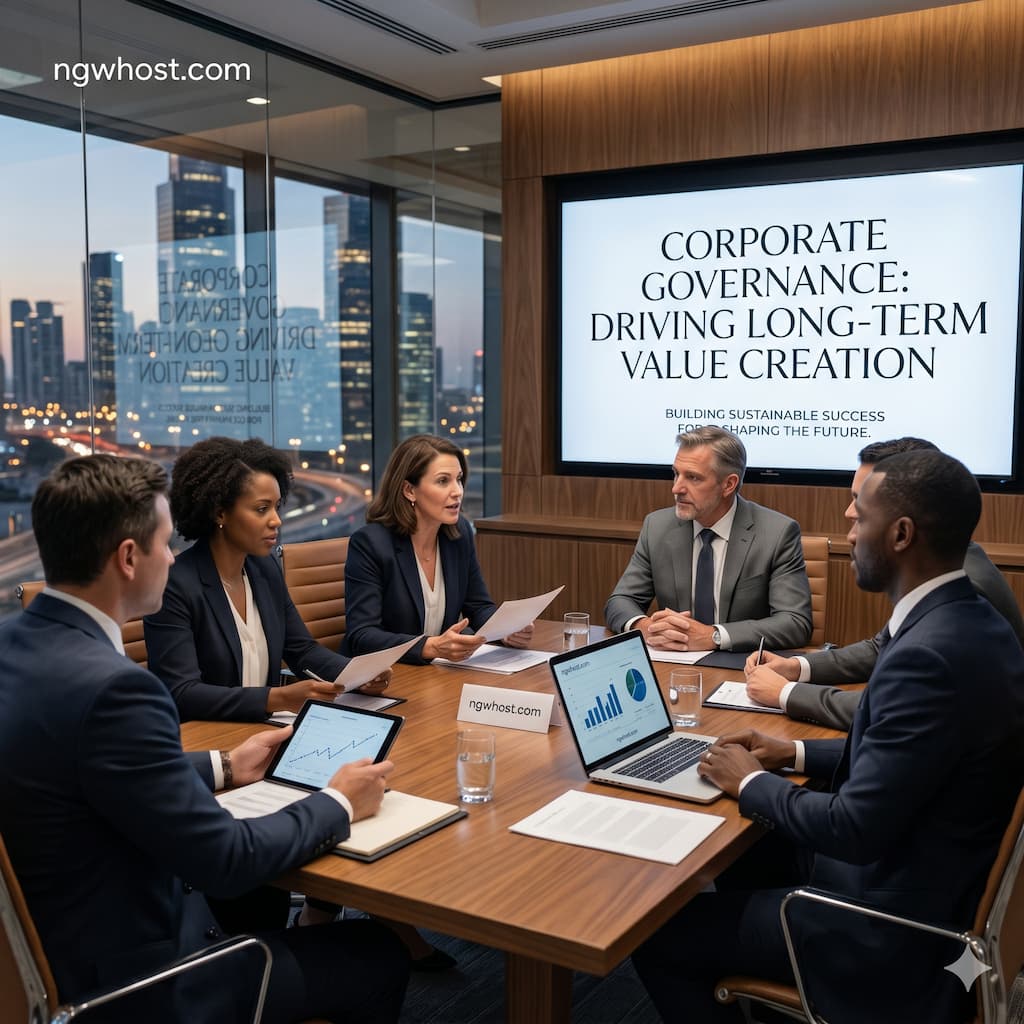
Corporate Governance: Driving Long-Term Value Creation
The modern enterprise ecosystem is confronting a definitive structural realignment. For decades, corporate boards, executive leadership teams, and institutional shareholders operated under a relatively narrow interpretation of organizational stewardship. Success was measured primarily through short-term, retrospective financial reporting cycles, quarterly earnings-per-share (EPS) performance targets, and immediate stock price appreciation. Corporate governance was largely treated as a reactive compliance exercise—a rigid checklist of regulatory mandates, proxy voting procedures, and boilerplate internal controls designed to satisfy national oversight bodies.
However, the global commercial landscape has transitioned into a highly volatile, interconnected, and asset-light paradigm. Modern enterprise value is no longer dictated strictly by physical machinery, factory footprints, or static capital reserves.
Instead, the overwhelming majority of an enterprise’s market capitalization rests on intangible assets: proprietary data lakehouses, software-defined intellectual property, brand equity, machine learning infrastructures, and institutional systemic resilience.
Operating a large-scale international corporation under a backward-looking, compliance-only governance framework introduces severe systemic exposure. Short-term performance pressures frequently lead to underinvestment in critical research and development (R&D), the mistreatment of vital supply chain ecosystems, and a dangerous vulnerability to sudden technological disruptions or changing sovereign regulatory mandates.
To insulate balance sheets, protect long-term market valuation, and secure an absolute competitive moat, progressive technology and business leaders are overhauling their foundational governance frameworks. They are moving away from passive check-the-box governance and adopting Active Governance for Long-Term Value Creation.
Far from a superficial public relations trend or a minor corporate policy adjustment, modern corporate governance combines advanced risk modeling pipelines, algorithmic stakeholder monitoring arrays, data-driven compliance fabrics, and ironclad operational oversight to transform the boardroom into an agile engine for sustainable corporate expansion.
1. The Strategic Shift: From Quarterly Retrospection to Sustainable Foresight
To engineer a resilient corporate core, Board Directors and Chief Executive Officers (CEOs) must transition their organizational data philosophy away from descriptive hindsight and toward continuous, forward-looking strategic foresight.
The Structural Evolution of Governance Frameworks
- Legacy Administrative Governance: Focuses on historical accountability. It monitors past events—such as closed-period financial audits, historical proxy voting records, and completed regulatory filings.
- The Forward-Looking Value Fabric: Connects internal corporate operations directly with live geopolitical risk streams, emerging technological trends, supply chain continuity metrics, and real-time stakeholder sentiments.
By applying advanced predictive data modeling, time-series scenario planning, and systemic risk analysis, the board can calculate the multi-year impact of current capital allocation strategies.
Instead of evaluating corporate performance strictly through the lens of trailing quarterly cash flows, leadership treats corporate governance as an ongoing optimization exercise, routing capital toward long-term enterprise health and structural market dominance.
2. Core Pillars of a Value-Driven Corporate Governance Stack
Constructing a production-grade corporate governance framework capable of driving long-term value across a distributed enterprise requires an integrated infrastructure anchored by four foundational execution pillars.
Pillar I: Programmatic Capital Allocation Optimization
The primary mechanism through which a corporate board drives long-term value creation is the strategic deployment of corporate financial reserves. Short-term market pressures often incentivize boards to execute excessive share buybacks or over-distribute short-term dividends at the expense of vital future-focused investments.
- The Scale Blueprint: Systems architects deploy advanced Capital Allocation Simulators. These data-driven engines continuously run multi-variable regression loops over the corporation’s capital structure, tracking real-time trade-offs between immediate equity payouts and long-term capital expenditures (CapEx), such as software-defined architecture overhauls, foundational R&D initiatives, and strategic business acquisitions. The optimization core applies non-linear programming to calculate the absolute mathematically optimized investment roadmap needed to sustain high net revenue retention (NRR) and continuous market scaling over a ten-year horizon.
Pillar II: Continuous Cross-Border Regulatory Mapping
Multinational enterprises navigate a sprawling, heavily fragmented matrix of global compliance rules that change rapidly across different regional jurisdictions. Attempting to manage regulatory compliance through slow, manual legal reviews leaves corporate operations highly vulnerable to unexpected compliance breaches, severe financial penalties, and systemic reputational damage.
- The Scale Blueprint: Legal and operations teams deploy automated Regulatory Compliance Oracles. These systems leverage advanced machine learning models to continuously scan sovereign legislative trackers, international data protection updates (such as GDPR revisions), and global corporate governance codes. The platform maps these external compliance signals straight into the company’s internal operational workflows. If a legislative shift threatens a regional business node, the system automatically triggers rebalancing alerts, allowing executive teams to adjust corporate policies long before a new sovereign mandate takes effect.
Pillar III: Real-Time Stakeholder Telemetry Ingestion
Modern corporate governance recognizes that long-term shareholder value is inextricably linked to the stability and alignment of the broader stakeholder network, including corporate employees, core supplier webs, and customer bases.
- The Scale Blueprint: High-performance systems implement Stakeholder Sentiment Data Ingestion Fabrics. These platforms collect unstructured data feeds from multiple channels simultaneously—monitoring rolling customer satisfaction metrics (NPS), employee platform adoption velocities, anonymous internal sentiment indicators, and supplier delivery tracking telemetry. Advanced analytics engines process these data streams to isolate hidden operational friction points—such as a sudden drop in employee satisfaction within a critical software group or a material supplier vulnerability in a key logistics node—enabling executive leadership to intervene proactively long before a structural crisis manifests on the balance sheet.
Pillar IV: Institutional Cyber Resilience and Zero-Trust Oversight
As enterprise infrastructure becomes completely cloud-native and dependent on dynamic automation pipelines, corporate governance must actively extend its oversight straight to the digital security perimeter. A catastrophic corporate data breach or system hijacking can immediately wipe out years of accumulated brand equity and expose the firm to massive regulatory class-action lawsuits.
- The Scale Blueprint: Board-level risk committees implement strict Zero-Trust Governance Protocols wrapped in hardware-level encryption controls. The system maps the organization’s entire data architecture, cloud hypervisors, and automated tool registries into a unified observability dashboard. The board exercises oversight over machine-identity directories, ensuring that the principle of least privilege (PoLP) is algorithmically enforced across all connected networks, keeping the company’s core intellectual property fully insulated from internal insider threats or external cyber-espionage syndicates.
3. High-Performance Optimization: The Long-Term Governance Ledger
The implementation of software-defined, data-driven corporate governance allows modern boards to permanently bypass the limitations of legacy administrative frameworks.
- Strategic Risk Assessment Latency: Manual review requires months of fragmented consultant reporting. Automated telemetry engines deliver continuous, real-time risk parameter mapping.
- Capital Expenditure (CapEx) Horizon: Skewed toward short-term horizons due to constant quarterly market tracking. Structured for long-term multi-year scaling via programmatic capitalization optimization.
- Regulatory Compliance Drift: High vulnerability due to slow manual tracking of international rule changes. Minimized near-zero through automated compliance mapping oracles.
- Board Room Data Visibility Depth: Opaque, highly stylized executive presentations lacking granular data metrics. Clear, data-driven dashboard tracking across all regional entities.
- Intellectual Property Protection: Vulnerable to uncoordinated local data access and perimeter fragmentation. Ironclad security via hardware encryption and zero-trust verification gateways.
4. Operational Implementations: Governance Infrastructures in Action
Evaluating how advanced corporate governance models operate under complex market conditions highlights their critical role in safeguarding global corporate value.
Optimizing Long-Term Capital Allocation During Market Downturns
Consider a multinational consumer technology conglomerate that experiences a sudden, sharp cyclical contraction in consumer spending across its primary regional markets. Concurrently, activist short-term investors accumulate a minor equity concentration in the firm, launching an aggressive media campaign to demand that the board immediately halt its long-term cloud-native software redevelopment project, lay off critical engineering staff, and deploy its remaining cash reserves to fund an immediate share buyback program to support the short-term stock price.
An unhedged board frequently surrenders to this short-term pressure, sacrificing the long-term technological relevance of the enterprise to secure brief market relief.
Because this organization anchors its boardroom decisions to an automated capital allocation simulator, the board evaluates the activist demands with absolute mathematical clarity. The system runs millions of continuous scenario simulations, modeling the long-term impact of both pathways over a ten-year horizon.
The data model demonstrates that halting the software redevelopment project would result in a permanent loss of technological advantage, leading to a catastrophic drop in net revenue retention (NRR) within thirty-six months.
Armed with unassailable, data-driven projections, the board confidently rejects the short-term buyback proposal, maintains its core engineering investments, and communicates the mathematical validity of its long-term strategy to institutional index allocators, protecting the firm’s structural valuation and achieving massive market expansion when the economic cycle recovers.
Managing Regulatory and Geopolitical Supply Chain Risk Programmatically
A global cloud-infrastructure and logistics enterprise is orchestrating a substantial geographic expansion, involving the physical construction of advanced data center hubs and automated fulfillment nodes across several emerging international sovereign territories. The capital deployment timeline spans a seven-year horizon, making the project highly vulnerable to changing multi-state carbon border tariffs, regional data localization mandates, and evolving anti-trust regulations.
The organization protects its capital deployments by deploying an automated cross-border regulatory compliance oracle. The system maps every regional asset node, data transmission pathway, and local vendor agreement into a unified regulatory data graph.
If a sovereign nation introduces a surprise legislative proposal to mandate that all artificial intelligence telemetry data must be processed exclusively within local physical borders, the oracle registers the policy drift immediately.
The platform runs an automated impact analysis, calculating the exact financial and infrastructure adjustments required to comply with the proposed law. This early insight enables executive leadership to programmatically alter its engineering deployment contracts, transition data pipelines to localized container networks, and rebalance capital allocations months before the legislation is formally enacted, neutralizing regulatory non-compliance risks and achieving market-leading operational agility.
5. Security and Infrastructure Architecture for Hardened Board Control Planes
Because a centralized corporate governance data fabric aggregates an organization’s most critical strategic intelligence—including forward-looking financial simulations, proprietary compliance vulnerability logs, executive transition roadmaps, and highly sensitive cybersecurity posture data—this management interface represents a premium target for advanced persistent threat actors, corporate espionage syndicates, and adversarial data harvesting operations.
[Corporate Strategy Core] ──> [Confidential Compute Enclave] ──> Encrypted Zero-Trust Gates ──> Executive Dashboard
Implementing Anonymized Data Tokenization across Governance Pipelines
To train predictive capital models and analyze stakeholder telemetry safely without violating global data privacy frameworks or exposing sensitive internal metrics to unauthorized personnel, systems architects implement an automated data tokenization proxy directly at the edge of the data ingestion pipeline.
Before any operational log, employee sentiment report, or financial file is committed to the central governance data lakehouse, all sensitive personal fields and explicit internal account strings are automatically extracted, cryptographically hashed, and replaced with secure tokens. The analytical models calculate their pattern-matching logic strictly over anonymized operational metadata, maintaining total data utility while ensuring absolute corporate confidentiality.
Hardening the Governance Interface via Enclave Isolation and Multi-Party Signatures
Because the centralized corporate governance dashboard holds the absolute overview of organizational health, financial vulnerabilities, and regulatory postures, accessing this administrative hub requires extreme security constraints.
- Enclave Isolation: Isolate the entire governance analytics infrastructure, database repositories, and executive configuration consoles inside a strict Zero-Trust Network Access (ZTNA) envelope. The data repositories must run within hardware-isolated Confidential Computing Enclaves equipped with hardware-level memory encryption, keeping all executive insights completely insulated from unauthorized lateral access, external data exploitation, or internal insider threats at all times.
- Multi-Party Signatures (MPC): Corporate boards must ensure that any structural alteration to global governance policies, board voting charters, or corporate risk parameters requires concurrent cryptographic confirmation from a distributed quorum of verified executive keys across completely isolated network environments, preventing single points of failure.
6. Regulatory Convergence: Satisfying International Governance Mandates
Scaling a comprehensive corporate governance framework is no longer merely an institutional best practice; it is a vital operational necessity to maintain compliance with rapidly tightening international regulatory oversight rules.
- The Corporate Sustainability Due Diligence Directive (CSDDD): Landmark international governance guidelines demand that enterprise boards incorporate long-term structural climate risks, human rights impacts, and global supply-chain vulnerabilities directly into their core risk simulations to protect shareholder capital.
- The SEC Cybersecurity Disclosure Rules: Imposing strict guidelines on public organizations within the United States, these mandates require companies to maintain reliable, continuous logging frameworks and present clear evidence of board-level oversight and management of cybersecurity risks.
- Global Accounting and Sarbanes-Oxley (SOX) Mandates: Requiring public corporations to maintain pristine, auditable internal financial controls, these frameworks dictate that any software tool or predictive analytics platform used to direct corporate balance sheets or compute long-term financial forecasts must present verifiable data tracking pipelines and absolute code lineage.
Read More⚡ DeFi Governance: Managing Institutional Capital in Web3
Conclusion: Orchestrating the Sustainable Enterprise Moat
The integration of advanced data-driven corporate governance frameworks is not an optional optimization update for the modern boardroom; it is a fundamental technological requirement to navigate tomorrow’s hyper-connected, volatile economic arena. The historical strategy of managing multi-billion-dollar global enterprises through slow, retrospective manual compliance checks—while tolerating severe capital allocation shortfalls, unhedged regulatory exposures, and opaque operational visibility—is an unsafe operational approach that invites market displacement and balance-sheet erosion.
By engineering an integrated, forward-looking organizational fabric built on high-throughput real-time data ingestion pipelines, automated capital allocation optimization engines, continuous cross-border compliance mapping oracles, and ironclad zero-trust data protection networks, progressive enterprise leaders transform their corporate governance functions from passive tracking nodes into high-performance strategic weapons.
Ultimately, the definitive advantage in the global commercial ecosystem belongs entirely to the visionary enterprises that can evaluate risk, optimize capital, and execute strategic stewardship as fast as the market moves—mastering advanced corporate governance frameworks to drive secure, highly predictable, and market-leading global scale across any operational horizon.
Deploying computationally intensive capital allocation engines, high-throughput global regulatory data lakehouses, real-time stakeholder sentiment tracking pipelines, and ultra-secure executive risk management dashboards requires world-class, zero-downtime server infrastructure. Secure your company’s strategic enterprise core on an unassailable infrastructure foundation by exploring the premium enterprise hosting configurations at ngwhost.com.