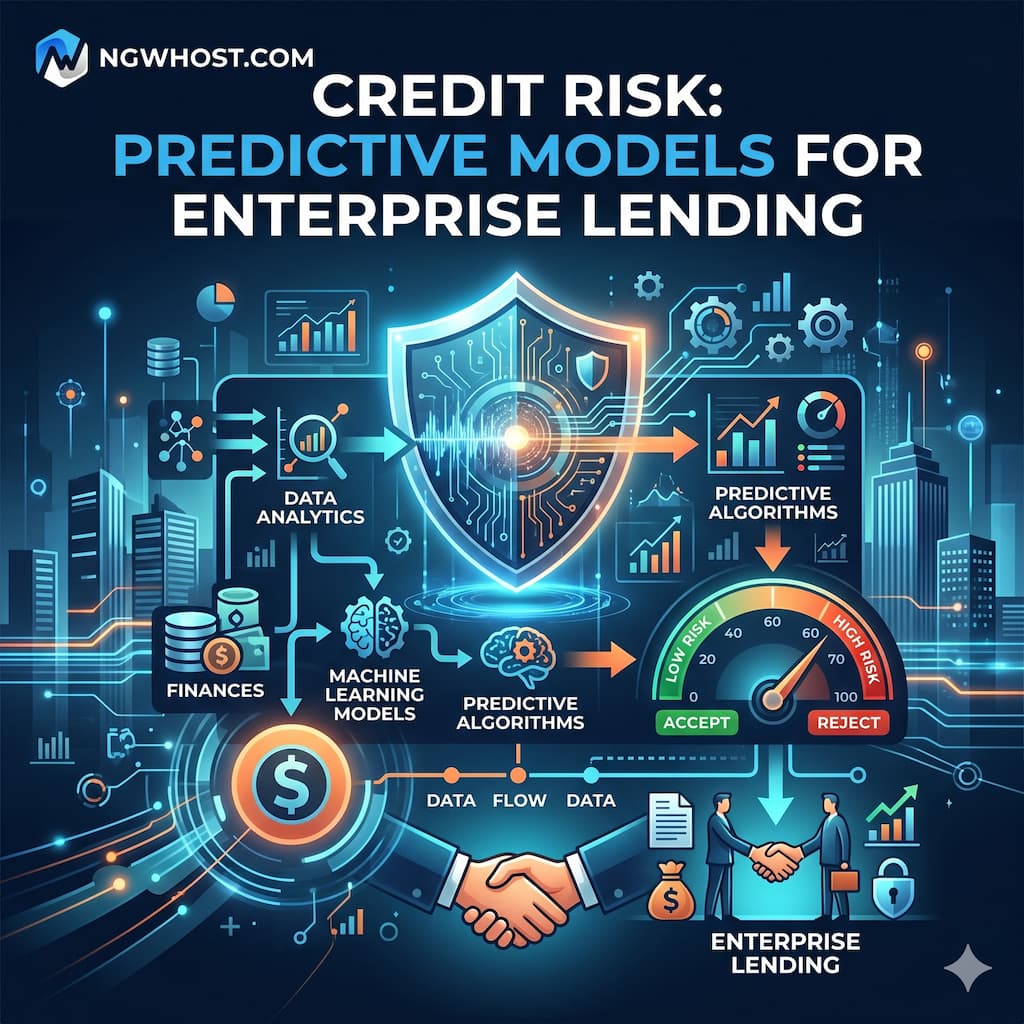
Credit Risk: Predictive Models for Enterprise Lending
The structural architecture governing commercial credit underwriting is experiencing a profound, data-driven transformation. For generations, corporate lenders, institutional banks, and enterprise credit syndicates relied on static, backward-looking assessment models. Credit committees evaluated multi-million dollar corporate loan requests by reviewing historical balance sheets, analyzing trailing tax returns on quarterly or annual cadences, and checking manual credit bureau scores. Risk management operated within a descriptive paradigm, heavily dependent on human intuition, rigid financial ratios, and snapshot accounting summaries.
While this conventional underwriting model offered baseline protection during slower-moving economic cycles, it introducing severe systemic vulnerabilities inside today’s hyper-connected, high-velocity digital commercial ecosystem.
Modern global enterprise networks process massive transactional volumes, handle complex multi-tier supply chains, and navigate volatile international market shifts at speeds that completely overwhelm legacy underwriting systems.
Relying on trailing financial declarations under this high-velocity reality leaves risk operations blind to emerging structural distress. This computational delay leads to elevated default rates, inefficient capital allocation, missed revenue opportunities with creditworthy scaleups, and severely degraded portfolio performance.
To eliminate this operational friction, lower loan-loss reserves, and secure an absolute market-leading competitive moat, forward-thinking enterprise tech and banking leaders are overhauling their credit risk frameworks. They are migrating away from static scorecards and deploying automated Predictive Credit Risk Modeling Platforms.
Far from an incremental dashboard patch or a basic data tracking spreadsheet, a production-grade enterprise predictive risk architecture integrates real-time multi-source data orchestration, advanced machine learning classification algorithms, continuous macroeconomic simulation modules, and hardware-insulated zero-trust data perimeters straight into the core lending infrastructure.
1. The Core Paradigm Shift: From Descriptive Hindsight to Continuous Credit Foresight
To construct an enterprise-grade lending engine capable of scaling safely across thousands of distributed corporate entities, risk architects must transition their underlying system design philosophy away from passive log review and focus on continuous, predictive risk monitoring.
The Structural Evolution of Commercial Credit Assessment
- Legacy Credit Scorecards: Rely almost entirely on reactive data tracking. Systems record what has already occurred within a borrower’s corporate perimeter—such as historical annual net margins, past asset turnover ratios, and retrospective ledger closures.
- The Predictive Risk Fabric: Unifies internal corporate enterprise resource planning (ERP) logs and bank transactional feeds directly with live macroeconomic forecasting models, streaming global supply chain telematics, and real-time open-market transaction data.
By establishing an uninterrupted, live feedback loop between live physical behaviors and automated credit risk optimization pipelines, predictive modeling networks permanently eliminate information lag. The underwriting center moves past its historical role as a passive manual validator.
The software framework evolves into an active, strategic engine designed to predict default probabilities weeks before an accounting anomaly manifests on a balance sheet, optimizing capital deployment velocity at peak efficiency.
2. Core Pillars of an Enterprise Predictive Credit Risk Stack
Constructing a production-grade predictive credit risk infrastructure capable of scaling safely across thousands of multi-jurisdictional enterprise borrowers requires a robust technology layer anchored by four foundational execution pillars.
Pillar I: High-Throughput Real-Time Data Ingestion and Event Orchestration
The ultimate predictive accuracy of any credit risk model depends entirely on the volume, consistency, and real-time ingestion velocity of the underlying data streams feeding its processing loops.
- The Engineering Blueprint: Systems architects deploy automated real-time data orchestration pipelines connected straight to borrower accounting interfaces, point-of-sale systems, global bank lockboxes, and supply chain ERP systems via secure Open Banking APIs. The ingestion factory normalizes unstructured financial telemetry—including fluctuating cross-border exchange rates, rolling invoice creation velocities, and automated inventory depletion logs—into a standardized, low-latency data schema. This continuous data harvest transforms unstructured tracking events into a single, uncorrupted source of truth for both online real-time inference and offline model retraining loops, completely preventing data skew vulnerabilities.
Pillar II: Advanced Machine Learning Classification and Ensembling Engines
Traditional corporate lending structures segment borrowers into broad, rigid risk brackets using basic linear formulas, frequently failing to map complex, non-linear relationships across thousands of alternative data variables.
- The Engineering Blueprint: Enterprise risk teams deploy optimized Machine Learning Classification Engines built on advanced gradient-boosting machines (such as XGBoost or LightGBM) paired with deep neural network architectures. The model processes thousands of distinct input features simultaneously—including a company’s customer concentration variance, payroll growth stability, vendor payment delay trends, and real-time social sentiment data. The engine applies ensemble learning models to calculate an adaptive, dynamic Probability of Default (PD) score that updates programmatically as new data points flow through the ingestion pipelines.
Pillar III: Stochastic Loss Simulators and Portfolio Stress Testing
Maintaining an unassailable financial perimeter requires the enterprise lending core to continuously evaluate its systemic resilience against sudden, catastrophic macroeconomic or geopolitical dislocations.
- The Scale Blueprint: The infrastructure integrates advanced Monte Carlo Simulation Engines that run millions of continuous, automated cash-drain and macro stress tests over the entire credit portfolio concurrently. The system models how borrower default rates, Loss Given Default (LGD) metrics, and overall Exposure at Default (EAD) would perform under severe market disruptions: an abrupt spike in central bank interest rates, an extended localized energy gridlock, or sudden shifts in cross-border currency values. If a simulation reveals that a potential macro disruption would breach structural regulatory capital requirements, the platform triggers automated rebalancing alerts, allowing risk officers to adjust credit limits proactively.
Pillar IV: Programmatic Limit Automation and Early Warning Systems (EWS)
Waiting for a formal quarterly or annual credit review cycle to adjust borrowing parameters or initiate collection playbooks exposes the lender to massive, unhedged loss windows during periods of rapid market contraction.
- The Scale Blueprint: Operations groups deploy an automated Early Warning System (EWS) connected straight to live transactional streams. The system monitors borrower behavioral features continuously against adaptive risk-threshold parameters. If the engine identifies an anomalous drop in a borrower’s daily sales velocities combined with an uncharacteristic elongation in their vendor payment cycles, it triggers an immediate automated intervention playbook: it programmatically dials down the firm’s revolving credit limits, locks automated overdraft extensions, and routes the high-risk file directly to specialised risk teams for immediate manual remediation, minimizing the blast radius of a potential business default in seconds.
3. High-Performance Optimization: The Predictive Credit Risk Metric Ledger
Upgrading an enterprise technology framework from uncoordinated manual credit scorecards to an automated, scaled predictive risk architecture completely redefines an organization’s lending efficiency and portfolio performance benchmarks.
| Performance Parameter | Legacy Credit Scorecards | Scaled Predictive Risk Architecture |
| Underwriting Triage Latency | Weeks of manual document collection and review | Real-time, sub-second automated risk scoring |
| Data Visibility Ingestion | Trailing, snapshot quarterly or annual reviews | Live, continuous Open Banking and ERP streaming |
| Default Model Adaptability | Rigid, manual scorecard updates every 1-2 years | Automated MLOps retraining and concept drift checks |
| Risk-Attribution Explainability | High dependence on subjective analyst judgment | Transparent, compliant game-theory feature mapping |
| Portfolio Blast Radius Control | Reactive; manual intervention after a default event | Autonomous; sub-second dynamic credit limit dialing |
4. Real-World Applications: Predictive Models in Active Lending Environments
Evaluating how advanced credit risk optimization and simulation platforms perform under complex, real-world enterprise lending conditions highlights their critical role in maximizing capital allocation efficiency and safeguarding portfolio value.
Real-Time Credit Limit Optimization and Default Mitigation in Supply Chain Finance
Consider a major institutional B2B lender that coordinates extensive revolving credit facilities and inventory financing lines for thousands of mid-market electronics distributors worldwide. The lending platform operates across a highly capital-intensive space. Suddenly, a severe component shortage or localized infrastructure breakdown triggers an immediate gridlock at a primary manufacturing corridor, trapping finished components in transit and threatening inventory starvation across downstream distributors.
For an unhedged credit provider reliant on traditional, slow-moving audit cycles, this sudden supply chain freeze results in immediate borrower cash-flow starvation. Lenders remain blind to the distress until distributors begin missing loan payments weeks later, resulting in massive write-offs.
The predictive enterprise lender completely neutralizes this systemic risk by anchoring its credit operations to an automated predictive risk framework. The platform monitors global supply chain telemetry, maritime transponder feeds, and borrower transactional invoice velocities continuously.
The moment the system registers a sudden, uncharacteristic delay in shipping logs combined with a drop in daily point-of-sale invoice generations at a specific distributor segment, it flags the anomaly instantly.
The system bypasses manual review delays and executes an automated protection playbook: it computes the financial impact of the delay across the portfolio, programmatically updates the probability of default scores for affected firms, and dynamically scales down their revolving credit exposures automatically. This rapid intervention preserves portfolio capital stability, prevents over-leveraging, and enables the credit provider to safely route capital to unaffected market segments smoothly.
Proactive Credit Risk Structuring for High-Growth E-Commerce Merchants
A digital merchant lending platform provides unsecured, revenue-based working capital lines to thousands of rapidly expanding e-commerce scaleups. Merchant sales volumes, advertising conversion metrics, and inventory turnover rates fluctuate wildly depending on changing seasonal trends, shifting consumer behavior patterns, and algorithmic social media advertising updates, creating intense cash-flow volatility across the borrower ecosystem.
The lending enterprise stabilizes its credit portfolio and capitalizes on high-margin opportunities by anchoring its underwriting core to an automated machine learning classification framework. The platform connects directly to merchants’ digital storefronts, fulfillment platforms, and bank accounts via secure APIs.
Using advanced time-series forecasting models running continuously, the system projects a merchant’s future revenue velocity weeks ahead with high mathematical precision.
If the model projects an upcoming sales acceleration based on real-time marketing metrics, the engine automatically expands the merchant’s credit limit programmatically, capturing maximum transaction processing volume.
Conversely, if the system isolates an early-stage customer acquisition cost expansion that threatens future debt-servicing capability, it adjusts the borrowing parameters down instantly, protecting corporate capital reserves from loan-loss erosion while maximizing portfolio yield.
5. Security and Infrastructure Architecture for Hardened Credit Risk Control Planes
Centralizing global corporate accounting records, integrating live enterprise banking data lakes, tracking predictive default models, and automating API-driven credit limit dialing pathways introduces intense data privacy and infrastructure security requirements. Because predictive credit risk platforms manage the direct movement of global corporate capital and hold highly sensitive enterprise intelligence, they represent top-tier targets for advanced persistent threat actors, corporate espionage networks, and malicious data-harvesting syndicates.
[Raw ERP & Bank Data] ──> [Confidential Compute Enclave] ──> Anonymized Feature Store ──> Secure Risk Prediction
Implementing Anonymized Feature Tokenization across Risk Pipelines
To train predictive models, evaluate factor analysis, and execute large-scale lookalike default clustering safely without violating global user privacy directives (such as GDPR or CCPA) or exposing proprietary corporate trade secrets to public network observers, organizations must implement a robust data perimeter.
Systems architects deploy an automated data tokenization proxy directly at the front edge of the data ingestion pipeline. Before any ledger file, bank statement, or transaction log is written to the central predictive data lakehouse, all sensitive personal fields and specific corporate partner identifiers are automatically extracted, cryptographically hashed, and replaced with secure tokens. The quantitative models and risk-attribution engines execute their pattern-recognition calculations over anonymized financial metadata, maintaining total data utility while ensuring absolute corporate data privacy across all regional entities.
Hardening the Quantitative Core via Enclave Isolation and Anti-Poisoning Controls
Because the centralized credit risk optimization core commands the absolute authority to analyze funding requests, alter credit allocation strategies, and execute automated account freezing via API links, accessing this administrative engine requires extreme security constraints.
- Enclave Isolation: Isolate the entire quantitative modeling core, analytics databases, and API configuration consoles inside a strict Zero-Trust Network Access (ZTNA) envelope. Every corporate account, data-scientist terminal, and internal software integration must undergo continuous multi-factor authentication, rigorous behavioral risk screening, and endpoint device posture assessments before gaining access to the platform interface. The data repositories must execute within hardware-isolated Confidential Computing Enclaves equipped with hardware-level memory encryption, keeping all enterprise credit insights completely insulated from unauthorized lateral access, internal insider threats, or external data exploitation at all times.
- Anti-Poisoning Controls: Implement strict automated validation checks over all incoming training data payloads. The data pipeline scans fresh features for anomalous variance anomalies or adversarial data injections, blocking malicious data-poisoning attempts designed to degrade model accuracy or introduce backdoors into the credit inference core.
6. Regulatory Convergence: Adhering to Global Capital Adequacy Directives
Scaling a comprehensive predictive credit risk architecture requires absolute compliance with an evolving web of international corporate governance, financial accounting mandates, and transaction tracking standards.
- The Basel III / Basel IV Capital Accords: Landmark international banking frameworks impose strict guidelines on how enterprise credit providers calculate their risk-weighted assets (RWA). These accords demand that institutions deploying advanced internal ratings-based (IRB) machine learning models must present verifiable data tracking pipelines, absolute code lineage, and rigorous validation metrics to back up their probability of default assertions.
- The IFRS 9 / CECL Standards: Global accounting frameworks require credit providers to utilize forward-looking Expected Credit Loss (ECL) models rather than historical incurred loss frameworks, making the integration of real-time predictive data streams and stochastic simulation networks a legal mandate to ensure correct balance-sheet provisioning.
- The EU AI Act Compliance Standards: Emerging international artificial intelligence legislation enforces strict transparency, auditability, and non-discrimination requirements on automated credit scoring algorithms and corporate profiling tools, demanding that enterprise lenders provide clear, non-bias mathematical reasoning documentation alongside every automated credit decision.
Read More⚡ Quantitative Analysis: Strategy for Corporate Funding
Conclusion: Orchestrating the Unassailable Enterprise Credit Engine
The deployment of a modern, data-driven predictive credit risk architecture is not an optional optimization update for commercial lenders and enterprise finance institutions; it is a fundamental technological requirement to navigate tomorrow’s hyper-connected, high-velocity economic arena. The historical strategy of managing multi-million-dollar global corporate credit portfolios through slow, human-centric scorecards and trailing spreadsheet reviews—while tolerating severe data latency, manual underwriting friction, and volatile loan-loss exposures—is an unsafe operational approach that invites market displacement and severe capital erosion.
By engineering an integrated, forward-looking financial fabric built on high-throughput real-time data ingestion pipelines, advanced machine learning classification ensembles, stochastic portfolio stress-testing engines, and automated early warning systems, progressive enterprise leaders transform their risk functions from passive tracking nodes into high-performance strategic weapons.
Ultimately, the definitive advantage in the global commercial ecosystem belongs entirely to the visionary enterprise leaders that can evaluate risks, optimize credit structures, and deploy capital as fast as the market moves—mastering advanced predictive analysis frameworks to drive secure, highly efficient, and market-leading global scale across any operational horizon.
Deploying computationally intensive machine learning risk engines, high-throughput financial data lakehouses, real-time credit structure optimization models, and ultra-secure automated account protection frameworks requires world-class, zero-downtime server infrastructure. Secure your company’s digital credit risk engine on an unassailable infrastructure foundation by exploring the premium enterprise hosting configurations at ngwhost.com.