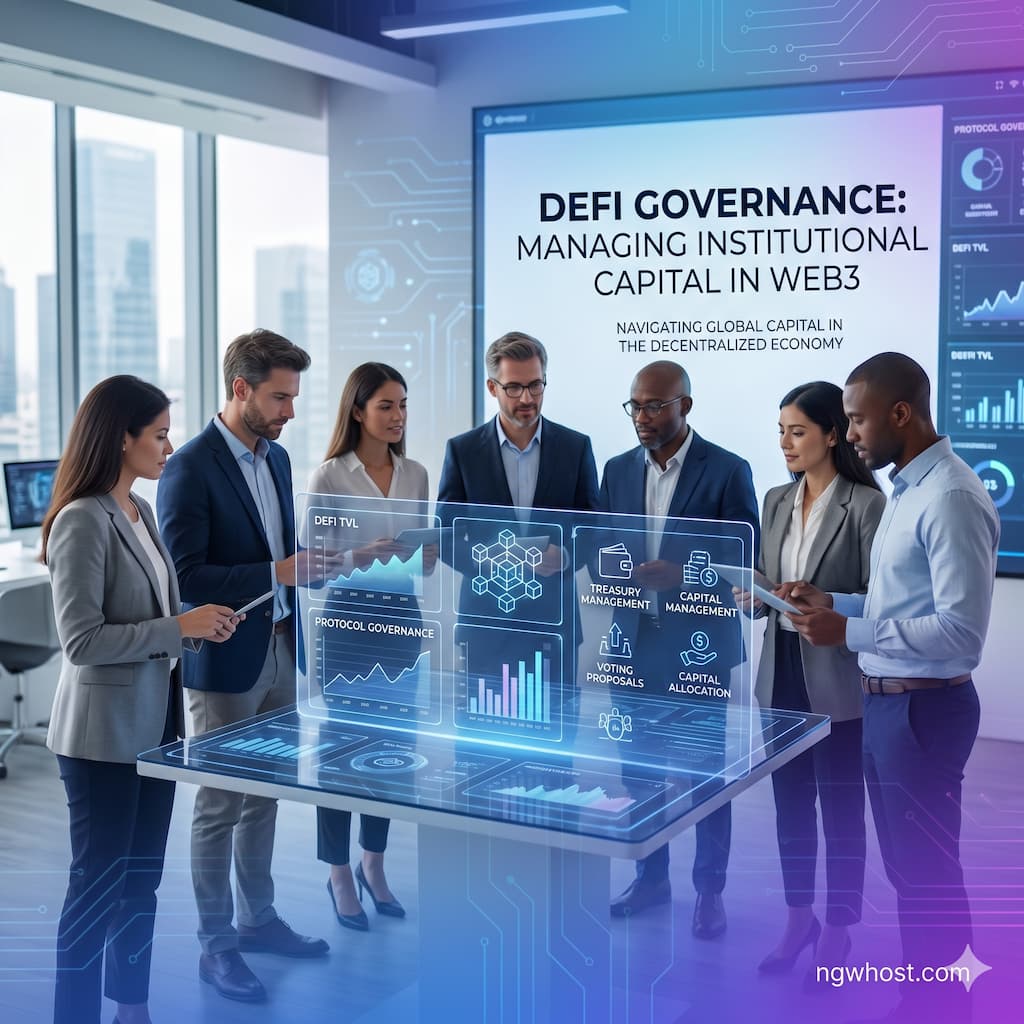
DeFi Governance: Managing Institutional Capital in Web3
The collision between institutional asset management and decentralized finance (DeFi) has moved past the initial phase of speculative exploration. Today, sovereign wealth funds, hedge funds, family offices, and corporate treasuries are actively deploying capital into decentralized protocols. They are seeking to capture premium yields, participate in automated market maker (AMM) liquidity pools, and leverage tokenized real-world assets (RWAs).
However, as institutional allocators scale their commitments within the Web3 ecosystem, they run into a structural challenge that goes far beyond traditional smart-contract risk or market volatility: the mechanics of decentralized governance.
In traditional finance, corporate governance is built on deeply established, legally binding corporate registries, proxy voting networks, and centralized board structures. If an asset manager objects to a strategic corporate action, they can leverage public shareholder channels, engage in direct regulatory mediation, or liquidate their equity stakes through high-throughput public markets.
In the domain of Web3, corporate actions, parameter updates, risk matrices, and capital distribution mechanics are dictated algorithmically by smart contracts running on decentralized ledgers. These actions are triggered exclusively through token-weighted voting systems managed by decentralized autonomous organizations (DAOs).
For an institutional fund managing fiduciary capital, participating in or defending against these decentralized voting frameworks introduces severe operational and legal risks. A single uncoordinated governance vote can modify a protocol’s collateralization ratios, alter its interest rate curves, or introduce unverified smart-contract code upgrades. Any of these events can trigger sudden capital impairment or compliance failures.
To survive in this open-source architecture, enterprise technology and investment leaders must upgrade their operational stacks. They are systematically designing and deploying advanced DeFi Governance Infrastructure to securely manage institutional wealth across Web3 networks.
1. The Core Paradox: Token-Weighted Democracy vs. Fiduciary Duty
To construct an institutional-grade Web3 risk framework, fund managers and systems engineers must first analyze the structural friction between raw token-voting mechanisms and traditional fiduciary obligations.
 [Legacy Shareholder Voting]: Proxy Registries ──> Board Mediation ──> Reversible Legal Enforcement
 [DeFi Token Governance]: On-Chain Proposals ──> Automated Voting ──> Immutable Smart Contract Execution
In a pure, decentralized DAO environment, governance operates on a simple cryptographic baseline: one token equals one vote. Anyone who accumulates a sufficient threshold of a protocol’s governance tokens can author a formal proposal (an on-chain improvement proposal) to alter the software’s underlying logic. If the proposal secures a majority vote from the token-holding quorum within a designated time block, the smart contract automatically executes the code modification on the live blockchain ledger.
This architecture introduces three critical vulnerabilities for institutional allocators:
- The Vulnerability of Governance Attacks (Flash Loan Exploits): Malicious actors can utilize flash loans to borrow millions of dollars worth of governance tokens from a lending pool within a single transaction block. They use this temporary capital to force a predatory governance vote through a DAO, altering the protocol’s code parameters to drain its treasury, and then return the borrowed tokens—all inside a single minute, completely bypassing traditional legal or regulatory intervention.
- The Challenge of Structural Voter Apathy: The vast majority of retail token holders do not actively participate in complex technical votes. This creates a vacuum where small, concentrated syndicates of activist investors or anonymous whales can manipulate protocol strategies to serve short-term personal liquidity plays, leaving long-term institutional allocators exposed to unhedged risk adjustments.
- The Burden of Compliance Violations: Traditional DAOs frequently execute proposals without conducting rigorous regulatory checks, anti-money laundering (AML) screening, or data privacy assessments. For a fund operating under strict sovereign compliance oversight, an anonymous DAO proposal that routes protocol revenues into sanctioned jurisdictions can instantly trigger immediate regulatory enforcement, forcing the fund to liquidate its entire asset position under catastrophic market conditions.
To eliminate these systemic operational bottlenecks, progressive enterprise funds are abandoning passive token holding. They are deploying automated, code-driven defense layers to actively monitor, evaluate, and control their governance exposure across the Web3 network fabric.
2. Core Pillars of an Institutional DeFi Governance Stack
Constructing a production-ready, enterprise-grade governance infrastructure across a distributed Web3 network requires an integrated technology layer anchored by four foundational execution pillars.
Pillar I: Real-Time Governance Telemetry Ingestion Engines
The ability of an investment fund to protect its digital assets depends entirely on its capacity to discover and evaluate pending governance changes before they are executed on the live ledger.
- The Engineering Blueprint: Enterprise technology teams deploy automated Governance Telemetry Aggregators. These specialized data systems continuously monitor on-chain voting endpoints, decentralized discussion forums (such as Discourse registries), snapshot signaling spaces, and code repositories (like GitHub pull requests) simultaneously. The ingestion engine extracts raw proposal data, normalizes unstructured proposal text into a standardized data schema, and routes real-time telemetry straight to the fund’s risk dashboard, ensuring analysts spot emerging proposal vulnerabilities days before an active on-chain voting period opens.
Pillar II: Multi-Party Computation (MPC) Voting Registries and Secure Escrow
Participating in high-volume, decentralized on-chain votes requires funds to interact directly with Web3 smart-contract interfaces, introducing severe cryptographic key exposure risks if managed through standard browser extension wallets.
- The Engineering Blueprint: Institutional platforms execute governance actions exclusively through FIPS 140-3 Level 4 Hardened Hardware Security Modules (HSMs) running advanced Multi-Party Computation (MPC) protocols. Instead of keeping a master private key on an active, online device to sign a vote, the MPC system breaks the signing key into separate, independent key shares distributed across isolated cryptographic server boundaries. When a vote is authorized, the nodes run a secure multi-party protocol to sign the transaction collectively. This setup allows the fund to cast governance votes across multiple distinct blockchain networks without ever bringing a complete private key online or triggering asset-dilution vulnerabilities.
Pillar III: Dynamic Policy Evaluation and Automated Delegation Architectures
Enterprise funds cannot afford to task expensive, in-house investment teams with manually reviewing every minor configuration vote across dozens of deployed DeFi protocols.
- The Scale Blueprint: Systems architects implement Algorithmic Governance Policy Engines paired with secure, conditional Token Delegation Protocols. Investment boards program explicit boundary rules into the control layer—defining preset thresholds for acceptable risk parameters (e.g., automated delegation parameters can be set to automatically vote “Yes” on standard software bug fixes, while instantly triggering a manual executive review quorum if a proposal attempts to adjust platform fees or collateral assets). For standard technical maintenance updates, the system utilizes secure cryptographic smart-contract delegation to automatically route the fund’s voting weight to trusted, verified institutional developers, preserving internal analytical resources for high-priority strategic decisions.
Pillar IV: Formal Code Verification and Timelock Circuit Breakers
Maintaining absolute institutional resilience requires funds to verify that the actual code payload embedded inside an on-chain proposal matches the textual description published on a DAO forum.
- The Scale Blueprint: Risk management teams deploy automated Smart-Contract Verification Oracles paired with Timelock Circuit Breakers. Before a fund casts a final vote on a high-stakes proposal, the verification engine runs the proposed code snippet inside an isolated virtual sandbox environment, checking the programming logic for hidden backdoors, malicious reentrancy vectors, or arithmetic overflow flaws. Furthermore, funds prioritize protocols that feature hardcoded governance timelocks—mandatory delays between a proposal’s approval and its actual network deployment—giving institutional systems engineers a defensive window to safely withdraw capital if a predatory or compromised proposal manages to pass.
3. High-Performance Optimization: The Institutional Governance Ledger
The strategic transition away from uncoordinated manual tracking to an automated, data-driven governance infrastructure completely redefines an organization’s risk profile within Web3 capital markets.
- Proposal Tracking Latency: Manual forum monitoring requires days of ad-hoc observation. Automated telemetry ingestion delivers near-instant, real-time alert mapping.
- Cryptographic Key Exposure Risk: High vulnerability on basic browser wallets during transaction signing. Drops to zero via distributed, hardware-isolated MPC key shares.
- Governance Attack Protection: Vulnerable to unexpected flash loan exploits and stealth proposals. Hardened by real-time sandbox verification and timelock circuit breakers.
- Regulatory Compliance Oversight: Non-existent; blind to anonymous voter profiles. Secured through zero-knowledge identity validation and permissioned voting pools.
- Voter Execution Efficiency: High manual labor overhead per individual vote. Streamlined through programmatic policy engines and conditional token delegation.
4. Operational Implementations: Governance Infrastructures in Action
Evaluating how advanced governance frameworks operate under real-world, institutional investment conditions demonstrates their critical role in protecting global corporate capital.
Defending Institutional Assets against a Predatory Governance Takeover
Consider a large-scale institutional digital asset fund that has deployed $50 million in stablecoin assets into an automated decentralized lending protocol to capture stable, predictable yield. The protocol is governed by a public DAO. A malicious activist syndicate quietly accumulates a significant concentration of the protocol’s native governance tokens, utilizing high-volume secondary markets and flash loan networks to obscure their capital accumulation path.
The syndicate authors a surprise, high-velocity on-chain proposal designed to adjust the protocol’s risk parameters—lowering the collateral liquidation threshold for an obscure, highly volatile asset asset token that the syndicate controls, which would effectively allow them to borrow the fund’s stablecoin reserves against worthless collateral.
Because the institutional fund operates an automated governance telemetry platform, the predatory proposal is intercepted the millisecond it is broadcast to the ledger network. The system recognizes the sudden spike in voting concentration combined with the anomalous collateral risk parameter adjustment, immediately marking the proposal as a high-threat attack vector.
The policy engine halts automated token delegation, triggers an immediate high-priority alert to the fund’s investment board, and engages the automated timelock circuit breaker.
The fund’s risk team utilizes the mandatory 48-hour governance timelock window to programmatically withdraw its entire $50 million stablecoin reserve out of the lending pools and route it to an uncompromised, permissioned alternative network—completely isolating the fund from the asset-draining exploit before the malicious code can execute.
Managing Regulatory Risk through Permissioned Governance Sub-Pools
A multinational commercial banking group is designing an institutional Web3 syndication platform to issue tokenized corporate trade receivables across a public blockchain infrastructure. To ensure liquidity depth, the platform must connect to a decentralized liquidity network, yet the bank is strictly barred by international AML and Counter-Terrorism Financing (CTF) regulations from participating in open-source voting forums alongside completely anonymous, unverified digital identities.
The banking group solves this structural compliance bottleneck by engineering an Institutional Permissioned Governance Sub-Pool. The platform utilizes advanced zero-knowledge cryptography (zk-Identity tokens) to construct a private, ring-fenced governance tier layer over the public DeFi protocol core.
Before an entity can purchase governance tokens, introduce proposals, or cast votes within this sub-pool, they must clear strict regulatory onboarding filters managed by a verified compliance oracle.
The system validates that all transacting participants are accredited corporate institutions, completely masking private operational data from public view while generating an immutable, cryptographic compliance ledger for international banking regulators automatically—enabling the bank to scale its Web3 operations with complete legal safety.
5. Security Architecture for Hardened Web3 Governance Control Planes
Because a centralized governance console controls the direct voting weight, strategic parameter settings, and capital allocation pathways across multi-million-dollar Web3 portfolios, the management interface represents a premium target for advanced espionage networks and cyber-sabotage rings.
- Enforcing Multi-Signer MPC Consensus for Governance Proposals: Fund managers must never allow single technician accounts, individual financial analysts, or unmonitored automated software processes to independently modify global voting rules, alter delegation scripts, or submit high-stakes on-chain proposals. Implement strict MPC frameworks paired with multi-signer validation rules across the governance console. Altering a system-wide voting policy, changing a delegated developer identity, or authorizing an outward governance transfer must require concurrent, cryptographic confirmation from a distributed quorum of verified executive keys across completely isolated network environments, protecting the system from internal fraud or external compromise.
- Hardening the Telemetry Engine via Zero-Trust Network Isolation: Isolate the entire governance analytics infrastructure, database lakehouses, and API configuration consoles inside a strict Zero-Trust Network Access (ZTNA) envelope. Every corporate user account, data-scientist terminal, and internal software integration must clear continuous multi-factor authentication, rigorous behavioral risk screening, and endpoint device posture assessments before gaining access to the platform interface, keeping your enterprise Web3 revenue metrics completely insulated from unauthorized lateral access or remote injection exploits at all times.
6. Regulatory Convergence: Navigating Global Web3 Oversight Standards
Scaling a comprehensive Web3 governance architecture is no longer merely an infrastructure best practice; it is a vital legal necessity to satisfy international regulatory bodies as decentralized asset governance moves into mainstream global law.
- The MiCA Regulations (European Union): Imposing clear guidelines across all member states, MiCA enforces specific operational transparency rules for entities managing decentralized applications, requiring rigorous tracking of voting concentrations, public disclosure of governance risks, and explicit structural liability frameworks.
- The SEC and CFTC Enforcement Directives (United States): Regulatory bodies are increasingly scrutinizing the organizational structures of DAOs, stating that holding a significant concentration of governance tokens and actively directing protocol code upgrades can classify an investment fund as an unregistered general partnership, making comprehensive compliance auditing frameworks mandatory.
- Global Financial Action Task Force (FATF) Mandates: International anti-money laundering standards dictate that decentralized protocols and institutional access gateways must maintain reliable, real-time tracking of transaction paths and participant profiles, forcing funds to deploy advanced cryptographic auditing tools across all active Web3 environments.
Read More⚡ Venture Capital Trends: Navigating Tech Startups Funding
Conclusion: Mastering the Decentralized Governance Continuum
The integration of an automated DeFi governance architecture is not an optional optimization project for modern asset management; it is a fundamental technological requirement to navigate tomorrow’s hyper-connected, code-driven economic landscape. The historical strategy of managing Web3 capital through passive, unmonitored token holdings—while tolerating severe governance attack exposures, voter apathy blind spots, and lagging manual forum analysis—is an unsafe operational approach that invites total capital starvation and balance-sheet erosion.
By engineering an integrated, forward-looking risk management fabric built on high-performance real-time telemetry ingestion pipelines, distributed MPC hardware voting registries, automated policy evaluation engines, and ironclad zero-trust data protection networks, progressive enterprise leaders transform their Web3 asset allocations from volatile exposures into high-performance strategic assets.
Ultimately, the definitive advantage in the global wealth ecosystem belongs entirely to the visionary enterprises that can evaluate and defend their governance parameters as fast as the ledger moves—mastering advanced DeFi governance frameworks to drive secure, highly efficient, and market-leading global scale across any digital horizon.
Deploying computationally intensive governance telemetry lakehouses, high-performance MPC cryptographic signing arrays, real-time smart-contract sandbox simulators, and low-latency automated response dashboards requires state-of-the-art, zero-downtime server infrastructure. Secure your startup’s digital engine on an unassailable foundation by exploring the premium enterprise hosting configurations at ngwhost.com.