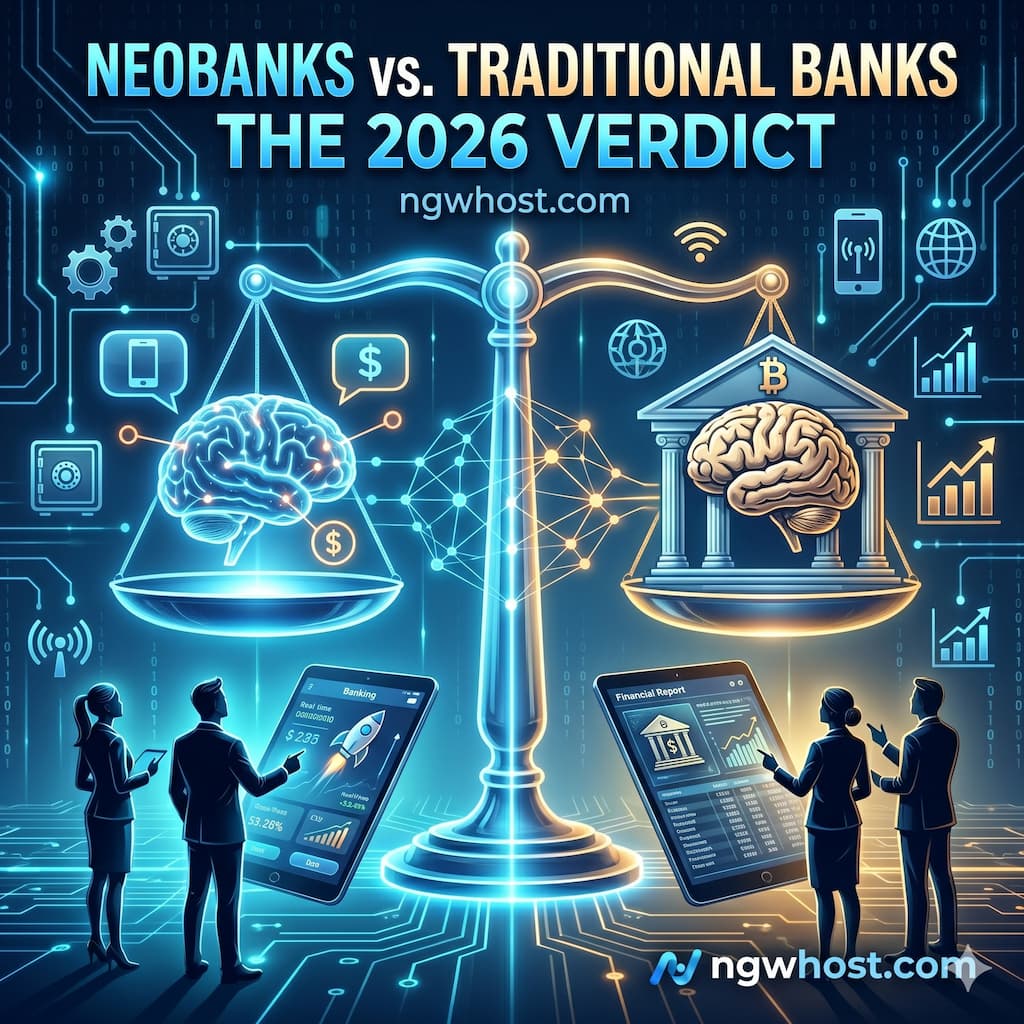
Neobanks vs. Traditional Banks: The 2026 Verdict
The global banking war has reached its critical inflection point. As we navigate through May 2026, the decade-long narrative of “disruption” has evolved into a sophisticated, battle-tested reality. We are no longer asking if digital-only banks can survive, or when legacy institutions will completely collapse. Instead, the market has delivered a nuanced, highly structural answer.
The global neobanking market size has surged past $350 billion, expanding at a breathtaking compound annual growth rate (CAGR) of over 36%. Concurrently, traditional institutions have leveraged their massive balance sheets, soaring net interest margins, and institutional trust to mount an aggressive counter-offensive.
For the digital entrepreneurs, web administrators, and financial strategists at ngwhost.com, understanding this shifting ecosystem is vital. Your choice of banking partner directly influences your operational friction, transaction speed, and capital efficiency.
This comprehensive intelligence brief delivers the definitive 2026 verdict on Neobanks vs. Traditional Banks, breaking down the numbers, the structural shifts, and the tactical choice you must make for your business this year.
1. The 2026 Profitability Pivot
Historically, the competition between legacy banks and tech-driven challenger banks was fought entirely on the battlefield of customer acquisition. Neobanks burned billions in venture capital to offer zero-fee accounts and beautiful user interfaces, resulting in massive user bases but fragile balance sheets.
In 2026, the game has fundamentally changed from “growth at all costs” to high-conviction profitability.
                   ┌──────────────────────────────────┐
                   │   2026 REVENUE & PROFITABILITY   │
                   └────────────────┬─────────────────┘
                                    │
           ┌────────────────────────┴────────────────────────┐
           ▼                                                 ▼
┌───────────────────────┐                         ┌───────────────────────┐
│       NEOBANKS        │                         │   TRADITIONAL BANKS   │
└───────────┬───────────┘                         └───────────┬───────────┘
            │                                                 │
            ├─► 38% Globally Profitable                       ├─► Controls 95% of Revenue
            ├─► Average CAC: $35                              ├─► Average CAC: $300+
            └─► 30-40% of New Acquisitions                    └─► Retention Layer: Capital Moats
The Simon-Kucher Data
According to the landmark Simon-Kucher Global Neobanking Study 2026, 38% of major neobanks are now fully profitable, a massive leap from a meager 12% just three years prior. Titans like Revolut (boasting over 45 million users), Nubank, and Monzo have successfully moved beyond a single dependency on interchange fees. They have transformed into full-stack financial platforms, offering high-margin lending, insurance, stock brokerage, and crypto/stablecoin yield integration.
The Incumbent Revenue Moat
Despite this impressive shift, the revenue asymmetry remains stark. Neobanks are capturing an estimated 30% to 40% of all new customer acquisitions globally, and nearly one in four primary banking relationships worldwide is now digital-first. However, traditional banks still control roughly 95% of global financial services revenue. Incumbents have managed to preserve their primary revenue streams by capturing the large-scale commercial loans, high-net-worth wealth management, and enterprise treasury operations that neobanks are only beginning to scratch.
2. Core Comparison: Bricks vs. Clicks in 2026
To understand where your capital belongs, we must evaluate both models across the current macroeconomic landscape.
A. Neobanks: The Efficiency Masters
Operating entirely without physical branches allows challenger banks to maintain an extraordinarily low cost-to-serve ratio.
- Customer Acquisition Cost (CAC): The average CAC for a top-tier neobank sits at an efficient $35, compared to the bloated $300+ average required by traditional legacy banks to acquire a retail client.
- The Business Account Boom: In 2026, the business neobanking segment represents a dominant 68% market share. Small-to-medium enterprises (SMEs) and digital creators are abandoning legacy providers in droves. Neobanks win here by offering automated invoicing, multi-currency accounts, instant global payment rails, and seamless programmatic API integrations with accounting software like QuickBooks and Xero.
B. Traditional Banks: The Custodial Fortresses
Traditional banks have survived the digital onslaught by acting as the ultimate custodial fortresses. When high interest rates dominated the macro landscape, traditional banks reaped massive record-shattering profits from Net Interest Income (NII).
- The Safety Flight: Following the banking tremors of the mid-2020s, corporate treasurers still prefer to park massive capital reserves within Systemically Important Financial Institutions (SIFIs) like JPMorgan Chase, HSBC, or Itaú. Legally backed by central bank guarantees and centuries of infrastructure, traditional institutions retain an undeniable advantage in Trust Equity.
3. Tech Architecture: Agentic AI and Multi-Rail Payments
The technological divide between these two forces has narrowed significantly by mid-2026, though their operational execution remains vastly different.
The Rise of Autonomous “Self-Executing” Finance
In May 2026, banking is driven heavily by Agentic AI and digital co-pilots.
- Neobank AI Integration: Digital-first banks use advanced machine learning models directly at the edge to calculate credit worthiness in seconds, resulting in lightning-fast micro-loan approvals for SMEs. Their AI fraud-detection algorithms operate in real-time, matching transaction anomalies against user behavioral biometrics with sub-second latency.
- Traditional Bank AI Integration: Incumbents are aggressively integrating contextual AI into their legacy ERP and CRM frameworks. By 2026, automated co-pilots are used in over 80% of institutional banking applications, optimizing liquidity management and drafting multi-million-dollar syndicated loan contracts.
Real-Time Infrastructure: FedNow, RTP, and Stablecoins
The payment infrastructure of 2026 relies completely on immediacy.
- Instant Rails: Real-time payment systems like FedNow and RTP in the United States, alongside SEPA Instant in Europe and Pix in Latin America, have moved from peripheral options to standard enterprise operational requirements.
- The Tokenized Treasury: As highlighted by recent J.P. Morgan fintech trend reports, global stablecoin market capitalization has cleared the $300 billion mark, with monthly transaction volumes approaching a colossal $1 trillion. Leading neobanks have successfully embedded these programmable, 24/7 blockchain settlement rails into their cross-border B2B business accounts, bypassing the slow, expensive, and daylight-hour-dependent legacy SWIFT network.
4. Head-to-Head Breakdown (May 2026 Metrics)
| Operational Feature | Neobanks / Challenger Banks | Traditional Incumbent Banks |
| Global User Adoption | 500 Million+ Active Users | Multi-Billion Base (Dominant) |
| Average Net Promoter Score | +52 (High Usability/Satisfaction) | +12 (Persistent Customer Friction) |
| Primary Revenue Driver | Subscription Tiers, Lending, FX Margins | Net Interest Spread, Corporate Advisory |
| Cross-Border Settlement | Real-time via APIs, Stablecoins, & Digital Rails | 1–3 Days via traditional SWIFT framework |
| Regulatory Model | Often Partnered (BaaS) or Emerging Charters | Full Institutional Bank Charters |
| Ideal Target Client | SMEs, Digital Entrepreneurs, Gen Z / Millennials | High-Net-Worth Individuals, Enterprise Corporates |
5. The Convergence: The Middle is Disappearing
The most striking trend of 2026 is that the lines are blurring. The market is witnessing a massive Structural Convergence.
  ┌───────────────────────┐               ┌───────────────────────┐
  │       NEOBANKS        │               │   TRADITIONAL BANKS   │
  └───────────┬───────────┘               └───────────┬───────────┘
              │                                       │
              ▼                                       ▼
    [Seeking Bank Charters]                 [Buying Tech Platforms]
              │                                       │
              └───────────────────►◄──────────────────┘
                                   │
                                   ▼
                       ┌───────────────────────┐
                       │   THE 2026 HYBRID     │
                       │    FINANCIAL STACK    │
                       └───────────────────────┘
Challenger banks are maturing; they are actively applying for full-scale national bank charters to capture spread economics directly and eliminate their reliance on third-party Banking-as-a-Service (BaaS) sponsors. Conversely, traditional banks are weaponizing their massive capital pools to acquire agile fintech platforms, sunsetting their clunky legacy apps, and rolling out digital-first spin-offs (such as Marcus or specialized digital portals) to protect their retail deposit base from eroding.
As a result, the middle of the market is completely disappearing. The mediocre local bank with bad software is failing, and the small, under-capitalized regional neobank that cannot monetize its users is shutting down. The field belongs exclusively to scaled digital giants and tech-modernized mega-institutions.
6. The Tactical Verdict: Where Should You Keep Your Money?
For the global digital administrators running websites, agencies, and platforms on ngwhost.com, the selection of a banking architecture shouldn’t be emotional—it must be functional. The optimal 2026 strategy is a Diversified Hybrid Financial Stack.
When to Utilize a Neobank:
- Operational Velocity: If your business model relies on high-frequency programmatic operations, real-time developer API access, instant multi-currency currency conversions, or seamless connectivity to global e-commerce payment processors like Stripe or Mercado Pago.
- Freelance and Creator Economy: If you are a digital entrepreneur managing a distributed international workforce or running cross-border ad campaigns that require instant virtual credit cards with flexible limits.
When to Rely on a Traditional Bank:
- The Safe Haven: Keep your primary long-term operational reserve capital and tax allocations inside a Tier 1 traditional institution. The institutional backing ensures total liquidity insulation against systemic fintech platform shocks.
- Complex Financing: When your business scales to the point of requiring massive credit facilities, asset-backed commercial lines, or localized real estate financing.
Read More⚡ High-Frequency Trading: How AI is Changing the Game
Conclusion: The Era of Intelligent Finance
The 2026 verdict is clear: Neobanks have won the Usability and Access War, but Traditional Banks still command the Capital Throne. The battle is no longer about destroying the opposition; it is about who can adopt the other’s strengths the fastest.
For your business, the path forward is clear. Do not trap your enterprise in the past by utilizing an un-digitized legacy bank out of pure inertia, and do not expose your entire business treasury to a single non-chartered startup app out of pure convenience. Optimize your cash flow, leverage the automation of agentic neobanking APIs for your daily transactions, but secure your core wealth within the foundational bedrock of traditional system security.
The financial rails are faster than they have ever been. Is your business running on the right track?