High-Frequency Trading: How AI is Changing the Game
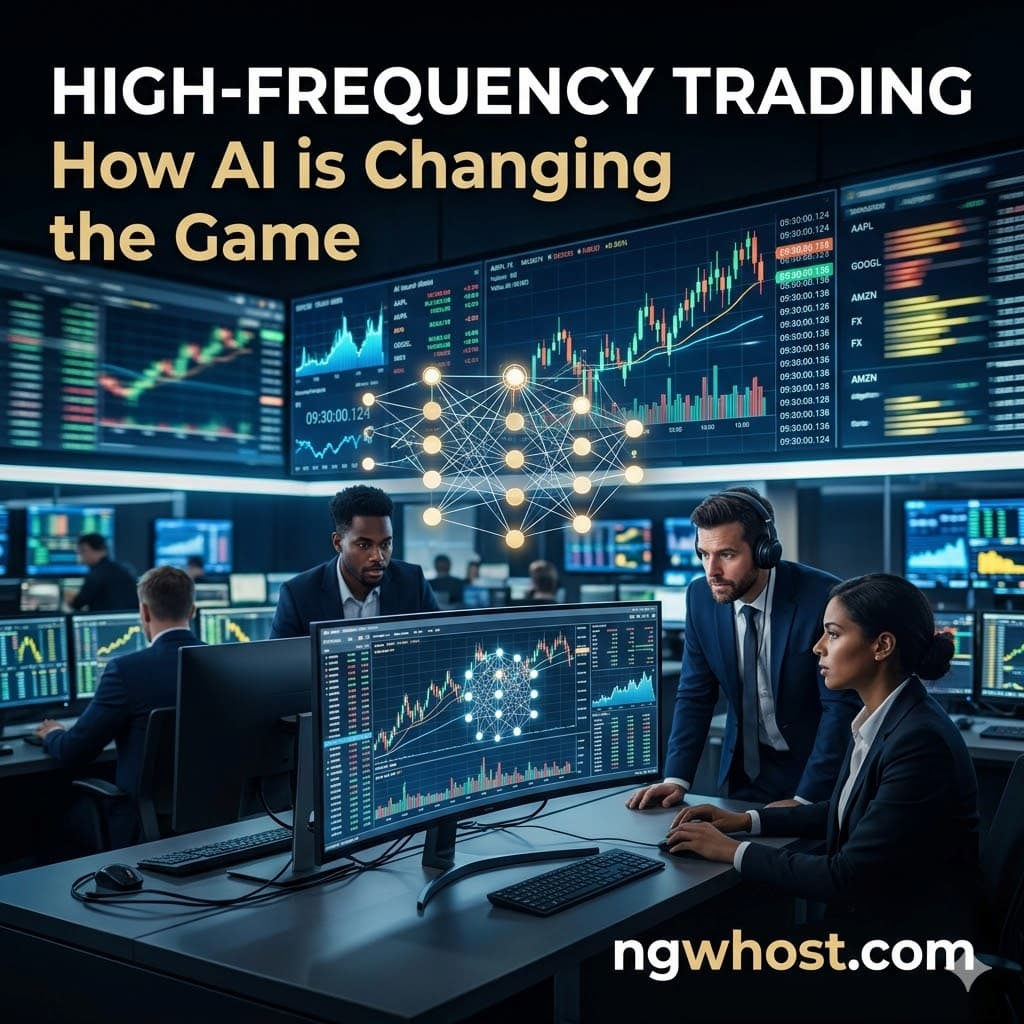
The stock market of May 2026 is barely recognizable to the traders of a decade ago. We have moved past the era of simple “if-this-then-that” algorithms and into the age of Autonomous Market Intelligence. In high-frequency trading (HFT), where the difference between a massive profit and a total loss is measured in microseconds, Artificial Intelligence is no longer just a tool—it is the entire game.
For the community at ngwhost.com, many of whom manage the high-performance hosting environments that power these very algorithms, the evolution of AI-driven HFT represents the ultimate stress test for digital infrastructure.
In this guide, we will analyze how AI has revolutionized speed, the “Next-Gen” machine learning models dominating 2026, and the risks of a market where machines are the only ones left in the room.
1. The 2026 Shift: From Rules to Reasoning
In the early days of algo-trading, systems followed rigid, coded rules. If a price crossed a certain moving average, the system bought. If it hit a stop-loss, it sold.
In 2026, AI has introduced Agentic Reasoning into HFT. Modern trading bots don’t just follow rules; they interpret context.
- Dynamic Adaptation: AI agents now recognize “regime changes” in real-time. If a geopolitical event (like the Middle East shocks of early 2026) shifts market volatility, the AI autonomously rewrites its execution parameters without human intervention.
- Predictive Intent: Beyond looking at price action, 2026-era HFT models analyze “order book toxicity.” They use machine learning to predict when a large institutional player is about to dump a position, allowing the HFT bot to position itself ahead of the move.
2. Core Technologies: The 2026 HFT Stack
To compete in 2026, firms have moved beyond simple Python scripts. The HFT stack is now a marvel of hardware and software integration.
A. Reinforcement Learning (RL)
This is the “Self-Optimizing Trader.” RL models in 2026 learn via trial and error in high-fidelity simulations. They receive “rewards” for profitable trades and “penalties” for slippage. This allows the bot to develop complex strategies—like Iceberging (breaking large orders into tiny pieces) or Scalping—that adapt to the specific liquidity of an exchange in milliseconds.
B. Natural Language Processing (NLP) 4.0
In 2026, HFT is not just about numbers; it’s about words. Advanced NLP models scan millions of sources—earnings calls, X (Twitter) sentiment, and even satellite weather data—to predict market shifts.
Example: If an AI detects a CEO sounding “hesitant” during a live broadcast, it can trigger a sell-off in that company’s stock before the human reporter even finishes their sentence.
C. Quantum Machine Learning (QML)
The newest frontier in 2026 is Quantum HFT. While full-scale quantum computers are still emerging, hybrid Quantum-Classical algorithms are already being used to solve complex “portfolio optimization” problems that would take a traditional supercomputer minutes to solve. In HFT, this means finding the most efficient way to route trades across 50 different exchanges simultaneously.
3. Top Machine Learning Models Dominating 2026
If you are building an HFT environment on ngwhost.com, these are the models currently driving the most alpha:
| Model Type | Best For | Why it Wins in 2026 |
| LSTM (Long Short-Term Memory) | Pattern Recognition | Detects long-term recurring structures in tick-by-tick data. |
| Random Forest / XGBoost | Multi-Asset Decision Making | Evaluates hundreds of market variables simultaneously for high-accuracy entries. |
| Transformer Networks | Sentiment Correlation | Connects global news events to specific stock movements with 95% accuracy. |
| Q-Learning Bots | Dynamic Scalping | Learns the “rhythm” of the bid-ask spread to capture tiny price discrepancies. |
4. The Speed War: Miliseconds vs. Microseconds
In 2026, “Latency” is the enemy. This has led to two major shifts in infrastructure:
I. Edge Computing and Co-location
HFT firms no longer host their trading bots in centralized data centers. They use Edge Nodes co-located directly inside the exchange’s servers (like the servers in New York, London, or Tokyo). By hosting on ngwhost.com nodes with sub-millisecond proximity to these exchanges, traders can shave off the “travel time” of a signal.
II. FPGA and ASIC Acceleration
Standard CPUs are too slow for 2026. Modern HFT AI is “burned” directly into FPGA (Field Programmable Gate Array) chips. These chips are hardware-optimized to run one specific AI model at the speed of light, bypassing the “OS layer” entirely to execute trades in under 100 microseconds.
5. Risks and Regulatory Challenges in 2026
The “AI-fication” of the market has brought significant risks that regulators are struggling to manage.
- The “Flash Crash” Threat: When thousands of AI bots use similar models, they can create a “Feedback Loop.” If one AI starts selling, others follow, leading to a “Flash Crash” where a stock drops 20% in seconds before humans can even react.
- The Black Box Problem: In 2026, many AI models are so complex that even their creators don’t fully understand why they made a certain trade. This makes it difficult for the SEC (USA) or the FCA (UK) to investigate market manipulation.
- AI Compliance Frameworks: By May 2026, regulators have begun enforcing “Neural-Compliance.” HFT firms must now provide a “Reasoning Pathway” for their AI trades, proving that the bot wasn’t “colluding” with other bots to manipulate the spread.
6. How Small Traders Can Use AI in 2026
While HFT is dominated by the giants, the technology is trickling down to the “Retail-Plus” investor.
- No-Code Algos: Tools like Composer and Capitalise.ai allow individual traders to build and deploy AI bots using natural language.
- AI-Enhanced Backtesting: In 2026, you don’t just “test” a strategy; you use AI to “stress-test” it. The AI simulates millions of different market crashes, news events, and interest rate hikes to see how your bot would survive a “Black Swan” event.
Read More⚡ Estate Planning 2026: Protecting Your Digital Assets
Conclusion: The New Market Frontier
In 2026, High-Frequency Trading is the ultimate expression of human intelligence amplified by machine speed. We have moved from a market of “buyers and sellers” to a market of “Competing Algorithms.”
For the readers of ngwhost.com, the takeaway is clear: success in the modern market is no longer about having the best “hunch.” It is about having the best model, the fastest hardware, and the most resilient server infrastructure. As AI continues to evolve, the “Game” will only get faster, smarter, and more autonomous.
The bots are at the gate. Is your infrastructure fast enough to keep up?