
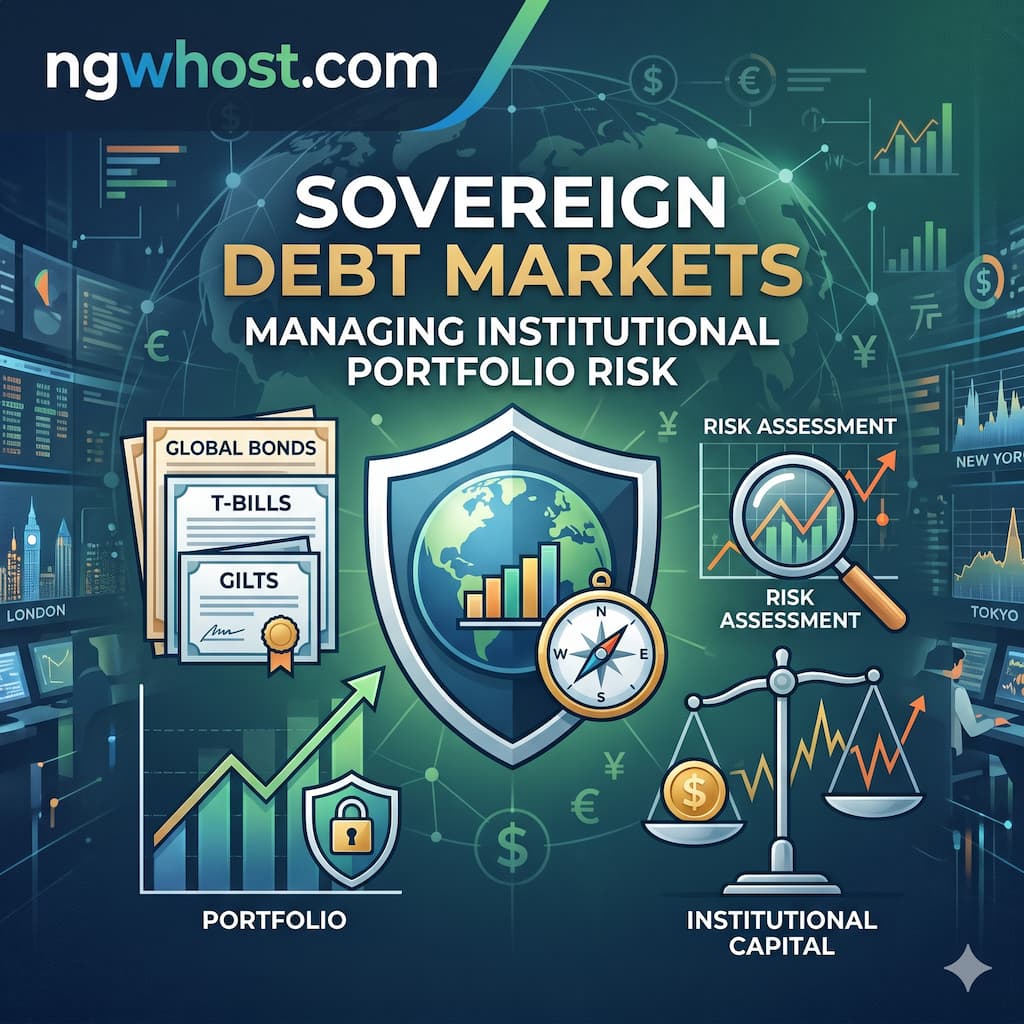
Sovereign Debt Markets: Managing Institutional Portfolio Risk
Sovereign debt has historically served as the foundational bedrock of the global financial architecture. For institutional asset managers, central banks, pension funds, and sovereign wealth funds, government bonds—particularly US Treasuries, German Bunds, and Japanese Government Bonds (JGBs)—have traditionally been treated as risk-free or near-risk-free anchor assets. These instruments are relied upon to provide predictable income, portfolio insulation during equity market drawdowns, and pristine collateral for complex repo (repurchase agreement) and derivative markets.
However, the paradigm governing sovereign debt markets has fundamentally fractured. A volatile cocktail of structural shifts—including historic expansions in debt-to-GDP ratios across developed economies, persistent fiscal deficits, structurally higher global inflation, and the weaponization of monetary policy via rapid quantitative tightening (QT)—has introduced unprecedented volatility into the fixed-income ecosystem.
For institutional portfolio managers, managing sovereign risk is no longer a passive exercise in duration matching. It demands a highly sophisticated, multi-dimensional framework capable of quantifying and mitigating credit, liquidity, interest rate, and geopolitical risks in real time.
1. The Anatomy of Modern Sovereign Risk
To effectively manage institutional exposure, portfolios must first deconstruct sovereign risk into its constituent parts. Modern sovereign debt analysis looks far beyond a nation’s baseline credit rating to evaluate dynamic macro-financial feedback loops.
Structural Fiscal Trajectories and Debt Sustainability
The long-term creditworthiness of a sovereign issuer is intrinsically tied to its debt-to-GDP ratio and its structural primary fiscal balance. When a sovereign’s interest expense begins to outpace its nominal GDP growth rate, the market enters a dangerous dynamic known as fiscal dominance. In this environment, monetary policy becomes subservient to fiscal realities, as central banks face intense pressure to suppress interest rates or monetize debt to keep government borrowing costs sustainable.
Portfolio managers utilize the Debt Sustainability Framework (DSF) to map out the long-term trajectory of a nation’s fiscal health, calculated as:
$$\Delta d_t = \frac{r_t – g_t}{1 + g_t} d_{t-1} – p_t$$
Where:
- $d_t$ is the debt-to-GDP ratio at time $t$
- $r_t$ is the real interest rate
- $g_t$ is the real GDP growth rate
- $p_t$ is the primary fiscal balance as a percentage of GDP
If the real interest rate ($r$) consistently exceeds real growth ($g$), a sovereign must run a substantial primary surplus ($p$) just to keep its debt ratio stable. For many developed economies running structural deficits, this math forces asset managers to price in a structural “term premium”—the extra compensation investors demand for holding long-term debt.
Inflation, Currency Depreciation, and Real Yields
Sovereign defaults in developed markets rarely manifest as outright nominal repudiations (refusing to pay). Instead, sovereign risk in fiat-currency systems typically manifests as inflationary debasement. When a government inflates away the real value of its liabilities, fixed-income portfolios suffer severe destruction of real purchasing power. Portfolio managers must continuously monitor the relationship between nominal yields, breakeven inflation rates, and real yields to ensure their portfolios are adequately compensated for currency degradation.
2. Yield Curve Dynamics and Duration Management
The yield curve is the ultimate gauge of macroeconomic expectations and sovereign risk pricing. Institutional risk managers must look at the curve not as a static line, but as a dynamic mechanism driven by three primary structural shifts: shifting levels (parallel moves), twists (steepening or flattening), and curvature (changes in the belly of the curve).
Yield (%)
  │
  │        /‾‾‾‾‾‾‾‾‾‾‾  (Bear Steepening: Long rates rise faster)
  │       /
  │      / ── ── ── ──   (Normal Curve)
  │     /
  │    / \
  │   /   \__________   (Inverted Curve: Short rates exceed long rates)
  └───┴─────────────────►
                       Maturity
Navigating De-Inversion and Curve Steepening
Following prolonged periods of yield curve inversion—historically an accurate predictor of economic contraction—the process of curve de-inversion presents severe risks to long-duration portfolios. Risk managers must differentiate between two distinct macroeconomic paths:
- Bull Steepening: Driven by the short end of the curve falling faster than the long end. This typically occurs when a central bank aggressively cuts its benchmark policy rate in response to economic deceleration. Long-duration portfolios benefit substantially from capital gains in this scenario.
- Bear Steepening: Driven by long-term yields rising faster than short-term yields. This is a far more toxic environment for fixed-income managers, driven by rising inflation expectations, expanding fiscal issuance supplies, or foreign central banks divesting from their treasury reserves.
Advanced Duration Hedging Techniques
To protect massive institutional allocations against adverse yield curve shifts, managers deploy advanced duration-matching and immunization strategies. Rather than relying solely on simple Macaulay or Modified Duration, risk desks calculate Key Rate Durations (KRDs).
KRD measures a portfolio’s sensitivity to a change in a single specific spot rate along the yield curve while keeping all other rates constant. By utilizing KRDs, an institutional manager can pinpoint exactly where their portfolio is vulnerable—for example, if a portfolio is overly exposed to a sudden spike in 10-year or 30-year yields—and construct highly precise hedges using Interest Rate Swaps (IRS) or Treasury Futures contracts.
3. The Liquidity Paradigm: Managing Market Dislocation
The post-2008 regulatory landscape (e.g., Basel III, Dodd-Frank, and strict supplementary leverage ratios) structurally altered the market-making capacity of major global banks. Primary dealers face stringent balance-sheet constraints, meaning they can no longer easily absorb massive liquidations of sovereign bonds during periods of market stress. Consequently, even the most liquid sovereign debt markets on earth can experience abrupt, structural liquidity blackouts.
Case Study: The 2020 Treasury Flash Crash & 2022 UK Gilt Crisis
In March 2020, dash-for-cash liquidations caused a total breakdown in US Treasury market depth, forcing the Federal Reserve to intervene with multi-trillion dollar liquidity backstops. Similarly, in late 2022, a sudden UK fiscal announcement triggered a rapid spike in Gilt yields, setting off a near-fatal margin call spiral among Liability-Driven Investment (LDI) pension funds, requiring emergency quantitative easing from the Bank of England to restore market functioning.
Quantifying Liquidity Risk in Sovereign Portfolios
Institutional risk desks can no longer assume they can exit multi-billion dollar sovereign positions without causing severe market impact. Modern liquidity risk models track a combination of live market variables:
- Bid-Ask Spread Volatility: Tracking structural widening of spreads across different maturity buckets.
- Order Book Depth: Analyzing the aggregate volume of limit orders available at various price intervals outside the best bid and offer.
- Market Impact Coefficients (Kyle’s Lambda): Measuring the precise price movement caused by a standardized volume influx.
To mitigate liquidity risk, institutional portfolios build strict concentration limits, expand their access to cleared repo facilities to raise cash without triggering outright asset sales, and diversify across highly non-correlated sovereign issuers.
4. Constructing a Multi-Asset Sovereign Risk Mitigation Matrix
When managing systemic institutional risk, relying on a single hedging instrument introduces unhedged basis risks. Portfolios require a diversified matrix of credit, interest rate, and macro overlays.
| Risk Dimension | Primary Threat Vector | Tactical Institutional Hedge | Strategic Portfolio Adjustment |
| Interest Rate Risk | Broad yield curve shifts, sudden inflation spikes | Long Eurodollar / SOFR futures, Receiver/Payer options | Shift allocation toward Floating-Rate Notes (FRNs) and shorter duration tranches |
| Sovereign Credit Risk | Outright default, restructuring, rating downgrades | Sovereign Credit Default Swaps (CDS), credit-linked notes | Reallocate capital across cross-border jurisdictions utilizing strict fiscal filters |
| Purchasing Power Risk | Real yield destruction via structural inflation | Treasury Inflation-Protected Securities (TIPS), Linkers | Increase structural allocations to hard commodities, infrastructure assets, and equities |
| Liquidity / Margin Risk | Forced liquidations, collateral hair-cut expansions | Centralized repo clearing access, bilateral liquidity lines | Maintain dedicated highly-liquid cash buffers and short-term cash equivalents |
Utilizing Sovereign Credit Default Swaps (CDS)
While developed-market defaults are rare, the pricing of Sovereign CDS contracts serves as an invaluable, highly liquid market indicator of credit stress. An institutional portfolio manager holding a large concentration of a specific country’s debt can purchase CDS protection to hedge against credit deterioration or downgrade risks. If the nation’s credit profile deteriorates, the spread on the CDS widens, generating capital gains that offset the falling cash prices of the underlying bonds.
5. Geopolitical Risk and Cross-Border Allocation
Sovereign debt markets are inherently political. For global institutional investors, managing cross-border sovereign risk requires a deep integration of macroeconomic analysis and geopolitical forecasting.
Weaponization of Financial Infrastructure and FX Risk
The modern geopolitical landscape has demonstrated that sovereign debt holdings can be frozen, sanctioned, or restricted overnight. Institutional asset managers must carefully analyze where their sovereign assets are domiciled, cleared, and settled. Furthermore, cross-border fixed-income investing introduces substantial Foreign Exchange (FX) risk. A high nominal yield in an emerging market sovereign can be completely erased if the local currency experiences a rapid, unhedged depreciation against the portfolio’s base reporting currency.
To manage this, global portfolios implement systematic FX Hedging Programs, utilizing forward contracts, cross-currency swaps, and currency options to decouple the underlying sovereign yield from foreign exchange volatility.
The Rise of Multi-Polar Reserve Assets
As global central banks and sovereign wealth funds diversify away from traditional unipolar reserve assets due to shifting geopolitical alliances, money flows across sovereign debt markets are changing permanently. Risk managers must adapt by building flexible, dynamic asset allocation models that monitor cross-border capital flows, central bank reserve accumulation trends, and structural shifts in global trade invoicing.
6. Technology and Data Architecture in Sovereign Risk Management
Scaling the management of institutional sovereign portfolios requires a modern, high-performance data and analytics infrastructure. Legacy risk software processing batch end-of-day data is entirely inadequate for navigating intra-day market dislocations.
[Real-Time Exchange / Dark Pool Feeds] ➔ [High-Throughput Risk Engine] ➔ [Instant Portfolio Optimization]
- Algorithmic Scenario Analysis and Stress Testing: Modern risk desks run thousands of daily Monte Carlo simulations, stress-testing portfolios against extreme historical benchmarks (e.g., the 1970s stagflation shock, the 1998 Asian Financial Crisis, the 2011 Eurozone Debt Crisis) alongside hypothetical forward-looking scenarios like a sudden breakdown of the Euro currency or a coordinated global debt restructuring framework.
- Alternative Alternative Data Pipelines: Advanced institutional desks integrate unconventional data indicators into their predictive risk models. This includes tracking real-time satellite imaging of industrial clusters to gauge economic output before official GDP prints, parsing digital political sentiment data to anticipate unexpected legislative or election shifts, and monitoring high-frequency central bank liquidity injection data points.
Read More⚡ Green Bonds vs Sustainability Loans: Corporate ESG in 2026
Conclusion: The New Frontier of Fixed-Income Management
The era of treating sovereign debt as a passive, set-and-forget asset class is officially over. In a global economy defined by historic debt levels, structural inflation risks, and evolving geopolitical realities, sovereign bonds demand an active, highly disciplined risk management approach.
The institutional portfolio managers who succeed in this volatile macroeconomic environment will be those who treat sovereign debt as a dynamic credit instrument. By deploying rigorous duration immunizations, continuously monitoring the real-time health of market liquidity, utilizing a multi-asset hedging matrix, and anchoring operations in sophisticated data architecture, asset managers can successfully protect capital, optimize yields, and turn fixed-income volatility into a source of long-term alpha.
For more institutional research on fixed-income architecture, global macroeconomic trends, and enterprise-scale financial infrastructure blueprints, visit ngwhost.com.