Digital Twins: Revolutionizing Global Supply Chains
Global supply chains are navigating an unprecedented era of operational complexity and systemic volatility. Geopolitical realignments, extreme climate disruptions, sudden demand swings, port congestion, and component shortages have exposed the fragile mechanics of traditional logistics networks. For decades, supply chain management relied on static spreadsheets, lagging ERP reports, and siloed transactional data. These legacy tools provided reactive visibility, forcing logistics managers to address operational bottlenecks long after disruptions had already compromised fulfillment schedules and inflated operating budgets.
That reactive operational model has encountered a fundamental technological boundary.
To build resilient, adaptive, and self-healing logistics networks, global enterprise leaders are adopting one of the most transformative digital primitives of modern industrial engineering: Digital Twins.
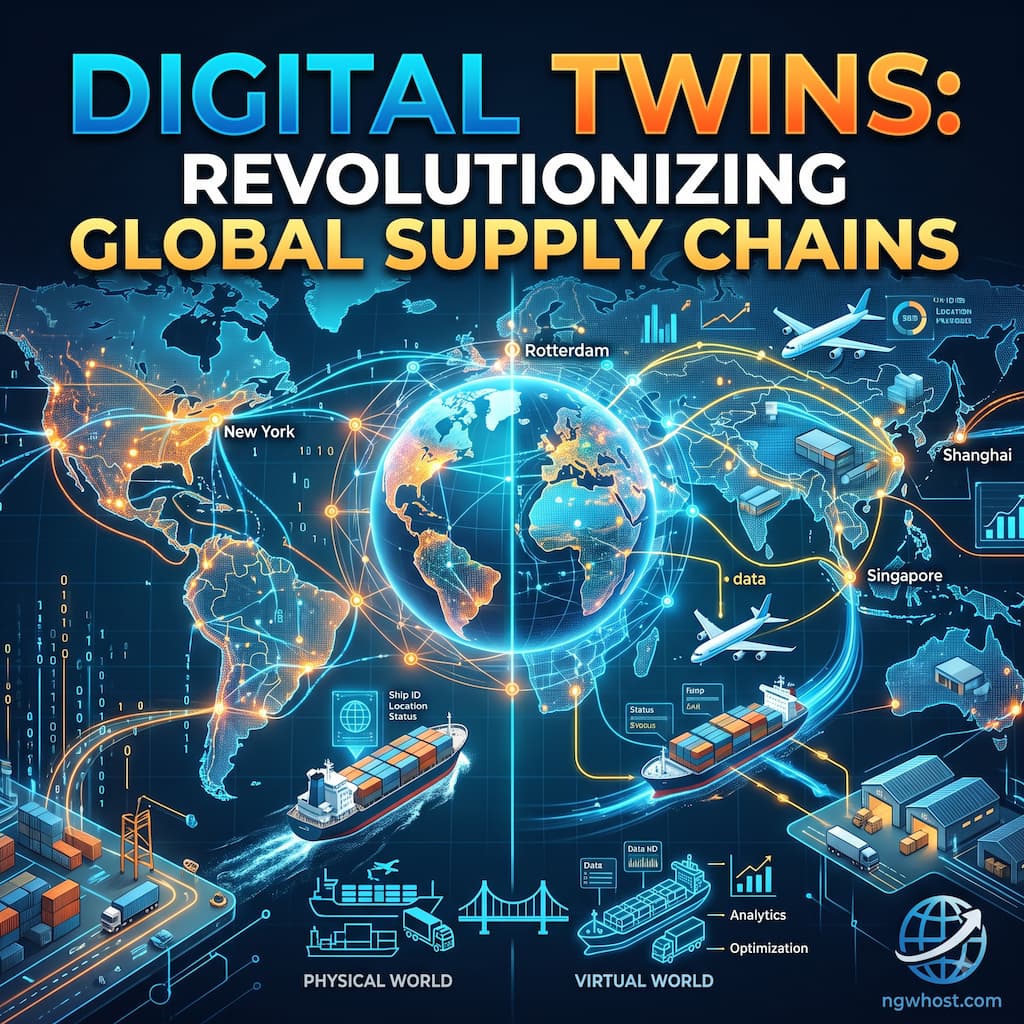
A Digital Twin in supply chain management is a dynamic, physics-based, and data-driven virtual replica of an end-to-end physical logistics ecosystem. By continuously ingesting real-time telemetry from IoT sensors, satellite tracking feeds, weather networks, customs API gateways, and warehouse automation systems, a Digital Twin reflects the exact current state of global operations.
More than just a passive 3D map or monitoring dashboard, a supply chain Digital Twin leverages advanced predictive analytics, discrete event simulation, and machine learning to simulate hypothetical scenarios, forecast bottlenecks before they materialize, and autonomously optimize routing, inventory levels, and asset allocation across international distribution networks.
This post analyzes the architectural mechanics of logistics Digital Twins, evaluates real-time predictive simulation models, compares legacy supply chain management against Digital Twin architectures, and examines the cloud server infrastructure required to host high-consequence enterprise telemetry stacks on ngwhost.com.
1. The Operational Imperative: Beyond Static Supply Chain Visibility
To understand why enterprise logistics networks are deploying Digital Twin platforms, one must examine the severe operational friction points eroding legacy supply chain management.
The Fragmented Visibility Crisis
Global supply chains encompass hundreds of independent entities: raw material suppliers, tier-1 component manufacturers, freight forwarders, maritime shipping lines, port terminals, customs brokerages, regional distribution centers, and last-mile delivery fleets. Historically, each actor maintained isolated data silos. Information exchange occurred via delayed EDI messages, manual emails, or batch database syncs. This created severe blind spots, leaving supply chain directors unaware of delays until container ships were anchored offshore or factory assembly lines stalled.
The Failure of Deterministic Planning
Traditional supply chain planning models operated on deterministic assumptions: fixed lead times, predictable ocean freight transit durations, stable fuel prices, and static customer demand curves. In reality, modern global trade is non-deterministic and highly stochastic. A single localized disruption—such as a canal blockage, port strike, or regional severe weather event—cascades unpredictably across interconnected international distribution networks, rendering static linear schedules obsolete within hours.
The Cost of Excess Safety Stock
To buffer against systemic unpredictability, companies historically built massive inventory buffers, stockpiling excess raw materials and finished goods in regional warehouses. While safety stock mitigates stockout risks, it ties up billions of dollars in working capital, increases warehousing overhead, elevates the risk of inventory obsolescence, and creates severe bullwhip effects across multi-tier supplier networks.
Digital Twins eliminate these structural vulnerabilities by replacing static, reactive planning with continuous, real-time predictive simulation.
2. Architectural Pillars: How a Supply Chain Digital Twin Operates
A supply chain Digital Twin is constructed across a modular, four-layer technology architecture that bridges physical logistics hardware with advanced cloud computing.
Layer 1: The Physical Telemetry and IoT Data Pipeline
At the foundation of the Digital Twin sits the physical supply chain ecosystem, equipped with real-time data collection hardware:
- IoT Sensor Nodes: GPS trackers, cellular beacons, and RFID tags attached to shipping containers, pallets, and individual high-value assets monitor real-time location, temperature, humidity, shock, and tilt.
- Telematics Systems: Connected fleet telematics stream engine diagnostics, driver hours, fuel consumption, and transit velocities from trucks and locomotives.
- External API Gateways: Real-time data streams from maritime AIS vessel tracking, commercial airport cargo portals, weather forecasting models, and international customs databases are continually ingested.
Layer 2: The Unified Spatial and Data Integration Layer
Raw, heterogeneous data streams from thousands of IoT devices and external APIs are transmitted to a centralized cloud ingestion engine. The system normalizes, cleanses, and unifies structured and unstructured data, mapping physical assets to a synchronized spatial graph. This layer constructs a real-time, digital mirror of every warehouse, vessel, flight, truck, container, and SKU moving across the global network.
Layer 3: Simulation Engines and Machine Learning Physics
Once the digital replica is established, analytical simulation engines execute continuous computational modeling:
- Discrete Event Simulation (DES): Models the step-by-step operational flow within physical facilities—simulating container crane movements at port terminals, truck queuing at gate entry points, and automated guided vehicle (AGV) picking paths inside fulfillment centers.
- Prescriptive Machine Learning: Machine learning models analyze historical traffic patterns, weather trends, and port turnaround times to predict arrival times (ETAs) with sub-hour accuracy, automatically flagging high-risk shipments long before delays occur.
Layer 4: Autonomous Orchestration and Control Tower Interface
The top layer provides supply chain managers with an interactive 3D control tower interface while executing automated control loops. When the Digital Twin detects a disruption—such as a port closure—it automatically calculates alternative multimodal routing options (e.g., rerouting air freight to a regional hub or adjusting production schedules at downstream plants) and can trigger API execution directly into enterprise ERP and TMS software.
3. Structural Optimization Ledger: Legacy Supply Chain vs. Digital Twin Networks
Evaluating the core operational and analytical parameters that separate traditional logistics management from Digital Twin supply chain platforms highlights why enterprise organizations are upgrading their digital architecture.
Data Update Frequency & Velocity
- Legacy Supply Chain Management: Batch processing, periodic EDI messaging, and static daily updates. Creates significant operational latency.
- Digital Twin Supply Chain Networks: Real-time, continuous telemetry streaming via IoT, satellite AIS, and API webhooks. Zero-latency spatial visibility.
Planning Model & Temporal Orientation
- Legacy Supply Chain Management: Deterministic, historical planning. Reacts to past events and static lead-time averages.
- Digital Twin Supply Chain Networks: Stochastic, predictive simulation. Models hypothetical future scenarios and forecasts disruptions before they impact operations.
Disruption Management Paradigm
- Legacy Supply Chain Management: Reactive firefighting. Manual intervention required after delays cause operational bottlenecks.
- Digital Twin Supply Chain Networks: Prescriptive, automated mitigation. System proactively suggests and executes optimized rerouting and inventory rebalancing.
Capital Allocation & Inventory Efficiency
- Legacy Supply Chain Management: High working capital tied up in static safety stock buffers to absorb supply chain volatility.
- Digital Twin Supply Chain Networks: Lean, dynamic inventory allocation based on real-time supply confidence and accurate predictive lead times.
4. Transformative Use Cases: Deploying Digital Twins Across the Value Chain
Supply chain Digital Twins deliver immense operational value across every link of the global logistics chain:
Dynamic Port and Terminal Management
Maritime port operators deploy Digital Twins of container terminals to optimize vessel berth scheduling, crane allocation, and container yard stacking strategies. By simulating vessel arrival sequences and container discharge workflows in real time, port authorities reduce vessel turnaround times, eliminate harbor congestion, and lower carbon emissions from idling ships.
Predictive Warehouse and Fulfillment Center Optimization
Inside distribution facilities, Digital Twins model warehouse layouts, conveyor belt traffic, picking paths, and robotic AGV deployments. Facility managers run real-time simulations to reconfigure warehouse slotting strategies dynamically based on seasonal demand spikes, reducing order picking cycle times and eliminating throughput bottlenecks.
End-to-End Cold Chain Integrity for Pharmaceuticals and Food
For temperature-sensitive biologicals, vaccines, and perishable food products, maintaining continuous climate control is vital. A Digital Twin continuously tracks environmental telemetry inside reefer containers. If ambient temperatures drift beyond safe thresholds due to a cooling unit fault, the Digital Twin alerts logistics managers instantly, models remaining product shelf-life, and reroutes the shipment to the nearest cold-storage facility to prevent cargo loss.
Sustainable Supply Chain Carbon Accounting
As international environmental regulations mandate strict Scope 3 emission disclosures, Digital Twins provide granular carbon tracking across multimodal transportation routes. The platform measures actual fuel burn and emissions across ocean, air, rail, and road segments, allowing logistics teams to balance delivery speed, cost, and environmental impact when selecting routing pathways.
5. Systemic Operations: Digital Infrastructure for High-Throughput Telemetry Platforms
Deploying, calibrating, and maintaining a global supply chain Digital Twin demands an underlying digital server infrastructure that prioritizes high bandwidth, low latency, massive parallel compute capacity, and zero downtime. Digital Twin platforms process continuous, high-consequence data streams—ranging from millions of concurrent IoT telemetry payloads and high-frequency spatial graph updates to complex mathematical simulation routines and automated ERP webhooks.
If an enterprise Digital Twin platform or logistics control tower experiences database configuration drift, memory bottlenecks, network packet loss, or server downtime during a major global shipping event, the consequences are immediate. Real-time spatial tracking desynchronizes, predictive simulation loops fail, and automated routing triggers stall—exposing global supply chains to unmitigated operational chaos and severe financial losses.
To eliminate this operational friction, progressive logistics technology teams and digital platform operators deploy highly optimized, zero-downtime server architectures.
These infrastructure layers continuously monitor active API endpoints, real-time spatial telemetry database write paths, and high-throughput simulation compute nodes, ensuring processing response times stay locked within sub-millisecond thresholds regardless of data volume.
Maintaining an unassailable infrastructure perimeter is vital to eliminate bandwidth bottlenecks, protect proprietary enterprise trade data, and preserve platform trust, driving peak structural execution across enterprise portals and hosting domains like ngwhost.com.
6. Implementation Roadmap: Building an Enterprise Digital Twin Network
For supply chain executives, logistics directors, and enterprise IT architects seeking to deploy Digital Twin capabilities across their operations, the transition requires a structured, phased approach:
- Phase 1: Sensor Infrastructure and Ingestion Standardization: Equipping high-value mobile assets with IoT telematics and standardizing data formats across suppliers, carriers, and internal ERP/TMS platforms.
- Phase 2: Building the Unified Spatial Replica: Constructing a synchronized, digital graph of physical nodes (warehouses, factories, ports) and connected transit corridors.
- Phase 3: Deploying Predictive Simulation Engines: Integrating machine learning models and discrete event simulation algorithms to move from basic real-time monitoring to predictive forecasting.
- Phase 4: Autonomous Control Loop Integration: Connecting the Digital Twin directly to enterprise execution software to automate routine mitigation tasks, dynamic rerouting, and inventory rebalancing.
Read More⚡ Neuromorphic Chips: Computing Beyond Silicon Limits
Conclusion: The Era of Self-Healing Supply Chains
Digital Twins are not an incremental optimization for logistics monitoring; they mark a fundamental paradigm shift in how global supply chains are engineered, managed, and executed. The legacy model that forced international trade networks to operate through reactive firefighting, delayed documentation, and static safety buffers is an obsolete framework that cannot survive modern global volatility.
The future of international commerce belongs entirely to the visionary logistics leaders, supply chain architects, and data-driven platform networks that master the orchestration of real-time Digital Twins today.
By unifying IoT spatial telemetry, discrete event simulation, predictive machine learning, and zero-downtime cloud infrastructure perimeters, the international technology and logistics communities are building an unassailable foundation for resilient, self-healing global trade.
As IoT device costs decline, spatial computing matures, and cloud compute capacity scales globally, Digital Twins will become standard infrastructure across every international logistics network—permanently establishing Digital Twins as the essential engine driving the future of global supply chains.
Hosting computationally intensive simulation engines, processing real-time telemetry streams, validating cloud-scale automation pipelines, and managing ultra-secure global server frameworks requires world-class, zero-downtime infrastructure. Secure your enterprise digital data framework on an unassailable foundation by exploring the premium hosting configurations at ngwhost.com.