
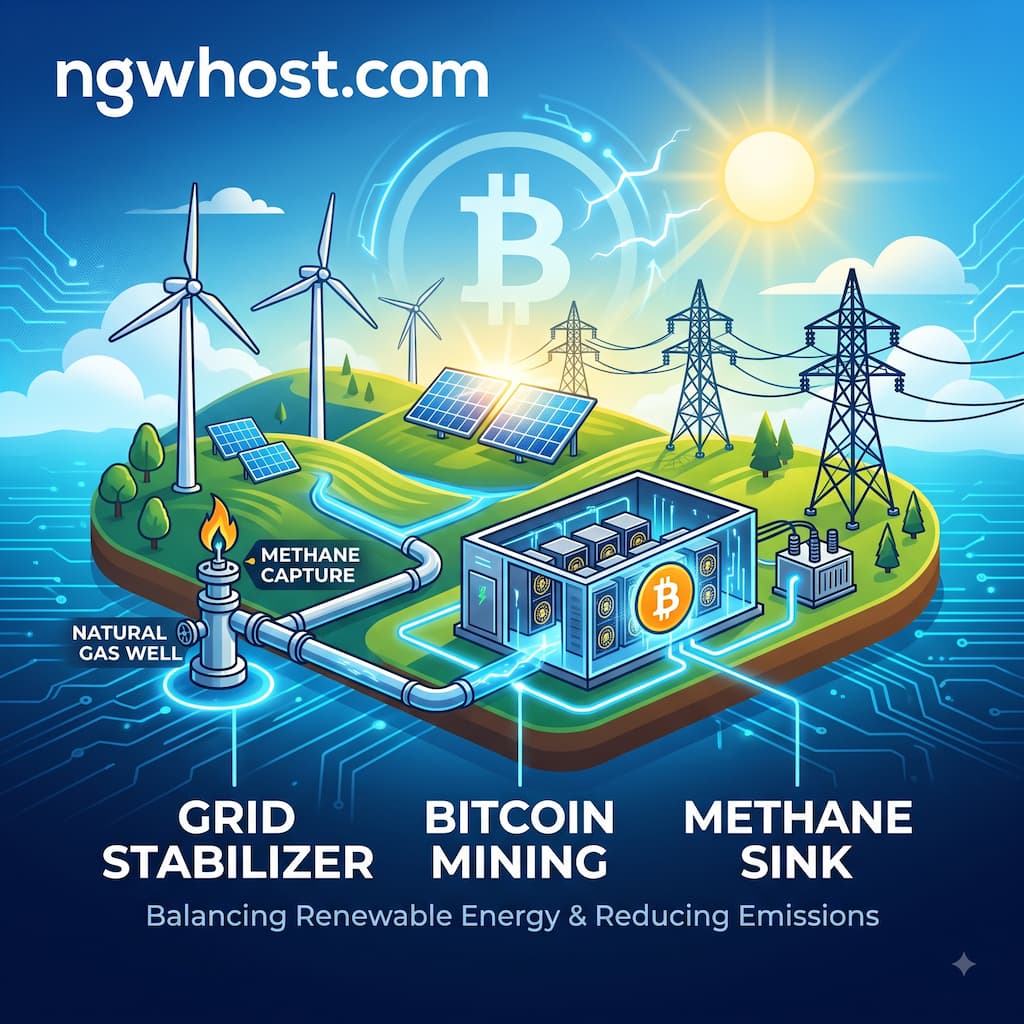
Bitcoin Mining as a Grid Stabilizer and Methane Sink
For over a decade, public discourse surrounding Bitcoin’s energy consumption has been dominated by a single, reductionist narrative: that proof-of-work mining is an unsustainable environmental burden. Critics frequently pointed to raw megawatt-hour figures, comparing network energy draw to small nation-states, while operating on the assumption that energy usage is inherently wasteful regardless of source, location, or grid mechanics.
However, a fundamental transformation is underway across global energy markets, power generation systems, and environmental engineering.
Driven by the rapid growth of non-dispatchable renewable power, modern power grid balancing demands, and urgent imperatives to mitigate potent greenhouse gas emissions, energy infrastructure operators are discovering a powerful, location-agnostic partner: Proof-of-Work Bitcoin Mining.
Far from being an environmental liability, Bitcoin mining is emerging as a dynamic, controllable electrical load that stabilizes fragile energy grids, funds renewable expansion, and actively sequesters flared or vented methane gas—converting harmful fugitive emissions into economic value.
This post analyzes the thermodynamics of grid balancing, evaluates flared gas mitigation mechanics, compares traditional industrial loads against interruptible mining operations, and examines the digital platform infrastructure required to host high-consequence energy telemetry systems on ngwhost.com.
1. The Modern Grid Challenge: Intermittency and Curtailment
To understand why power utilities and renewable energy developers are integrating Bitcoin mining facilities into their generation assets, one must examine the physical realities of modern electrical power networks.
Electricity grids operate under a strict physical constraint: supply and demand must match continuously in real time. If power generation exceeds demand, grid frequency surges, risking equipment damage and blackout conditions. If demand exceeds generation, frequency drops, causing system-wide destabilization.
The rapid global transition toward solar and wind power introduces structural friction into this delicate equilibrium:
Non-Dispatchable Intermittency
Unlike traditional thermal power plants (such as natural gas or coal) that can ramp generation up or down on command, wind and solar assets produce electricity only when the wind blows or the sun shines. Peak generation often occurs during periods of low regional demand—such as strong wind production in the middle of the night or solar overproduction at mid-day.
Renewable Curtailment and Negative Pricing
When renewable generation surges beyond regional transmission capacity or immediate grid demand, grid operators are forced to curtail (turn off) clean power generation. In zero-demand scenarios, wholesale electricity prices frequently turn negative, forcing generation operators to pay grid managers to take excess power off the line. This economic friction erodes project returns and discourages new clean energy investment.
Transmission Congestion and Spatial Bottlenecks
Pristine renewable resources are rarely located near dense urban consumption centers. Wind farms in rural plains and solar arrays in desert regions face severe transmission capacity limits. Building new high-voltage transmission lines requires years of regulatory approvals, land rights disputes, and billions in capital expenditure.
2. Bitcoin Mining as a Flexible, Interruptible Load (Demand Response)
Bitcoin mining introduces a unique thermodynamic payload to electrical grid management. Unlike traditional data centers, manufacturing plants, or residential communities—which require uninterrupted power 24/7/365—a Bitcoin mining facility represents an agile, interruptible, location-flexible electrical buyer.
The Mechanics of Demand Response
Bitcoin mining ASICs (Application-Specific Integrated Circuits) can be ramped up, dialed down, or turned off completely in sub-second intervals via automated software controls. This capability allows energy operators to deploy mining units as dynamic grid balancing assets:
- Under Peak Generation / Low Grid Demand: When wind or solar output surges beyond grid demand, the mining facility powers on, purchasing excess, curtailed power at low or negative costs. This provides renewable developers with a reliable revenue floor, monetizing energy that would otherwise be wasted.
- Under Peak Grid Demand / Generation Shortages: When extreme weather events (such as winter freezes or summer heatwaves) spike residential power demand, grid operators issue automated demand-response signals. Bitcoin miners instantly shut off their machines, releasing hundreds of megawatts back to the public grid within milliseconds—acting as a virtual power plant without needing toxic battery storage banks.
Demand Response Structural Comparison
- Traditional Industrial Manufacturing: High interruption cost; requires hours or days to ramp down; causes severe supply chain disruption and equipment damage.
- Legacy Hyperscale Data Centers: Moderate to low flexibility; requires continuous 99.999% uptime for cloud services; relies on backup diesel generators during grid strain.
- Bitcoin Mining Facilities: Absolute flexibility; instant sub-second shutdown via software protocols; zero operational supply chain damage or consumer service impact.
3. Methane Mitigation: Converting Environmental Hazards into Value
While grid stabilization addresses power management, Bitcoin mining’s second major environmental breakthrough occurs at the point of hydrocarbon extraction and waste decomposition: Methane Abatement.
The Methane Threat
Methane (CH4) is a potent greenhouse gas, boasting a global warming potential over 80 times greater than carbon dioxide (CO2) over a 20-year timescale. Major sources of fugitive methane include oil and gas well venting/flaring, municipal solid waste landfills, and agricultural livestock operations.
The Flaring and Venting Problem
During oil extraction, associated natural gas frequently rises to the surface. In remote oilfields lacking pipeline infrastructure, operators face an economic dilemma: building multi-million-dollar pipelines for low volumes of gas is financially unviable. As a result, operators either flare (burn) the gas or vent it directly into the atmosphere.
Due to wind conditions and incomplete combustion, industrial flaring is highly inefficient, frequently leaking raw methane into the atmosphere.
Mobile Containerized Mining: The Methane Sink Solution
Bitcoin mining turns this environmental liability into a mobile, profitable waste management process:
- Fugitive Methane Capture: Raw gas is captured directly at the source (oil well pads or landfill sites).
- High-Efficiency Generation: The gas fuels mobile generators that burn methane at 99%+ efficiency, converting harmful methane into water vapor and minimal CO2.
- Containerized Computation: Electricity generated on-site powers containerized mining units, converting stranded power directly into digital assets to fund environmental cleanup.
4. Key Energy Verticals Integration
The synergy between proof-of-work mining and primary energy infrastructure is expanding across multiple energy verticals:
Landfill Gas-to-Energy (LFGTE) Systems
Municipal solid waste landfills represent massive point-source methane emitters. Integrating containerized mining operations with landfill gas generation capture systems turns municipal waste streams into continuous, self-funding clean energy projects.
Hydroelectric and Geothermal Off-Peak Optimization
Run-of-river hydroelectric stations and geothermal plants generate constant baseload power regardless of seasonal market demand. During rainy seasons or low-demand periods, stranded hydro generation can be monetized via on-site mining, providing capital to maintain regional water infrastructure.
Zero-Carbon Nuclear Baseload Balancing
Nuclear power plants operate at peak efficiency under constant thermal baseload conditions. However, shifting daily grid demand forces nuclear operators to navigate difficult load-following cycles. Bitcoin mining allows nuclear assets to operate continuously at 100% thermal capacity, monetizing off-peak power during low-demand night hours.
5. Systemic Operations: Digital Infrastructure for Energy Telemetry Platforms
Deploying, monitoring, and controlling distributed Bitcoin mining setups integrated with power generation grids demands an underlying digital server infrastructure that prioritizes high bandwidth, ultra-low latency, and zero downtime. Modern energy-mining operations rely on real-time SCADA integrations, continuous telemetry data streams, automated demand-response webhooks, and high-frequency hash rate routing protocols.
If an enterprise energy management platform or utility control gateway experiences database configuration drift, network latency, or server outages during an automated demand-response trigger event, the consequences are immediate. Mining rigs fail to shed load on time, grid frequency strays outside safe thresholds, and financial non-compliance penalties apply.
To eliminate this operational friction, progressive energy technology teams and digital infrastructure operators deploy highly optimized, zero-downtime server architectures.
These infrastructure layers continuously monitor active API endpoints, real-time energy telemetry database write paths, and high-throughput network control channels, ensuring processing response times remain locked within sub-millisecond thresholds.
Maintaining an unassailable infrastructure perimeter is vital to eliminate bandwidth bottlenecks, protect industrial control systems, and preserve platform trust, driving peak structural execution across enterprise portals and hosting domains like ngwhost.com.
6. Regulatory Landscape and the Future of Energy-Backed Digital Assets
As environmental, social, and governance (ESG) standards mature, regulatory perspectives on Bitcoin mining are shifting from punitive restriction to strategic integration:
- Grid Operator Incentive Alignments: Power grid authorities (such as ERCOT in Texas) are formally recognizing mining facilities as critical load-balancing tools, integrating mining operators directly into state emergency response frameworks.
- Fugitive Emission Mandates: Environmental protection agencies globally are tightening restrictions on methane venting and flaring. Bitcoin mining provides oil and gas operators with an immediate, self-funding technology stack to achieve net-zero methane compliance ahead of regulatory deadlines.
Read More⚡ Solid-State Batteries: Powering the Clean Energy Era
Conclusion: The Convergence of Money and Energy
Bitcoin Mining is not an inefficient consumer of power; it is a fundamental thermodynamic tool that transforms how energy is generated, balanced, and preserved. The legacy narrative that framed digital proof-of-work purely as an environmental threat is being replaced by an engineered reality where cryptographic computation serves as a vital catalyst for clean energy transition.
The future of sustainable power generation belongs to the forward-thinking energy producers, grid engineers, and data-driven platform networks that master the orchestration of flexible digital loads today.
By unifying non-dispatchable renewable balancing, mobile methane abatement, automated demand response, and zero-downtime digital infrastructure perimeters, the international technology and energy communities are building an unassailable foundation for global energy efficiency.
As renewable penetration accelerates and methane mitigation mandates expand worldwide, flexible cryptographic loads will become standard infrastructure across every power grid—permanently establishing Bitcoin mining as an essential engine driving power grid stabilization and environmental remediation.
Hosting computationally intensive energy telemetry engines, processing real-time grid telemetry streams, validating cloud-scale automation pipelines, and managing ultra-secure global server frameworks requires world-class, zero-downtime infrastructure. Secure your enterprise digital data framework on an unassailable foundation by exploring the premium hosting configurations at ngwhost.com.