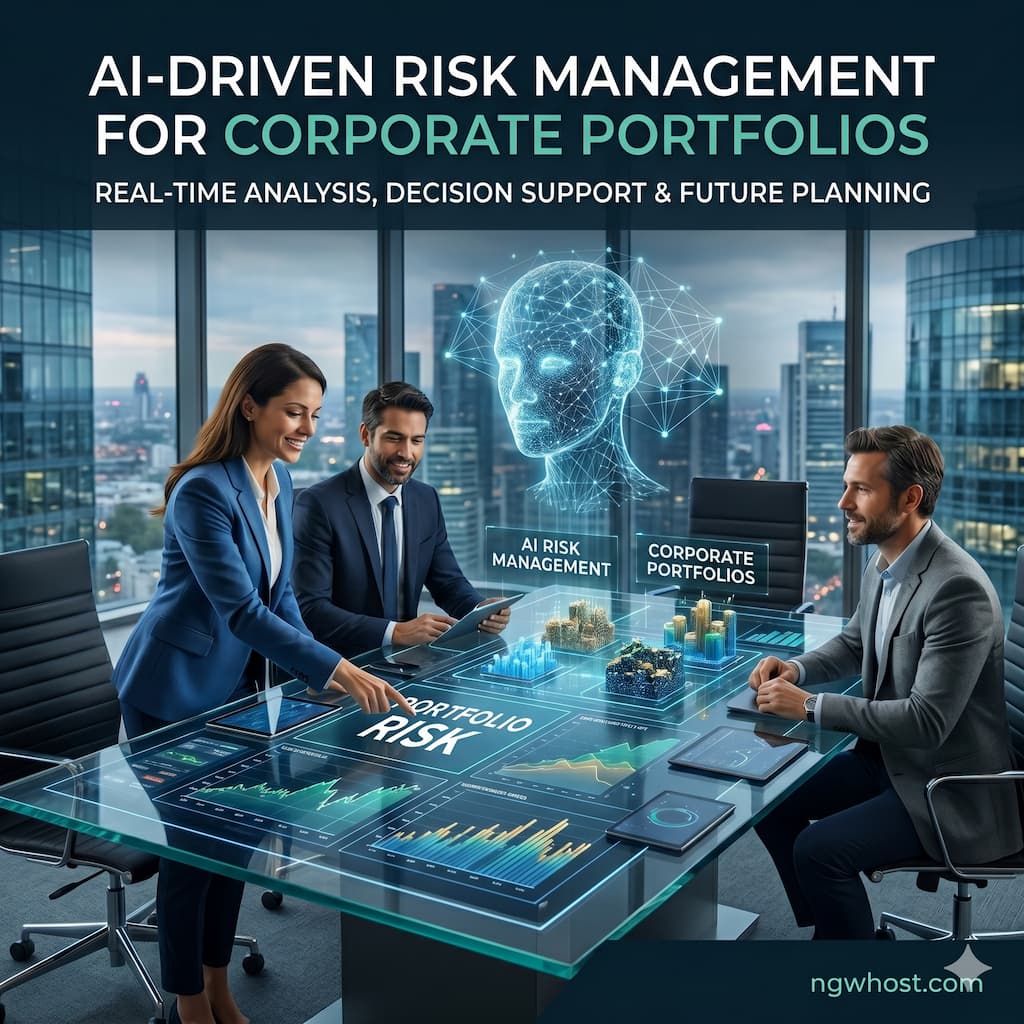
AI-Driven Risk Management for Corporate Portfolios
The structural landscape of corporate treasury and capital allocation has entered a hyper-volatile era. As we operate in May 2026, finance directors, corporate treasurers, and enterprise allocators are navigating a global macroeconomic matrix defined by rapid shifts in interest rate policies, algorithmic social sentiment swings, fluid cross-border regulatory frameworks, and the widespread tokenization of real-world assets (RWAs). In this environment, relying on historical, backward-looking risk assessment methodologies is no longer a standard administrative oversight—it is a recipe for systemic capital drag and balance sheet exposure.
Historically, managing corporate portfolio risk was a linear, periodic discipline. Investment committees and financial analysts spent weeks gathering data from disparate systems, compiling static spreadsheets, and generating Value at Risk ($VaR$) calculations based on 30-day trailing asset correlations. By the time a risk reporting packet crossed a Chief Financial Officer’s (CFO) desk during a quarterly review, the underlying market conditions had frequently evolved into an entirely new paradigm.
For the forward-thinking digital entrepreneurs, cloud infrastructure managers, and platform innovators within the ngwhost.com community, operational efficiency is a core engineering philosophy. We architect server nodes and cloud databases to eliminate processing latencies, remove single points of failure, and optimize throughput workloads.
Applying this exact same systemic discipline to your company’s capital stack requires a total transition from manual, reactive auditing to Agentic, Real-Time AI-Driven Risk Management Infrastructure.
By unifying multi-channel financial data into an automated, AI-driven risk orchestration layer, modern corporations are turning risk mitigation from a defensive back-office constraint into a predictive growth engine. This comprehensive 2026 guide delivers a thorough technical analysis of the modern AI risk management stack, evaluates advanced cognitive simulation engines, and provides an actionable operational blueprint to protect your corporate capital while maximizing yield efficiency this decade.
1. The 2026 Portfolio Metamorphosis: The Flight to Ambient Auditing
To successfully deploy an AI-driven risk architecture today, you must first dismantle the concept of episodic capital reporting. The evolution of institutional financial risk tracking can be broken down into three distinct operational waves:
- The Descriptive Retroactive Era (The Past): Standard statistical reporting. Risk teams audited past ledger anomalies and generated fixed mathematical models based on historical price ranges. They lacked natural language text comprehension and were completely blind to real-time, non-linear market events.
- The Predictive Copilot Era (The Transition): The integration of isolated machine learning modules and early generative chat systems. Financial analysts gained the capability to prompt an AI model to summarize complex economic PDFs or write basic Python scripts to run Monte Carlo simulations. While powerful, this era remained fundamentally passive, requiring precise prompt engineering and manual human data handoffs.
- The Agentic Sovereign Era (2026): The current global benchmark. Corporate treasuries function as an Autonomous, Ambient Financial Sensing Network. Powered by large reasoning foundation models operating natively on top of centralized corporate data meshes, the risk engine does not wait to be queried. It continuously tracks global market variables, automatically simulates portfolio outcomes, isolates vulnerabilities, and executes proactive hedging maneuvers with zero human latency.
  LEGACY TREASURY AUDITING (Passive & Episodic)
  [Manual ERP Exports] ──► [Spreadsheet Math Compilation] ──► [Delayed VaR Calculation] ──► [Reactive Board Review]

  2026 AI-DRIVEN RISK Posture (Ambient & Continuous)
  [Continuous Multi-Feed Data Ingestion]
                │
                ▼
   ┌────────────────────────────────────────┐
   │      AI Risk Orchestration Core        │ ──► [Sub-Second Cross-Asset Stress Testing]
   ├────────────────────────────────────────┤
   │ * Predictive Liquidity Shock Mapping   │ ──► [Instant Algorithmic Hedging Execution]
   │ * Cognitive Macro-Sentiment Analysis   │ ──► [Continuous Compliance & Audit Sensing]
   └────────────────────────────────────────┘
According to institutional corporate finance benchmarks recorded this quarter, enterprises utilizing fully automated AI risk orchestration networks experience a 55% reduction in unexpected portfolio drawdown velocities and save thousands of hours of routine treasury processing every single year.
2. Core Pillars of the 2026 AI Risk Management Architecture
Constructing a resilient, un-hackable corporate asset defense grid requires integrating four foundational technological pillars directly into your financial and operational infrastructure stacks.
I. Multi-Modal Stream Ingestion and Semantic Sentiment Mapping
Traditional portfolio management models are fundamentally crippled by data formatting silos—they can only parse highly structured, clean numerical rows.
- The 2026 Breakthrough: Modern AI risk engines deploy Multi-Modal Data Mesh Ingestion Layers.
- The Execution: The system ingests and processes an array of unstructured data streams in real-time. The AI reads multi-language central bank transcripts, tracks legislative regulatory filings across global jurisdictional databases, scrapes real-time semantic sentiment paths across decentralized developer networks, and monitors satellite geo-tracking feeds of industrial logistic shipping lines. By blending these qualitative macro indicators with quantitative pricing feeds, the engine detects hidden risk correlations long before they manifest on a traditional ticker screen.
II. Multi-Agent Collaborative Systemic Simulation
Complex, multi-asset portfolios—spanning traditional equities, fixed-income instruments, cross-border currencies, and tokenized real-world assets—cannot be accurately stress-tested by a single isolated machine learning algorithm. Modern architectures deploy Collaborative Multi-Agent Networks inside sandboxed environments.
- The Adversarial Simulation: The system configures specialized digital agent personas to aggressively stress-test your asset balances. A Macro Economist Agent models sudden interest rate jumps or fiat currency devaluations. A Geopolitical Analyst Agent simulates structural supply chain blockages or international customs conflicts. An Adversarial Short-Seller Agent aggressively probes the portfolio’s liquidity structure for hidden leverage traps or margin exposure.
- The Outcome: The agents simulate millions of synthetic “Black Swan” variations daily, forcing the underlying risk engine to continuously prove and optimize its capital preservation metrics.
III. Automated Algorithmic Hedging and Liquidity Guardrails
Isolating a portfolio vulnerability is meaningless if your operational team takes hours or days to execute a defensive realignment while a market drawdown is actively accelerating.
- The Action Autopilot: 2026 risk platforms utilize secure, tokenized Function-Calling Core Rails.
- The Interventions: When the AI engine calculates that a specific asset tier has exceeded its pre-configured risk corridor, it programmatically triggers an automated hedging sequence. The system communicates via secure APIs with decentralized or centralized liquidity hubs to adjust portfolio weights, purchase downside derivative options, or re-allocate capital into highly secure, sovereign short-term debt instruments—stabilizing the corporate balance sheet within a millisecond execution window without requiring manual human oversight.
IV. Continuous, Ambient Compliance and Regulatory Sensing
Operating an international digital brand requires satisfying an incredibly complex, fast-moving array of global regulatory mandates. Non-compliance results in severe financial penalties, asset freezes, and irreversible reputational erosion.
- The Regulatory Mirror: Modern AI risk platforms deploy Continuous Compliance Sensing Engines. The system continuously monitors changing tax withholding rules, updated corporate data privacy acts, and shifting legal classifications of digital and tokenized assets across multiple jurisdictions. The AI flags changing compliance exposures in real-time, automatically adjusts transactional routing variables, and generates audit-ready financial ledger summaries dynamically, satisfying external corporate auditors effortlessly.
3. The 2026 AI Risk Management Stack: Corporate Platform Engines
Transforming your treasury from an opaque, reactive cost-center into an agile, predictive competitive advantage requires connecting your capital repositories to context-aware risk platforms. The current 2026 landscape features elite enterprise options:
| Platform Category | Leading 2026 Platforms | Core Enterprise Utility | Standout AI Advantage |
| Enterprise Portfolio Optimization | Aladdin by BlackRock (AI Core) | Global cross-asset risk modeling, liquidity tracking, & compliance audits | Sovereign Scale Synthesis: Processes millions of economic scenarios against trillions in institutional assets simultaneously. |
| Cognitive Analytics & Ingestion | Palantir AIP for Finance | Building interactive digital twins of corporate balance sheets & supply lines | Ontological Data Unification: Unifies structured corporate ERP logs smoothly with unstructured real-world macro indicators. |
| Real-Time Data Infrastructure | Databricks / Snowflake Cortex | Real-time financial data lake streaming & decentralized model processing | Secure Model Enclaves: Permits corporate data science teams to execute custom LLM risk analytics inside ring-fenced databases. |
4. Tactical Blueprint: Operationalizing AI Risk Orchestration
Transitioning your enterprise away from reactive spreadsheet habits and constructing a fully automated, data-driven portfolio defense grid requires a systematic, architecturally sound blueprint.
Step 1: Maximize Corporate Data Liquidity via Unified APIs
An AI risk model’s predictive precision is fundamentally capped by the breadth and completeness of its training data inputs. Before turning on autonomous auditing agents, you must systematically eliminate your internal corporate data silos.
Establish direct API connections and real-time open-telemetry webhooks connecting your e-commerce storefront checkouts, internal ERP ledgers, multi-currency corporate banking accounts, and primary server infrastructure parameters on ngwhost.com into a centralized Unified Financial Data Lake. This provides your risk agents with an un-obstructed, 360-degree stream of truth representing your operating reality.
Step 2: Establish the “Human-in-the-Loop” Governance Gate
Do not attempt to remove human strategic vision entirely from high-stakes corporate treasury and capitalization choices. While autonomous agents are unmatched at rapid data collection, multi-file synthesis, and sub-second hazard isolation, ultimate risk ownership and long-term visionary orientation require human emotional intelligence. Implement a highly fluid communication loop:
[Live Market Anomaly Spotted] ──► [Multi-Agent Group Simulates Downside Risks] ──► [AI Builds Tailored Hedging Options] ──► [Human CFO One-Click Authorization] ──► [Automated System Execution]
Configure your platform’s configuration settings to push high-conviction risk reports and pre-populated mitigation options straight into a centralized Live Operational Feed. The AI handles the exhaustive heavy lifting—calculating drawdowns, sourcing liquidity options, and writing the execution scripts—while the human executive retains absolute veto power, authorizing the strategy with a single click before the automated system modifies corporate allocations or commits capital.
Step 3: Deploy Cross-Model Multi-Provider Verification
To completely eliminate the threat of algorithmic blind spots, structure your automated multi-agent architecture to utilize Cross-Model Multi-Provider Verification for high-risk treasury choices.
- The Configuration: Set up your primary data research and multi-stream ingestion routines to run on a core advanced reasoning foundation model. Concurrently, configure your internal risk validation and audit agents to run on a completely separate, independent foundation model architecture. Forcing different model ecosystems to cross-check each other’s mathematical conclusions radically minimizes the risk of shared hallucinations or hidden systematic processing errors.
5. Critical Risk Management: Navigating the Algorithmic Pitfalls
Operating a highly automated, AI-driven corporate infrastructure requires continuous, data-backed governance to protect your enterprise from unique digital liabilities:
- The Hazard of the “Flash-Crash” Cascade: Because autonomous risk models are engineered to react to market anomalies instantly, a sudden, short-term data glitch or a localized flash-crash event can trigger multiple corporate risk engines globally to execute automated asset liquidations simultaneously. This algorithmic herd behavior can accelerate downward price spirals, trapping your capital in unnecessary, expensive market entries and exits. Technical leads must implement strict Operational Bound Safeguards and velocity throttles to constrain automated liquidation loops.
- The Threat of Hallucinated Strategic Projections: While generative models possess incredible synthesis capabilities, they can occasionally misinterpret complex, non-linear client interactions or miscalculate an asset’s correlation matrix based on ambiguous financial statements. If a corporate board relies blindly on an un-verified, hallucinated AI projection to execute high-stakes corporate acquisitions or heavy currency shifts, the business faces structural exposure. Maintain rigorous validation protocols for all macro-level forecasting models.
- Navigating the Reality of Model Drift: Financial correlations are fundamentally dynamic—an asset pair that exhibited an ironclad inverse correlation for a decade can suddenly decouple completely due to changing global regulations or structural market innovations. If an algorithm continuously calculates portfolio risk using outdated training parameters, its hedging logic will degrade, corrupting downstream treasury safety. Your quantitative team must execute automated, monthly backtesting loops to keep your prediction metrics perfectly calibrated to real-world market conditions.
6. The Technological Synergy: Redundant Systems for Corporate Capital
For the advanced cloud systems developers, software engineers, and technology visionaries who scale their digital footprints on the backbone of the ngwhost.com ecosystem, the structural logic of an automated AI risk architecture is deeply intuitive.
When you configure an enterprise hosting layout or scale an international web application database, you do not tolerate single points of failure. You don’t leave your system architecture vulnerable to an isolated computing crash, a localized network drop, or an un-monitored processing leak. You design with structural, mathematical redundancy: you utilize load balancers to distribute data traffic smoothly, deploy isolated container instances across multiple geographic data zones to handle processing spikes effortlessly, and maintain secure, multi-region database mirrors to ensure that if a critical server cluster drops offline, the broader network continues to perform flawlessly without data loss or corruption.
Deploying an integrated AI-Driven Risk Management Architecture is simply extending that exact same systemic, multi-layered structural redundancy to your company’s intelligence and capital stacks:
- Your Multi-Modal Stream Ingestors and Semantic Sentiment Trackers operate as your high-velocity edge nodes, managing day-to-day incoming market insights and consumer behavioral spikes with absolute fluid precision.
- Your Multi-Agent Collaborative Simulation Networks and Sandboxed Testing Environments act as your resilient core database systems, instantly compounding, simulating, and validating your strategic options, completely insulated from individual human blind spots or data processing failures.
- Your Automated Algorithmic Hedging Rails and Compliance Sensing Engines behave as your secure, enterprise-grade system firewalls, silently optimizing your operating margins, shielding your corporate treasury from market volatility, and ensuring absolute legal defensibility against changing global regulatory demands.
By mastering this integrated configuration, you strip away balance sheet vulnerabilities, eliminate operational cash drag, and position your digital brand to scale at terminal velocity while maintaining total financial and operational sovereignty over the global enterprise you built.
Read More⚡ Venture Debt Financing: Capital Strategies for Tech Startups
Conclusion: The Automated Balance Sheet Victory
The traditional monthly financial review and slow capital auditing desk have run their course. In a hyper-competitive global marketplace defined by rapid technological adaptation and instant corporate fulfillment requirements, forcing modern treasury personnel to rely on click-by-click manual data entry and historical guessing games is a recipe for operational failure and margin erosion.
The path to sustainable corporate scalability requires an absolute embrace of autonomous, predictive, and data-liquid software architecture. By unifying your multi-source financial data feeds via high-performance cloud networks, linking your risk telemetry directly into your central ERP and repository cores, enforcing rigorous data anonymization protocols, and prioritizing continuous algorithmic backtesting, you completely remove risk, friction, and human operational latency from your expansion loops entirely.
The capital of the global economy is flowing at internet speed. Build your risk perimeter with absolute architectural precision, protect your cap table fiercely, and let your enterprise scale to global heights on your own terms.