Intent-Based Web3: The End of Complex Blockchain UX
Decentralized applications have spent over a decade constructing an open, transparent financial paradigm. Smart contracts on public blockchains have unlocked programmatic lending, self-custodial asset ownership, borderless value transfer, and decentralized exchange liquidity pools. Yet, despite these monumental achievements in distributed systems and financial engineering, the mainstream adoption of Web3 remains severely constrained by a glaring bottleneck: an extraordinarily hostile and complex user experience (UX).
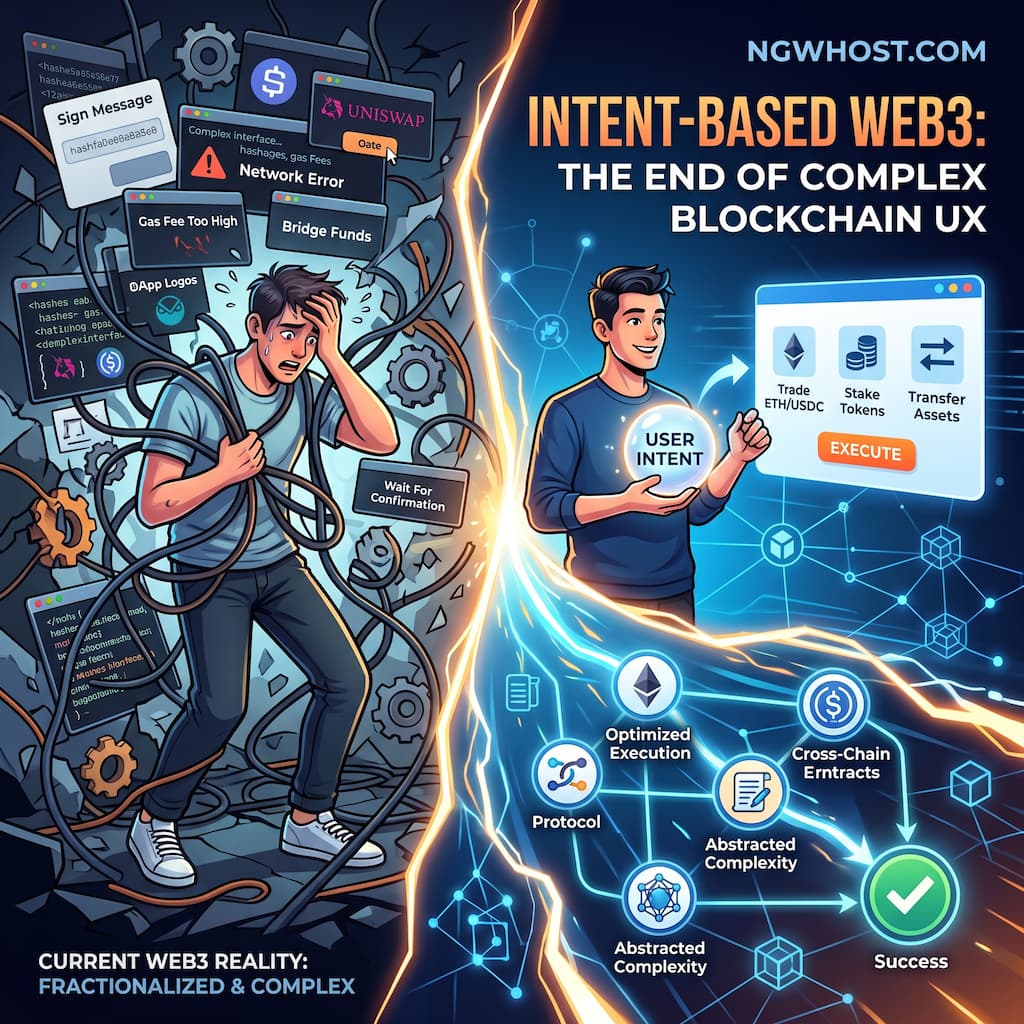
In the current Web3 landscape, performing even a basic cross-chain transaction requires a user to navigate an exhausting obstacle course of technical mechanics.
A user wishing to purchase an asset on an emerging Layer-2 network must:
- Manually fund a specific wallet address.
- Purchase native tokens to pay for base-layer gas fees.
- Find a reliable cross-chain bridge and approve separate token allowances.
- Calculate slippage tolerances and wait for cross-network block confirmations.
- Switch remote procedure call (RPC) network endpoints inside their browser extension wallet.
- Acquire a completely different secondary gas token to execute the final swap on the destination network.
At every step of this process, users are exposed to transaction failure risks, frontrunning exploits, phishing traps, network configuration mistakes, and accidental asset loss.
For mainstream consumers and enterprise institutions, this imperative model of computing—where the user is forced to micromanage every individual step, transaction route, and gas calculation—is completely unacceptable.
To dismantle this barrier and onboard the next billion users, blockchain architecture is undergoing a profound paradigm shift: Intent-Based Web3 Architectures.
Instead of requiring users to specify how to execute every individual step of a complex on-chain path (an imperative transaction), an intent-based architecture allows users to declare simply what outcome they want to achieve (a declarative intent).
Specialized off-chain third parties—known as Solvers, Fillers, or Searchers—compete in an open marketplace to satisfy that intent instantly, fronting capital, routing through the best liquidity paths, absorbing gas volatility, and executing the transaction with mathematically guaranteed execution certainty.
This post analyzes the architectural mechanics of intent-based systems, evaluates account abstraction and solver settlement networks, compares imperative execution against declarative intent architectures, and examines the digital cloud server infrastructure required to host high-consequence Web3 gateway engines on ngwhost.com.
1. The Imperative Crisis: Why Traditional Web3 UX Fails Users
To understand why the transition toward intents is inevitable, one must analyze the fundamental limitations of the traditional imperative blockchain transaction model.
The Imperative Computing Burden
In classical computing, an imperative instruction is an explicit sequence of low-level commands: “Do Step A, then verify State B, then execute Call C, and pay Fee D.”
For the past decade, interacting with the Ethereum Virtual Machine (EVM) and non-EVM blockchains has been strictly imperative. The end-user is treated as an active systems operator who must understand:
- Nonces and pending transaction queues.
- Dynamic gas pricing (EIP-1559 base fees and priority tips).
- Smart contract approval vulnerabilities (unlimited allowance risks).
- Cross-chain bridge finality windows and liquidity imbalances.
If a single variable in that sequence is miscalculated—such as setting an insufficient gas limit or picking a congested bridge—the transaction fails, yet the user still pays non-refundable network fees.
The Fragmented Multi-Chain Reality
As the blockchain ecosystem modularized into dozens of Layer-2 rollups, Layer-3 app-chains, and sovereign Layer-1 networks, liquidity and state became severely fragmented.
Instead of a unified Web3 financial ecosystem, users were forced to manage fragmented account balances across Arbitrum, Optimism, Base, Polygon, Solana, and Ethereum Mainnet.
Managing multiple gas tokens and manually bridging assets across isolated liquidity silos created an operational nightmare that drove retail users away from on-chain interactions.
Intent-based architectures eliminate this cognitive overload by hiding the underlying blockchain plumbing entirely behind declarative user goals.
2. Structural Mechanics: How Intent-Based Architectures Function
An intent is not an on-chain transaction; it is a signed, cryptographically binding message that specifies an initial state and an acceptable final state, leaving the entire execution path open to optimization by third-party agents.
The lifecycle of an intent-based transaction follows four distinct operational phases:
The Intent Lifecycle Pipeline
- Phase 1: Declarative Intent Generation: The user specifies their desired goal through a clean interface (for example, swapping 1,000 USDC on Arbitrum for the best possible rate of ETH on Base, with a minimum return of 0.35 ETH). The user signs this intent with their private key, committing zero gas upfront.
- Phase 2: Intent Broadcasting to Off-Chain Auction Mempools: The signed intent is broadcast to an off-chain network of specialized actors known as Solvers (or Fillers).
- Phase 3: Solver Competition and Optimal Route Construction: Solvers analyze the intent and compete against one another to fulfill it. Solvers utilize their own private liquidity, access across centralized exchanges (CEXs), decentralized exchanges (DEXs), and cross-chain messaging bridges to construct the fastest, cheapest, and most capital-efficient settlement route.
- Phase 4: On-Chain Verification and Atomic Settlement: The winning solver submits the settlement transaction to the destination chain’s smart contract. The contract verifies that the user’s explicit conditions (such as minimum output received and correct destination wallet) are met with mathematical precision before releasing the user’s funds to the solver.
The Power of Outcome-Based Invariants
The critical security feature of an intent-based architecture is the use of strict state invariants. The user does not need to trust the solver.
If a solver attempts to execute an intent through an inefficient path, frontrun the trade, or return fewer tokens than the user specified in their signed intent message, the on-chain settlement smart contract simply rejects the transaction. The user loses nothing, and the solver bears the full cost of any failed execution attempt.
3. Core Enablers: Account Abstraction (ERC-4337) and Chain Abstraction
The rise of intent-based Web3 is closely intertwined with two foundational technological movements: Account Abstraction (ERC-4337) and Chain Abstraction.
Account Abstraction (Smart Contract Wallets)
Traditional Externally Owned Accounts (EOAs)—such as standard MetaMask or hardware wallets—are limited by cryptographic ECDSA key-pair rules. An EOA cannot execute logic, batch operations, or pay gas in alternative tokens.
Under ERC-4337 and native account abstraction:
- Wallets become programmable smart contracts.
- Gas Sponsorship (Paymasters): Solvers and decentralized applications can sponsor gas fees entirely or allow users to pay gas in any ERC-20 token (e.g., paying gas with USDC instead of native ETH).
- Multicall Atomic Batching: Users can approve a token transfer, swap it, and stake the result in a single atomic click, eliminating multiple confirmation pop-ups.
- Social Recovery and Session Keys: Eliminates the requirement of writing down a 12-word seed phrase on paper, replacing it with biometric passkeys and social guardians.
Chain Abstraction
When intent frameworks are combined with account abstraction, they achieve Chain Abstraction. The user no longer needs to know—or care—which specific blockchain or Layer-2 is processing their trade.
To the user, their balance appears as a single unified global balance, and their transactions settle instantaneously regardless of where underlying liquidity resides.
4. Structural Optimization Ledger: Imperative Transactions vs. Intent-Based Execution
Evaluating the structural, operational, and user experience differences that separate legacy imperative execution from intent-driven architectures illustrates why Web3 protocols are redesigning their frontends and settlement backends.
User Responsibility and Execution Knowledge
- Imperative Blockchain Execution: High complexity. User must calculate gas, select specific routes, manage multiple RPCs, and handle cross-chain bridges.
- Intent-Based Architecture: Zero complexity. User specifies the desired end outcome; off-chain solvers handle all underlying execution mechanics.
Risk of Transaction Failure and Gas Loss
- Imperative Blockchain Execution: High risk. If a transaction fails mid-flight due to slippage or out-of-gas errors, the user still loses network gas fees.
- Intent-Based Architecture: Zero risk. Solvers bear 100% of the execution risk and gas costs. If the intent cannot be satisfied, the user pays nothing.
Protection Against Predatory MEV and Frontrunning
- Imperative Blockchain Execution: Vulnerable. Transactions broadcast to public mempools are frequently targeted by sandwich bots and frontrunning searchers.
- Intent-Based Architecture: Native MEV protection. Solvers fulfill orders directly or match them through private off-chain batch auctions, eliminating public slippage exploits.
Cross-Chain Velocity and Settlement Speed
- Imperative Blockchain Execution: Slow (minutes to hours). Constrained by standard bridge confirmation times and multi-network block finality.
- Intent-Based Architecture: Instantaneous (seconds). Solvers front their own capital on the destination chain immediately upon intent verification.
5. Leading Real-World Intent Frameworks: Reshaping the Web3 Ecosystem
Several pioneering protocols and standards are actively deploying intent-based infrastructure across decentralized finance:
UniswapX and CoW Protocol (DEX Swapping)
- CoW Swap (Coincidence of Wants): Uses batch auctions where decentralized solvers compete to match user trades peer-to-peer off-chain or route through on-chain AMMs, guaranteeing optimal pricing and zero MEV exposure.
- UniswapX: An open, auction-based routing protocol that offloads routing, bridging, and gas management to a competitive network of external fillers.
Across Protocol (Intent-Driven Cross-Chain Bridging)
Across utilizes an intent-based architecture for cross-chain liquidity. Instead of locking tokens in slow multi-signature bridge vaults and waiting for optimistic challenge windows, liquidity providers (relayers) fulfill user bridging requests on the destination chain within seconds using their own capital.
The relayers then settle their reimbursements in aggregate on the base layer, transforming a 30-minute cross-chain bridge into a 5-second seamless transfer.
Universal Intent Languages (Anoma, Essential, and ERC-7683)
To prevent the formation of isolated, proprietary solver networks, open standards are emerging:
- ERC-7683: A cross-chain intent standard co-developed by Across and Uniswap that establishes a universal framework for defining cross-chain orders, enabling a shared network of solvers to fulfill intents across any blockchain.
- Anoma: A privacy-preserving, intent-centric architecture that treats intents as the fundamental building block of all decentralized interactions, matching complex multi-party swaps and barter transactions off-chain.
6. Systemic Operations: Cloud Infrastructure for High-Throughput Solver Gateways
Deploying, monitoring, and maintaining intent-routing engines, competitive solver algorithms, cross-chain relayer nodes, and RPC indexers demands an underlying digital server infrastructure that prioritizes high bandwidth, sub-millisecond compute latency, and zero downtime. Solvers operate in hyper-competitive off-chain auction environments where latency differences of a few milliseconds determine whether a solver wins an order fulfillment or misses a profitable arbitrage opportunity.
Furthermore, solvers and relayers manage high-consequence telemetry data streams—ranging from multi-chain mempool listeners and real-time CEX/DEX order book synchronization to automated private key signing vaults and liquidity balancing webhooks.
If an enterprise solver infrastructure, Web3 gateway node, or RPC hosting endpoint experiences database configuration drift, network packet loss, memory throttling, or server downtime during a period of market volatility, the consequences are immediate. Intent auctions time out, cross-chain settlements stall, liquidity rebalancing transactions fail, and solver operators incur severe financial losses.
To eliminate this operational friction, progressive Web3 technology teams, market makers, and digital platform developers deploy highly optimized, zero-downtime server architectures.
These infrastructure layers continuously monitor active API endpoints, real-time blockchain RPC write paths, and high-throughput computational matchmaking nodes, ensuring processing response times stay locked within sub-millisecond thresholds regardless of network load.
Maintaining an unassailable infrastructure perimeter is vital to eliminate bandwidth bottlenecks, protect cryptographic signing vaults, and preserve platform trust, driving peak structural execution across enterprise portals and hosting domains like ngwhost.com.
7. The Road Ahead: Overcoming Solver Centralization and Monopoly Risks
While intent-based architectures dramatically improve user experience, they introduce new architectural trade-offs that the Web3 research community is actively addressing:
- Mitigating Solver Centralization: If the computational or capital requirements to become a solver are too high, only a tiny handful of elite quantitative market makers will be able to fulfill intents, leading to market monopolization and censorship risks. Designing open, permissionless solver auctions is critical to maintaining a healthy, competitive ecosystem.
- Privacy and Information Leakage: Broadcasting complex user intents to off-chain solvers can reveal sensitive trading strategies or private financial intentions. Integrating zero-knowledge proofs (ZKP) and encrypted off-chain intent mempools ensures that user data remains private until the moment of settlement.
Read More⚡ Thermal Batteries: Decarbonizing Heavy Industry Heat
Conclusion: The Invisible Infrastructure Paradigm
Intent-Based Web3 is not an incremental cosmetic update to user interfaces; it marks a fundamental computational revolution in how humans and decentralized networks interact. The legacy approach of forcing end-users to act as low-level protocol coordinators, gas estimators, and manual bridge operators is an obsolete model that is being permanently superseded by declarative, outcome-driven systems.
The future of decentralized technology belongs entirely to the visionary protocol architects, solver engineers, and data-driven platform networks that master the orchestration of intent-based architectures today.
By combining declarative intent frameworks, account abstraction, competitive off-chain solver networks, and zero-downtime cloud infrastructure perimeters, the international Web3 community is building an unassailable foundation for global scale.
As universal intent standards solidify and cross-chain abstraction matures worldwide, the friction of underlying blockchains will become completely invisible—establishing Intent-Based Web3 as the definitive catalyst ending complex blockchain UX forever.
Hosting computationally intensive Web3 gateway nodes, processing real-time solver telemetry streams, validating cloud-scale automation pipelines, and managing ultra-secure global server frameworks requires world-class, zero-downtime infrastructure. Secure your enterprise digital data framework on an unassailable foundation by exploring the premium hosting configurations at ngwhost.com.