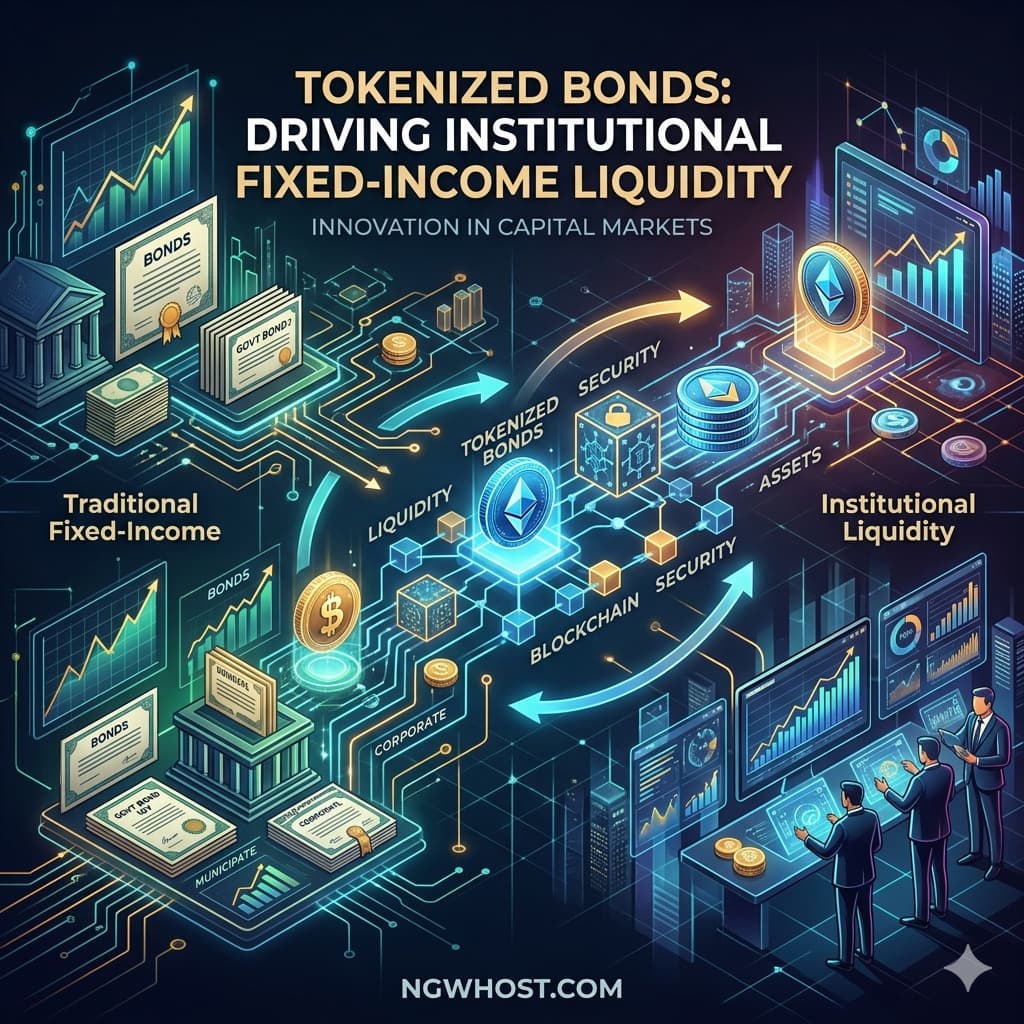
Tokenized Bonds: Driving Institutional Fixed-Income Liquidity
The foundational architecture of the global fixed-income market is facing a profound technological transformation. For centuries, debt issuance, bond trading, and post-trade settlement have relied on multi-layered legacy infrastructure. Trillions of dollars in sovereign debt, corporate bonds, and municipal obligations are locked inside fragmented, opaque databases managed by an array of intermediaries, clearinghouses, and central securities depositories (CSDs).
These traditional market structures inflict systemic friction on institutional investors, characterized by long clearing cycles (T+2 or T+3), high settlement risk, manual compliance verification, and significant capital inefficiencies.
Furthermore, the secondary market for many corporate and structured bonds suffers from deep liquidity fragmentation. While top-tier sovereign instruments benefit from active electronic order books, a vast majority of corporate debt issues trade infrequently over-the-counter (OTC).
This dynamic leaves institutional allocators exposed to wide bid-ask spreads and prolonged execution delays.
To bypass these legacy constraints and unlock trapped capital, global investment banks, tier-one asset managers, and sovereign treasuries are building a programmable alternative. They are systematically migrating traditional debt instruments onto secure distributed ledger technology (DLT). This process is known as Tokenized Bonds.
Far from a conceptual fintech experiment, the tokenization of fixed-income instruments represents a structural leap forward. It merges the legal certainty of debt securities with the instantaneous, atomic execution of Web3 protocols, radically redefining global institutional liquidity.
1. The Architectural Shift: Transforming Passive Debt into Programmable Value
To understand the scale of the tokenized bond revolution, institutional architects must analyze how distributed ledgers reorganize the traditional debt lifecycle. Tokenization converts a fractional ownership claim on a bond or debt obligation into an immutable, programmatically auditable cryptographic token.
The Evolution of the Bond Infrastructure Stack
- Legacy Fixed-Income Infrastructure: Bond issuance requires manual underwriting coordination, distinct CSD ledger registries, multi-day custodial settlement hops, and siloed interest (coupon) payment calculation agents.
- Tokenized Fixed-Income Architecture: Debt contracts are compiled directly into secure smart contracts on-chain. Issuance, compliance rules, secondary exchange, and cash-flow distributions are unified within a single decentralized execution layer, delivering instant (T-0) settlement finality.
By establishing a single, immutable source of truth shared across issuers, buyers, custodians, and regulators simultaneously, tokenized bonds eliminate the need for manual multi-party data reconciliation. The bond shifts from a passive piece of legal documentation into an active, programmable vehicle capable of managing its own lifecycle independently.
2. Core Pillars of an Institutional Tokenized Bond Infrastructure
Deploying enterprise-grade bond tokenization engines requires a highly resilient, secure framework built across four foundational pillars.
Pillar I: Smart Contracts as the Automated Programmatic Fiscal Agent
In a traditional fixed-income framework, servicing a bond involves an expensive network of paying agents, trustees, and calculation entities responsible for processing coupon payments, managing principal redemptions, and tracking ownership registries.
- The Scale Blueprint: Tokenized bonds write this fiscal logic directly into the asset’s underlying smart contract code. When a coupon date is triggered by the ledger’s state machine, the smart contract automatically calculates the interest distribution, verifies current wallet balances, and distributes cash-equivalent stablecoins or Central Bank Digital Currencies (CBDCs) straight to bondholders’ digital vaults in seconds. This automation drives operational overhead down to near-zero.
Pillar II: Embedded Identity Verification and Regulatory Firewalls
Because fixed-income markets handle highly regulated capital flows, institutional tokenized bonds cannot exist on completely open, anonymous networks.
- The Scale Blueprint: Platforms deploy advanced, permissioned security token protocols, such as ERC-3643 or specialized institutional ledger frameworks. These token architectures feature a built-in compliance engine that interacts seamlessly with decentralized identity registries. Before a tokenized bond can be transferred, the smart contract runs an automated check on the sender’s and recipient’s Know Your Customer (KYC) and Anti-Money Laundering (AML) status. If a counterparty lacks the necessary clearing credentials or resides in a restricted jurisdiction, the transaction is instantly blocked, guaranteeing continuous compliance without manual administrative oversight.
Pillar III: Atomic Settlement and Cross-Chain Delivery-vs-Payment (DvP)
A primary vulnerability in legacy institutional finance is settlement risk—the danger that one party delivers their asset but the counterparty fails to transfer the corresponding cash.
- The Scale Blueprint: Web3 infrastructures solve this problem via Atomic Settlement. Utilizing smart contracts, the transfer of the tokenized bond and the transfer of the digital payment occur concurrently as a single, indivisible cryptographic event. Either both sides of the transaction complete successfully within seconds, or the entire operation rolls back automatically. This eliminates counterparty delivery risk, completely eradicating the need for highly capitalized clearing intermediaries and clearinghouse margin buffers.
Pillar IV: Interoperability and Institutional Ledger Bridges
The institutional financial landscape is inherently multi-chain. Various global banking consortiums operate across distinct private networks (such as Hyperledger Fabric or Corda), while others utilize public enterprise scaling layers like Ethereum Layer-2 environments.
- The Scale Blueprint: To prevent capital from becoming trapped inside isolated digital ecosystems, platform architects rely on secure cross-chain data networks like the Cross-Chain Interoperability Protocol (CCIP). This allows a tier-one bank to issue a tokenized corporate bond on a private cloud network and securely distribute it to accredited institutional investors operating across disparate decentralized environments, maximizing capital efficiency and cross-border distribution velocity.
3. High-Performance Optimization: The Institutional Velocity Matrix
The transition from paper-based and siloed electronic clearing systems to programmable tokenized bond networks allows corporate treasuries and institutional allocators to capture significant capital advantages.
| Operational Performance Metric | Traditional Fixed-Income Rails | Tokenized Web3 Bond Networks |
| Settlement Clearing Window | T+2 to T+3 business days | Instant (T-0): Atomic completion in under 3 minutes |
| Operational Accessibility | Restricted (~40 hours/week; banking holidays apply) | Continuous: 24/7/365 global automated execution |
| Secondary Market Liquidity | Highly Fragmented (Opaque OTC phone/dealer networks) | Unified: On-chain liquidity pools and automated AMMs |
| Fractionalization Granularity | Low (High institutional blocks; e.g., $100\text{K} – $1\text{M}$ minimums) | High: Adjustable down to fractional dollar increments |
| Collateral Mobilization Velocity | Slow (Requires multi-day custodial movements) | Instant: Real-time integration with automated repo markets |
4. Unlocking the Institutional Use Cases: Beyond Digital Issuance
The structural benefits of tokenized bonds extend far past the initial minting process. They unlock highly dynamic financial strategies that optimize everyday institutional treasury operations.
Instantaneous, Automated Repo Markets (Tokenized Collateral)
The repurchase agreement (repo) market is the invisible engine powering global banking liquidity, allowing institutions to secure short-term cash financing by pledging high-grade bonds as collateral. In the legacy framework, setting up a repo position requires hours of manual settlement processing and margin calculation.
Tokenized bonds turn this process into a microsecond operation. Because the asset is fully programmable, an enterprise can pledge its tokenized bond holdings into a automated smart-contract repo pool. The protocol instantly locks the tokenized bond, evaluates its real-time market value via decentralized oracles, and releases liquid stablecoins or CBDCs to the borrower immediately. When the loan is repaid with interest, the contract releases the bonds back to the borrower’s vault automatically, completely eliminating operational lag.
Democratic Fractionalization for Global Corporate Debt
Issuing traditional corporate bonds involves massive administrative costs, meaning companies rarely issue debt in small tranches. This forces the market to rely on massive institutional syndicates and locks out mid-sized institutional allocators.
Tokenization slashes issuance and lifecycle maintenance costs down to a fraction of traditional benchmarks. This economic shift allows corporations to securely issue fractionalized bond tranches with significantly lower entry minimums. This democratization widens the issuer’s pool of global capital, builds stronger secondary-market order books, and allows smaller corporate entities to access institutional debt financing cleanly and efficiently.
5. Security Architecture for Enterprise-Grade Tokenization Engines
Handling systemic institutional debt markets demands an absolute, uncompromising adherence to Zero Trust Security Standards. Because blockchain transactions are immutable, system security must be hardcoded straight into the underlying silicon and server infrastructure.
[Inbound Issuance Bid] ──> [MPC Cryptographic Sharding] ──> [Formal Code Verification] ──> [Atomic On-Chain Settlement]
Multi-Party Computation (MPC) Cryptographic Shielding
Enterprises must never store the master administrative keys to their tokenized bond smart contracts on traditional database nodes or single physical hardware modules. Instead, production platforms implement Multi-Party Computation (MPC) architectures.
MPC cryptographically shards the access key into distinct mathematical pieces distributed across geographically isolated server blocks and independent organizational compliance heads. To authorize an asset issuance, a critical interest-rate modification, or a corporate structural change, a preset quorum of signers must validate the transaction concurrently. This configuration completely neutralizes insider collusion risks and removes single points of network failure.
Real-Time Transaction Screening and Smart-Contract Whitelisting
Before any transaction is committed to the shared ledger, the tokenization architecture must route the execution telemetry through automated compliance firewalls (such as Chainalysis or TRM Labs).
These risk engines analyze the interacting digital wallets in real time against global sanctions registers, darknet endpoints, and flagged malicious vectors. If an address displays an elevated threat score, the smart contract enforcer isolates the transaction automatically, protecting the institutional ecosystem from regulatory non-compliance.
6. The Shifting Regulatory Landscape: Institutional Integration Realized
Historically, the primary hurdle preventing conservative institutional allocation into tokenized assets was the lack of clear, uniform regulatory guidelines. Today, this legal ambiguity is dissolving rapidly across the globe.
- The GENIUS Act (United States): This comprehensive federal legislation explicitly recognizes digital securities and tokenized real-world assets as fully legitimate financial instruments. It mandates that tokenization platforms comply with standard SEC framework parameters while granting regulated banking institutions the clear authority to custody, trade, and settle tokenized debt instruments on public and private blockchain infrastructures.
- MiCA Framework (European Union): The Markets in Crypto-Assets regulation establishes a unified, crystalline legal framework across all EU member states, defining rigid structural requirements for asset-backed tokens and ensuring institutional allocators operate with absolute legal protection.
- APAC and Middle East Leadership: Major financial hubs, including Singapore (MAS via Project Guardian) and the UAE (VARA), have pioneered specialized sandboxes and custom licensing pathways specifically optimized for institutional fixed-income tokenization, accelerating international capital flows across East-West digital trade corridors.
Read More⚡ Corporate Debt Issuance: Strategy for Enterprise Funding
Conclusion: The Programmable Fixed-Income Era
The tokenization of bonds is not an incremental optimization for the debt markets; it is a fundamental architecture upgrade for global institutional finance. The legacy method of keeping multi-billion-dollar fixed-income portfolios trapped inside static, disconnected database silos—while tolerating multi-day settlement delays, expensive intermediary frictional fees, and fragmented secondary markets—is rapidly becoming an unviable operational strategy.
By leveraging an integrated distributed ledger infrastructure, programming legal compliance straight into smart contracts, executing instantaneous atomic settlements, and unlocking automated collateral mobilization pipelines, forward-thinking financial leaders do far more than just log data. They build a hyper-efficient, highly liquid, and endlessly scalable capital engine.
The future of global fixed-income distribution belongs entirely to the agile enterprise institutions that can process capital as fast as they process data—mastering tokenized bond fabrics to drive predictable, secure, and seamless financial scale across any competitive horizon.
Deploying heavy tokenization engines, high-throughput smart contract pipelines, real-time compliance gateways, and low-latency financial databases requires ultra-reliable, zero-downtime server infrastructure. Build your enterprise’s digital financial core on an unassailable foundation by exploring the premium hosting architectures at ngwhost.com.