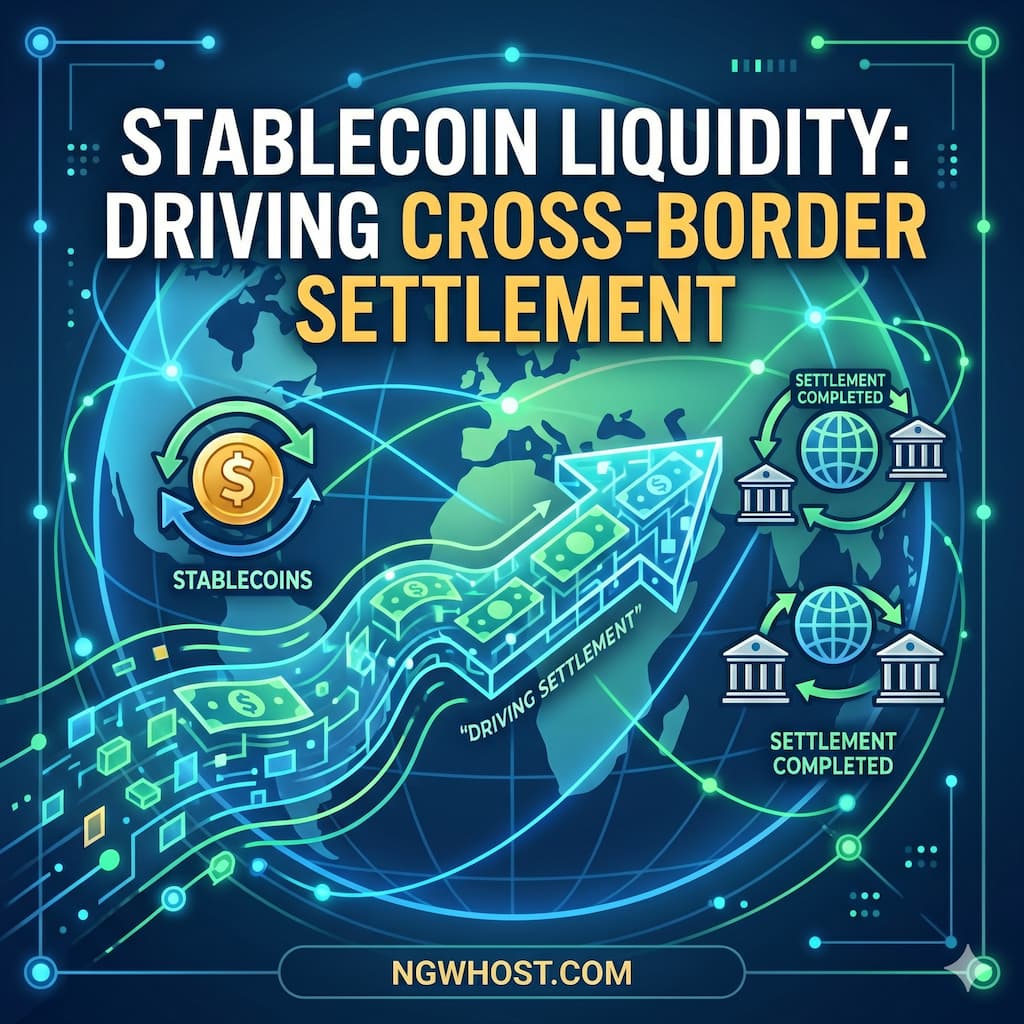
Stablecoin Liquidity: Driving Cross-Border Settlement
The global cross-border payment ecosystem is undergoing its most radical transformation since the inception of the SWIFT network in 1973. Historically, moving money across borders has been a fragmented, slow, and capital-inefficient process. A typical international corporate B2B transaction requires navigating multiple correspondent banking layers, clearing houses, time-zone gaps, and manual compliance checks. The result is a system plagued by T+2 to T+5 settlement delays, unpredictable fees, and structural lack of transparency.
Stablecoins have emerged as a disruptive primitive designed to bypass this legacy architecture entirely. By anchoring the stability of fiat currencies like the US Dollar (USD) or Euro (EUR) to the programmatic efficiency, 24/7 uptime, and atomicity of blockchain networks, stablecoins are redefining commercial treasury operations.
However, the viability of stablecoins for enterprise-grade cross-border settlement does not depend on the underlying blockchain speed alone. The true bottleneck—and ultimate differentiator—is stablecoin liquidity. For multi-million dollar corporate transactions to execute without causing market distortion, deep, resilient liquidity across both on-chain pools and fiat-crypto gateways is paramount.
1. The Physics of Cross-Border Capital: Why Liquidity is King
When an enterprise initiates a cross-border payment, they are not simply moving data; they are exchanging assets. In traditional finance, this relies on the correspondent banking framework, where banks hold foreign currency balances in accounts abroad—known as Nostro-Vostro accounts.
[Sender Bank] ➔ [Correspondent Bank A (Nostro)] ➔ [Correspondent Bank B (Vostro)] ➔ [Receiver Bank]
This model locks up trillions of dollars in stagnant collateral globally just to facilitate transactions. Stablecoins eliminate the need for pre-funded Nostro-Vostro accounts by enabling Atomic Settlement—the simultaneous exchange of assets on a single, shared ledger.
Yet, for a multinational corporation to settle a transaction, three distinct layers of stablecoin liquidity must align perfectly:
On-Chain Ledger Market Depth
If a corporate treasury wants to convert $50M from a USD-pegged stablecoin (e.g., USDC, USDT) to an EUR-pegged stablecoin (e.g., EURC) natively on-chain, there must be deep decentralized finance (DeFi) or centralized automated market maker (AMM) pools capable of absorbing that trade size. Without sufficient market depth, the transaction suffers from slippage—the difference between the expected price of a trade and the price at which the trade actually executes.
Fiat-to-Crypto Gateways (On/Off Ramps)
A cross-border transaction typically begins in local fiat currency (e.g., Brazilian Real or Japanese Yen) and ends in local fiat currency. Therefore, liquidity is heavily dependent on the depth of the local market ramps. The stablecoin ecosystem must have deep order books connecting regional commercial banks to centralized exchanges and liquidity brokers to ensure that entering and exiting the digital wrapper happens instantly at a 1:1 parity.
The Velocity of Stablecoin Capital
Liquidity is not just a measure of volume; it is a function of velocity. The formula governing stablecoin utility in cross-border payments can be modeled through a variation of the classical Equation of Exchange:
$$M \cdot V = P \cdot T$$
Where:
- $M$ is the total circulating supply of the stablecoin
- $V$ is the velocity of money (how frequently a single token is used for transactions over a specific period)
- $P$ is the price level of transaction services
- $T$ is the total volume of real cross-border transactions
In high-efficiency settlement corridors, a stablecoin with high velocity ($V$) can facilitate massive transaction volumes ($T$) even with a compressed circulating supply ($M$), provided the underlying liquidity pools refresh instantly through automated arbitrage.
2. Token Standards and Bridge Architecture: Navigating a Multi-Chain World
Stablecoins do not exist in a vacuum; they are distributed across dozens of distinct layer-1 and layer-2 blockchain networks (e.g., Ethereum, Solana, Arbitrum, Base). This multi-chain reality creates fragmented liquidity siloes. If a corporate customer holds USDC on Ethereum but their counterparty requires it on Solana, moving that value requires robust bridge architecture.
[Ethereum Network] ➔ [Native Issuance Protocol (CCTP)] ➔ [Solana Network]
    (Burn USDC)                 (API Verifier)               (Mint USDC)
Historically, the industry relied on wrapped asset bridges, where tokens were locked in a smart contract on the source chain, and synthetic “wrapped” tokens were minted on the destination chain. These became catastrophic vectors for security breaches, resulting in billions of dollars in exploits.
Native Issuance Protocols (CCTP)
To solve the structural vulnerabilities of wrapped assets and aggregate liquidity fragmentation, issuers have built native bridging layers. A prime example is Circle’s Cross-Chain Transfer Protocol (CCTP).
CCTP does not use wrapped tokens. When a transaction crosses chains, the protocol burns the stablecoin natively on the source chain, verifies the transaction via an on-chain API, and instantly mints an identical amount of native, pristine stablecoins on the destination chain. This ensures capital efficiency, zero slippage, and maximum security for corporate treasurers moving capital across networks.
3. High-Velocity Corporate Routing: How Liquidity Engines Work
For an enterprise user, the underlying complexity of blockchain routing must be completely invisible. B2B payment providers and neo-banking platforms build Smart Liquidity Routing Engines to automate cross-currency settlement optimized for execution speed and cost.
Consider a corporate settlement scenario: a manufacturing firm in Germany needs to pay a parts supplier in South Korea $10M USD equivalent in South Korean Won (KRW).
1.Fiat Ingestion:Instant.
The German firm deposits Euros (EUR) into their local neo-banking account via the SEPA Instant network.
2.On-Ramp to Digital Wrapper:Sub-second.
The platform’s liquidity engine automatically routes the EUR to a regulated fiat-to-crypto gateway, converting the fiat EUR into a Euro stablecoin (e.g., EURC) with near-zero price impact.
3.Cross-Currency Stablecoin Swap:Automated Route Optimization.
The routing engine scans decentralized liquidity pools (like Uniswap V3 or Curve) and centralized order books to find the most capital-efficient path to swap EURC for a USD-pegged stablecoin (e.g., USDC), minimizing slippage.
4.On-Chain Rail Transmission:Under 5 seconds.
The USDC is transmitted over a high-throughput, low-cost blockchain rail (such as Solana or a major Layer-2 network) directly to the destination corridor’s regional liquidity node.
5.Off-Ramp & Local Cleared Payout:Final Settlement.
The local liquidity hub receives the USDC, converts it via a deeply liquid KRW order book, and dispatches native South Korean Won to the supplier’s bank via the local real-time clearing system.
4. Liquidity Matrices: Centralized vs. Decentralized Pools
To sustain heavy corporate transaction flows, liquidity must be dynamically managed across both Centralized Exchanges (CEXs) and Decentralized Protocols (DeFi). Both systems offer distinct operational profiles:
| Liquidity Metric | Centralized Liquidity (Order-Book Based) | Decentralized Liquidity (Automated Market Makers) |
| Execution Mechanism | Traditional bid-ask order books managed by institutional market makers | Algorithmic liquidity pools governed by immutable smart contracts |
| Transparency | Off-chain ledger tracking; requires trust in the exchange entity | 100% on-chain transparency; auditable in real-time via public block explorers |
| Slippage Curve | Linear scaling based on market maker depth and order book density | Geometric scaling based on specific pool equations ($x \cdot y = k$) |
| Counterparty Risk | Credit risk associated with the exchange custody framework | Smart contract vulnerability and oracle manipulation risks |
Corporate-focused fintechs rarely choose one over the other. Instead, they implement hybrid models, aggregating liquidity from both matrices to ensure that a massive transaction can split its volume across multiple venues simultaneously, maintaining a stable execution price.
5. Overcoming the Regulatory and Compliance Liquidity Gates
The intersection of digital asset liquidity and cross-border corporate settlement is highly scrutinized by global regulators. To prevent stablecoins from being utilized for illicit capital flight or sanction evasion, strict institutional compliance guardrails must be embedded into the liquidity layer itself.
Programmable Compliance and Smart Contracts
Unlike physical cash or traditional bank rails, modern stablecoins are programmable software. Features like blacklisting can be executed directly within the token’s smart contract. If an address is flagged by global watchlists (such as OFAC), its ability to transact or interact with liquidity pools is halted instantly.
MiCA and the European Framework
The implementation of the Markets in Crypto-Assets (MiCA) regulation in Europe has set a rigid global precedent for stablecoins. Under MiCA, asset-referenced tokens and e-money tokens face strict reserve requirements.
Issuers must back their circulating stablecoin supply with high-quality, liquid assets (such as short-term government bonds and protected bank deposits) held in segregated accounts. This regulatory clarity has drastically reduced bank-run risks, making corporate CFOs significantly more comfortable deploying stablecoins for large-scale enterprise settlement.
6. The Enterprise Case Study: Tangible ROI of Stablecoin Rails
To understand the transformative power of stablecoin liquidity, look at the operational metrics contrasting traditional correspondent banking against optimized on-chain infrastructure for an international B2B logistics company settling vendor invoices globally:
- Settlement Time: Reduced from an average of 72 hours via correspondent networks down to less than 30 seconds end-to-end.
- Transaction Fees: Slashed from a standard global average of $15 – $50 per wire transfer plus 1-3% FX markup down to fractions of a cent in network fees plus minor, predictable execution slippage.
- Capital Efficiency: Eliminates the necessity of keeping millions of dollars in locked, idle Nostro capital in foreign bank accounts, freeing up massive amounts of working capital that can be deployed back into core business growth or interest-bearing treasury vehicles.
7. The Future Horizon: Wholesale CBDCs and Unified Liquidity Networks
As the ecosystem matures, the lines between corporate stablecoin liquidity and state-backed digital currencies are beginning to blur. The next evolution of cross-border settlement will be defined by the convergence of two major technological trends:
Commercial Bank Stablecoins & Tokenized Deposits
Tier-1 global financial institutions are increasingly launching their own institutional stablecoins and tokenizing their legacy deposit bases. These tokens run on private, permissioned networks or public hyper-scalable ledgers, connecting directly to traditional wholesale interbank settlement clearing rails.
Interoperability Networks
The ultimate state of global transaction banking is a unified, interoperable network where private stablecoins, tokenized commercial bank deposits, and wholesale Central Bank Digital Currencies (CBDCs) flow seamlessly through automated cross-currency liquidity hubs. This setup will dynamically route value across the globe along the path of least resistance, least cost, and maximum speed.
Read More⚡ B2B Neo-Banking: Scaling Corporate Credit Lines
Conclusion: Driving the Frictionless Enterprise
Stablecoin liquidity is no longer an experimental sandbox for retail crypto trading; it has matured into a critical component of global corporate financial infrastructure. By transforming cross-border settlement from a cumbersome multi-day manual process into a real-time, programmatic utilities engine, stablecoins are effectively erasing national economic borders for enterprises.
The corporate treasuries, neo-banks, and fintech platforms that recognize the paramount importance of secure, compliant, and deeply liquid stablecoin networks will be the ones that architect the next era of commerce. In a digital-first global economy, capital must move at the speed of information—and deep stablecoin liquidity is the engine driving that shift.
Want to dive deeper into digital asset infrastructure, high-velocity corporate payment routing, or cloud-scale enterprise fintech setups? Head over to ngwhost.com for more deep-dive analyses.