Inflation-Indexed Bonds: Safe Haven Strategies 2026
The global fixed-income landscape has undergone a violent structural transformation. As we progress through May 2026, wealth allocators, fund managers, and digital entrepreneurs are forced to confront an economic reality that conventional financial models failed to predict: the persistence of sticky, structural inflation. With global supply chains continuously adapting to geopolitical fragmentation, energy costs remaining elevated, and sovereign debt scaling to historic thresholds, the traditional purchasing power of fiat currency is facing a relentless multi-year erosion.
In this macroeconomic climate, leaving cash reserves completely exposed or relying on traditional fixed-rate bonds is no longer a viable defensive strategy. When nominal yields fail to outpace the real-world rise in consumer prices, standard fixed-income portfolios inadvertently guarantee a negative real return.
For the tech-forward business owners, platform architects, and digital asset allocators within the ngwhost.com community, financial resilience is just as critical as server uptime. To insulate your corporate treasury or personal wealth from inflationary degradation, you must deploy advanced capital preservation frameworks.
This comprehensive investment brief delivers an enterprise-grade analysis of Inflation-Indexed Bonds (IIBs) in 2026, details the specific strategic mechanics needed to maximize real yields, and provides a multi-jurisdictional roadmap to construct an absolute safe haven for your capital this year.
1. The 2026 Macro Environment: Why Fixed-Rate Debt is a Trap
To successfully execute an asset preservation strategy today, you must first dismantle the outdated investment heuristics of the early 2020s. For decades, traditional government bonds (such as the standard U.S. 10-Year Treasury) were universally treated as the ultimate risk-free ballast for a diversified portfolio.
In 2026, that thesis has collapsed under the weight of Real Yield Compression.
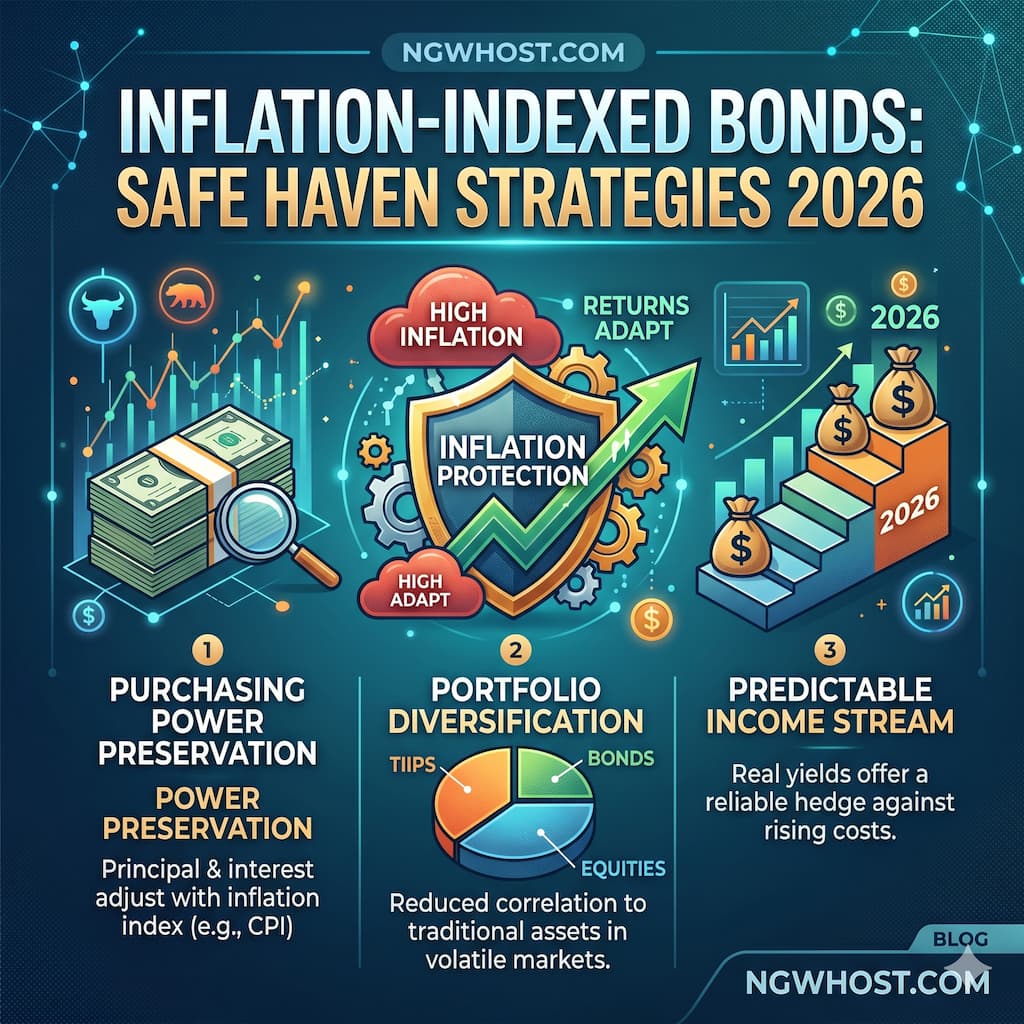
When you purchase a conventional fixed-rate bond, you lock in a static nominal interest payment (the coupon) over a predetermined duration. If headline inflation spikes during that period, the real purchasing power of both your annual coupon payments and your ultimate principal repayment at maturity drops lineally.
Consider the modern mathematical mismatch: with headline consumer price inflation hovering at elevated baselines this quarter, a standard nominal bond yield frequently translates into a negative real return once adjusted for real-world living and operational cost spikes.
  TRADITIONAL FIXED-RATE BOND IN AN INFLATIONARY CYCLE
  [Static Nominal Coupon] ──► [Rising Consumer Prices] ──► [Compressed Real Purchasing Power]

  INFLATION-INDEXED BOND (IIB) ADJUSTMENT CYCLE
  [CPI Data Released] ──► [Principal Adjusts Upward] ──► [Coupon Paid on Expanded Principal Base]
To break free from this wealth destruction loop, sophisticated capital allocators use Inflation-Indexed Bonds as their primary defensive anchor. These specialized sovereign instruments are contractually engineered to eliminate inflation risk by tying their underlying financial structure directly to real-time consumer price metrics.
2. Deconstructing the Mechanics of Inflation-Indexed Bonds
Inflation-Indexed Bonds—known as TIPS (Treasury Inflation-Protected Securities) in the United States, Linkers in the United Kingdom, and Notas do Tesouro Nacional (NTN-B) in Brazil—operate via a highly unique structural design. Unlike standard debt instruments, an IIB adjusts its core parameters to ensure your capital grows in lockstep with inflation.
I. Principal Indexation and Capital Preservation
The defining feature of an inflation-indexed bond is that its principal balance is variable, not fixed. The principal is contractually linked to an official inflation benchmark, typically the Consumer Price Index (CPI) or a localized equivalent.
When inflation occurs, the underlying principal value of the bond is automatically adjusted upward by the exact percentage of the price increase. Conversely, if the economy encounters a brief deflationary cycle, the principal tracks downward. However, top-tier sovereign issuers include a Deflationary Floor Guarantee, ensuring that at maturity, the investor receives whichever is higher: the inflation-adjusted principal or the original par value.
II. The Compounding Coupon Effect
Many investors mistakenly believe that inflation-indexed bonds feature a variable interest rate. In reality, the coupon rate remains entirely fixed throughout the life of the bond. The magic lies in the math: because the fixed coupon rate is applied directly to the inflation-adjusted principal rather than the original par value, your actual dollar-denominated cash distributions expand automatically during inflationary spikes.
$$\text{Actual Coupon Distribution} = \text{Fixed Coupon Rate} \times \text{Inflation-Adjusted Principal Balance}$$
This dual-action mechanism creates an un-matched defensive synergy: your principal tracking protects your foundational wealth, while your expanding coupon payments insulate your immediate operational cash flow from rising prices.
3. Top Sovereign Inflation-Protected Assets for 2026
Building a resilient, global safe haven requires diversifying your inflation-linked exposure across multiple distinct sovereign issuers. In 2026, the global bond market features highly specialized, institutionally liquid avenues:
A. United States: TIPS (Treasury Inflation-Protected Securities)
TIPS remain the most liquid and deeply traded inflation-indexed instruments on earth, serving as the baseline anchor for global corporate treasuries.
- The 2026 Target: Modern allocators focus heavily on short-duration TIPS (1 to 5-year maturities). Short-term TIPS track immediate, unexpected shifts in monthly CPI data with minimal Duration Risk (the sensitivity of a bond’s price to changes in broader central bank interest rates).
- The Secondary Engine: Series I Savings Bonds: For individual investors and small business owners, Series I Bonds offer a powerful, non-marketable alternative. They combine a fixed base rate with an inflation rate that resets every six months, providing a highly predictable, tax-deferred compounding shield.
B. Brazil: NTN-B (Tesouro IPCA+)
For sophisticated yield seekers operating in 2026, Brazil’s inflation-linked debt instruments offer some of the highest real yields in the democratic world.
- The 2026 Structural Advantage: Linked directly to the IPCA (Broad Consumer Price Index), NTN-Bs regularly offer a staggering yield profile, frequently paying out IPCA + 6.0% to 6.5% real interest.
- The Portfolio Role: While they carry emerging-market currency exposure (the Brazilian Real), they function as an extraordinary strategic hedge for digital businesses that maintain global multi-currency operational layer infrastructures, outperforming Western fixed-income counterparts on a pure real-yield basis.
C. United Kingdom & Europe: Index-Linked Gilts and OAT_i
The European and British inflation-linked ecosystems are highly mature, tracking localized retail and consumer price indices (RPI/HICP).
- The 2026 Tactical Focus: These instruments are primarily deployed by institutional pension funds and sovereign wealth structures to hedge long-term corporate liabilities against systemic structural changes in the Eurozone and British energy markets.
4. Tactical Safe Haven Strategies for 2026 Portfolio Construction
Simply buying an inflation-indexed bond is not enough to secure a victory in the current economic landscape. True risk mitigation requires embedding these assets into a dynamic, highly targeted allocation framework.
Strategy 1: The Short-Duration TIPS Ladder
In May 2026, macro interest rates remain elevated as central banks combat persistent price pressures. In a high-rate environment, long-term bonds (e.g., 20 to 30-year maturities) face severe capital price degradation if interest rates creep higher.
- The Play: Construct a Short-Duration IIB Ladder using 1, 2, 3, and 5-year maturities. As the 1-year bonds mature, your corporate treasury reinvests the capital into the newer, higher-yielding rungs at the back of the ladder. This systematic rotation maximizes your exposure to updated inflation resets while completely insulating your capital from the volatile swings of long-term bond markets.
Strategy 2: The Multi-Asset Real-Return Matrix
Inflation-indexed bonds should not operate in an isolated silo. To maximize your defensive alpha on ngwhost.com, you must combine them alongside other complementary real-world hard assets.
┌────────────────────────────────────────────────────────┐
│            2026 MULTI-ASSET REAL-RETURN MATRIX         │
└───────────────────────────┬────────────────────────────┘
                            │
            ┌───────────────┼───────────────┐
            ▼               ▼               ▼
┌───────────────────────┐┌───────────────────────┐┌───────────────────────┐
│ SHORT-DURATION IIBs   ││ PHYSICAL GOLD / RWAs  ││ EQUITIES & TECH HARDWARE│
│ Contractual inflation  ││ Absolute monetary    ││ Captures corporate   │
│ protection with zero  ││ shield with zero     ││ pricing power & AI-  │
│ market downside.      ││ counterparty risk.   ││ driven efficiency.   │
└───────────────────────┘└───────────────────────┘└───────────────────────┘
By balancing your portfolio across this matrix, you create a self-correcting financial engine. If a sudden geopolitical crisis triggers a severe commodity price spike, your physical gold and raw materials surge instantly. Simultaneously, your short-duration inflation-indexed bonds automatically capture the escalating CPI metrics, expanding your fixed income distributions and shielding your core capital from downside economic friction.
5. Critical Tax and Valuation Vulnerabilities to Manage
Deploying an enterprise-level preservation strategy requires navigating complex fiscal traps. If left unmonitored, regulatory anomalies can quietly compromise your net returns.
- The Phantom Tax Trap: In many jurisdictions (including the United States), the annual upward inflation adjustment applied to a bond’s principal balance is contractually treated as taxable income in the year it occurs—even though the investor does not actually receive that cash until the bond reaches its ultimate maturity. This creates a “phantom tax” liability.
- The Mitigation Strategy: To completely bypass this cash flow drain, always structure your inflation-indexed bond allocations within tax-insulated wrappers—such as corporate holding trusts, specialized Private Placement Life Insurance (PPLI) policies, or dedicated retirement accounts.
- The Indexation Lag Challenge: Inflation data is inherently retrospective. The CPI metrics compiled and released by government agencies reflect price changes that occurred weeks in the past. If an economy encounters an aggressive, overnight hyper-inflationary shock, there is a technical 2 to 3-month latency window before the bond’s principal balance recalculates to reflect the new economic baseline.
6. Comparing Safe Haven Alternatives in 2026
To understand exactly where inflation-indexed bonds excel, let us analyze how they compare against other popular alternative stores of value under modern economic stress tests:
| Strategic Safe Haven Asset | Default Counterparty Risk | Volatility Index | Inflation Capture Velocity | Core Portfolio Utility |
| Inflation-Indexed Bonds (IIBs) | Sovereign-Backed (Near Zero) | Low / Stable | Contractually Fixed (Via CPI) | Foundational treasury stabilization & reliable cash distribution. |
| Physical Bullion (Gold) | Absolute Zero | Medium / High | Macro-Cyclical | Geopolitical catastrophe protection & long-term currency hedge. |
| Cryptocurrency (Bitcoin) | Decentralized Network Risk | High / Speculative | Long-Term Scarcity Alpha | Asymmetric digital growth & non-fiat asset allocation. |
| High-Yield Cash/Neobanks | Commercial Bank Default | Zero | Lagging / Sub-Inflation | Immediate 30-day operational bills and payroll liquidity. |
7. The Technological Synergy: Redundant Backups for Capital
For the advanced cloud developers, infrastructure engineers, and digital entrepreneurs who host their modern enterprise applications on ngwhost.com, the logic of inflation-indexed bond allocation is deeply intuitive.
When you architect an enterprise web ecosystem, you do not tolerate single points of failure. You do not rely on a single server, nor do you leave your database completely un-monitored against systemic software bugs. You implement redundant architectural nodes, automated failovers, and secure offline data backups to ensure that if a core infrastructure node experiences an unexpected system crash, the broader platform continues to render flawlessly without data corruption.
An allocation into inflation-indexed bonds functions exactly like a secure, encrypted offline backup for your wealth.
By moving a portion of your high-velocity online revenues or digital agency cash flows out of speculative equity pools or vulnerable bank accounts and anchoring them into contractually protected, sovereign-backed inflation-linked debt, you install a financial failover system. You marry your high-speed online scalability with the immutable, compounding, and legally insulated wealth preservation mechanics of the global macroeconomic elite.
Read More⚡ Venture Debt 2026: Scaling Startups Without Dilution
Conclusion: The Sovereign Verdict on Wealth Preservation
The monetary landscape of 2026 has permanently penalized financial complacency. Allowing your corporate reserves or generational savings to sit exposed in un-optimized cash pools or traditional fixed-rate debt instruments is a silent concession to purchasing power destruction.
Securing your position as a globally diversified allocator is not a matter of predicting daily market charts or guessing volatile commodity spikes. It is an exact discipline of structural configuration. By constructing a disciplined short-duration TIPS ladder, diversifying into high-yielding international structures like Brazil’s NTN-Bs, wrapping your assets within tax-insulated corporate structures, and combining your bonds alongside hard real-world assets, you effectively build an un-breachable wall around your capital.
The global economy will continue to move at rapid, unpredictable velocity, and the purchasing power of fiat currencies will continuously face political pressure. Secure your foundation, automate your rebalancing thresholds, and let your core capital grow non-stop behind an institutional, inflation-proof shield.