Investing in Rare Earth Metals: A Guide for 2026
The global race for technological and energy sovereignty has completely transformed the commodities landscape. As we navigate through 2026, the traditional dominance of fossil fuels and standard industrial metals has been eclipsed by a group of seventeen elements hidden at the bottom of the periodic table.
Welcome to the definitive investor’s guide to Rare Earth Elements (REEs).
For the digital entrepreneurs, infrastructure architects, and macroeconomic allocators within the ngwhost.com community, rare earth metals are the invisible scaffolding of the modern world. Without these materials, the high-performance computing clusters that host your web ecosystems, the optical fibers that transmit your digital data across oceans, and the advanced hardware tokens securing your digital assets would simply cease to exist.
As geopolitical fragmentation accelerates and the transition to clean energy reaches unprecedented volumes, select rare earth metals are flashing the strongest institutional buy signals of the decade. This comprehensive guide breaks down the structural mechanics of the 2026 rare earth market, maps out the critical elements driving high returns, identifies geopolitical chokepoints, and outlines a tactical framework to scale your portfolio with these strategic assets.
1. Decoding REEs: What Are Rare Earth Metals?
Despite their name, rare earth metals are not particularly rare in terms of crustal abundance. Elements like cerium are more plentiful than copper or lead. However, they are classified as “rare” because they are rarely found in concentrated, easily exploitable ore bodies. They are typically mingled with radioactive elements like thorium and uranium, making extraction and separation an incredibly complex, capital-intensive, and environmentally sensitive chemical process.
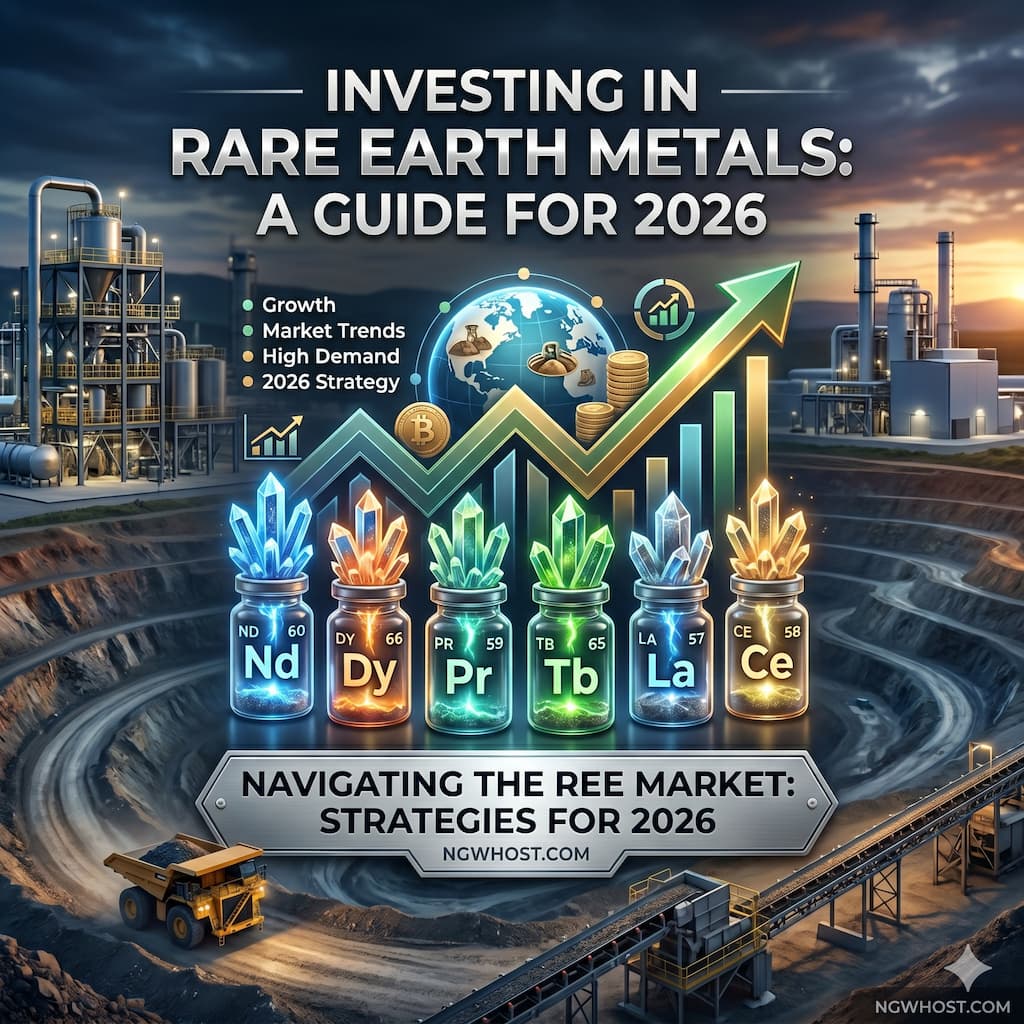
The seventeen rare earth elements include the fifteen lanthanides plus scandium and yttrium. For investment purposes in 2026, the market divides these metals into two distinct categories based on weight and market demand.
                  ┌──────────────────────────────────────┐
                  │         RARE EARTH ELEMENTS          │
                  └──────────────────┬───────────────────┘
                                     │
            ┌────────────────────────┴────────────────────────┐
            ▼                                                 ▼
┌───────────────────────┐                         ┌───────────────────────┐
│   LIGHT REEs (LREEs)  │                         │   HEAVY REEs (HREEs)  │
└───────────┬───────────┘                         └───────────┬───────────┘
            │                                                 │
            ├─► Neodymium (Nd)                                ├─► Dysprosium (Dy)
            ├─► Praseodymium (Pr)                             ├─► Terbium (Tb)
            └─► Lanthanum & Cerium                            └─► Yttrium & Europium
A. Light Rare Earth Elements (LREEs)
LREEs are more abundant but represent the bedrock of high-volume industrial applications. The most critical sub-set consists of Neodymium (Nd) and Praseodymium (Pr), often referred to in financial markets as NdPr. These two elements are the foundational inputs for the manufacturing of NdFeB (Neodymium-Iron-Boron) permanent magnets—the strongest permanent magnets known to science.
B. Heavy Rare Earth Elements (HREEs)
HREEs are significantly less common in the Earth’s crust and command vastly higher price premiums. The stars of this category are Dysprosium (Dy) and Terbium (Tb). In 2026, these elements are highly prized because they are added to neodymium magnets to preserve their magnetic properties at extreme operating temperatures.
2. The 2026 Macro Supercycle: What is Driving Demand?
The investment thesis for rare earth metals in 2026 rests on a structural imbalance between irreversible, skyrocketing global demand and a heavily bottlenecked supply chain.
The AI Infrastructure and Robotics Boom
The exponential scaling of Artificial Intelligence (AI) has exited the digital cloud and entered the physical realm. In 2026, capital expenditure on humanoid robotics, automated industrial fulfillment centers, and advanced defense tech has surged.
Every robotic joint, high-speed actuator, and precision micro-motor relies heavily on ultra-powerful NdPr permanent magnets to minimize weight and maximize mechanical torque. Concurrently, the hyper-expansion of AI-optimized data centers requires advanced cooling pumps and high-efficiency generators that are fundamentally dependent on premium REE alloys.
The Decarbonization Mandate
The global transition toward electrification has hit its steepest deployment curve.
- Electric Vehicles (EVs): While battery chemistry continues to evolve, the electric drivetrain has stabilized. Over 90% of modern EVs utilize permanent magnet synchronous motors because they are vastly more efficient than induction alternatives. A single EV permanent magnet motor requires roughly 1 to 2 kilograms of NdPr.
- Wind Energy: Direct-drive offshore wind turbines, which are seeing massive multi-billion-dollar buildouts across the North Sea and the Atlantic in 2026, require up to 600 kilograms of rare earth magnets per megawatt of capacity to operate reliably without heavy mechanical gearboxes.
3. The Geopolitical Chokepoint: De-Risking the Supply Chain
To invest safely in rare earth metals, you must understand the geopolitical architecture of the market. Historically, China has maintained a near-monopoly, controlling roughly 60% of global REE mining extraction and an overwhelming 85% to 90% of the world’s processing, separation, and magnet manufacturing capacity.
[Raw Ore Extraction (60% China)] ──► [Chemical Separation (85% China)] ──► [Magnet Production (90% China)]
The 2026 Fragmentation Paradigm
As global trade barriers rise and “friend-shoring” becomes national policy across the West, the United States, the European Union, and Australia have implemented sweeping legislative acts—such as the US Critical Minerals Scarcity Act and the EU Critical Raw Materials Mandate. These regulations explicitly penalize industries that rely on un-diversified supply chains and offer massive tax credits, subsidies, and guaranteed government off-take agreements to Western-aligned mining and processing firms.
This structural fragmentation has created a massive pricing premium for “Non-Chinese Visual Provenance” REEs. Corporations are willing to pay a 20% to 30% markup for neodymium and dysprosium that is fully tracked, sustainably mined, and separated outside of East Asian monopoly rings.
4. Top Rare Earth Asset Classes & Elements to Target
True portfolio diversification within this sector requires tracking the specific elements that possess the highest supply-deficit profiles this year.
1. Neodymium-Praseodymium (NdPr)
- Market Position: The absolute liquid core of REE investing.
- 2026 Dynamics: Supply deficits for NdPr are projected to expand by 15% year-on-year through the remainder of the decade. It is the most accessible element for retail and institutional allocators due to standard spot-price tracking across international commodities exchanges.
2. Terbium (Tb) and Dysprosium (Dy)
- Market Position: The strategic amplifiers.
- 2026 Dynamics: Because these heavy rare earths are incredibly scarce outside of specific ionic clay deposits, they command an extraordinary price-per-kilogram premium. They represent the ultimate hedge against defense-supply bottlenecks, as military hardware, stealth coatings, and aerospace guidance systems cannot function without them.
5. How to Invest in Rare Earths: A Tactical Framework
Investing in rare earths is vastly different from buying gold or crude oil. You cannot easily pull a bar of neodymium into a personal safe, as raw REEs oxidize rapidly and require highly specialized storage. Instead, allocators in 2026 access this trend through a modular financial stack.
Strategy 1: Pure-Play Mining and Processing Equities (High Reward)
Investing directly in the equity of western companies that have successfully cleared the grueling environmental and capital hurdles of building an operational refinery.
- MP Materials (NYSE: MP): The owner and operator of the Mountain Pass mine in California. MP represents the premier Western pure-play, as they have successfully scaled from simple mining extraction to full-scale on-site chemical separation and localized magnet manufacturing facility integration.
- Lynas Rare Earths (ASX: LYC): Based in Australia with a massive processing facility in Malaysia, Lynas is the largest producer of separated LREEs outside of China. It offers excellent structural liquidity and direct exposure to the premium-priced non-Chinese supply loop.
- Iluka Resources (ASX: ILU): A heavy mineral sands producer that is actively constructing Australia’s first fully integrated refinery for both light and heavy rare earths, backed by significant government capital cushions.
Strategy 2: Specialized Exchange-Traded Funds (ETFs) (Medium Risk)
For broad, liquid, and hassle-free exposure to the global rare earth ecosystem without individual corporate operational risk, ETFs remain the preferred entry vehicle.
- VanEck Rare Earth/Strategic Metals ETF (REMX): Tracks a global index of companies involved in the mining, refining, and recycling of rare earth and strategic metals. It provides immediate diversification across Western operators, Australian explorers, and Japanese advanced alloy producers.
Strategy 3: Tokenized Mineral Assets and RWAs (The 2026 Frontier)
The intersection of real-world asset tokenization and industrial commodities has completely stabilized this year.
- The Mechanism: Independent warehouse registries pool audited, industrial-grade drums of separated NdPr oxide or metallic terbium. These physical allocations are tokenized as Real-World Assets (RWAs) on public, carbon-neutral blockchain ledgers.
- The Advantage: Individual investors can now buy fractionalized ownership of the actual physical metal, holding a digital certificate that tracks the spot price of the material flawlessly, completely bypassing the historical limitations of private contract minimums.
6. Critical Valuation Metrics for Investors
When performing due diligence on a rare earth mining or technology platform, you must avoid the common traps of standard mining analysis. Look for three distinct structural indicators:
| Valuation Metric | What it Measures | Target Ideal Threshold | Why it Matters in 2026 |
| Total REO Grade | The concentration of Rare Earth Oxides within the raw ore. | > 1.5% for hard rock; > 0.05% for ionic clays | Higher grades dramatically lower the per-ton chemical processing cost. |
| NdPr Basket Ratio | The percentage of high-value NdPr relative to cheaper elements like cerium. | > 20% of the total volume | Cerium and Lanthanum are in oversupply; NdPr is what drives company profitability. |
| Separation Capability | Can the company refine the ore into pure metal on-site? | Full independent separation operational status | Shipping raw concentrate to third-party offshore refineries destroys your margin and introduces geopolitical risk. |
7. Major Risks to Evaluate Before Allocating Capital
No high-yield asset class is without structural risks, and rare earth investments require absolute vigilance:
- Environmental and Regulatory Liabilities: The chemical processing of rare earths produces toxic acidic waste and low-level radioactive byproducts. A single environmental leak or regulatory compliance failure can cause local governments to suspend a multi-billion-dollar refinery’s license overnight.
- Substitutability and Technological Shifts: High prices encourage engineering workarounds. Companies like Tesla are continuously designing alternative EV drivetrains that minimize or eliminate rare earth magnets. While these alternative motors are bulkier and less efficient, a massive drop in the cost of alternative technologies could put a ceiling on REE price expansion.
- Chinese Market Flooding: China retains the power to manipulate international spot prices. If Western-aligned mines begin capturing significant market share, the eastern monopoly blocks can artificially expand their domestic production quotas, flooding the global market with cheap elements to suppress prices and push high-cost Western operators into bankruptcy.
8. The Digital Infrastructure Symmetry: The ngwhost.com View
For the technology innovators, platform builders, and server administrators reading this blog, investing in rare earth metals represents the ultimate physical-to-digital macro hedge.
Your daily operations exist in the highly agile, fast-paced world of software, web rendering, and cloud architecture. But that cloud is anchored to the earth by thousands of tons of physical hardware. Data center solid-state drives (SSDs) require yttrium; laser-guided fiber optic cables rely on erbium; high-performance computing fans require samarium.
By taking a portion of your business reserves or portfolio capital and reallocating it into the physical, mineral building blocks that make the internet possible, you build an incredibly resilient corporate architecture. You marry your digital velocity with the foundational, un-duplicable, and highly insulated wealth dynamics of global industrial scarcity.
Read More⚡ Peer-to-Peer Lending: Managing Risks and Returns 2026
Conclusion: Securing Your Position on the Periodic Table
Investing in rare earth metals in 2026 has successfully moved past the speculative boom-and-bust cycles of the past decade. It has consolidated into a permanent, structurally vital, and deeply strategic asset class that sits at the absolute core of global geopolitical and industrial strategy.
The macroeconomic signals are clear: as the planet electrifies and AI deployment demands massive mechanical scale, the elements that enable automation will continuously command premium valuations. By diversifying your capital across liquid strategic ETFs, backing Western operators with independent separation capabilities, and exploring the emerging liquidity of tokenized real-world mineral assets, you insulate your wealth against traditional fiat inflation and align your portfolio with the real infrastructure of the future.
The future is not just automated and green; it is physical. Are your investments anchored in the elements driving the transition?