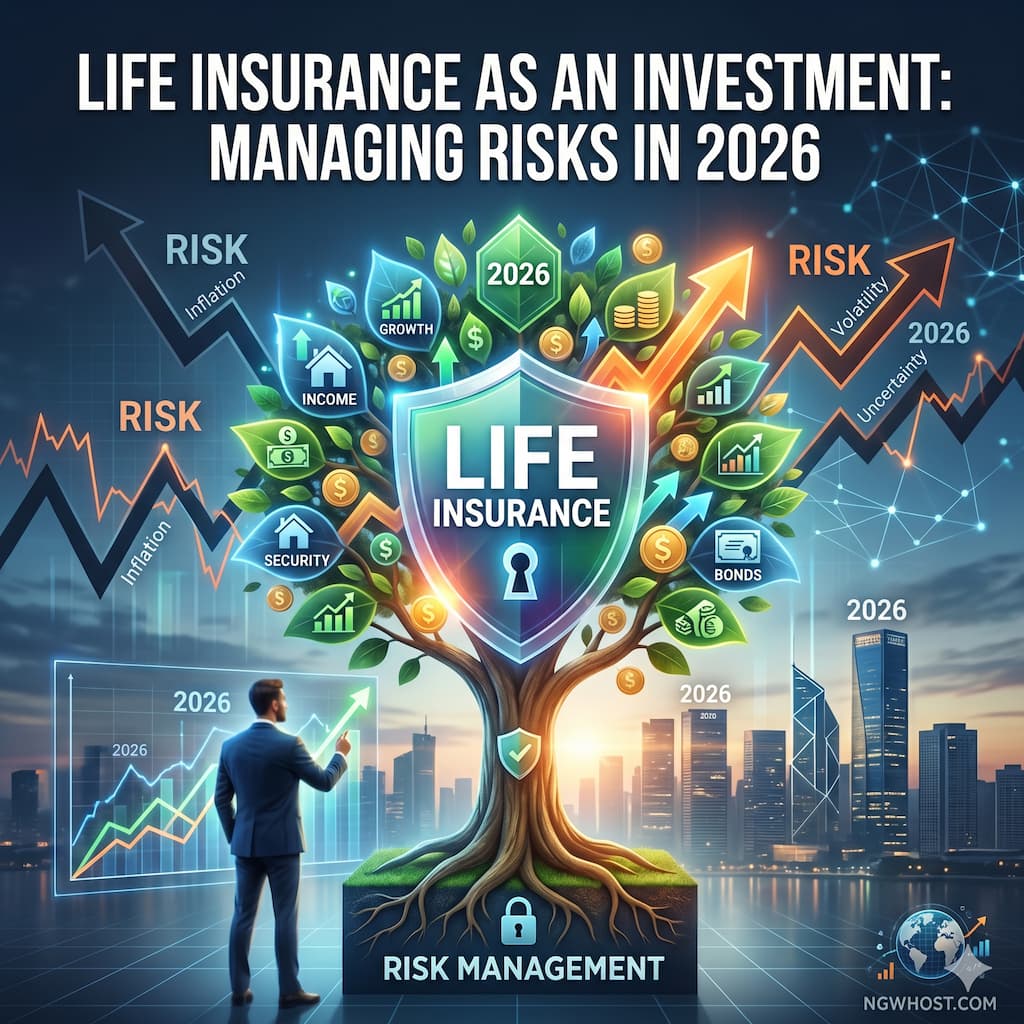
Life Insurance as an Investment: Managing Risks in 2026
The lines governing global wealth preservation, tax mitigation, and portfolio diversification have permanently blurred. As we navigate through May 2026, traditional balanced portfolios are facing unique structural headwinds. With public equity valuations trading at historic premiums and traditional fixed-income yields struggling to outpace sticky, structural inflation, sophisticated allocators are looking beyond conventional asset classes to secure their capital.
One of the most profound macro rotations of the mid-2020s has been the transformation of permanent life insurance from a simple, defensive estate-planning tool into an aggressive, high-yield institutional investment wrapper.
For the tech-forward entrepreneurs, digital agency owners, and web administrators within the ngwhost.com community, maximizing cash-flow efficiency is a baseline operational rule. When your operating companies generate substantial liquidity, leaving excess capital inside a low-yielding corporate bank account exposes your business to fiscal drag and systemic banking risks.
This comprehensive investment brief details the mechanics of utilizing life insurance as a high-performing asset class in 2026, analyzes the specific risk vectors you must manage, and provides a tactical roadmap to build an absolute fiscal shield around your wealth this year.
1. The 2026 Financial Landscape: Why Life Insurance is an Asset Class
To understand why capital is flowing heavily into insurance products in 2026, we must look at the recent updates to global tax reporting and wealth monitoring frameworks. With the full implementation of the Crypto-Asset Reporting Framework (CARF) and CRS 2.0, tax authorities globally now deploy advanced machine learning models to track traditional deposits, offshore corporate holdings, and digital assets in real-time.
In this environment of absolute fiscal transparency, permanent life insurance remains one of the few legally sanctioned, globally recognized structures that offers triple tax-free advantages:
- Tax-Free Cash Accumulation: The growth of the cash value inside the policy is entirely insulated from annual capital gains or dividend taxes.
- Tax-Free Distributions: Policyholders can access their accumulated capital via structured policy loans with zero tax liability.
- Tax-Free Death Benefit: Upon the passing of the insured, the entire capital pool transfers to beneficiaries completely free of income or probate taxes.
Moving Beyond Term Insurance
While term life insurance operates as a pure expense designed to cover a specific time window, permanent life insurance—specifically Whole Life and Universal Life structures—allocates a portion of your premium payments straight into a cash accumulation account. In 2026, this cash value behaves like a highly insulated, tax-sheltered corporate treasury, growing compound interest completely independent of public market volatility.
2. Deconstructing the 2026 Insurance Investment Stack
When allocating capital into this asset class today, you are not buying your grandparents’ life insurance policy. The modern 2026 ecosystem is dominated by highly sophisticated, structured vehicles designed for maximum investment alpha.
Vehicle A: Private Placement Life Insurance (PPLI)
PPLI has emerged as the premier choice for high-net-worth digital entrepreneurs and institutional allocators in 2026.
- The Architecture: Unlike retail policies that limit your investment choices to a few mutual funds, a PPLI acts as an open architecture wrapper. Investors can place an incredibly wide array of alternative assets inside the policy wrapper—including hedge fund allocations, private credit notes, venture capital stakes, and tokenized real-world assets (RWAs).
- The Alpha: Because the assets reside legally inside the life insurance contract, all the high-yield dividends, interest, and capital gains generated by those alternative investments accumulate on a 100% tax-exempt basis.
Vehicle B: Index Universal Life (IUL) with Uncapped Options
IUL policies allow the policyholder to tie their cash value growth to the performance of a public market index, such as the S&P 500, without actually exposing the principal to market downsides.
- The 0% Floor Mechanics: The defining feature of an IUL in 2026 is the contractual 0% downside floor. If the public stock market experiences a sharp correction and drops 20%, your policy’s investment account simply receives a 0% return for that period, preserving 100% of your accumulated principal.
- The 2026 Uncapped Options: Top-tier carriers have rolled out advanced “uncapped” indexing options utilizing proprietary volatility-controlled algorithms, allowing investors to capture substantial market upside during bull runs while maintaining absolute downside protection.
Vehicle C: High-Cash-Value Specially Designed Whole Life
For creators and business administrators seeking absolute predictability and liquidity, Specially Designed Whole Life policies are configured to maximize early cash accumulation.
- The Setup: By restructuring the premium parameters—funneling up to 80% of the initial capital into Paid-Up Additions (PUAs) rather than base insurance costs—the policy generates immense liquid cash value within the first 30 days of setup.
- The Dividend Engine: These policies are issued by mutual insurance companies that have paid consistent, non-guaranteed dividends for over 150 consecutive years, delivering a highly reliable, compounding net yield that beats standard money market accounts.
3. The 2026 Risk Matrix: Managing Your Insurance Investment
No asset class is entirely free of risk. Scaling your wealth using life insurance contracts requires managing a unique set of structural, regulatory, and counterparty vulnerabilities.
Risk 1: Cost of Insurance (COI) Drag
Inside an Index Universal Life (IUL) or Variable Universal Life (VUL) policy, the internal cost of insurance (COI) is not fixed; it rises naturally as the insured individual gets older.
- The Threat: If a policy is poorly structured, or if the underlying stock market index underperforms for multiple consecutive years, the rising internal COI can begin eating into the accumulated cash value principal. In worst-case scenarios, this can trigger a downward spiral where the policy requires massive, unexpected capital injections to prevent a complete lapse.
- The Risk Management Mitigation: Investors must mandate their specialized brokers to stress-test the policy illustrations using conservative, historical return baselines (e.g., modeling a flat 5% return rather than an optimistic 8% projection) to ensure the cash value growth comfortably outpaces the rising internal cost of insurance over a 30-year horizon.
Risk 2: Carrier Insolvency and Credit Risk
When you park millions of dollars inside a permanent life insurance contract, you are fundamentally exposing your capital to the balance sheet of the insurance company. If the carrier faces systemic financial distress, your cash value liquidity could be temporarily frozen or compromised.
- The Risk Management Mitigation: Only allocate capital to Comdex-rated entities with scores of 90 or higher, and carriers carrying an A.M. Best rating of A+ or A++. These top-tier mutual institutions operate under strict statutory reserve requirements, maintaining dollar-for-dollar liquid reserves that far exceed the fractional reserve limits imposed on traditional commercial banks. Furthermore, state guarantee associations provide an extra layer of structural insulation to protect policyholder principal.
Risk 3: The Modified Endowment Contract (MEC) Trap
The regulatory framework governing life insurance tax shelters is incredibly rigid. If you move capital into an insurance policy too quickly, the tax authority (such as the IRS in the United States) will reclassify the policy as a Modified Endowment Contract (MEC).
- The Threat: Once a policy triggers a MEC status, it permanently loses its unique tax advantages. Any subsequent policy loans or cash value distributions become subject to standard income tax rates and a 10% early withdrawal penalty, destroying the investment thesis of the structure.
- The Risk Management Mitigation: Ensure your policy is structured alongside an advanced actuarial team that implements precise 7-Pay Test testing algorithms. This creates a safe regulatory ceiling, allowing you to maximize cash contributions without breaching the boundary into a MEC.
4. Operational Analysis: Traditional Bonds vs. High-Cash-Value Insurance
To understand why corporate treasurers are pivoting to permanent insurance wrappers in mid-2026, let us examine how a Specially Designed Insurance Policy stacks up against a traditional sovereign or corporate bond allocation:
| Feature Set | Traditional Fixed-Income Bonds | 2026 Structured Cash Value Policy |
| Annual Tax Treatment | Yields are fully taxable as ordinary income | 100% Tax-Free / Tax-Deferred accumulation |
| Downside Risk Profile | Vulnerable to capital loss if interest rates rise | Contractual 0% Downside Floor protection |
| Liquidity Velocity | Subject to market selling fees and volatility spikes | Guaranteed liquid access via 24/7 policy loans |
| Asset Shield Status | Vulnerable to civil litigation and corporate liens | Statutorily protected from creditors in most regions |
| Collateral Capabilities | Requires manual bank approval and margin margins | Instant, non-purpose institutional collateralization |
| Generational Transfer | Plagued by probate delays and inheritance levies | Instant, tax-free distribution to beneficiaries |
5. The Infinite Banking Strategy: Turning Your Policy into a Private Bank
The ultimate scaling mechanism utilized by digital entrepreneurs in 2026 is a concept known as Infinite Banking or Cash Flow Arbitrage.
When your cash value accumulates inside a properly structured mutual insurance policy, you do not have to withdraw the money to fund your real-world business operations. Instead, you request a Structured Policy Loan from the carrier, using your accumulated cash value as absolute collateral.
The Arbitrage Math
The true power of this strategy lies in its non-direct recognition mechanics. When you take out a policy loan, the insurance company does not actually touch or subtract a single dollar from your internal cash accumulation account. Your entire cash value balance continues to compound and receive dividend distributions as if the loan didn’t even exist.
$$\text{Net Arbitrage Yield} = \text{Compounding Policy Dividend Rate } (e.g., 5.5\%) – \text{Contractual Simple Loan Cost } (e.g., 4.0\%) = +1.5\% \text{ Positive Arbitrage}$$
By leveraging this spread, an entrepreneur running an e-commerce platform or digital agency on ngwhost.com can use the carrier’s money to fund high-ROI business initiatives—such as inventory purchases for a TikTok Shop, scaling a paid advertising campaign, or acquiring a competitor’s domain portfolio—while their own core capital continues to compound non-stop behind an un-touchable tax shield.
6. Tactical Blueprint: Implementing the Infrastructure
If you are looking to deploy this wealth-preservation framework within your enterprise this year, execute this systematic, 3-step blueprint:
Step 1: Establish Corporate-Owned Life Insurance (COLI)
If your operating business is generating substantial surplus net income, do not distribute the funds as a taxable dividend to yourself just to invest it. Instead, structure a Corporate-Owned Life Insurance (COLI) policy. The operating entity acts as the premium payer and policy owner, using corporate treasury cash to fund the asset wrapper directly, optimizing corporate balance-sheet allocation from day one.
Step 2: Mandate a Max-Funded PUA Architecture
When interviewing insurance professionals, reject standard, off-the-shelf illustrations designed for death benefit protection. Explicitly mandate a Max-Funded, Minimum-Death-Benefit layout. Instruct the team to shrink the base insurance coverage to the legal limit required to preserve the tax code identity, and route the absolute maximum allocation toward Paid-Up Additions (PUAs) to prioritize instant cash value velocity.
Step 3: Integrate Your Debt and Liquidity Cycles
Once your policy’s cash value engine begins humming, stop using traditional lines of credit to fund routine business upgrades. Connect your policy dashboard directly to your business capital accounts. Use automated policy loans to manage seasonal cash flow compressions or equipment updates, routing your operational revenues straight back into the policy to pay down the loan balance and automatically reset your borrowing capacity.
7. The Technology Synergy: Redundant Architecture for Wealth
For the engineers, administrators, and technological innovators who anchor their digital businesses to ngwhost.com, the operational logic of permanent life insurance is deeply intuitive.
When you build a high-performance web application, you do not rely on a single, centralized server; you deploy redundant nodes, automated failovers, and secure data backups to insulate your platform from external system failures.
A max-funded permanent life insurance contract functions exactly like a redundant database for your wealth. By moving a portion of your business reserves out of the high-velocity, algorithm-dependent digital space and locking it inside an institutional mutual insurance contract, you establish a permanent, offline asset anchor. You marry your high-speed online scalability with the immutable, compounding, and legally insulated asset protection mechanics of the global financial elite.
Read More⚡ Wealth Tax Strategies: Protecting Your Assets in 2026
Conclusion: The Sovereign Asset Shield
Life insurance as an investment vehicle in 2026 has successfully shed its reputation as a static, old-school product. Under the guidance of sophisticated structuring, it has emerged as one of the most powerful, legally insulated wealth-multiplication platforms available to the modern entrepreneur.
Managing the risks within this asset class is not about predicting market charts; it is a matter of precise structural design and carrier vetting. By enforcing a conservative index model, anchoring your capital with AAA-rated mutual giants, avoiding the regulatory trap of the MEC boundary, and utilizing the non-direct recognition loan features for private banking arbitrage, you effectively neutralize the downsides of traditional investing.
The macro fiscal trends of 2026 are clear: the legislative pressure on liquid, exposed personal wealth is tightening. Protect your capital, secure your corporate treasury, and build an asset infrastructure that grows non-stop regardless of what happens to the world around you.