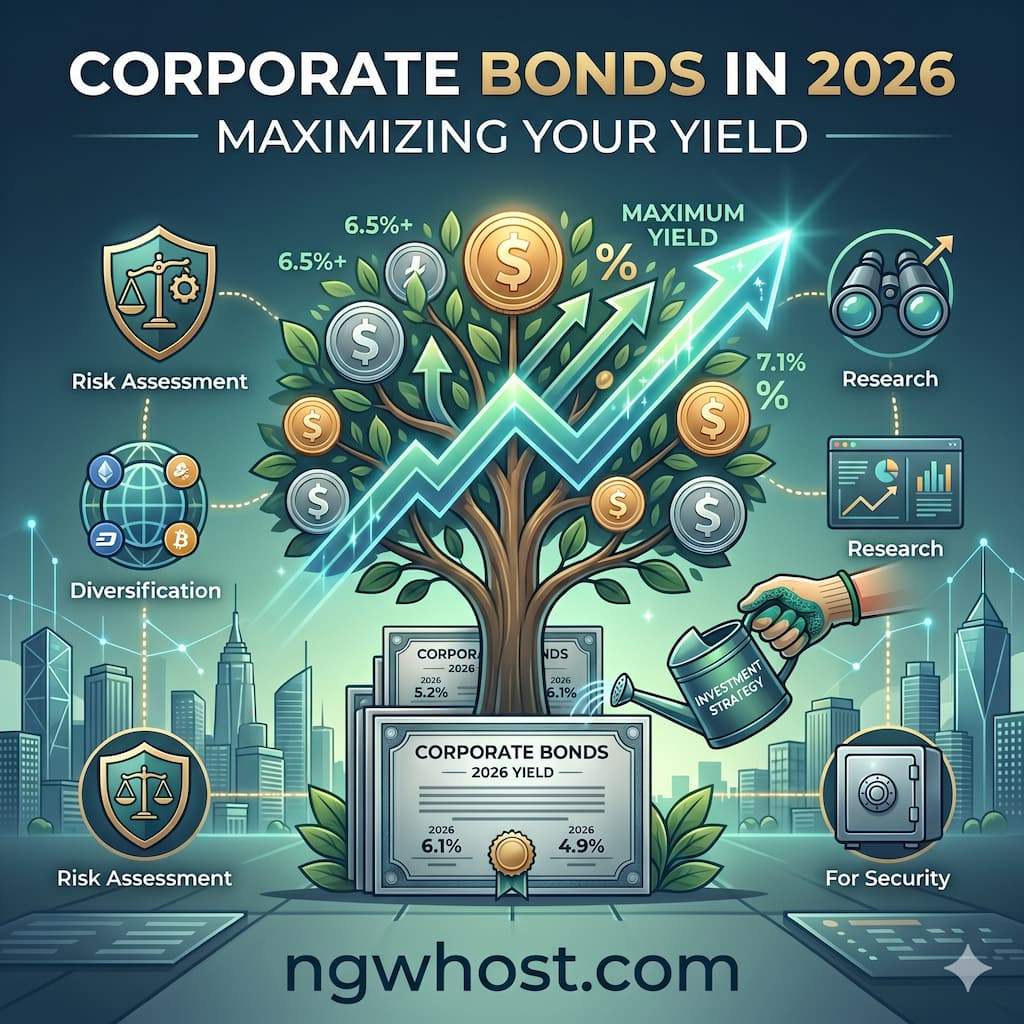
Corporate Bonds in 2026: Maximizing Your Yield
The financial landscape of 2026 has redefined what it means to be a fixed-income investor. After years of navigating the “higher-for-longer” interest rate environment of the mid-2020s, the market has finally reached a sophisticated equilibrium. For investors looking at ngwhost.com, understanding corporate bonds is no longer just about “safety”—it is about precision, technology, and strategic yield optimization.
In this comprehensive guide, we will dissect the current state of the corporate debt market, the shift toward green and sustainability-linked bonds, and the tactical moves required to maximize your yield in today’s digital-first economy.
1. The 2026 Macro Environment: Why Corporate Bonds?
As we move through 2026, the global economy has transitioned into a “Moderate Growth, High Efficiency” phase. While equities remain volatile due to rapid AI-driven industry disruptions, corporate bonds have emerged as a beacon of subsidized stability.
The Yield Reset
The era of zero-interest-rate policy (ZIRP) is a distant memory. Today, investment-grade corporate bonds are offering yields that rival historical stock market returns, but with significantly lower volatility. With central banks maintaining a watchful eye on “Structural Inflation 2.0,” the coupon rates on new issuances have remained attractive for those seeking consistent cash flow.
Credit Quality in the Age of AI
In 2026, credit analysis has been revolutionized. We are no longer just looking at debt-to-equity ratios. Investors now evaluate a corporation’s Compute Efficiency and Automated Overhead Ratios. Companies that have successfully integrated autonomous operations have seen their credit spreads tighten, making their debt some of the most sought-after assets in the fixed-income world.
2. Types of Corporate Bonds Dominating 2026
To maximize yield, you must first understand the “menu” of debt instruments available in the current market.
A. Investment-Grade (IG) Bonds
These are the “Blue Chips” of the debt world. Issued by companies with robust balance sheets, these bonds provide a reliable “base” for any portfolio. In 2026, IG bonds are yielding between 5.5% and 6.5%, depending on the sector.
B. High-Yield (HY) “Junk” Bonds
For those with a higher risk appetite, the high-yield sector in 2026 offers significant opportunities. Many “fallen angels”—formerly investment-grade companies that were downgraded during the 2024 tech correction—have restructured and are now paying premiums of 8% to 11%.
C. Green and Sustainability-Linked Bonds (SLBs)
Environmental, Social, and Governance (ESG) criteria have matured. In 2026, Sustainability-Linked Bonds are unique because their coupon rates are “step-up” or “step-down.” If a company fails to meet its carbon reduction targets, they pay you a higher interest rate. It’s a rare win-win: you either support a greener planet or get paid more for the company’s failure to do so.
3. Strategies to Maximize Your Yield
Simply buying a bond and holding it to maturity is a 20th-century strategy. To truly maximize returns in 2026, you need a more dynamic approach.
I. The “Barbell” Strategy
In a year where the yield curve remains slightly unpredictable, many professional investors are using the Barbell Strategy.
- The Short End: Invest 50% in short-term corporate paper (1–2 years) to capture high immediate coupons and maintain liquidity.
- The Long End: Invest 50% in long-term bonds (10–20 years) to lock in current high rates before the next potential central bank easing cycle.
II. Sector Rotation: The “Post-Silicon” Boom
In 2026, the energy sector is no longer just about oil and gas; it’s about Powering Data Centers. Corporate bonds issued by energy infrastructure companies are seeing massive demand. By rotating out of traditional retail debt and into “Energy-for-AI” debt, investors can often find a 100–150 basis point (bps) premium.
III. Tokenized Corporate Debt
As discussed in our previous coverage of RWA (Real World Assets), corporate bonds are now widely available in tokenized form.
Note: Investing in tokenized bonds on a blockchain allows you to bypass traditional brokerage fees, effectively adding 0.25% to 0.50% to your net yield instantly through cost savings.
4. Understanding the Risks in 2026
No high-yield strategy is without its pitfalls. The 2026 market presents unique risks that weren’t on the radar five years ago.
- Duration Risk: Even if a bond pays 7%, if interest rates rise another 1%, the market value of your bond will drop. In 2026, managing “Duration” is the difference between a winning and losing portfolio.
- The “Zombie” Company Risk: Beware of firms that are only surviving because they refinanced their debt just before the 2023 rate hikes. As that debt matures in 2026 and 2027, many will face a “Refinancing Cliff.”
- Cyber-Credit Risk: A major hack or AI-driven system failure can now impact a company’s ability to pay interest almost overnight.
5. Building Your 2026 Bond Portfolio: A Step-by-Step Guide
Step 1: Define Your Yield Target
Are you looking for a “Pension-Style” 5% return or a “Growth-Oriented” 9% return? Your target will dictate your split between Investment-Grade and High-Yield.
Step 2: Use an Aggregator Platform
In 2026, you don’t need to call a broker. Use digital bond platforms that allow you to filter by:
- YTM (Yield to Maturity)
- Credit Rating (S&P, Moody’s, or Decentralized Credit Scores)
- ESG Score
Step 3: Diversify by Geography
Don’t stick solely to US Treasuries or European Corporates. Emerging markets in 2026—specifically Brazil, India, and Vietnam—are issuing corporate debt in “Hard Currency” (USD/EUR) that offers yields exceeding 10% with manageable risk profiles.
6. The Tax Efficiency Factor
Maximizing yield isn’t just about what you earn; it’s about what you keep. In 2026, many investors are utilizing Tax-Advantaged Bond Ladders. By staggering the maturity dates of your bonds, you can ensure a steady stream of income that can be reinvested into higher-yielding opportunities if rates rise, or used to offset capital losses in other parts of your portfolio.
| Bond Category | Typical Duration | 2026 Yield Forecast | Risk Factor |
| Short-Term Tech | 1-3 Years | 5.8% | Low |
| Industrial Green Bonds | 5-7 Years | 6.4% | Moderate |
| Emerging Market Corp | 3-5 Years | 9.2% | High |
| Tokenized Real Estate Debt | Variable | 7.5% | Moderate |
7. The Future of Fixed Income: Beyond 2026
As we look toward the end of the decade, the line between “Bonds” and “Code” will continue to blur. We are already seeing the first Self-Amortizing Smart Bonds, where the bond programmatically sells the company’s product (e.g., electricity) and sends the proceeds directly to bondholders in real-time.
For the modern investor at ngwhost.com, the message is clear: The “Fixed” in Fixed Income is becoming more dynamic. By staying informed on technological shifts and maintaining a diversified, laddered approach, you can turn corporate debt into a high-performance engine for your wealth.
Read More⚡ The Impact of CBDCs on Your Personal Savings in 2026
Conclusion: Action Plan for ngwhost.com Readers
Maximizing your yield in 2026 requires a departure from the “set it and forget it” mentality. To succeed:
- Audit your current portfolio for “Refinancing Cliff” risks.
- Incorporate Sustainability-Linked Bonds to hedge against corporate ESG failures.
- Explore Tokenized Options to reduce middleman fees.
- Stay Balanced: Use the Barbell strategy to remain flexible.
The corporate bond market is no longer a boring corner of finance—it is a sophisticated, high-tech marketplace where the diligent investor can find extraordinary value.
FAQ: Corporate Bonds in 2026
Q: Are corporate bonds safer than stocks in 2026?
A: Generally, yes. In the event of a company liquidation, bondholders are paid before stockholders. However, high-yield bonds carry “Equity-like” risks.
Q: How do I start with only $1,000?
A: Look for “Fractional Bond” platforms or “Bond ETFs.” In 2026, many tokenized platforms allow for entries as low as $100.
Q: Should I worry about inflation eating my yield?
A: In 2026, look for ILBs (Inflation-Linked Bonds) or focus on short-duration bonds that allow you to reinvest at higher rates more frequently.
Disclaimer: The information provided on ngwhost.com is for educational purposes only and does not constitute financial advice. Always consult with a certified financial advisor before making significant investment decisions.