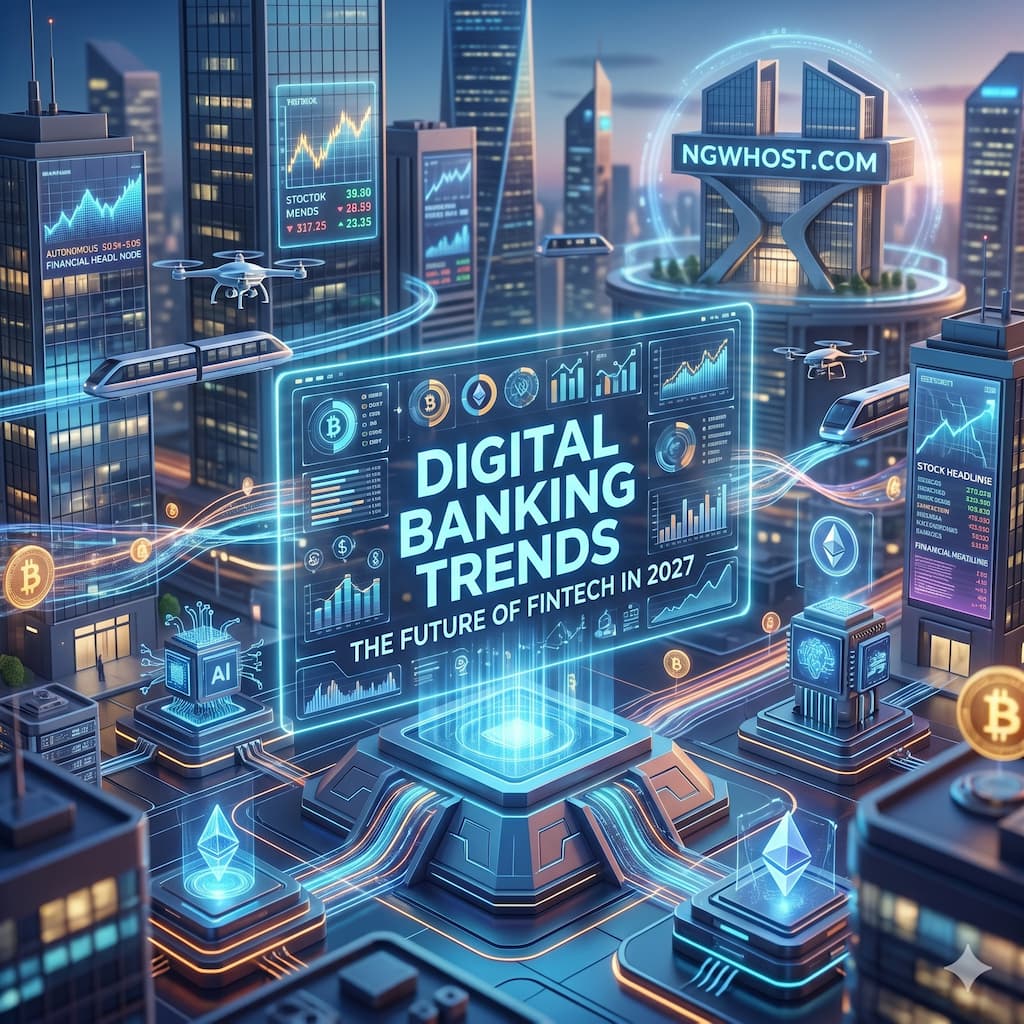
Digital Banking Trends: The Future of FinTech in 2027
The banking sector has undergone more transformation in the last three years than in the previous three decades. As we move through 2026 and look toward the horizon of 2027, the term “Digital Banking” is becoming redundant—banking is digital. However, the nature of that digital experience is shifting from transactional to relational, powered by a new stack of exponential technologies.
For the entrepreneurs and tech-forward readers at ngwhost.com, staying ahead of these trends is vital for managing capital, scaling businesses, and understanding the future of global liquidity. In this comprehensive guide, we explore the definitive digital banking trends for 2027.
1. The Era of the “Invisible Bank”: Embedded Finance
By 2027, the most successful banks won’t have the most popular apps; they will have the most integrated APIs. Embedded Finance is the trend of non-financial platforms offering banking services directly within their own ecosystems.
The Ecosystem Shift
Imagine a world where your SaaS platform provides instant credit lines based on your real-time revenue data, or your e-commerce dashboard allows you to manage international payroll without ever leaving the site.
- The “Uber-ization” of Loans: Just as Uber integrated payments so seamlessly that you forgot you were paying, 2027 will see “Embedded Lending.” Small businesses will access capital at the point of need—whether buying inventory or upgrading server infrastructure—directly through their management software.
- Why it matters: It reduces friction. For the business owner, the “bank” becomes a set of background features rather than a destination.
2. Hyper-Personalization via Generative AI Agents
In 2024, AI in banking meant basic chatbots. In 2027, it means Autonomous Financial Agents. These are personalized AI models that don’t just answer questions—they execute strategies.
From Insights to Actions
The 2027 digital bank will use “Hyper-Personalization” to act as a CFO for every individual.
- Predictive Cash Flow: Your banking agent will analyze your spending patterns and upcoming bills, automatically moving idle cash into high-yield “Micro-Investments” or tax-advantaged accounts for 48 hours to maximize interest before the bill is due.
- Smart Budgeting: Instead of telling you that you spent too much on coffee, the AI will negotiate lower rates on your recurring subscriptions or suggest a better credit card for your specific spending profile in real-time.
3. The Institutionalization of DeFi: “HyFi”
2027 marks the maturity of Hybrid Finance (HyFi)—the convergence of traditional centralized banking (CeFi) and Decentralized Finance (DeFi).
Regulated Liquidity Pools
Banks are no longer fighting blockchain; they are building on it. By 2027, major digital banks will offer “Regulated DeFi” products.
- Tokenized Real-World Assets (RWAs): You will be able to use a fraction of your commercial real estate or even your intellectual property as collateral for an instant, low-interest loan on a private blockchain ledger managed by your bank.
- Programmable Money: The use of Smart Contracts will automate complex business transactions. Escrow services, which used to take days and high fees, will be executed instantly by code once pre-set conditions (like a shipping delivery) are verified by an AI oracle.
4. The Rise of “Green Banking” and ESG Transparency
Sustainability is no longer a PR move; in 2027, it is a core feature of the banking interface. Driven by both consumer demand and strict 2026/2027 climate regulations, banks are becoming “Carbon Accountants.”
Real-Time Carbon Tracking
Your digital banking dashboard will soon show two balances: your currency and your Carbon Footprint.
- Scope 3 Reporting: For business accounts, banks will provide automated reports on the environmental impact of your supply chain based on your transaction history. This will be essential for staying compliant with new global trade rules.
- Green Incentives: Banks will offer “Dynamic Interest Rates.” If your business meets certain sustainability benchmarks, your loan interest rates could automatically drop, as the bank views “Green Businesses” as lower-risk long-term investments.
5. Biometric Sovereignty and the Death of Passwords
The security landscape of 2027 has moved beyond 2FA (Two-Factor Authentication) codes, which have become vulnerable to sophisticated AI-driven phishing.
Multimodal Biometrics
Banking apps in 2027 will use Continuous Authentication.
- Behavioral Biometrics: The bank will analyze the way you hold your phone, your typing cadence, and even your “gait” (via smartwatch data) to verify your identity silently in the background.
- Face + Voice + Iris: High-value transactions will require a 3-second multimodal check. This “Passwordless” future is not only more secure but significantly reduces the friction of logging in, making digital banking feel more like a natural extension of the user.
6. The “Super-App” Convergence: One App to Rule Them All
Following the success of WeChat in Asia, Western digital banks and FinTechs are racing to become “Super-Apps” by 2027.
Beyond Banking
Your banking app at ngwhost.com might soon be where you also:
- Register a Business: Filing for an LLC or CNPJ directly through the bank’s interface.
- Manage Health Insurance: Integrating wellness data to lower premiums.
- Real Estate Services: Browsing, touring, and financing a home within a single user journey.
- The Strategic Goal: Banks want to move from being a “utility” (where you store money) to a “lifestyle platform” (where you live your life).
7. Central Bank Digital Currencies (CBDCs) and Global Payments
By 2027, the pilot programs for the Digital Euro, the Digital Real (DREX), and others will be in full swing. This will revolutionize cross-border trade.
Instant International Settlements
Traditional SWIFT transfers, which can take 3–5 days, will feel like “snail mail” in 2027.
- Interoperability: CBDCs will allow for “Atomic Settlements”—the instant exchange of one currency for another at mid-market rates with zero intermediary bank fees. This is a massive win for digital entrepreneurs managing global teams or remote clients.
8. Strategic Roadmap: How to Prepare Your Business
To leverage these 2027 trends, businesses must begin auditing their financial infrastructure now:
| Priority | Action | Target Year |
| Data Cleanliness | Ensure your financial records are structured for AI analysis. | Late 2026 |
| API Integration | Move away from legacy banks that don’t offer robust API documentation. | Early 2027 |
| Security Update | Transition your team to passkey-based and biometric authentication. | Mid 2027 |
| ESG Tracking | Start categorizing vendors by their sustainability ratings. | Late 2027 |
9. The Potential Risks: What to Watch Out For
While the future is bright, 2027 brings new challenges:
- Algorithmic Bias: As AI makes more lending decisions, ensuring the models are “fair” and “explainable” will be a major legal hurdle.
- Digital Exclusion: As physical branches continue to close, ensuring that the elderly or tech-averse aren’t left behind is a growing social responsibility for FinTechs.
- AI Deepfakes: As biometric security grows, so does the sophistication of deepfake voice and video. “Vigilant Banking” will be the theme for 2027.
Read More⚡ Global Trade 2026: Navigating New Business Rules
10. Conclusion: Banking as a Service (BaaS)
In 2027, the “Future of FinTech” is not about a specific app or a new coin; it is about empowerment. The trends we see—from AI agents to CBDCs—are all designed to give the user more control, more speed, and more intelligence over their capital.
For those of us building the digital world, whether through hosting at ngwhost.com or managing global startups, these trends represent a massive opportunity. The barrier between “having a great idea” and “having the capital to execute it” is finally being dismantled by technology.
The bank of 2027 isn’t a building on the corner. It’s a line of code, a biometric thumbprint, and a silent AI partner working in the background to grow your wealth while you sleep.