Parallel EVMs: Scaling Blockchain Execution Speed
For nearly a decade, the Ethereum Virtual Machine (EVM) has stood as the undisputed standard for smart contract execution. It created the standard development paradigm for decentralized finance (DeFi), non-fungible tokens (NFTs), on-chain governance, and real-world asset tokenization. The vast majority of smart contract code, developer tooling, security audit frameworks, and Web3 libraries were designed specifically around the EVM’s execution environment.
However, as global on-chain activity exploded into millions of daily transactions, the core architecture of the standard EVM encountered a strict computational barrier: sequential transaction processing.
Traditional EVM implementations process transactions one by one in a linear, single-threaded queue. Even if a modern server hosting a blockchain validator node features 32, 64, or 128 CPU cores with multi-threading capabilities, the standard EVM utilizes only a single core to execute state transitions sequentially.
This single-threaded limitation creates severe network congestion, high transaction latency, and fee spikes during periods of high demand. If thousands of users simultaneously mint an NFT collection, every other unrelated transaction—such as a stablecoin transfer or a lending protocol liquidation—is forced to wait in the same single-file line.
To break this execution bottleneck while preserving the massive network effects of existing Solidity developer tools, blockchain architects are executing a fundamental performance leap: Parallel EVMs.
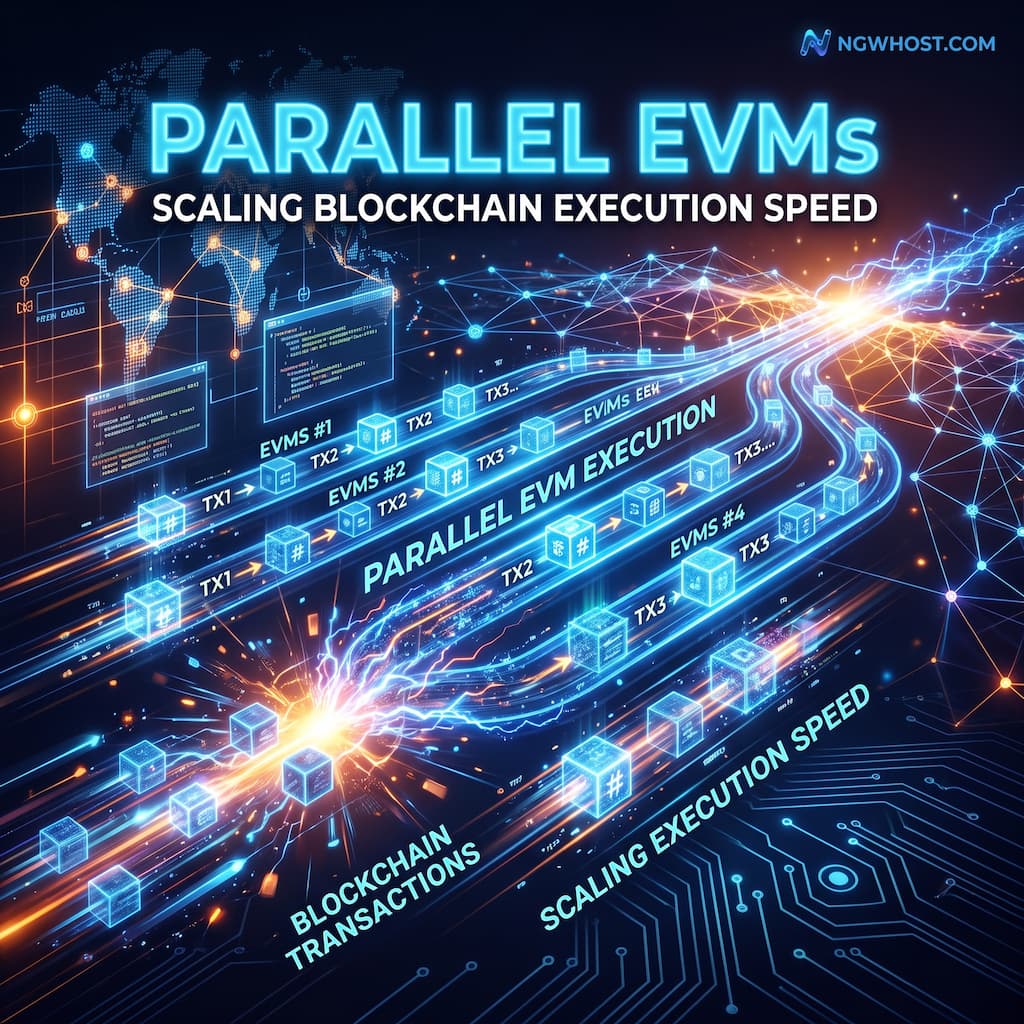
A Parallel EVM is a next-generation blockchain execution engine that processes multiple non-conflicting transactions simultaneously across multiple CPU threads. By integrating optimistic concurrency control, multi-version state access, and specialized storage databases, Parallel EVMs scale transaction throughput from dozens of transactions per second (TPS) to tens of thousands of TPS without breaking EVM compatibility.
This post analyzes the physical limitations of sequential state machines, evaluates the algorithmic mechanics of optimistic parallel execution, compares sequential vs. parallel EVM architectures, and examines the digital cloud server infrastructure required to host high-consequence validator and RPC nodes on ngwhost.com.
1. The Bottleneck: Why the Traditional EVM Is Single-Threaded
To understand why Parallel EVMs represent a critical architectural milestone, one must examine the state management model of the original EVM.
The Deterministic State Machine Requirement
A public blockchain is fundamentally a deterministic state machine. Thousands of independent validator nodes distributed worldwide must process the exact same sequence of transactions and arrive at the exact same global state root hash.
If two validators were to process transactions in a different order and calculate different state roots, the network would immediately fork and lose consensus.
The Single-File Queue and the State Access Dilemma
To ensure absolute determinism, Ethereum’s original designers selected a simple execution pattern: sequential processing. Transactions in a block are executed one after another in a fixed linear order (T1, T2, T3, …, Tn).
While sequential execution guarantees that state updates never conflict during processing, it introduces severe computational inefficiency:
- Hardware Underutilization: Modern enterprise server hardware relies on parallel processing across dozens of compute cores. A sequential EVM leaves 95%+ of modern multi-core processor capacity completely idle during block execution.
- State Access Contention: When Alice sends USDC to Bob, and Charlie sends DAI to Dave, these two transactions modify entirely independent account balances in the state trie. In a sequential EVM, Charlie’s transaction must still wait for Alice’s transaction to fully complete before it can even begin execution.
This single-threaded queue represents the true bottleneck of blockchain throughput, capping base-layer execution speed regardless of available bandwidth or compute power.
2. Algorithmic Mechanics: How Parallel EVMs Execute Concurrently
Building a parallel execution engine for smart contracts requires solving a central computer science problem: detecting and resolving state conflicts without sacrificing deterministic consensus.
Parallel EVMs achieve this primarily through Optimistic Concurrency Control (OCC), combined with multi-version concurrency control (MVCC) and dependency graphs:
The Parallel EVM Execution Pipeline
- Phase 1: Optimistic Parallel Dispatch: The execution engine assumes transactions in a block do not conflict and dispatches them simultaneously across all available CPU worker threads.
- Phase 2: In-Memory Multi-Version State Tracking: Each thread executes its assigned transaction in an isolated virtual environment, recording all read operations (inputs) and tentative write operations (outputs) with versioned timestamps without writing directly to the permanent disk state.
- Phase 3: Conflict Detection & Validation: The engine inspects memory access logs. If two transactions read and write to the same account storage slot (e.g., swapping tokens in the exact same liquidity pool), a conflict is flagged.
- Phase 4: Targeted Abort and Re-Execution: Conflicting transactions are aborted, their intermediate state changes are rolled back, and they are re-executed sequentially with updated state inputs.
- Phase 5: Deterministic State Batch Commit: Once all conflicts are resolved, all state changes are committed to the permanent blockchain storage in their original deterministic block order.
Software Transactional Memory (STM)
Most Parallel EVMs adapt algorithms derived from Block-STM (Software Transactional Memory, originally pioneered by Aptos and adapted for EVM environments by projects like Monad, Sei, and MegaETH).
Block-STM dynamically tracks transaction dependencies on the fly without requiring developers to declare state access lists in advance, maintaining standard Solidity smart contract compatibility.
3. Structural Optimization Ledger: Sequential EVM vs. Parallel EVM
Evaluating the core architectural, performance, and hardware parameters that separate traditional single-threaded EVM nodes from next-generation Parallel EVM networks illustrates why high-performance Layer-1 and Layer-2 networks are upgrading their execution engines.
Processing Paradigm & Core Utilization
- Traditional Sequential EVM: Single-threaded processing. Executes one transaction at a time, utilizing only 1 CPU core regardless of server capacity.
- Parallel EVM Architecture: Multi-threaded concurrent processing. Dynamically distributes non-conflicting transactions across all available CPU cores.
Transaction Throughput (TPS) Capacity
- Traditional Sequential EVM: Low throughput. Typically capped at 15 to 50 TPS on Layer-1 and a few hundred TPS on basic Layer-2 rollups.
- Parallel EVM Architecture: Ultra-high throughput. Capable of processing 5,000 to 50,000+ TPS depending on workload conflict ratios.
State Access & Conflict Management
- Traditional Sequential EVM: No conflict detection needed. Absolute serial execution eliminates simultaneous state reads and writes.
- Parallel EVM Architecture: Optimistic Concurrency Control (OCC) with dynamic Software Transactional Memory (Block-STM) to detect and re-execute conflicts.
Developer Experience & Tooling Compatibility
- Traditional Sequential EVM: Native Solidity, Hardhat, Foundry, and standard Web3 RPC endpoints.
- Parallel EVM Architecture: 100% bytecode and RPC compatible. Developers deploy standard Solidity contracts without writing custom parallelization code.
4. Key Performance Enablers: Custom State Storage Databases
Parallelizing transaction execution in CPU memory is only half the engineering challenge; the database layer must also be redesigned to prevent disk I/O bottlenecks.
In legacy Ethereum nodes (like Geth), state data is stored in key-value databases (such as LevelDB or PebbleDB) structured around Merkle Patricia Tries (MPT).
Reading and writing state data to an MPT involves traversing multiple cryptographic hash layers, resulting in slow, random disk read/write operations that bottleneck high-speed parallel computation.
To unlock the full potential of multi-threaded execution, Parallel EVMs implement specialized state storage engines:
Asynchronous, Non-Blocking Disk I/O
Traditional databases block the CPU thread while waiting for data to be fetched from an NVMe SSD drive. Parallel EVMs use modern Linux kernel I/O frameworks (such as io_uring) to execute thousands of disk read and write requests asynchronously in parallel without stalling CPU worker threads.
Custom B-Tree and Flat-File State Databases
Instead of generic key-value databases, projects like Monad develop custom, native databases (e.g., MonadDB) that store account states and storage slots in flat-file structures optimized for direct SSD block access.
This minimizes cryptographic hashing overhead and allows multi-threaded execution cores to query and update state data with sub-microsecond latency.
5. Systemic Operations: Digital Infrastructure for High-Throughput Node Gateways
Deploying, monitoring, and maintaining Parallel EVM validator clusters, high-speed RPC gateways, and indexer nodes demands an underlying digital server infrastructure that prioritizes high bandwidth, multi-core compute density, ultra-low-latency NVMe storage, and zero downtime. Parallel EVM nodes process continuous, high-consequence data streams—ranging from real-time peer-to-peer block gossiping and cryptographic state proof generation to thousands of concurrent JSON-RPC API queries and automated smart contract webhooks.
If an enterprise validator node, institutional RPC gateway, or high-frequency trading relayer experiences CPU throttling, disk I/O bottlenecks, network packet loss, or server downtime during a market surge, the consequences are immediate. Node synchronization drops behind the chain tip, RPC queries time out, automated trading bots fail to execute, and validator staking rewards are lost.
To eliminate this operational friction, progressive Web3 infrastructure providers, node operators, and digital platform developers deploy highly optimized, zero-downtime server architectures.
These infrastructure layers continuously monitor active API endpoints, real-time NVMe disk write paths, and multi-threaded CPU core utilization metrics, ensuring processing response times stay locked within sub-millisecond thresholds regardless of network load.
Maintaining an unassailable infrastructure perimeter is vital to eliminate bandwidth bottlenecks, protect cryptographic signing keys, and preserve platform trust, driving peak structural execution across enterprise portals and hosting domains like ngwhost.com.
6. Real-World Applications: What Parallel EVMs Unlock for Web3
By scaling transaction throughput while maintaining full EVM compatibility, Parallel EVMs enable on-chain applications that were previously impossible due to gas spikes and execution latency:
Central Limit Order Book (CLOB) Exchanges On-Chain
Automated Market Makers (AMMs) were created primarily because legacy blockchains were too slow and expensive to support traditional order books.
With Parallel EVMs capable of processing tens of thousands of TPS with sub-second block times, developers can build fully decentralized, high-frequency Central Limit Order Books on-chain—handling thousands of bids, asks, and order cancellations per second without clogging other decentralized applications.
Massively Multiplayer On-Chain Gaming (Autonomous Worlds)
Web3 games require continuous, low-latency micro-transactions for player movements, asset crafting, combat actions, and inventory trades.
Parallel execution allows thousands of players to interact with game contracts simultaneously across isolated virtual locations without creating network-wide gas fee spikes for players in other regions.
High-Volume Physical Asset Telemetry and DePIN Networks
Decentralized Physical Infrastructure Networks (DePIN)—such as decentralized wireless networks, connected vehicle fleets, and distributed energy sensor grids—stream massive volumes of real-time device telemetry onto the blockchain.
Parallel EVMs can ingest thousands of concurrent IoT data pings and micro-payments in parallel, bridging real-world hardware data to smart contracts without choking standard DeFi transaction flows.
Read More⚡ Venture Debt: Non-Dilutive Capital for Tech Growth
Conclusion: The New Execution Standard for Decentralized Computing
Parallel EVMs are not an experimental deviation from blockchain standards; they represent the natural computational maturity of the EVM ecosystem. The legacy era of forcing global decentralized applications through a single-threaded, sequential execution queue was a temporary developmental phase that is being superseded by multi-core, high-concurrency state machines.
The future of decentralized computing belongs entirely to the visionary protocol engineers, node infrastructure architects, and data-driven platform networks that master the orchestration of parallel execution engines today.
By unifying optimistic concurrency control, custom asynchronous state databases, full Solidity backwards compatibility, and zero-downtime cloud infrastructure perimeters, the international Web3 community is building an unassailable foundation for global financial scale.
As parallel execution standards solidify and Layer-1 and Layer-2 networks deploy multi-threaded engines worldwide, single-threaded bottlenecks will permanently disappear—establishing Parallel EVMs as the essential engine scaling blockchain execution speed forever.
Hosting computationally intensive blockchain validator nodes, processing real-time RPC data streams, validating cloud-scale automation pipelines, and managing ultra-secure global server frameworks requires world-class, zero-downtime infrastructure. Secure your enterprise digital data framework on an unassailable foundation by exploring the premium hosting configurations at ngwhost.com.