
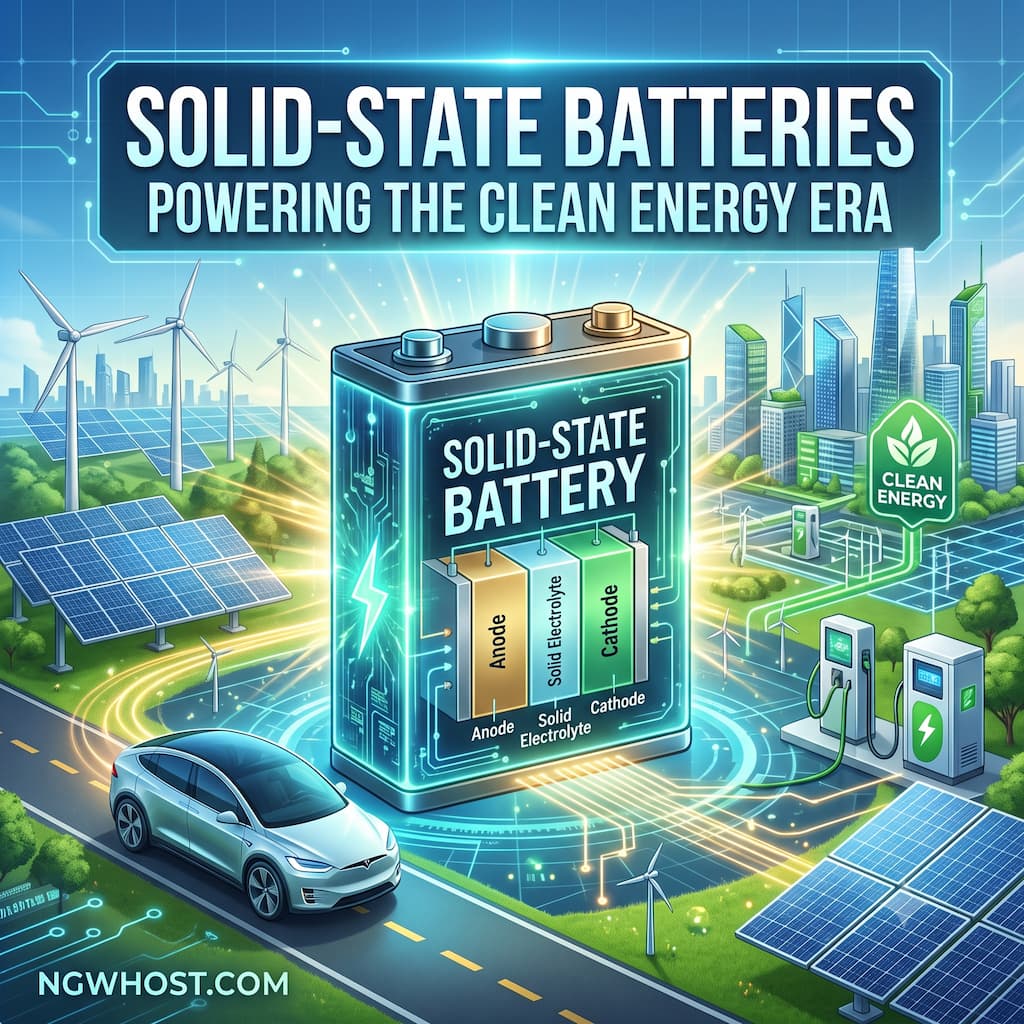
Solid-State Batteries: Powering the Clean Energy Era
For over three decades, the global transition toward renewable energy, electric mobility, and portable consumer electronics has relied almost entirely on a single electrochemistry paradigm: the conventional lithium-ion (Li-ion) battery. From smartphones and laptops to electric vehicles (EVs) and grid-scale energy storage systems, traditional lithium-ion batteries transformed global technology by delivering unprecedented energy density compared to legacy nickel-cadmium or lead-acid chemistries.
However, as global decarbonization mandates accelerate, classic lithium-ion technology is rapidly approaching its theoretical physical and chemical performance ceilings.
Modern liquid-electrolyte lithium-ion batteries suffer from inherently dangerous trade-offs. The organic liquid electrolytes that facilitate ion transfer between the cathode and anode are volatile and highly flammable, presenting severe thermal runaway and fire risks under physical impact or internal short-circuiting. Furthermore, liquid electrolytes degrade rapidly under extreme temperatures, limit fast-charging capabilities, and constrain volumetric energy density—leaving electric vehicles with weight penalties and restricted driving ranges.
To unlock the next phase of global clean energy deployment, a radical materials science revolution is underway: Solid-State Batteries (SSBs).
By replacing volatile organic liquid electrolytes with solid inorganic conductors—such as advanced ceramics, solid polymers, or sulfide-based glass compounds—solid-state battery technology fundamentally eliminates fire hazards while unlocking massive leaps in energy density, ultra-fast charging rates, and extended cycle life.
This post analyzes the electrochemistry of solid-state systems, compares electrolyte material classes, evaluates real-world industrial applications, and examines the cloud infrastructure required to host high-consequence energy telemetry data streams on ngwhost.com.
1. The Electrochemistry Paradigm Shift: Beyond Liquid Electrolytes
To understand why solid-state batteries represent the holy grail of energy storage, one must first examine the structural limitations of conventional liquid-electrolyte cells.
In a standard lithium-ion cell, a porous polymer separator physical isolates a graphite-based anode from a transition metal oxide cathode. The entire volume is saturated with a liquid organic solvent containing dissolved lithium salts. During charging, lithium ions migrate through the liquid electrolyte from the cathode to the anode, where they intercalate into the graphite matrix.
Solid-state batteries eliminate liquid solvents and graphite anodes entirely, introducing three fundamental electrochemical upgrades:
Replacing Liquid with Solid Electrolytes
The liquid electrolyte and porous separator are replaced by a solid physical layer that serves dual purposes: it acts as a rigid electronic insulator preventing physical contact between electrodes while simultaneously providing high ionic conductivity for lithium-ion movement.
Enabling Pure Lithium-Metal Anodes
Because solid electrolytes provide physical resistance against dendrite penetration (needle-like metallic lithium structures that grow during charging and short-circuit liquid cells), solid-state systems can utilize pure lithium-metal anodes instead of heavy graphite or silicon-composite structures.
Lithium metal possesses an extraordinarily high theoretical specific capacity (3,860 mAh/g compared to graphite’s 372 mAh/g), drastically reducing battery pack volume and weight.
Absolute Thermal Stability and Non-Flammability
Inorganic solid electrolytes do not ignite, vaporize, or suffer from thermal decomposition at high temperatures.
This absolute thermal safety eliminates the need for heavy, complex liquid-cooling plates, fire-suppression systems, and reinforced battery armor inside electric vehicle chassis—saving structural weight and lowering total pack manufacturing complexity.
2. Solid Electrolyte Architectures: Sulfides, Oxides, and Polymers
The commercialization race for solid-state batteries centers on three primary material classes, each offering distinct advantages across ionic conductivity, mechanical flexibility, and manufacturing scalability.
Sulfide-Based Solid Electrolytes
Sulfide compounds (such as LGPS—lithium germanium phosphorus sulfur) deliver the highest ionic conductivity among solid electrolytes, matching or exceeding the ion transfer speeds of traditional liquid electrolytes at room temperature.
- Advantages: Exceptional ionic room-temperature conductivity and excellent mechanical malleability, allowing low-pressure interface contact with active electrode materials.
- Challenges: Highly sensitive to moisture; contact with atmospheric humidity generates toxic hydrogen sulfide gas, requiring specialized dry-room manufacturing environments.
Oxide-Based Solid Electrolytes
Oxide materials (such as Garnet-type LLZO or NASICON-type structures) represent the most chemically stable and thermally resilient solid electrolyte class.
- Advantages: Absolute chemical stability, exceptional voltage tolerance, zero moisture sensitivity issues, and total resistance to lithium dendrite penetration.
- Challenges: Extremely brittle ceramic texture. Achieving low interfacial resistance between rigid ceramic electrolytes and solid active electrode materials requires ultra-high temperature sintering processes.
Polymer-Based Solid Electrolytes
Polymer matrices (such as polyethylene oxide—PEO mixed with lithium salts) represent the most cost-effective, flexible, and manufacturable solid-state path.
- Advantages: Highly flexible, easy to manufacture using existing roll-to-roll lithium-ion production infrastructure, and highly resistant to physical impact.
- Challenges: Low ionic conductivity at room temperature, requiring elevated operating temperatures (60ºC to 80ºC) to achieve adequate performance.
3. Structural Optimization Ledger: Traditional Liquid Li-Ion vs. Solid-State
Evaluating the performance and operational parameters that separate conventional liquid lithium-ion cells from solid-state battery systems highlights the massive generational leap driving global automotive and energy investments.
Energy Density Profile
- Traditional Liquid Li-Ion: Volumetric density capped around 650 to 750 Wh/L. Gravimetric density capped near 250 to 300 Wh/kg.
- Solid-State Battery System: Volumetric density reaches 1,000 to 1,200 Wh/L. Gravimetric density scales to 450 to 500+ Wh/kg.
Thermal Safety & Fire Hazards
- Traditional Liquid Li-Ion: High risk of thermal runaway, toxic gas venting, and fires under physical damage, overcharging, or internal shorting.
- Solid-State Battery System: Absolute non-flammability. Zero risk of thermal runaway fires under extreme mechanical puncture or thermal stress.
4. Transformative Use Cases: Re-Engineering Global Clean Infrastructure
As solid-state battery pilot production lines scale globally, their high energy density and safety profiles will transform multiple industry sectors:
Next-Generation Electric Vehicles (EVs)
Solid-state batteries remove the primary barriers to mass EV adoption: range anxiety and slow charging times.
- 1,000+ Kilometer Single-Charge Driving Ranges: By doubling volumetric energy density, automakers can pack twice the energy into the same physical battery footprint, enabling long-range passenger EVs.
- 10-Minute Ultra-Fast Charging: High thermal stability and lithium-metal mechanics allow cells to accept aggressive high-current charging cycles without triggering thermal breakdown or dendrite growth.
Electric Aviation and Urban Air Mobility (eVTOL)
Commercial electric aircraft and vertical takeoff vehicles (eVTOLs) require gravimetric energy densities exceeding 400 Wh/kg to overcome gravity penalties and maintain commercial passenger payloads.
Solid-state batteries provide the critical weight-to-power ratio required to make regional electric aviation commercial reality.
Grid-Scale Energy Storage Systems (BESS)
Deploying solid-state chemistry in stationary energy storage facilities eliminates the devastating fire risks associated with massive megawatt-hour lithium-ion container farms.
Renewable power grids can co-locate high-density solid-state battery banks directly adjacent to urban population centers and critical industrial facilities safely.
5. Systemic Operations: Cloud Infrastructure for Energy Grid Telemetry
Operating solid-state manufacturing plants, tracking global battery supply chains, and managing real-time Battery Management System (BMS) telemetry across distributed electric vehicle fleets requires a resilient digital infrastructure. Modern energy platforms process high-density, real-time data streams—ranging from individual cell voltage balance and thermal dissipation metrics to AI-driven predictive maintenance models.
When a smart energy grid or automotive fleet management portal receives real-time BMS telemetry, even minor server latency, database synchronization lags, or API timeouts can disrupt grid balancing algorithms and safety monitoring chains.
To eliminate this operational friction, progressive technology teams and energy analytics platforms deploy highly optimized, zero-downtime server architectures.
These infrastructure layers continuously monitor active API endpoints, real-time telemetry database write paths, and edge connectivity nodes, ensuring processing response times stay locked within sub-millisecond thresholds.
Maintaining an unassailable infrastructure perimeter is vital to eliminate bandwidth surges, protect sensitive energy grid transaction paths, and preserve platform trust, driving peak structural execution across digital enterprise portals and web hosting domains like ngwhost.com.
6. Manufacturing Challenges: The Path to Mass Production
While the theoretical advantages of solid-state batteries are definitive, transitioning from laboratory prototypes to mass commercial roll-out requires solving complex manufacturing and materials challenges:
- Solid-Solid Interfacial Resistance: Unlike liquid electrolytes that naturally wet and conform to porous electrode surfaces, solid electrolytes must maintain continuous physical contact with solid active materials. Mechanical expansion and contraction during charge-discharge cycles can create microscopic gaps, increasing internal impedance. Engineers solve this using advanced pressure-retention pack designs and elastic buffer layers.
- Scalable Roll-to-Roll Production Lines: Adapting existing lithium-ion gigafactories to manufacture brittle ceramic or moisture-sensitive sulfide electrolytes requires specialized dry-room environments, high-precision vacuum deposition, and ultra-high-temperature sintering equipment.
- Cost Parity Realization: Initial solid-state battery packs will command a cost premium over mature liquid lithium-ion cells. However, as pilot production scales up, the elimination of complex cooling hardware, weight reduction, and increasing manufacturing yields will drive solid-state systems toward long-term cost parity per kilowatt-hour.
Read More⚡ Decentralized AI Compute: The New Crypto Narrative
Conclusion: The Ultimate Energy Foundation
Solid-state battery technology is not an incremental electrochemical update; it represents the definitive materials science foundation powering the next era of clean energy, electric mobility, and global decarbonization. The historical reliance on volatile liquid electrolytes that limited vehicle range, imposed fire risks, and constrained energy density is an obsolete framework that cannot meet the demands of a electrified global economy.
The future of energy storage belongs entirely to the visionary material scientists, automotive pioneers, and data-driven platform networks that master the commercial deployment of solid-state systems today.
By combining pure lithium-metal anodes, non-flammable solid electrolytes, ultra-fast charging capabilities, and zero-downtime cloud infrastructure perimeters, the international technology community is building an unassailable foundation for a sustainable world.
As manufacturing gigafactories transition toward solid-state production lines, these high-density, safe, and long-lasting energy cells will redefine transportation and power grids—permanently establishing solid-state batteries as the primary engine driving the clean energy era.
Hosting computationally intensive energy analytics engines, processing real-time battery telemetry streams, validating cloud-scale automation pipelines, and managing ultra-secure global server frameworks requires world-class, zero-downtime infrastructure. Secure your enterprise digital data framework on an unassailable foundation by exploring the premium hosting configurations at ngwhost.com.