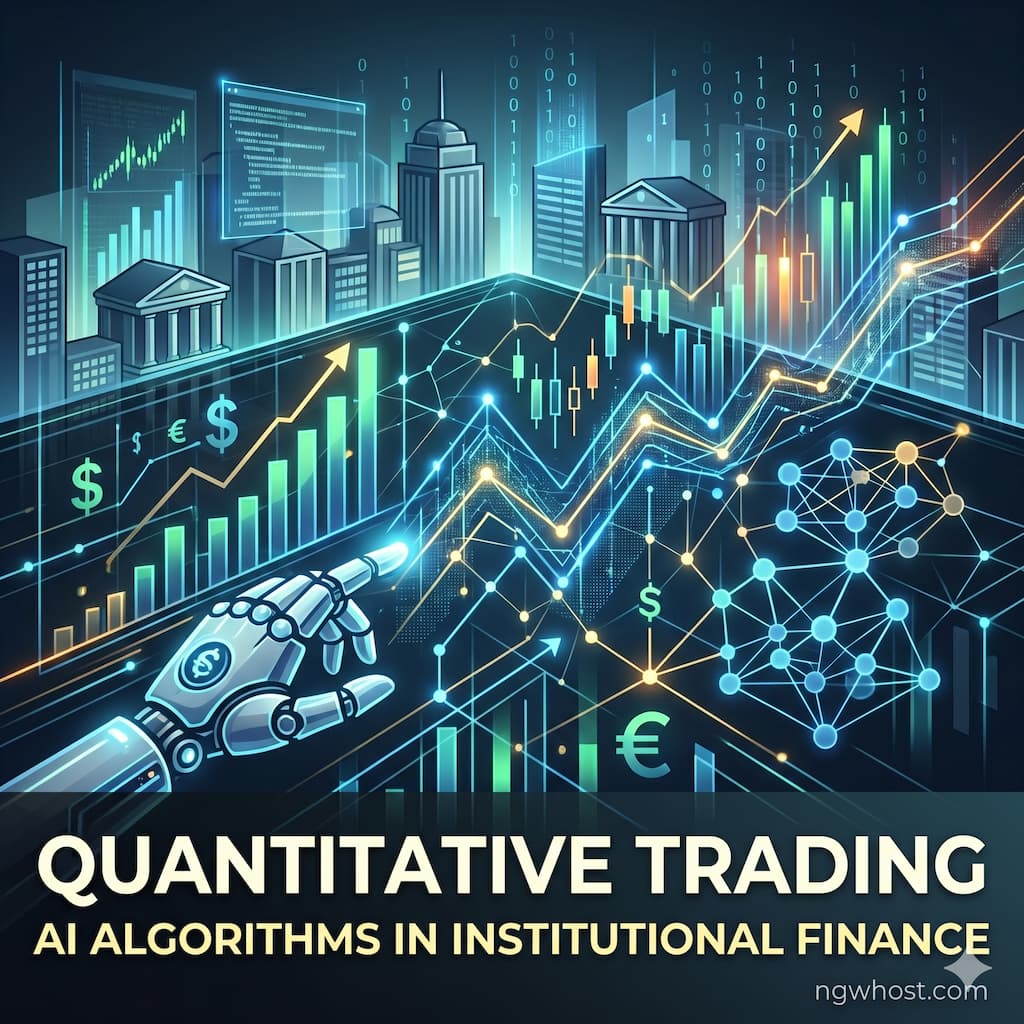
Quantitative Trading: AI Algorithms in Institutional Finance
The landscape of Wall Street and global financial hubs is no longer defined by chaotic trading floors, shouting brokers, and paper tickets. Today, the true battle for alpha takes place in quiet, climate-controlled server rooms located miles away from Manhattan, where lines of code execute trades in microseconds.
We have entered the era of Quantitative Trading dominated by Artificial Intelligence (AI).
For institutional finance—hedge funds, investment banks, and asset managers—AI is no longer a futuristic experiment. It is the core engine driving portfolio optimization, risk management, and market execution. This deep dive explores how mathematical models, machine learning (ML), and deep learning algorithms are reshaping institutional trading, the mechanics behind these systems, the challenges they face, and what the future holds.
1. The Evolution: From Rules-Based Quant to AI-Driven Trading
To understand the impact of AI, we must first distinguish between traditional quantitative trading and modern AI-driven trading.
Traditional Quantitative Trading (Quant 1.0)
Traditional quantitative trading relies heavily on static, rules-based mathematical models. A quant economist might identify a historical anomaly—such as a specific price discrepancy between two correlated stocks (pairs trading)—and write an algorithm to exploit it.
- The Limitation: These models are rigid. They assume that past market regimes will repeat themselves precisely. When market dynamics shift abruptly (e.g., during the 2008 financial crisis or the 2020 pandemic), these static models often break down because they cannot adapt without human intervention.
AI-Driven Quantitative Trading (Quant 2.0)
AI and Machine Learning introduce adaptability. Instead of hardcoding a specific rule, data scientists feed massive datasets into machine learning models and allow the algorithms to discover complex, non-linear relationships on their own.
- The Advantage: AI models continuously learn from new data. If a market regime shifts from low volatility to high volatility, an AI algorithm can recalibrate its parameters autonomously to mitigate risk and capture new patterns.
2. Core AI Methodologies in Institutional Finance
Institutional funds utilize a diverse toolkit of AI subfields. Each serves a specific purpose in the trading lifecycle, from alpha generation (finding profitable opportunities) to trade execution.
A. Machine Learning (Supervised & Unsupervised)
Machine learning forms the bedrock of modern predictive modeling in finance.
- Supervised Learning: Algorithms are trained on labeled historical data. For instance, a model might analyze 10 years of corporate earnings reports, interest rate changes, and subsequent stock movements to predict whether a asset’s price will rise or fall over the next 24 hours. Common algorithms include Random Forests, Gradient Boosting Machines (GBMs), and Support Vector Machines (SVMs).
- Unsupervised Learning: These algorithms look for hidden structures in unlabeled data. Institutional investors use clustering techniques (like K-Means or Hierarchical Clustering) to group assets based on behavioral similarities rather than traditional sector classifications. This allows for superior portfolio diversification.
B. Deep Learning and Neural Networks
When data becomes incredibly complex and high-dimensional, traditional ML falls short. This is where Deep Learning (DL) excels.
- Recurrent Neural Networks (RNNs) & LSTMs: Standard neural networks assume all inputs are independent. However, financial data is a time series; the price of an asset at 10:00 AM depends heavily on its price at 9:59 AM. Long Short-Term Memory (LSTM) networks are uniquely designed to remember long-term dependencies in sequential data, making them highly effective for price forecasting.
- Transformers: Originally designed for Natural Language Processing (NLP), Transformer models (the architecture behind ChatGPT) are being adapted for time-series financial data. Their “attention mechanisms” allow them to look at vast historical contexts simultaneously to predict market trends.
C. Reinforcement Learning (RL)
Reinforcement Learning operates on a system of rewards and penalties. An RL “agent” interacts with the market environment, executes simulated trades, and receives positive feedback (profits) or negative feedback (losses).
Unlike supervised learning, which predicts a static outcome, RL is used to determine optimal execution strategies. For example, if an institutional fund needs to sell $500 million worth of a stock without driving the price down, a reinforcement learning algorithm can learn how to slice that massive order into smaller fragments, distributing them across different venues and times to minimize market impact.
3. Alternative Data: The Fuel for Trading AI
An algorithm is only as good as the data it consumes. In the past, institutions relied on structural data: stock charts, financial statements, and macroeconomic indicators. Today, everyone has access to that data, meaning it yields little to no alpha.
To gain an edge, institutional AI relies heavily on Alternative Data—non-traditional datasets that capture real-time human and economic activity.
| Data Type | What It Tracks | How AI Evaluates It |
| Satellite Imagery | Retail parking lots, shadow lengths in oil storage tanks, crop health. | Computer vision measures supply chain health and predicts retail earnings before official reports. |
| Sentiment Data | Millions of daily tweets, Reddit threads, financial news articles, earnings call transcripts. | Natural Language Processing (NLP) gauges market psychology and institutional tone shifts. |
| Geolocation Data | Anonymous mobile phone tracking data inside shopping malls or factories. | Algorithms calculate foot traffic trends to forecast quarterly revenue for consumer brands. |
| Supply Chain Data | Shipping manifests, customs bills of lading, bill-of-materials tracking. | Predicts manufacturing bottlenecks or surges in product demand globally. |
4. Architectural Overview of an Institutional AI Trading System
Building an institutional-grade AI trading platform requires an incredibly robust, low-latency infrastructure. The system is generally broken down into four distinct layers:
1. Data Ingestion & Preprocessing Layer
This layer handles the massive influx of real-time and historical data. It cleans the data, handles missing values, normalizes time-series stamps across different global time zones, and stores it in high-performance databases (like KDB+ or ClickHouse).
2. Alpha Generation (The Brain)
This is where the AI models reside. The prepared data is fed into predictive models that generate “alpha signals”—mathematical indicators specifying whether an asset should be bought, sold, or held, along with a confidence score.
3. Portfolio Construction & Risk Management
Before a trade is executed, the alpha signals must pass through strict risk guardrails. This component ensures the fund does not breach exposure limits. The AI calculates parameters like Value at Risk (VaR) and adjusts position sizes dynamically based on current market volatility to protect capital.
4. Order Execution Layer (The Muscles)
Once a trade is approved, it enters the execution engine. Here, high-frequency algorithms interact with electronic communication networks (ECNs) and dark pools. The objective is to achieve the best possible execution price while minimizing transaction costs and avoiding detection by predatory high-frequency trading (HFT) firms.
5. The Double-Edged Sword: Risks and Pitfalls of AI in Finance
While AI grants massive advantages, it introduces unique, highly complex systemic risks. Institutional funds spend billions of dollars trying to mitigate these issues.
Overfitting (The “Backtest Paradox”)
Overfitting occurs when an AI model learns historical training data too perfectly—including the random noise.
[Overfitted Model: Memorizes past noise ➔ Fails in live trading]
[Generalized Model: Learns core dynamics ➔ Succeeds in live trading]
When a fund runs a backtest (simulating the model on historical data), an overfitted model will show spectacular, unrealistic returns. However, the moment it encounters live, unseen market conditions, it fails catastrophically because it memorized the past instead of understanding underlying market dynamics.
The “Black Box” Problem and Explainability
Deep neural networks consist of millions of parameters interacting in non-linear ways. This makes them a “black box”—it is often impossible to know exactly why a model made a specific trading decision.
For institutional finance, this is dangerous. Regulators (like the SEC or FCA) demand explanations for abnormal trading behaviors. Furthermore, if a model begins losing millions of dollars, portfolio managers need to know why so they can fix it. As a result, the industry is investing heavily in XAI (Explainable AI) frameworks to map out neural network decisions.
Regime Shifts and “Black Swan” Events
AI models learn from the parameters of the world they have seen. They cannot anticipate true structural breaks—such as unexpected geopolitical conflicts, unprecedented global pandemics, or sudden regulatory overhauls. When a “Black Swan” event occurs, historical correlations shatter, causing AI models to make erratic, unpredictable decisions.
Market Crowding and Flash Crashes
When multiple institutional funds use similar AI architectures, open-source libraries (like PyTorch or TensorFlow), and identical datasets, their algorithms often converge on the exact same conclusions.
If a sudden market dip triggers a sell signal across hundreds of independent AI models simultaneously, it can lead to a cascading feedback loop, draining liquidity from the market and causing a Flash Crash.
6. Case Studies: Pioneers of Institutional AI
Several elite firms have mastered the intersection of quantitative mathematics and computer science.
Renaissance Technologies (Medallion Fund)
Widely regarded as the most successful hedge fund in history, Renaissance Technologies’ Medallion Fund famously averaged annualized returns of over 60% (before fees) across multiple decades. Founded by mathematician James Simons, the firm populated its ranks not with Wall Street MBAs, but with string theorists, cryptographers, and computer scientists, pioneering the collection of massive data to trade patterns completely invisible to human eyes.
Two Sigma
Two Sigma embraces the concept of the stock market as a massive data science problem. The firm treats trading as a scientific experiment, utilizing massive cloud-computing clusters and advanced machine learning to parse petabytes of alternative data daily, constantly evolving its alpha signals.
Citadel Securities
As a premier market maker, Citadel Securities utilizes cutting-edge AI and high-frequency algorithms to provide liquidity to global markets. Their systems process trillions of data points every single day, matching buyers and sellers instantly while managing immense inventory risk via real-time AI recalibration.
7. The Future of AI in Quantitative Finance
As we look toward the horizon, several paradigm shifts are poised to revolutionize quantitative trading yet again.
Quantum Computing
Classical computers process information in binary bits (0s and 1s). Quantum computers use qubits, which can exist in multiple states simultaneously (superposition).
- The Financial Impact: Optimization problems that would take a modern supercomputer days to calculate—such as calculating optimal weights for a portfolio consisting of tens of thousands of global assets under volatile constraints—can be solved by a quantum computer in seconds. The intersection of Quantum Computing and Machine Learning (Quantum Machine Learning) will completely redefine speed and optimization in finance.
Multi-Agent Reinforcement Learning (MARL)
Instead of a single AI model analyzing the market, MARL involves deploying thousands of micro-AI agents within a simulation. Each agent represents a different type of market participant (e.g., a retail investor, a long-term pension fund, an aggressive market maker). By observing how these simulated agents interact with each other, institutions can predict how real markets will react to macroeconomic shifts with unprecedented accuracy.
Generative AI and Synthetic Data
The scarcity of high-quality financial data during rare market anomalies (like market crashes) limits AI training. Institutions are now using Generative Adversarial Networks (GANs) to create synthetic financial data. These models can generate realistic, mathematically sound scenarios of simulated economic depressions or hyperinflation, allowing quants to stress-test their algorithms against events that haven’t occurred in the real world yet.
Read More⚡ Cross-Border M&A: Navigating Corporate Regulatory Risk
Conclusion
Artificial Intelligence has permanently fundamentally altered the rules of engagement in institutional finance. The traditional discretionary trader relying purely on intuition, charts, and corporate meetings is being rapidly outpaced by automated, self-learning algorithmic systems.
However, the rise of AI does not mean the elimination of humanity from the equation. The nature of the human role has simply shifted. Wall Street no longer needs traders to execute orders; it needs world-class data scientists, machine learning engineers, and quantitative researchers to design, monitor, and refine the AI systems.
In this hyper-competitive environment, the ultimate winners will not be the algorithms themselves, but the institutions that successfully build the most resilient infrastructure to feed, train, and control them.
Looking for robust, low-latency infrastructure to host your quantitative workloads or financial databases? Explore our high-performance solutions at ngwhost.com.