CBDC Infrastructure: The Future of Institutional Banking
The landscape of global tier-one finance is undergoing a foundational, code-level re-engineering. For decades, the rails of institutional banking—high-value interbank clearing, cross-border settlements, and collateral optimization—have relied on legacy electronic messaging networks and batch-processing frameworks. While these traditional pipelines move trillions of dollars daily, they do so with structural lag, exposing market participants to settlement risk, liquidity lock-ups, and heavy administrative reconciliation cycles.
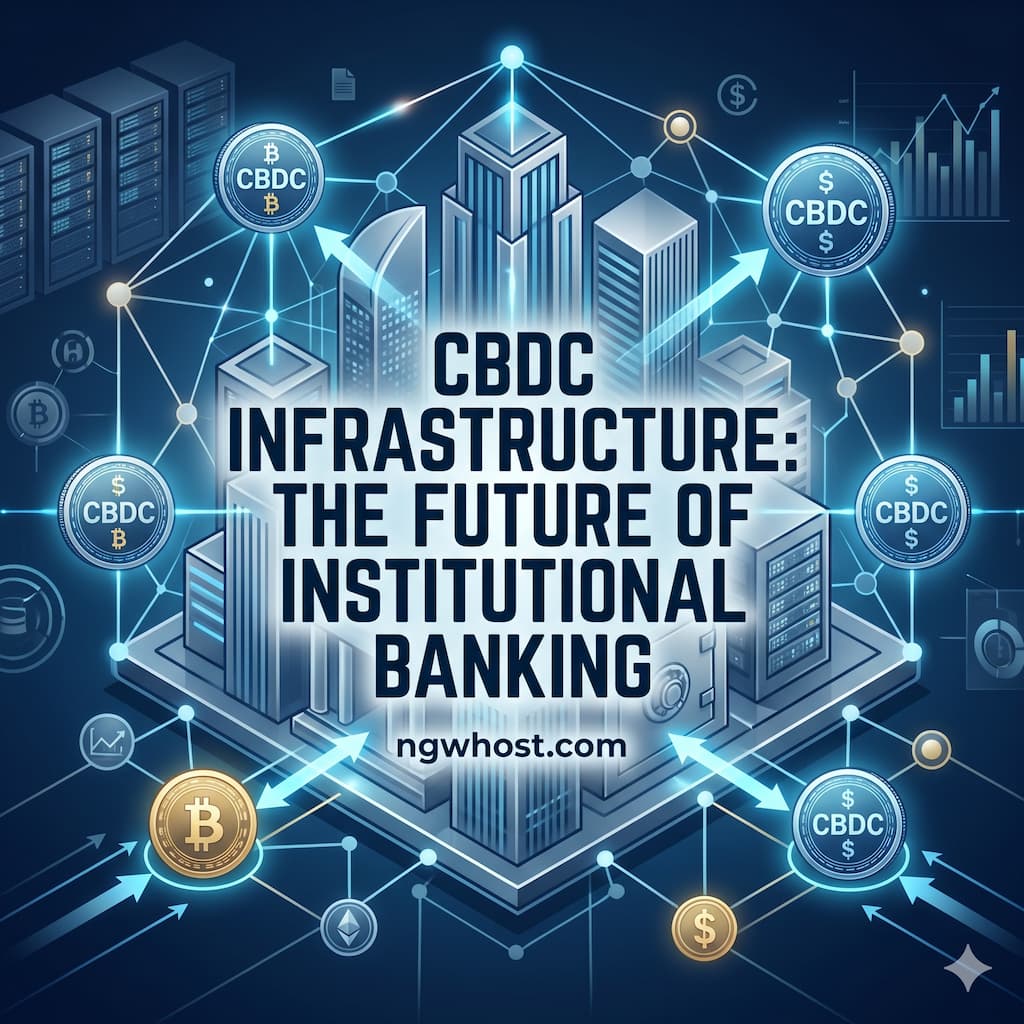
The catalyst for the next era of wholesale finance is the structural deployment of Central Bank Digital Currency (CBDC) infrastructure.
Moving beyond the speculative narratives of decentralized retail tokens, central banks and Tier-1 financial institutions are focusing heavily on Wholesale CBDCs (wCBDCs). Rather than functioning as a digital bank note for retail consumers, a wholesale CBDC acts as a tokenized, cryptographically secure equivalent of central bank reserves, accessible exclusively by licensed financial intermediaries.
By building unified ledger systems that embed programmability directly into sovereign liabilities, CBDC infrastructure is transforming institutional banking from a system of reactive balance-sheet messaging into a network of instantaneous, self-executing, and frictionless capital allocation.
[Legacy Interbank Clearing]: Multilateral Swift Messages ──> Nostro/Vostro Reconciliation ➔ T+2 Settlement Delay
[CBDC Wholesale Infrastructure]: Tokenized Central Reserves ──> Programmable Smart Contracts ➔ Real-Time Atomic Settlement
1. The Architectural Framework: Tokenized Reserves and Unified Ledgers
To understand the operational alpha of wholesale CBDC infrastructure, architectural engineers contrast it with traditional electronic bank reserves. Legacy central bank databases operate as electronic accounting ledgers. When Bank A transfers $100 million to Bank B via a standard Real-Time Gross Settlement (RTGS) system, the central bank’s computing core processes a balance transfer message, updates its internal accounting database, and instructs the commercial entities to reconcile their respective internal ledgers.
CBDC architecture replaces this relational database messaging sequence with Tokenized Bearer Assets.
Inside a wholesale CBDC network, sovereign money is minted as a distinct, cryptographically verifiable token representing a direct liability on the central bank’s balance sheet. The transaction is the settlement. The movement of the token from Bank A’s wallet address to Bank B’s wallet address transfers absolute legal finality simultaneously, completely removing the necessity for downstream clearing houses and asynchronous message validation loops.
[Central Bank Minting Engine] ➔ [Permissioned DLT Core Nodes] ➔ [Wholesale Institutional Wallets] ➔ Real-Time Token Velocity
The Three Technical Topology Models
Central banks typically evaluate three primary technical topologies when designing their core deployment architecture, matching operational complexity with institutional control lines:
- On-Chain Private/Permissioned Distributed Ledger Technology (DLT): Utilizing enterprise-grade permissioned frameworks—such as Hyperledger Fabric, R3 Corda, or customized Ethereum Virtual Machine (EVM) subnets. The central bank acts as the ultimate root validator node, while designated Tier-1 commercial banks operate as network validators.
- Centralized High-Throughput Databases with Cryptographic Signatures: Eschewing decentralized consensus algorithms entirely to leverage hyper-scalable centralized ledger fabrics. Transactions are validated via strict public-key cryptography and appended to an unalterable, linear hash chain managed directly by the central authority.
- The Unified Ledger Model (The Concept of the Programmable Platform): Highly championed by the Bank for International Settlements (BIS). This architecture does not simply isolate the CBDC on its own independent rail; it places wholesale sovereign money tokens, tokenized commercial bank deposits, and tokenized real-world assets (such as government bonds and commercial paper) onto the exact same shared execution ledger, allowing multi-asset atomic swaps to occur natively without crossing external system bridges.
2. Technical Mechanisms: Atomic Settlement and Programmable Liquidity
The integration of smart contracts natively into the sovereign currency layer unlocks unprecedented capabilities for institutional capital optimization. The two primary pillars of this operational transformation are Atomic Settlement and Programmable Liquidity Saving Mechanisms (LSMs).
[Tokenized Cash Leg (wCBDC)] ──┐
[Tokenized Asset Leg (Bonds)]──┘──> [Smart Contract Escrow Execution] ➔ Simultaneous Finality (Delivery vs. Payment)
Delivery vs. Payment (DvP) and Atomic Settlement
In traditional securities markets, purchasing government bonds or corporate equities requires a multi-day settlement window (T+1 or T+2). This temporal gap introduces counterparty credit risk; if a purchasing bank fails before the settlement window closes, the selling entity is left holding unliquidated assets.
Wholesale CBDC infrastructure facilitates instantaneous Atomic Settlement (Delivery vs. Payment – DvP).
By utilizing programmable smart contracts, the tokenized cash leg (wCBDC) and the tokenized asset leg (e.g., tokenized US Treasuries) are bound inside a single, indivisible transaction block. The smart contract ensures that the cash token can never transfer ownership unless the asset token simultaneously moves in the opposite direction. If either leg fails to fulfill its programmatic validation criteria, the entire transaction is algorithmically voided, permanently reducing counterparty risk to absolute zero.
Algorithmic Liquidity Optimization via Smart Contracts
A historical challenge of real-time gross settlement systems is liquidity hoarding. To avoid intraday overdraft penalties, banks frequently delay large outbound payments, causing gridlocks across the interbank network.
CBDC infrastructures resolve this via automated, conditional payment logic. Banks can deploy smart contracts that continuously audit their active liquidity pipelines.
If Bank A expects an incoming $500 million settlement from Bank C at 2:00 PM, it can program an automated outbound wCBDC transfer to Bank B that executes the exact microsecond the incoming token payload hits its wallet address:
JSON
{
  "contract_id": "LIQUIDITY_OPTIMIZER_US_01",
  "trigger_condition": "incoming_wcbdc_payload_confirmed",
  "expected_source": "0xCentralBank_Reserve_Node_C",
  "min_value": 500000000.00,
  "automated_action": "execute_instant_outbound_transfer",
  "destination_wallet": "0xCommercialBank_Node_B",
  "max_slippage_tolerance": 0.0000
}
This programmable automation enables continuous, high-velocity netting loops across the entire banking ecosystem, drastically multiplying total liquidity velocity without requiring commercial entities to maintain massive, unproductive cash buffers on their balance sheets.
3. Cross-Border Orchestration: Project mBridge and the De-fragmentation of Global Forex
The true test of modern financial infrastructure is its efficiency across cross-border corridors. Legacy cross-border transactions rely heavily on the Correspondent Banking Network. A payment traveling from an enterprise client in Singapore to a supplier in the UAE must move through multiple intermediary banks, crossing separate domestic clearing systems, triggering manual compliance checks, and requiring the maintenance of capital-intensive Nostro/Vostro accounts pre-funded with foreign liquidity reserves.
Project mBridge: The Multi-CBDC Super-Grid
To permanently eliminate this cross-border friction, the BIS Innovation Hub alongside central banks from Hong Kong, China, Thailand, and the UAE developed Project mBridge. Running on a custom permissioned DLT architecture known as the mBridge Ledger, this multi-CBDC (mCBDC) platform allows central banks to issue their respective sovereign currency tokens directly onto a single shared cross-border grid.
[Singapore Corporate Node] ➔ [Local Commercial Bank] ➔ [mBridge Unified Ledger Node] ➔ [UAE Commercial Bank] ➔ [Supplier Settlement]
By placing multiple sovereign digital currencies onto a unified, real-time platform, commercial banks can execute direct, peer-to-peer foreign exchange (FX) token swaps instantly without routing through intermediary US-dollar correspondent nodes.
A cross-border commercial payment that historically required 3 to 5 business days and accumulated significant intermediate transaction fees is compressed into a sub-10 second automated atomic execution, completely bypassing legacy settlement infrastructure.
4. The Systemic Integration Challenge: ISO 20022 and Legacy Coexistence
Central banks cannot simply hit a reset switch on global financial infrastructure. Wholesale CBDC platforms must coexist seamlessly with existing legacy enterprise messaging architectures and regulatory frameworks during a multi-decade transition period. The structural bridge that facilitates this interoperability is the universal adoption of the ISO 20022 messaging standard.
[Legacy Banking App] ➔ [ISO 20022 Standardized Rich Data Packet] ➔ [API / Oracle Bridge] ➔ [wCBDC Ledger Execution]
The Convergence of High-Density Financial Data
The ISO 20022 standard reorganizes financial data into structured, XML/JSON-compatible rich data formats. Unlike legacy SWIFT MT messaging systems that pass simple text arrays requiring manual processing, ISO 20022 packets transport deep, contextual data fields natively alongside the transaction payload—including granular ultimate-beneficiary identification, verified tax data, legal contract identifiers, and automated Know Your Customer (KYC) clearance codes.
By leveraging these standardized rich data structures, modern financial middleware platforms can deploy robust API and oracle layers (such as Chainlink’s interoperability solutions) to link legacy core banking systems directly with private CBDC DLT rails.
When an institution initiates a legacy payment instruction, the middleware automatically parses the ISO 20022 payload, translates the parameters into a smart-contract executable token command, and triggers the instantaneous atomic minting or transfer of the wholesale CBDC token on-chain without requiring the bank to rebuild its front-end enterprise software stack.
5. Security and Risk Matrices: Safeguarding Sovereign Ledgers
While the efficiency gains of wholesale CBDC infrastructure are undeniable, shifting sovereign currency systems to cryptographic ledger architectures introduces highly critical technology risk profiles that require rigorous, multi-layered security frameworks.
Mitigating Single-Point-of-Failure Exploits
In a traditional distributed database network, achieving consensus requires nodes to broadcast and validate block data continuously. In a sovereign wholesale financial environment, a consensus freeze or a successful 51% sybil exploit across validator nodes would paralyze an entire nation’s capital markets.
To insulation networks against this vulnerability, central banks enforce highly conservative, Byzantine Fault Tolerant (BFT) consensus mechanisms. These algorithms guarantee absolute, immediate settlement finality—meaning transactions can never be rolled back or re-ordered post-validation—and ensure continuous operational execution even if up to one-third of the institutional validator nodes suffer catastrophic offline cyber-attacks or disconnect from the grid.
Post-Quantum Cryptographic Preparedness
Because CBDC tokens rely on public-key cryptography (such as ECDSA) to authenticate ownership and sign smart-contract execution instructions, they face a severe structural threat from the impending maturation of quantum computing arrays. If a malicious actor accesses sufficient quantum computing capabilities, they could theoretically backward-engineer a central bank’s master private key from public validator signatures, enabling the fraudulent minting of sovereign liabilities.
[Quantum Adversary Node] ──(Shor's Algorithm Attack)──> Legacy Cryptography Fails
                                      ▼
[wCBDC Quantum-Safe Ledger] ➔ [Lattice-Based Cryptographic Encryption] ➔ Absolute Attack Rejection
To counter this existential vector, next-generation wholesale CBDC architectures are being compiled with Post-Quantum Cryptography (PQC) algorithms natively embedded into the ledger software layer. By utilizing advanced lattice-based cryptographic signature schemes (such as CRYSTALS-Dilithium), CBDC networks guarantee that sovereign money remains mathematically un-breachable, even when facing high-performance quantum computational threats.
6. Financial and Scale Dynamics: The Institutional Infrastructure Blueprint
The deployment of a globally interoperable wholesale CBDC core infrastructure transforms the structural cost matrix of tier-one institutional banking groups:
| Performance Metric | Legacy Correspondent Banking System | Next-Gen Wholesale CBDC Infrastructure | Enterprise Capital Impact |
| Settlement Velocity | T+1 to T+3 standard clearing intervals | Instantaneous, real-time sub-second finality | Compresses float-time to zero and unlocks massive working capital velocity |
| Capital Allocation Efficiency | High; requires billions pre-funded in static Nostro/Vostro caches | Zero; liquidity is dynamically swapped atomically on-demand | Eliminates counterparty capital locking drag and reduces balance sheet inflation |
| Transaction Processing Cost | $\$25.00 – \$75.00$ average cross-border routing fee structure | $< \$0.01$ administrative execution overhead | Permanently slashes intermediate clearing expenses across B2B channels |
| Audit Compliance Reconcilement | Manual, asynchronous batch reconciliation of text logs | Continuous, real-time automated auditability via immutable hashes | Eradicates operational ledger variance and slashes back-office administrative overhead |
7. The Horizon: Tokenized Deposit Arenas and Automated Central Banking
As wholesale CBDC core infrastructure achieves mainstream institutional scale across the late 2020s, it will serve as the baseline technological foundation for a fully unified, autonomous global financial operating system.
Tokenized Commercial Deposit Interoperability
The next major evolution is the absolute convergence of wholesale central bank money and Tokenized Commercial Deposits. In this mature model, commercial banks do not maintain standard electronic accounting databases for corporate clients; they issue customized commercial deposit tokens running on private enterprise networks.
When a corporate client executes an interbank payment, a multi-layered smart contract triggers a simultaneous, real-time atomic swap: the commercial deposit token of Bank A is burned, a wholesale central bank CBDC token moves across the central ledger to settle the interbank balance, and a new commercial deposit token is instantly minted on Bank B’s network to credit the recipient entity.
This seamless orchestration preserves the classic two-tiered monetary system while introducing total, end-to-end digital velocity.
[Burn Bank A Deposit Token] ➔ [Transfer Core wCBDC Token] ➔ [Mint Bank B Deposit Token] (Simultaneous Multi-Tier Swap)
Algorithmic Macroeconomic Policy Execution
Looking out toward the far frontier of structural monetary economics, programmable CBDC infrastructure will enable central banks to execute Real-Time Automated Monetary Policy. Instead of waiting for quarterly consensus meetings to adjust prime interest rate baselines and relying on manual open-market bond operations to shift systemic liquidity, central banks can program conditional logic loops directly into the currency fabric.
The core ledger can continuously monitor real-time economic velocity metrics, cross-border capital flow indicators, and institutional liquidity concentrations via automated API tracking layers.
If systemic credit metrics breach specific inflation or contraction boundaries, the central bank’s core minting contract can execute real-time, micro-adjustments to interbank reserve interest rates or programmatically modulate intraday liquidity allowances across validator nodes on a second-by-second basis, creating a self-balancing, frictionless macroeconomic environment optimized for maximum structural stability.
Read More⚡ Venture Capital Trends: Funding Next-Gen Tech Ecosystems
Conclusion: Orchestrating the Frictionless Financial Era
The transition of global institutional banking onto wholesale CBDC core infrastructure represents far more than a superficial digitization strategy or a minor speed optimization cycle. It is a profound, irreversible architectural revolution that is permanently rewriting the structural rules of sovereign currency, legal finality, and capital allocation.
Attempting to run a modern, high-velocity multi-national banking group or asset management consortium using legacy, text-based relational database messaging systems is an exercise in systemic capital inefficiency. The financial institutions, technology desks, and sovereign central banking boards that commit heavily to mastering the implementation of permissioned DLT topologies, post-quantum cryptographic security protocols, and ISO 20022 unified data standardizations will command the global financial arena.
By shifting their core infrastructure models to treat sovereign fiat money not as a static text balance on a remote ledger, but as a dynamic, programmable, and instantly settling digital bearer asset, forward-thinking enterprises can effectively unlock unparalleled levels of capital efficiency.
The organizations that successfully pioneer this structural digital-to-physical monetary convergence will not simply safeguard their balance sheets against counterparty volatility—they will out-pace, out-settle, and out-invest their legacy counterparts, commanding the definitive strategic high ground across the emerging global digital economy.
For regular technical briefings on enterprise hosting architectures, data privacy compliance, post-quantum network security configurations, and central bank digital infrastructure blueprints, visit ngwhost.com.