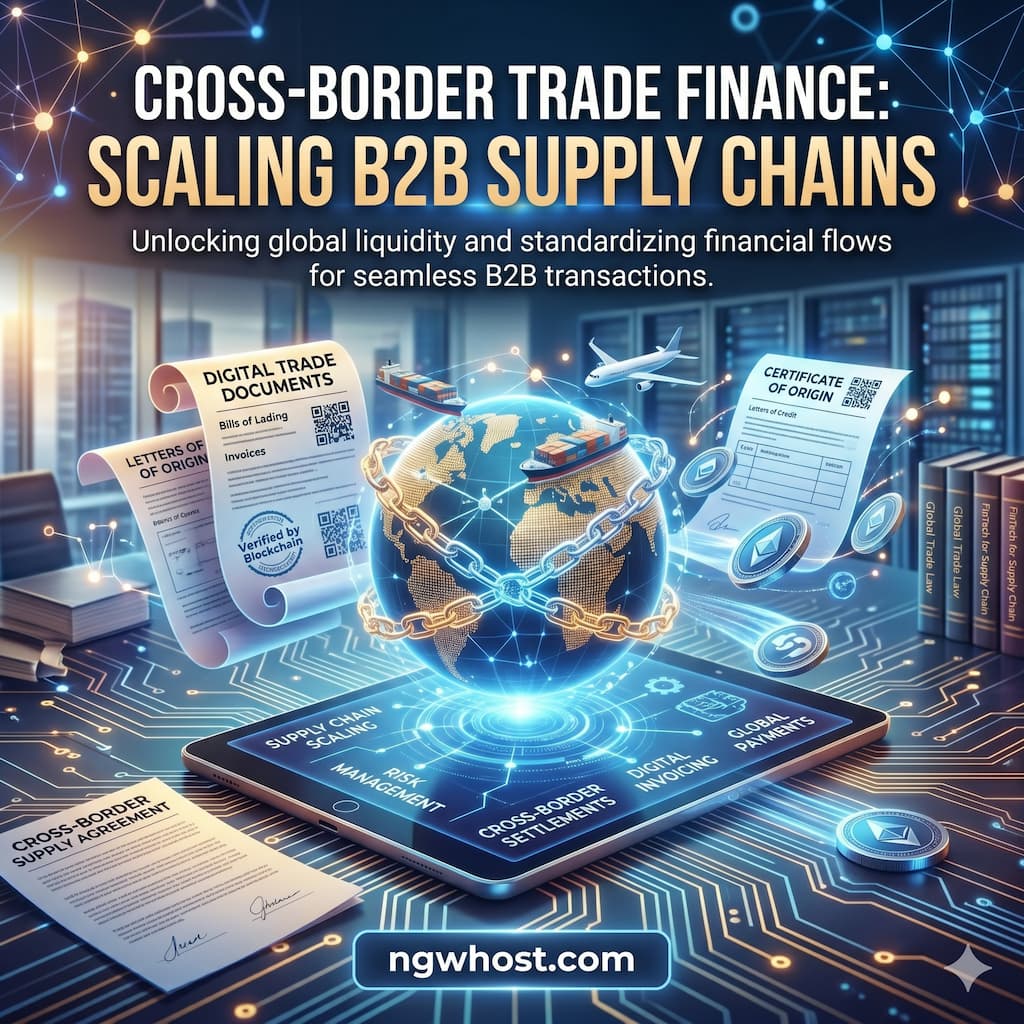
Cross-Border Trade Finance: Scaling B2B Supply Chains
The velocity of international business-to-business (B2B) commerce has completely decoupled from historical physical constraints. As we navigate through 2026, global enterprise supply chains operate as highly complex, non-linear digital organisms. A single technology enterprise or e-commerce scaling vehicle can simultaneously orchestrate raw material extraction across Latin America, advanced chip fabrication in East Asia, logistics fulfillment hubs within Europe, and multi-channel distribution networks across North America.
Yet, while physical manufacturing and real-time digital tracking systems have achieved exceptional speeds, the underlying financial plumbing that supports international trade has historically remained frozen in a legacy paradigm. For decades, traditional cross-border trade finance relied on an exhaustive maze of paper-heavy mechanisms—such as physical Letters of Credit ($LCs$), manual Bills of Lading, fractured correspondent banking systems, and opaque escrow procedures.
When an enterprise must wait days for a centralized banking institution to manually clear customs documentation, verify shipping bills, or release working capital tranches, the entire operational pipeline encounters severe structural drag. In a hyper-competitive global arena where supply chain resilience and execution speed define an enterprise’s market valuation, capital paralyzation is an existential liability.
For the digital entrepreneurs, web platform leads, and cloud systems architects within the ngwhost.com community, eliminating friction and maximizing resource throughput are core operational principles. We design server infrastructures to remove processing latency, isolate system dependencies, and eliminate single points of failure.
Applying this exact same systemic discipline to your global capital management means transitioning from manual, paperwork-heavy international settlement loops to a fully unified, programmatic, and software-driven system: Modern Cross-Border Trade Finance Infrastructure.
This comprehensive 2026 intelligence brief delivers an analytical breakdown of the modern trade finance revolution, details the architectural pillars of real-time, asset-backed liquidity routing, and provides an actionable operational roadmap to de-risk your enterprise supply chain while scaling global transaction speeds.
1. The 2026 Financial Metamorphosis: Dismantling the Paper-Heavy Escrow
To successfully engineer an automated B2B supply chain today, you must first understand why the historical frameworks of international trade finance have collapsed under their own computational weight. For over a century, global trade relied on the Correspondent Banking Matrix and Manual Document Verification.
The Structural Cost of Information Asymmetry
When an enterprise based in one jurisdiction wanted to procure a substantial batch of specialized technical hardware or manufacturing components from a supplier located on another continent, both parties faced profound counterparty risk:
- The Exporter’s Dilemma: The supplier was hesitant to manufacture or ship high-value assets without absolute structural guarantees of incoming settlement.
- The Importer’s Dilemma: The corporate buyer was highly reluctant to release liquid capital reserves before verifying the pristine condition and verifiable tracking metrics of the transit assets.
Traditional banks resolved this information asymmetry by acting as manual, high-fee escrow intermediaries, issuing physical letters of credit. However, this required shifting mountains of paper documents across global customs hubs, resulting in massive operational bottlenecks, high administrative underwriting overhead, and severe capital paralysis.
In 2026, the marketplace has permanently shifted toward Direct, Data-Liquid Peer-to-Peer Settlement Meshes. Powered by the universal adoption of the ISO 20022 messaging standard—which structures rich compliance and asset identity metadata directly inside every financial transmission packet—and the widespread integration of tokenized real-world assets (RWAs), the supply chain ecosystem has evolved into a real-time, automated trade layer.
  LEGACY LETTERS OF CREDIT (The Paper Bottleneck)
  [Buyer Bank] ──► [Manual Courier Escrow] ──► [Paper Bill Verification] ──► [Seller Bank Delayed Release]
  * Extreme Latency, High Administrative Fees, Segmented Working Capital

  2026 INTEGRATED TRADE FINANCING (The Programmable Mesh)
  [IoT Delivery Signal] ──► [Automated Compliance Processing API] ──► [Atomic Multi-Currency Clearing]
  * Zero Intermediary Drag, Real-Time Inventory Visibility, Capital Velocity Optimization
By turning trade finance from an administrative paper trail into an executable software architecture, modern enterprise infrastructure scales international capital movement to internet velocity, minimizing supply-chain drag and optimizing corporate cash-flow efficiency.
2. Core Technological Pillars of Modern Cross-Border B2B Supply Chains
Scaling a borderless digital supply chain and maximizing working capital efficiency requires integrating four foundational technological pillars directly into your platform’s financial and system architectures.
I. Programmable Tokenized Liquidity and Stablecoin Settlement Rails
The defining advancement of the 2026 corporate treasury landscape is the mass utilization of regulated stablecoins and tokenized bank deposits for routine commercial supply chain settlements.
- The Real-Time Settlement Layer: Highly regulated, fully collateralized, and yield-bearing digital assets backed by short-term sovereign debts have become the global benchmark for high-ticket B2B trade clearing.
- The Operational Turn: Instead of waiting for traditional commercial banking clearings to crawl through weekend closures or regional bank holidays, an enterprise can settle multimillion-dollar component invoices programmatically via smart contracts within a sub-second window. Capital lockup is permanently eliminated, allowing global suppliers to immediately reallocate funds into manufacturing pipelines without missing a beat.
II. IoT Sensor Integration and Atomic Delivery-vs-Payment ($DvP$)
Relying on manual declarations or retroactive freight audits to verify the true state of transit cargo creates a major vector for counterparty friction. Modern B2B logistics loops resolve this blindness via IoT-Driven Atomic Smart Contracts.
- The Cryptographic Bond: High-value transit assets are equipped with integrated, cryptographic IoT tracking sensors that continuously monitor geographic coordinates, ambient temperature boundaries, shock parameters, and seal integrity.
- The Execution Loop: These sensors broadcast real-time telemetry straight to your platform’s data lake via secure APIs. The second a freight sensor crosses a pre-configured geographic milestone or registers a verified customs clearing scan, the automated smart contract triggers an immediate Atomic DvP Sequence: it simultaneously verifies the asset’s structural integrity and programmatically releases a specific liquidity tranche to the supplier’s wallet.
  [IoT Sensor Logs Geographic Milestone]
                    │
                    ▼
  ┌────────────────────────────────────────────────┐
  │         Automated Smart Contract Gate          │
  ├────────────────────────────────────────────────┤
  │ * Verifies temperature & seal compliance logs  │
  │ * Confirms cryptographic asset signature checks│
  │ * Calculates live FX conversion metrics        │
  └────────────────┬───────────────────────────────┘
                   │
                   ▼
  [Simultaneous Atomic Liquidity Release & Clearing]
III. AI-Orchestrated Predictive FX Routing and Hedging Systems
Foreign exchange volatility represents an ongoing threat to international supply chain operating margins. A sharp, unexpected currency de-valuation during a 30-day ocean transit window can instantly erode the profitability of an entire product line.
- The Intelligent Guard: Modern cross-border trade platforms integrate AI-Powered Predictive FX Routers. These background models continuously trace liquidity metrics across thousands of international exchanges simultaneously.
- The Optimization Output: When a future supply chain invoice obligation is generated, the AI evaluates live macroeconomic trends and localized liquidity depths. It programmatically structures multi-currency hedging corridors or splits the transaction tranches into low-volatility paths, locking in highly optimized conversion rates and ensuring exact, guaranteed supplier payouts long before the freight hits the destination dock.
IV. Continuous, Continuous AML and Compliance Sensing
Historically, the primary obstacle choking cross-border money movement was regulatory compliance verification latency. To prevent illicit money flows and fulfill complex regulatory reporting lines, banks routinely flag and freeze international commercial transfers for manual administrative inspection, trapping vital corporate cash in compliance dead-zones.
- The Streaming Compliance Shield: Modern trade finance rails deploy Continuous Compliance Sensing Engines.
- The Mechanism: Instead of reviewing an international ledger transaction retroactively, AI-driven compliance nodes audit the digital profile, transactional history, and supply chain metadata of the transacting entities in real-time during the API handshake. Utilizing advanced cryptographic verifications and machine-learning pattern matchers, the network certifies the absolute legal compliance of the high-ticket transfer within a sub-second window, satisfying cross-border compliance mandates without introducing a millisecond of operational latency.
3. The 2026 Cross-Border Ecosystem: Leading B2B Corporate Engines
Transforming your capitalization layers from an expensive, manual administrative cost-center into an agile, predictive competitive moat requires connecting your core database perimeters to specialized, context-aware payment networks. The current 2026 horizon features elite enterprise options:
| Platform Category | Leading 2026 Platforms | Core Corporate Utility | Standout Engineering Advantage |
| API-First Multi-Currency | Stripe Corporate / Airwallex / Wise for Business | Automated global invoicing, multi-currency collections, & instant local clearing | Unified Treasury Grid: Programmatically converts and routes capital across 150+ domestic rails via an integrated API layer. |
| Tokenized Real-World Rail | Centrifuge / Ripple Payments / BVNK | High-ticket B2B settlement, cross-border sweeps, & tokenized liquidity | On-Demand On-Chain Settlement: Eradicates regional pre-funding mandates by utilizing regulated stablecoins for instant bridging. |
| Emerging Market Specialist | dLocal / EBANX | Capital scaling across high-growth regions (LatAm, APAC, Africa) | Deep Domestic Rail Integration: Connects international corporate cores directly to native networks like Brazil’s Pix or India’s UPI. |
4. Tactical Blueprint: Engineering a High-Velocity Supply Chain FinTech Stack
Transitioning your enterprise away from legacy, human-constrained banking channels and constructing an automated, data-driven cross-border B2B revenue engine requires a systematic, architecturally sound roadmap.
Step 1: Maximize Financial Data Liquidity via Integrated APIs
An AI-driven routing and trade finance engine’s analytical precision is fundamentally bounded by the transparency and completeness of its incoming data streams. You must eliminate your internal financial data silos.
Establish direct API connections and real-time open-telemetry webhooks connecting your e-commerce storefront billing layers, internal ERP ledgers, warehouse inventory parameters, and primary server deployment parameters on ngwhost.com into a centralized, highly secure Global Operations Data Lake. This provides your treasury models with an unobstructed, 360-degree stream of truth representing your true operating cash flow.
Step 2: Configure a Dynamic Corridor Allocation Matrix
Do not lock your organization into utilizing a single, rigid payment rail for all global jurisdictions. Implement an automated Dynamic Corridor Optimization Framework within your payment gateway backend. Configure your system’s operational hooks to route transactions programmatically based on localized regional efficiencies. Route regional consumer inflows via high-velocity localized domestic rails (like Pix or SEPA Instant), while steering high-ticket corporate manufacturing settlements through asset-backed tokenized rails. This structural execution path guarantees that every incoming dollar is cleared through the most capital-efficient network path possible, protecting your trailing corporate operating margins from unnecessary intermediate bank drag.
Step 3: Implement Zero-Trust Treasury Security and Automated Sweeps
As your cross-border billing loops accelerate into real-time velocities, protecting your floating liquidity from advanced digital threat vectors and platform counterparty risks becomes an absolute priority. Enforce strict Zero-Trust Treasury Security Parameters: store your active operational digital signatures inside Hardware Security Module (HSM) enclaves, mandate multi-signature cryptographic authorization frameworks for any outbound transfer exceeding custom thresholds, and configure automated, programmatic rules to sweep excess daily currency balances directly into highly secure, sovereign short-term debt instruments or your primary commercial banking core.
5. Critical Risk Management: Navigating International Cash and Logistics Hazards
Operating a globally distributed, high-speed corporate capital stack requires continuous, data-backed governance to protect your enterprise from unique digital and legal liabilities:
- The Hazard of Non-Transparent FX Markups and Spread Extraction: While many modern fintech platforms advertise “zero transfer fees” or “low-cost clearing,” they frequently bury their primary monetization metrics deep within non-transparent, inflated foreign exchange spreads. A payment provider might offer a completely free cross-border wire but quietly calculate the currency conversion at 1.5% away from the true mid-market exchange rate. Your financial analytics team must run automated API audits to calculate the exact internal rate of return ($IRR$) impact on your currency conversion lines.
- Navigating Regulatory Compliance Fragmentation: Despite the harmonization driven by modern global data standards like ISO 20022, individual sovereign nations retain complete authority over capital entry, exit, and tax withholding laws. A real-time payment corridor that operates flawlessly between the United States and Europe can encounter sudden regulatory locks or documentation demands when scaling into emerging markets with strict capital control structures. Maintain cross-border technical redundancy by verifying that your core platform operators hold active financial licenses across multiple independent sovereign legal jurisdictions.
- The Danger of Irreversible Settlement Exploits: The exceptional benefit of instant local clearing networks and tokenized asset rails means that if an unauthorized or malicious actor manages to exploit your system’s API access tokens or initiate a fraudulent cross-border transfer, the capital leaves your corporate custody irreversibly in milliseconds. Unlike legacy wires, which feature a multi-hour manual recall window, instant digital settlements are final. Your infrastructure must implement rigorous Identity and Access Management (IAM) protections, automated transactional velocity limits, and real-time behavioral anomaly alerts across all payment generation targets.
6. The Digital Synergy: Redundant Systems for Corporate Capital
For the advanced cloud systems developers, full-stack database architects, and technology visionaries who scale their digital platforms on the backbone of the ngwhost.com ecosystem, the structural logic of an optimized global treasury stack is deeply intuitive.
When you configure an enterprise hosting layout or scale an international cloud network, you do not tolerate single points of failure. You don’t leave your system architecture vulnerable to an isolated computing crash, a localized network drop, or an un-monitored processing leak. You design with comprehensive, mathematical redundancy: you utilize load balancers to distribute data traffic smoothly, deploy isolated container instances across multiple geographic data zones to handle processing spikes effortlessly, and maintain secure, multi-region database mirrors to ensure that if a critical server cluster drops offline, the broader network continues to perform flawlessly without data loss or corruption.
An integrated Cross-Border Trade Finance Architecture functions exactly like a highly redundant, high-availability network for your business equity and liquidity:
- Your Virtual IBAN Networks and Localized Alternative Rails operate as your high-velocity edge nodes, parsing, clearing, and routing daily incoming capital allocations with absolute fluid precision.
- Your AI-Driven Predictive FX Routers and Tokenized Settlement Channels act as your resilient core database systems, instantly compounding, rebalancing, and protecting your active capital reserves, completely insulated from individual human blind spots or local banking system failures.
- Your Zero-Trust Treasury Parameters and Multi-Jurisdictional Fallbacks behave as your secure, enterprise-grade system firewalls, silently optimizing your operating margins, shielding your corporate wealth from capital control restrictions, and ensuring absolute corporate velocity against changing global market demands.
By mastering this integrated configuration, you strip away balance sheet vulnerabilities, eliminate operational cash drag, and position your digital brand to scale at terminal velocity while maintaining total financial and operational sovereignty over the global enterprise you built.
Read More⚡ Tax Mitigation Strategies for Tech Scaleups in 2026
Conclusion: The Era of Borderless Capital Fluidity
The traditional geographical boundaries that historically segmented global enterprise operations have been permanently erased by the 2026 digital fintech revolution. The transformation of cross-border trade finance from a slow, expensive administrative chore into an instantaneous, programmable software layer represents the ultimate modernization of corporate finance. High-speed global market access and real-time capital clearing are no longer privileges exclusive to multi-national banking conglomerates; the technology has decentralized the capability, placing institutional clearing power directly into the hands of agile digital founders.
Success within this high-velocity environment is not a matter of luck; it is an exact discipline of precise data liquidity, modular software engineering, and zero-trust risk governance. By unifying your transactional and hosting pipelines via secure APIs, configuring automated multi-currency routing workflows, enforcing absolute token transparency across your security parameters, and prioritizing multi-rail network redundancy, you completely eliminate risk and structural drag from your expansion equation.
The commercial landscape of 2026 rewards velocity, data integrity, and capital-efficient execution. Build your integration stack with absolute precision, protect your cap table fiercely, and let your enterprise scale to global heights on your own terms.